

TDXchange is a secure, scalable Managed File Transfer and Enterprise Data Exchange platform that helps organizations automate, integrate, govern, and monitor mission-critical data workflows. It supports on-premises, private and public cloud, hybrid, multi-cloud, and Kubernetes deployments. Its flexible, license-driven model allows organizations to start with the capabilities they need and expand as migrations progress and business requirements grow. Explore TDXchange or contact bTrade to discuss your requirements.
TDXchange: Secure Data Exchange, Quantum-Safe and Zero Trust by Design. Built to Automate, Integrate, Govern, and Scale.
The modern landscape of Managed File Transfer (MFT) is fast-paced and increasingly complex. As cyber threats grow more sophisticated and quantum computing looms on the horizon, organizations must support secure, scalable, and compliant data exchanges across global ecosystems. Meeting these challenges requires more than just traditional encryption or point-to-point solutions.
Enterprises need more than an MFT platform that simply moves files securely. They need a quantum-safe, native Zero Trust platform that protects mission-critical information against today’s attacks and tomorrow’s cryptographic threats. It must also provide flexible automation, complete auditability, end-to-end operational visibility, and ease of use while supporting deployment on-premises, in private or public clouds, across hybrid and multi-cloud environments, or using Kubernetes. TDXchange from bTrade brings these capabilities together in one secure, scalable, and flexible enterprise data exchange platform.
TDXchange Key Highlights
- Quantum-Safe Security and Crypto Agility: TDXchange v5 incorporates NIST-standardized post-quantum cryptographic capabilities, including ML-KEM for quantum-resistant key establishment and ML-DSA and SLH-DSA for digital signatures. Its crypto-agile architecture supports classical, hybrid, and post-quantum deployment models, helping organizations protect sensitive data at rest and in transit while progressively changing algorithms, keys, certificates, and partner configurations without redesigning established business workflows.
- Native End-to-End Zero Trust Architecture Across All Platform Components: TDXchange applies continuous authentication, authorization, least-privilege access, policy enforcement, monitoring, and auditability across users, administrators, applications, APIs, workflows, service accounts, trading partners, AI services, and internal platform components. No interaction is trusted solely because it originates inside the network or platform.
- Flexible Workflow Automation: Replace manual processes and fragile scripts with flexible, click-based scheduling and API-driven, event-driven, and file-triggered workflows. Automate file retrieval, validation, processing, transformation, encryption, routing, delivery, notifications, retries, exception handling, and archiving from one centrally managed platform.
- Flexible Deployment: Deploy TDXchange on-premises, in a private or public cloud, across hybrid and multi-cloud environments, or using Kubernetes. Maintain consistent administration, security, governance, automation, and operational visibility regardless of where the platform runs.
- Flexible Licensing and Growth: Start with the TDXchange capabilities required today and expand as migrations proceed and business needs grow. TDXchange’s license-driven model allows organizations to add protocols, trading partners, integrations, automation, capacity, and advanced capabilities without replacing the platform or redesigning the existing implementation.
- AI-Assisted Operational Intelligence: Accelerate onboarding, simplify administration, investigate failures, identify anomalies, optimize workflows, and provide contextual operational recommendations while maintaining Zero Trust security, role-based access, auditing, and human oversight.
- Intuitive User Experience and Partner Self Service: Employees and external partners can securely upload, download, and check file transfer status through a browser portal without installing software. Authorized teams can also manage approved users, partners, workflows, reports, and operational tasks through delegated administration, while central IT maintains security policies and governance.
- End-to-End Visibility, Configurable Dashboards, and Intelligent Alerting: Monitor file transfers, workflow steps, trading partners, users, administrators, configurations, infrastructure, and business outcomes through centralized, configurable dashboards. Policy-driven alerts, SLA monitoring, exception management, and detailed operational context help teams identify risks, prioritize meaningful events, and resolve issues faster.
- Complete Auditability and Policy Governance: Maintain detailed histories of file transfers, workflow execution, identity and access decisions, administrative activity, configuration changes, security controls, retries, exceptions, delivery, and acknowledgment. Searchable records, tamper-resistant audit trails, reporting, and SIEM integration support investigations, accountability, regulatory reviews, and audit readiness.
- Trading-Partner Management and Maintenance Automation: Centrally manage partner identities, endpoints, protocols, certificates, schedules, workflows, policies, and operational activity. Configurable maintenance windows can pause outbound delivery attempts during planned partner downtime, securely queue affected files, suppress unnecessary failure alerts, and automatically resume processing when the window ends.
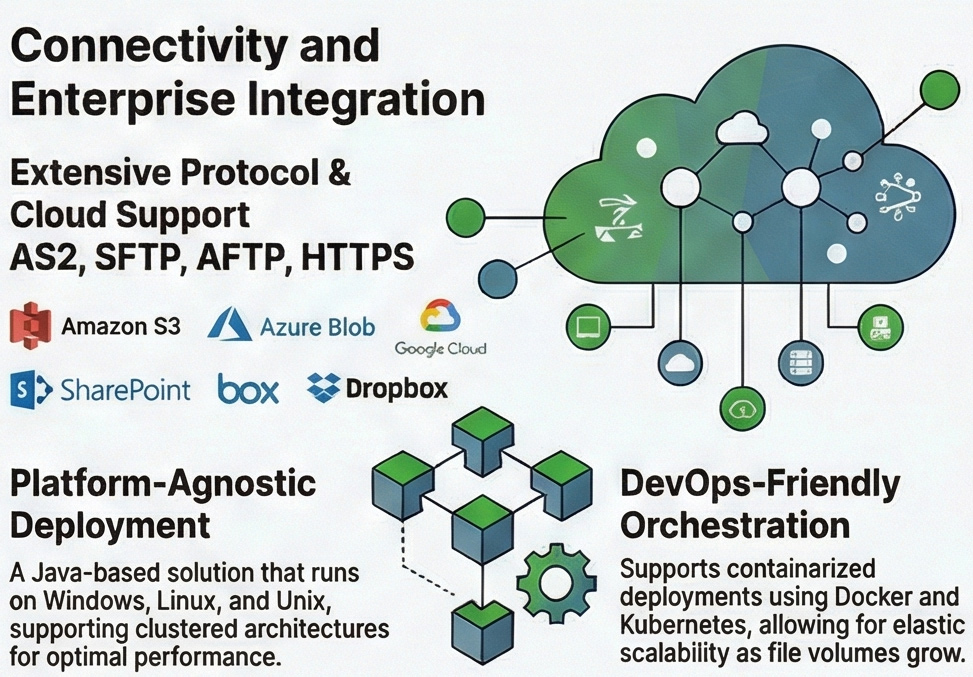
- Enterprise Integrations, APIs, and Protocol Support: Connect enterprise applications, EDI platforms, cloud services, file systems, custom applications, and external partners through REST APIs, web services, and native support for AS2, AS4, AFTP, SFTP, FTPS, and HTTPS. Cloud and storage integrations include Amazon S3, Microsoft Azure Blob Storage, Google Drive, Google Cloud Storage, Microsoft SharePoint, Box, Dropbox, and Windows SMB file shares.
- Enterprise Scalability, Resilience, and Multi-Tenancy: Support growing transaction volumes, partner communities, business units, and global operations through active-active clustering, load balancing, automatic failover, elastic scaling, true multi-tenancy, delegated administration, Docker containers, Kubernetes orchestration, geo-redundancy, and flexible on-premises, cloud, and hybrid deployment.
- Accelerated Large-File Transfer: bTrade’s native AFTP technology accelerates large-file transfers across high-latency and bandwidth-constrained networks while preserving centralized security, workflow automation, monitoring, auditing, partner governance, and operational control.
- Regulatory Compliance Support: Encryption, Zero Trust access controls, MFA, Automated DLP and malware integrations, automated backups, tamper-resistant logging, configurable retention, policy enforcement, detailed reporting, and anomaly detection help organizations support initiatives associated with HIPAA, GDPR, PCI DSS, SOX, FISMA, and other regulatory or industry requirements.
- Active Long-Term Product Development: TDXchange continues to evolve through sustained engineering investment, major platform releases, modern security architecture, AI-assisted operations, cloud-native scalability, expanded integrations, and customer-driven capabilities.
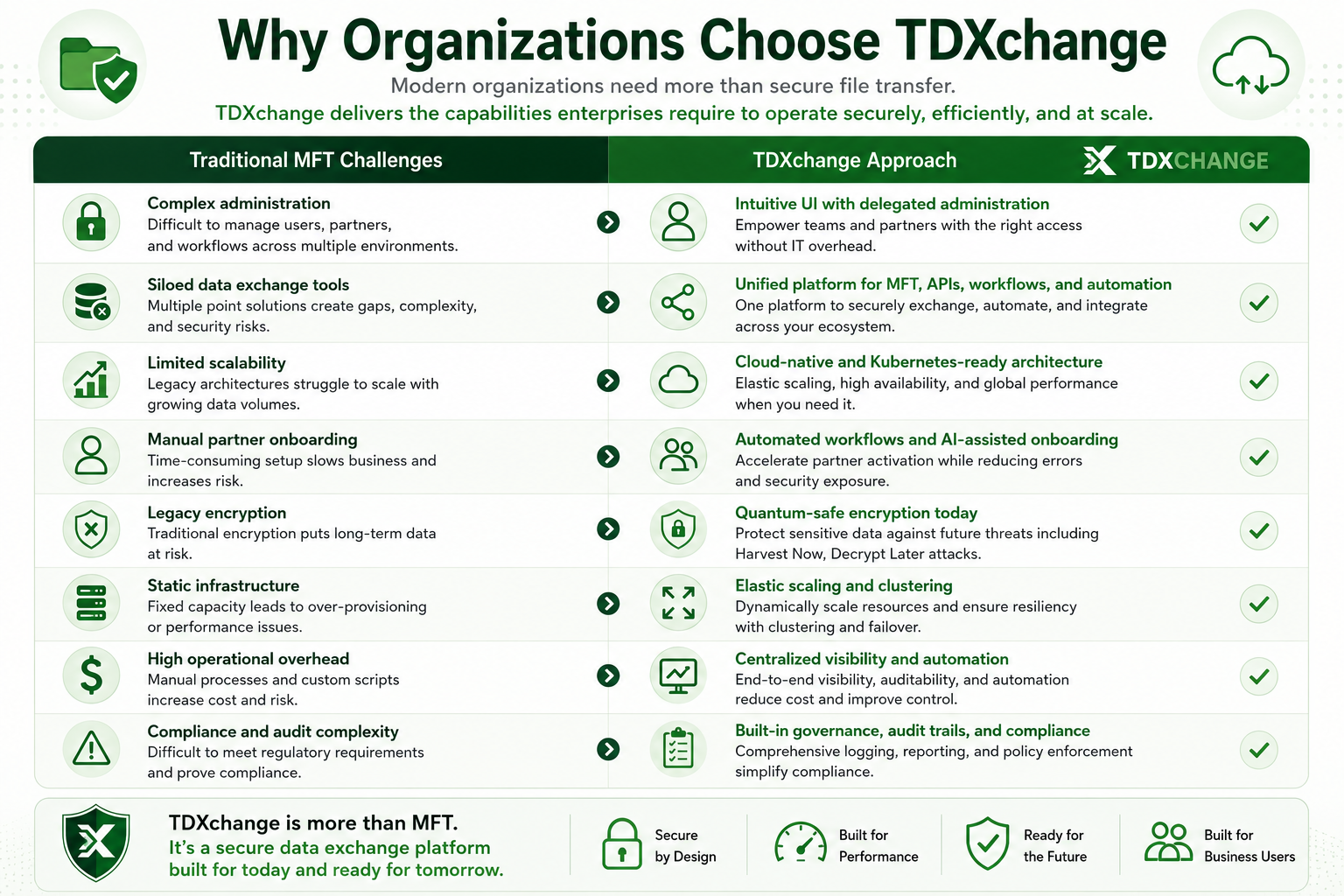
Introducing TDXchange: A Secure, Quantum-Ready Managed File Transfer Platform
TDXchange is bTrade’s enterprise-grade solution for secure managed file transfer, built on over 30 years of trusted expertise. Designed to simplify complex data workflows and protect digital assets, TDXchange delivers a fully integrated, end-to-end MFT platform that is future ready, regulatory-compliant, and resilient by design.
TDXchange is not simply a Managed File Transfer solution. It is a secure enterprise data exchange platform that unifies file transfers, APIs, automation, workflows, and partner communications into a single operational framework.
Trusted by a significant portion of the Global 1000 and Fortune 500, TDXchange is the solution of choice for building, managing, and scaling secure file exchange ecosystems in finance, healthcare, legal, logistics, media and entertainment, manufacturing, energy, and beyond.
Key Features of TDXchange:
TDXchange is a secure enterprise data exchange platform that combines Managed File Transfer (MFT), APIs, workflow automation, and partner onboarding into a single solution. Organizations can securely exchange data across internal systems, cloud environments, applications, and trading partners while maintaining centralized governance and visibility.
Quantum-Safe Security and Zero Trust Architecture
TDXchange helps organizations prepare for both today's cybersecurity threats and tomorrow's quantum computing risks.
Key security capabilities include:
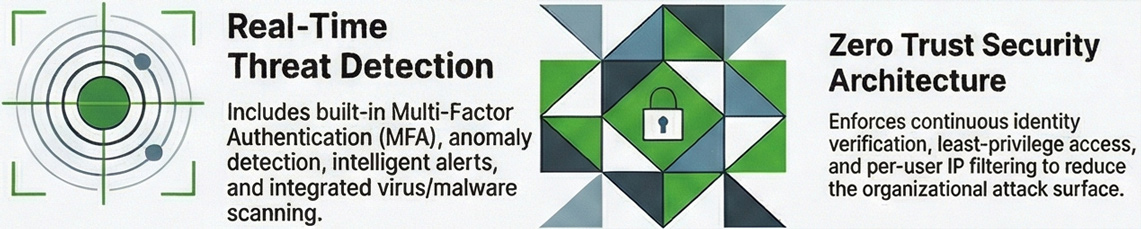
- Post-Quantum Cryptography (PQC) using NIST-standardized capabilities, including ML-KEM for quantum-resistant key establishment and ML-DSA and SLH-DSA for digital signatures, supported by a crypto-agile architecture that enables classical, hybrid, and post-quantum deployment models
- Crypto-agile architecture designed to support future cryptographic transitions
- Zero Trust security model with continuous verification and least-privilege access controls
- Encryption for data in transit and at rest
- Built-in Multi-Factor Authentication (MFA)
- Per-user IP filtering and geographic access restrictions
- Automated Virus, malware, and DLP integrations
- Tamper-resistant audit logging and automated backups
- Real-time anomaly detection and intelligent alerting
Multi-Tenant by Design
Unlike many legacy MFT platforms, TDXchange was built from the ground up as a true multi-tenant solution.
Organizations can securely separate:
- Business units
- Departments
- Customers
- Trading partners
- Operational environments
while maintaining centralized administration, governance, and visibility.
Granular Access Control and Enterprise Authentication
TDXchange supports flexible authentication and authorization models that integrate with existing enterprise security frameworks.
Supported authentication methods include:
- Microsoft Entra ID
- Active Directory
- LDAP
- OAuth 2.0
- Native TDXchange authentication
Role-Based Access Control (RBAC) and delegated administration allow organizations to empower business users while maintaining security and compliance.
Flexible Workflow Automation and Scheduling
TDXchange enables organizations to automate complete business processes rather than simply schedule individual file transfers.
TDXchange orchestrates governed, multi-step workflows across file systems, enterprise applications, databases, APIs, cloud services and trading partners. For example, a single workflow can retrieve data from an ERP system, authenticate the source, validate and transform the information, apply security and approval policies, encrypt and securely transfer it to a trading partner, manage retries and exceptions, invoke downstream processing through an API, capture acknowledgments, notify responsible teams and preserve the complete transaction and audit history.
Workflows can be initiated by schedules, incoming files, API requests, application events, partner activity, business conditions, approvals, or the successful completion of another workflow.
Each step can be governed by dependencies, conditional logic, retries, exception handling, and audit controls. Rather than treating successful file delivery as the end of the process, TDXchange coordinates subsequent application activities and provides end-to-end visibility into workflow execution, exceptions, and business outcomes.
Once configured, scheduled file transfers run automatically at the required times, including daily or overnight, without users manually initiating each run. TDXchange handles configured processing steps, retries, and notifications automatically, while preserving transaction history. Teams receive alerts when exceptions require attention, reducing routine manual work while maintaining operational oversight.
Key automation capabilities include:
- Flexible, point-and-click scheduling based on specific dates, times, recurring intervals, calendars, and business processing windows
- Event-driven workflows that execute when files arrive, applications generate events, APIs are called, or predefined business conditions are met
- REST API and web service integration for initiating, managing, and monitoring automated processes
- Multi-step workflow orchestration across files, APIs, applications, cloud platforms, and trading partners
- Post-delivery orchestration that can trigger remote jobs, execute scripts, call REST or SOAP APIs, and initiate downstream application processes after a file is successfully delivered
- Conditional post-delivery actions and routing based on transfer status, acknowledgment, validation results, file metadata, partner requirements, or business rules
- Secure passing of file names, locations, transaction identifiers, partner information, and other workflow context to downstream jobs, scripts, and APIs
- Automated monitoring, auditing, retry, exception handling, and notification for downstream actions
- Multi-step dependencies that prevent subsequent processing from beginning until delivery and required post-delivery actions complete successfully
- Automated validation, transformation, compression, encryption, digital signing, inspection, routing, archiving, and notification
- Approvals and human decision points for workflows that require business or compliance review
- Automated retries, exception handling, recovery, and escalation
- Workflow-level SLA monitoring and alerts for missed delivery windows or processing thresholds
- Reusable automation patterns that help organizations standardize processes across departments and trading partners
TDXchange combines scheduled and event-driven automation to support batch processing, near-real-time integration, and complex enterprise workflows. Configurable trading partner and adapter maintenance windows pause outbound attempts during planned downtime, securely queue files, and automatically resume processing when the destination becomes available.
Automation continues after delivery. TDXchange can trigger remote jobs, execute scripts, call APIs, or initiate downstream application workflows for data ingestion, validation, reconciliation, database processing, reporting, acknowledgments, and notifications, all within the same governed transaction.
Flexible Deployment and Growth
TDXchange is designed to fit both where an organization operates today and where it plans to go next.
The platform can be deployed on-premises, in a private or public cloud, across hybrid and multi-cloud environments, or using Kubernetes. Regardless of the deployment model, organizations maintain consistent administration, security, governance, workflow automation, and operational visibility.
Deploy TDXchange Where It Fits Your Business
Organizations can choose the deployment model that best aligns with their infrastructure, security, regulatory, performance, and data-sovereignty requirements.
TDXchange supports:
- On-premises infrastructure
- Private cloud environments
- Public cloud platforms, including AWS, Microsoft Azure, and Google Cloud
- Hybrid and multi-cloud architectures
- Virtual machines
- Kubernetes-based deployments
- Production, non-production, and disaster recovery environments
- Geographically distributed implementations
The deployment model can evolve as business requirements change. Organizations can begin on-premises and later expand into the cloud, establish a hybrid architecture, or introduce Kubernetes without replacing the underlying MFT platform.
Organizations that prefer a fully managed SaaS solution can use TDCloud, which is built on the proven TDXchange platform.
Start with What You Need and Expand Over Time
TDXchange is a fully license-driven platform. Its capabilities are controlled through licensing, allowing organizations to begin with the protocols, features, capacity, and integrations required for the initial phase of their implementation.
As migrations progress and business requirements grow, additional capabilities can be licensed and enabled within the existing platform. This allows organizations to expand TDXchange without moving to another product or redesigning their established implementation.
Organizations can expand over time by adding:
- Secure file transfer protocols
- Trading partners and users
- Workflow automation capabilities
- Cloud and enterprise application integrations
- Production and non-production environments
- Cluster nodes and processing capacity
- High availability and disaster recovery capabilities
- Delegated administration and multi-tenancy
- Advanced monitoring, reporting, and operational intelligence
- Additional security and governance capabilities
Built for Phased Migrations
Large MFT migrations rarely happen all at once. Applications, workflows, and trading partners are commonly moved in phases based on business priority, technical complexity, and operational risk.
TDXchange allows organizations to start with a smaller set of capabilities and expand the same implementation as each migration phase is completed. New protocols, workflows, partners, integrations, and capacity can be introduced when they are needed, while migrated processes continue operating on the same centrally managed platform.
This approach helps organizations:
- Align licensing with current requirements
- Avoid purchasing every capability on day one
- Migrate applications and trading partners in manageable phases
- Reduce migration risk and operational disruption
- Preserve existing configurations and workflows as the environment grows
- Respond to new business requirements without changing platforms
- Scale from a focused implementation to an enterprise-wide MFT environment
TDXchange provides flexibility in both where the platform runs and how it grows. Organizations can choose the right deployment model, begin with the capabilities they need today, and expand the same platform as migrations proceed, transaction volumes increase, and business requirements evolve.
Ease of Use and Delegated Self-Service
Enterprise capabilities should not require unnecessary operational complexity. TDXchange combines a browser-based interface with centralized administration, guided configuration, and role-based access to make secure data exchange easier to deploy, learn, and operate.
Ease-of-use capabilities include:
- A centralized browser-based interface for managing transfers, workflows, users, partners, security policies, dashboards, and reporting
- Point-and-click scheduling and workflow configuration for common automation requirements
- Consistent administration across on-premises, cloud, hybrid, and distributed environments
- Near real-time role-specific dashboards that present the information and controls relevant to each user
- Delegated administration that allows authorized business teams to manage defined responsibilities without receiving unrestricted platform access
- Self-service capabilities for approved user, mailbox, workflow, reporting, and trading partner operations
- Centralized partner onboarding and configuration management
- Standardized configuration patterns that help teams implement new partners and workflows consistently
- Searchable transaction histories and centralized troubleshooting tools
- AI-assisted administration, onboarding, investigation, and operational guidance
- API-driven provisioning and administration for organizations that want to integrate TDXchange with existing service-management and automation processes
This approach helps reduce the learning curve, limit dependence on specialized administrators, and distribute operational responsibilities while maintaining centralized security and governance.
Broad Protocol Support and Enterprise Integration
TDXchange connects file transfers, APIs, applications, cloud platforms, internal systems, users, and external trading partners through a single governed Enterprise Data Exchange platform.
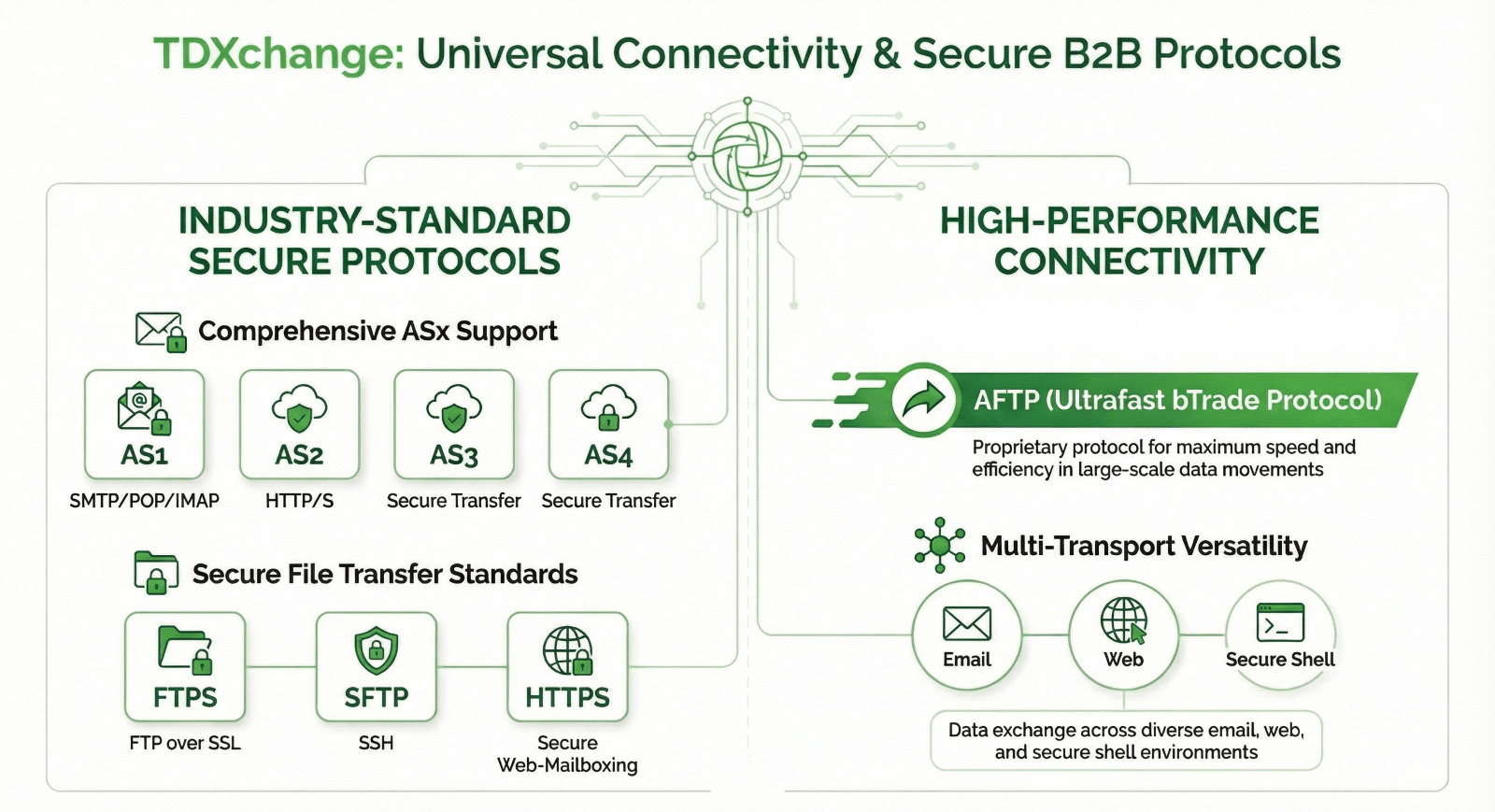
Supported secure transfer protocols include:
- AFTP
- SFTP
- FTPS
- HTTPS
- AS2
- AS4
API and application integration capabilities include:
- REST APIs
- SOAP web services
- API-initiated and event-driven workflows
- ERP and CRM systems
- EDI platforms
- Data-processing and analytics platforms
- Custom business applications
- Post-delivery execution of remote jobs, scripts, APIs, and downstream application processes
- Enterprise identity and access-management services
- SIEM, IT service management, and observability platforms
Native cloud and storage integrations include:
- Amazon S3
- Microsoft Azure Blob Storage
- Google Cloud Storage
- Google Drive
- Microsoft SharePoint
- Box
- Dropbox
- Windows File Shares using SMB
TDXchange can monitor cloud repositories and file-system locations for newly available files or files matching predefined criteria. It can then validate, process, transform, encrypt, route, and deliver that information to applications, cloud services, internal systems, and trading partners as part of a governed workflow.
Integration capabilities also include:
- Scheduled and event-driven data exchange
- Monitoring of cloud folders and storage locations
- Automated delivery to predefined repositories and application endpoints
- Conditional routing based on file, partner, metadata, or business criteria
- Connections to malware inspection, DLP, and key-management services
- Operational and security telemetry integration with enterprise platforms
- Secure Microsoft Outlook file exchange through AttachGuard
The objective is not simply to connect more systems. TDXchange governs what happens before, during, and after information moves across cloud, hybrid, on-premises, application, and trading partner environments.
Trading Partner Onboarding and Lifecycle Management
TDXchange centralizes the onboarding and ongoing management of external partners, internal applications, business units, and service accounts.
Partner-management capabilities include:
- Centralized partner profiles and endpoint configurations
- Support for partner-specific protocols, authentication methods, certificates, keys, schedules, workflows, and security policies
- Delegated partner administration governed by granular RBAC
- Standardized onboarding processes that help reduce configuration inconsistencies
- API-assisted provisioning and integration with existing onboarding systems
- Partner-specific dashboards, reporting, and transaction histories
- Certificate and credential lifecycle visibility
- Maintenance-window automation for planned partner downtime
- Complete auditing of partner configuration and administrative changes
- Separation of partner data and administrative responsibilities through native multi-tenancy
These capabilities help organizations onboard and manage large partner communities without losing centralized control, security, or visibility.
Cloud-Native Scalability, High Availability, and Resiliency
TDXchange is designed to support mission-critical data exchange across high-volume, distributed, and hybrid enterprise environments.
Scalability and resiliency capabilities include:
- Active-active, multi-node clustering
- Automatic failover and workload distribution
- Elastic scaling to support changing transaction volumes
- Kubernetes deployments and containerized infrastructure
- Support for Windows, Linux, Unix, cloud, and hybrid deployment models
- Hybrid cloud architectures
- Geo-redundancy and disaster recovery
- Centralized administration across distributed nodes and environments
- Resilient workflow processing, automated retry, and recovery
- Secure queuing during temporary partner or infrastructure outages
- Horizontal expansion without requiring organizations to redesign existing workflows
- AFTP acceleration for high-volume and latency-sensitive transfers
This architecture allows organizations to expand transaction capacity, add trading partners, introduce new integrations, and modernize infrastructure while maintaining availability, performance, and centralized governance.
Real-Time Visibility, Configurable Dashboards, and Auditability
TDXchange provides end-to-end visibility across transfers, workflows, users, applications, trading partners, configurations, security events, and platform infrastructure.
Organizations can distinguish a successful file delivery from a successfully completed business process by following the transaction through reception, validation, processing, routing, delivery, acknowledgment, and downstream completion.
Track Individual Files From Source to Destination
TDXchange tracks files through the transfers and workflows it manages across connected applications, storage services, and trading partners. Authorized teams can use searchable transaction histories to investigate a file’s journey, review processing stages, identify the last recorded successful step, and examine delays, retries, or failures.
Tracking connects source and destination information with workflow activity, timing, routing decisions, and delivery results. Where configured integrations provide downstream status or acknowledgments, the history can also show the receiving application’s reported outcome.
This gives teams a practical way to answer where a file went, what happened during processing, and whether the required exchange completed.
Learn more about file tracking and transaction traceability in TDXchange.
Automated Compliance Reporting and Detailed Audit Logs
TDXchange is enterprise file-transfer software that maintains centralized, searchable and tamper-resistant audit histories covering file transfers, authorized file access, authentication and authorization decisions, workflow execution, administrative activity, security events and configuration changes. Audit data is encrypted when stored in the database to help protect its integrity for investigations, compliance audits and regulatory reviews.
Records identify who or what performed an action, the IP address used, when it occurred, what was affected, which policies were applied, and whether the action succeeded or was denied. Configuration histories show what changed, who changed it and when.
Authorized teams can search these histories, apply retention policies, generate reports on demand, and schedule recurring audit and compliance reports. Reports can cover selected periods, users, partners, workflows, transactions, outcomes, exceptions, security events and administrative activity. TDXchange can also share relevant events with SIEM, audit, compliance and enterprise-governance platforms.
Key visibility and reporting capabilities include:
- Real-time monitoring of transfers, workflows, queues, retries, failures and acknowledgments
- Complete transaction histories showing workflow stages, decisions, exceptions and outcomes
- Configurable dashboards for operational roles, business units, partners and workflows
- Centralized visibility across clustered, cloud, hybrid and distributed environments
- Searchable audit trails and encrypted audit-data storage
- Configuration-change tracking
- On-demand and scheduled audit and compliance reporting
- Workflow-level SLA monitoring
- Policy-driven alerts, notifications and escalations
- Operational trend and root-cause analysis
- Secure content-level search where authorized
- Integration with SIEM, IT service management, audit, compliance, analytics and observability platforms
These capabilities help organizations investigate incidents, demonstrate accountability and automatically generate recurring compliance reports supported by complete, defensible audit evidence.
Intelligent and Context-Aware Alerting
TDXchange helps organizations focus on conditions that require action instead of generating undifferentiated operational noise.
Alerting capabilities include:
- Transfer, workflow, application, and partner failure alerts
- Alerts for missed schedules and expected files that do not arrive
- Workflow-level SLA threshold and breach notifications
- Certificate and credential expiration alerts
- Configuration and administrative change notifications
- Security-policy, authentication, authorization, and anomaly alerts
- Alerts for unusual file sizes, volumes, destinations, transfer times, or partner behavior
- Business-impact-aware notifications based on workflow criticality
- Automated escalation to the appropriate operational, security, or business team
- Suppression of unnecessary failure alerts during configured maintenance windows
- Integration with email, service-management, SIEM, and enterprise-observability processes
By combining operational, security, partner, and business context, TDXchange helps teams identify meaningful risk sooner while reducing alert fatigue.
Adaptive Security, Policy-Driven Governance, and Compliance
TDXchange helps organizations enforce consistent governance while adapting to evolving regulatory requirements, security standards, and cyberthreats. Centralized policies apply across identities, file transfers, workflows, APIs, applications, cloud integrations, administrators, and trading partner interactions.
Its expandable, license-driven architecture allows organizations to add protocols, integrations, security controls, automation, capacity, and advanced capabilities as requirements change without replacing the platform or redesigning established workflows and partner connections.
Keeping pace with changing compliance requirements and security threats requires both adaptable platform controls and ongoing software development. TDXchange allows authorized teams to revise access permissions, approval workflows, retention settings, monitoring rules, and partner policies as requirements change. Crypto agility supports changes to algorithms, keys, certificates, and cryptographic policies, while integrations with enterprise DLP, malware inspection, and SIEM platforms help organizations apply their broader security controls to file exchange.
bTrade supports this adaptability through continued product engineering and DevSecOps practices, including threat modeling, automated vulnerability scanning, code analysis, security assessments, controlled releases, and vulnerability remediation. These practices help address newly identified risks and strengthen TDXchange as security expectations evolve. Customers can respond through configuration changes, integration updates, or software upgrades, depending on the requirement and their deployed version.
Learn more about how bTrade applies DevSecOps and NIST SSDF principles to TDXchange.
Automated DLP Inspection and Policy Enforcement
TDXchange is not a standalone Data Loss Prevention classification engine. It integrates existing enterprise DLP platforms and partner DLP technologies directly into automated Managed File Transfer workflows.
Before a sensitive document is transmitted, TDXchange can invoke the connected DLP technology to inspect the file. The DLP engine identifies sensitive, regulated, or confidential content, evaluates it against the organization’s established policies, and returns a policy result to the workflow.
Based on that result, TDXchange can automatically:
- Allow an authorized transfer to continue
- Block a transfer that violates policy
- Move the file to a secure quarantine location
- Apply additional encryption controls
- Route the transfer for human review or approval
- Notify security, compliance, or operational teams
- Trigger an escalation or incident-response workflow
- Record the inspection result, policy decision, and enforcement action in the audit history
This architecture allows organizations to apply existing enterprise DLP policies consistently across automated transfers, workflows, applications, trading partners, business units, and clustered TDXchange nodes. Centralized monitoring and audit histories provide visibility into inspected, approved, blocked, quarantined, and escalated transfers.
Available inspection, classification, and enforcement actions depend on the connected DLP technology, organizational policies, and configured TDXchange workflows. This integrated approach allows organizations to retain their established DLP investments while adding automated file-transfer enforcement, centralized governance, and defensible auditability.
Adaptive security, governance, and compliance capabilities include:
- Granular RBAC, MFA, continuous authorization, and least-privilege access controls
- Delegated administration with clearly defined responsibilities
- Policy-driven workflow execution, routing, approvals, retention, and exception handling
- Partner-specific security, processing, certificate, and cryptographic policies
- Tamper-resistant transaction, security, configuration, and administrative audit trails
- Searchable evidence covering file movement, processing, retries, delivery, acknowledgment, and administrative activity
- Workflow-level SLA policies, real-time monitoring, configurable dashboards, and compliance reporting
- AI-assisted anomaly detection for unusual transfers, unexpected file patterns, abnormal user or partner behavior, and workflow deviations
- Data validation and integration with malware inspection, DLP, SIEM, identity, observability, audit, and governance platforms
- Automated retention, archival, backup, recovery, and evidence preservation
- Flexible on-premises, cloud, hybrid, multicloud, and Kubernetes deployment options
- Reporting that helps support HIPAA, PCI DSS, SOX, GDPR, GLBA, DORA, CJIS, FISMA, and other applicable requirements
Crypto-agile security enables organizations to update algorithms, keys, certificates, and cryptographic policies and progressively adopt classical, hybrid, and post-quantum protection. Native End-to-End Zero Trust Architecture applies continuous authentication, authorization, policy enforcement, least-privilege access, monitoring, and auditability across all platform components, including users, applications, service accounts, APIs, workflows, trading partners, AI services, and internal services.
TDXchange does not treat governance as a reporting exercise performed after a transfer is completed. Policies and security controls are applied throughout the complete data exchange lifecycle, creating consistent protection and defensible operational evidence.
Together, these capabilities provide an adaptable foundation that helps organizations strengthen security, expand functionality, and respond to changing compliance obligations without disrupting mission-critical data exchanges.
AI-Assisted Operations and Operational Intelligence
TDXchange uses AI-assisted capabilities to simplify administration, accelerate investigation, and help organizations make better operational decisions across complex Enterprise Data Exchange environments.
AI-assisted capabilities include:
- Natural language administration and operational queries
- AI-assisted trading partner and workflow onboarding
- Summaries of transfer, workflow, partner, and system activity
- Intelligent anomaly detection and behavioral analysis
- Correlation of related events across transactions, workflows, partners, configurations, and infrastructure
- Context-aware troubleshooting and likely-cause identification
- Identification of affected files, partners, workflows, and business processes
- Workflow and operational improvement recommendations
- Guided investigation that helps administrators locate relevant evidence faster
- Predictive operational insights that can identify developing risks before they become business disruptions
AI interactions are governed by the same Zero Trust, least-privilege, Role-Based Access Control, and auditing principles applied throughout TDXchange. Users can access only the information and recommendations permitted by their assigned roles, while AI activity remains visible and auditable.
The objective is not to replace experienced administrators. It is to help them understand complex operational conditions, find the right evidence, and reach informed conclusions faster.
Accelerated File Transfer
TDXchange includes bTrade's proprietary Accelerated File Transfer Protocol (AFTP), designed to move large files up to 100 times faster than traditional protocols such as SFTP, FTPS, and HTTPS.
AFTP helps organizations:
- Accelerate large file transfers
- Improve performance across high-latency networks
- Support cloud and hybrid deployments
- Reduce transfer windows for mission-critical workloads
Intuitive User Experience and Secure Web-Based File Exchange
TDXchange is designed to be easy to learn, administer, and operate. Its modern, browser-based interface simplifies configuration, monitoring, troubleshooting, reporting, and trading partner management, helping both business users and IT teams become productive quickly.
TDXchange provides a secure self service file transfer portal where authorized employees, external partners, suppliers, and customers can send, receive, access, and resend files through a web browser. Partners can exchange files independently without installing software, configuring transfer clients, or asking IT to perform each transfer. Native multifactor authentication protects individual users and administrators, while role based permissions limit each user to approved files and actions. Routine file sharing does not require administrative privileges.
Users can also view the status and history of their transfers, providing greater visibility into whether files were received, processed, or successfully delivered. Customizable dashboards, streamlined workflows, and centralized visibility make secure file exchange simple while maintaining enterprise security, governance, and auditability.
Key capabilities include:
- Modern, easy-to-use browser-based interface
- No end-user software installation required
- Secure web mailbox for sending, receiving, accessing, and resending files
- End-user visibility into transfer status and history
- Secure ad hoc file sharing
- Large file transfer support
- Customizable dashboards and reporting
- Simplified administration, monitoring, and troubleshooting
- Self-service capabilities for authorized business users
- Centralized transaction visibility and auditing
- Granular role-based access and policy enforcement
AttachGuard for Microsoft Outlook
TDXchange includes AttachGuard, an Outlook integration that automatically replaces email attachments with secure TDXchange download links.
Benefits include:
- Secure file sharing directly from Outlook
- Eliminates email attachment size limitations
- Improves data security and compliance
- Full auditing and transfer tracking
- Seamless user experience with no workflow changes
Benefits of TDXchange
Strengthen Security and Prepare for Cryptographic Change
TDXchange protects sensitive information throughout its lifecycle using quantum-safe cryptography, native Zero Trust architecture, encryption, granular access controls, MFA, security monitoring, and tamper-resistant auditing. Its crypto-agile architecture also helps organizations adopt new algorithms, keys, and certificates as security standards evolve without redesigning established business workflows.
These capabilities help reduce cyber risk and support security, privacy, and compliance initiatives associated with HIPAA, GDPR, PCI DSS, SOX, FISMA, and other applicable requirements.
Automate Complete Business Processes
TDXchange automates more than file movement. Scheduled and event-driven workflows can coordinate validation, transformation, routing, delivery, approvals, notifications, retries, and exception handling across files, APIs, applications, cloud platforms, and trading partners.
After delivery, TDXchange can trigger remote jobs, execute scripts, call APIs, or initiate downstream application processes. Configurable maintenance windows also help prevent planned partner downtime from creating unnecessary failures, alerts, and manual reprocessing.
This end-to-end automation reduces manual effort, improves consistency, and helps business processes complete faster and more reliably.
Improve Visibility and Resolve Issues Faster
TDXchange provides centralized, end-to-end visibility into transfers, workflows, users, partners, configurations, security events, and system operations. Configurable dashboards, intelligent alerts, searchable transaction histories, and AI-assisted investigation help teams identify affected processes, understand what changed, and locate likely causes faster.
Organizations can distinguish successful delivery from successful business-process completion, reduce operational disruption, improve service levels, and spend less time reconstructing events across disconnected systems.
Scale Without Adding Operational Complexity
As data volumes, trading partners, integrations, and business requirements grow, TDXchange scales with them. Its clustered, cloud-native architecture supports active-active operations, high availability, Kubernetes deployments, elastic expansion, and disaster recovery across on-premises, cloud, and hybrid environments.
Organizations can increase capacity and resilience without replacing the platform, redesigning established workflows, or introducing separate administrative tools for each environment.
Accelerate Large and Time-Sensitive Data Movement
bTrade’s proprietary Accelerated File Transfer Protocol (AFTP) helps organizations move large files significantly faster than traditional transfer methods, particularly across high-latency and long-distance networks.
Faster data movement reduces transfer windows, helps time-sensitive workflows complete sooner, and supports data-intensive processes across global, cloud, hybrid, analytics, media, healthcare, and financial environments.
Simplify Governance, Administration, and Self-Service
TDXchange combines centralized governance with granular RBAC, delegated administration, configurable dashboards, policy-driven workflows, and comprehensive audit trails. Authorized business teams can manage approved users, partners, workflows, reporting, and day-to-day operations without receiving unrestricted administrative access.
This balance of centralized control and governed self-service reduces the burden on IT, makes the platform easier to operate, and provides the accountability required for regulated and security-sensitive environments.
Connect and Modernize the Enterprise Ecosystem
TDXchange connects enterprise applications, APIs, cloud platforms, storage services, internal systems, and trading partners through a unified data exchange platform. Organizations can modernize workflows incrementally while continuing to use existing infrastructure, applications, protocols, and partner connections.
By governing files, APIs, events, and downstream processes within the same platform, TDXchange reduces integration fragmentation and provides a consistent security, automation, visibility, and audit model across the enterprise.
Continued Product Development and Long-Term Investment
TDXchange is an actively developed Managed File Transfer and Enterprise Data Exchange platform supported by bTrade’s continued investment in architecture, security, automation, observability, artificial intelligence, cloud integration, scalability, administration, and user experience.
Recent development includes TDXchange v5, Native End-to-End Zero Trust Architecture, NIST-standardized quantum-safe security, crypto agility, Kubernetes-based scalability, enterprise observability, workflow-level SLA monitoring, AI-assisted anomaly detection, natural-language administration, maintenance-window automation, delegated self-service, and expanded cloud and application integration.
bTrade’s roadmap is shaped by customer requirements, operational experience, cybersecurity risks, regulatory expectations, emerging standards, and changes in enterprise architecture. Customer challenges are evaluated as opportunities to create reusable platform capabilities that benefit the broader TDXchange community.
This continued investment helps organizations modernize incrementally, adopt new capabilities without replacing established workflows, and depend on TDXchange as a long-term platform rather than a short-term file-transfer product.
Frequently Asked Questions About TDXchange:
What is TDXchange?
TDXchange is a secure Enterprise Data Exchange platform that combines Managed File Transfer, workflow automation, APIs, trading partner onboarding, secure file sharing, operational visibility, and centralized governance within a single solution.
Organizations can use TDXchange to securely exchange and process data across internal systems, cloud environments, business applications, users, and external trading partners.
How is TDXchange different from a traditional MFT platform?
Traditional MFT platforms primarily focus on securely moving files between endpoints. TDXchange extends beyond file delivery by coordinating files, APIs, applications, cloud services, workflows, users, and trading partners as part of complete, governed business processes.
It combines secure transfer, workflow orchestration, post-delivery processing, partner management, end-to-end visibility, policy enforcement, and auditability within one platform.
Can TDXchange integrate with existing MFT infrastructure, applications, and cloud services?
Yes. TDXchange supports secure protocols including AFTP, AS2, AS4, SFTP, FTPS, and HTTPS, along with REST APIs and SOAP web services. This allows it to integrate with existing MFT platforms, ERP and CRM systems, EDI environments, custom applications, and trading partners.
Native integrations include Amazon S3, Microsoft Azure Blob Storage, Google Cloud Storage, Google Drive, Microsoft SharePoint, Box, Dropbox, and Windows SMB file shares. Organizations can migrate incrementally, operate TDXchange alongside existing infrastructure, and transition partners and workflows in phases.
What workflow automation capabilities does TDXchange provide?
TDXchange supports scheduled, event-driven, API-initiated, and condition-based workflows. A workflow can begin when a file arrives, a schedule is reached, an API is called, an application generates an event, an approval is completed, or another workflow finishes.
TDXchange can orchestrate multi-step workflows across file systems, enterprise applications, databases, APIs, cloud services and trading partners. A single workflow can retrieve data from an ERP system, validate and transform the information, apply security and approval policies, encrypt and securely transfer it to a trading partner, invoke downstream processing through an API and track the final outcome.
Configurable trading partner and adapter maintenance windows can also pause outbound attempts during planned downtime, securely queue files, and automatically resume processing when the destination becomes available.
Is TDXchange easy to use?
TDXchange provides a centralized browser-based interface for managing transfers, workflows, schedules, users, partners, dashboards, alerts, reporting, and security policies.
Point-and-click configuration, role-specific dashboards, centralized troubleshooting, API-driven provisioning, and AI-assisted operations help simplify deployment and daily administration. Granular RBAC and delegated self-service also allow authorized business teams to manage approved users, partners, workflows, reporting, and operational tasks without receiving unrestricted platform access.
Is TDXchange a multi-tenant MFT platform?
Yes. TDXchange was designed as a multi-tenant Enterprise Data Exchange platform. A single deployment can securely support multiple business units, departments, subsidiaries, customers, and trading partner communities.
Each tenant can maintain separate users, data, configurations, workflows, administrative responsibilities, and reporting while the organization retains centralized management, security, and visibility.
What visibility, SLA monitoring, and alerting capabilities does TDXchange provide?
TDXchange provides end-to-end visibility into transfers, workflows, users, applications, trading partners, configurations, security events, and system operations.
For individual file investigations, teams can follow the recorded journey from source to destination across participating systems, review completed workflow stages, and identify the last recorded status or an exception requiring attention. Tracking covers activity managed by TDXchange and external results made available through configured integrations.
Configurable dashboards, real-time monitoring, searchable transaction histories, configuration-change tracking, comprehensive audit trails, and intelligent alerting help teams identify affected processes and investigate problems faster. When downstream status or acknowledgment information is available, TDXchange can distinguish successful file delivery from successful business-process completion.
Organizations can also monitor workflow-level delivery and processing expectations and generate alerts for failures, delays, missing files, missed schedules, SLA thresholds, certificate expirations, security events, configuration changes, and abnormal activity.
What post-quantum cryptography does TDXchange support?
TDXchange supports NIST-standardized post-quantum cryptographic capabilities, including ML-KEM for quantum-resistant key establishment and ML-DSA and SLH-DSA for digital signatures.
Its crypto-agile architecture supports classical, hybrid, and post-quantum deployment models, helping organizations progressively modernize algorithms, keys, certificates, and partner configurations while preparing for risks such as “Harvest Now, Decrypt Later.”
How does TDXchange implement Zero Trust?
TDXchange v5 implements Native End-to-End Zero Trust Architecture across all platform components. Users, administrators, applications, APIs, workflows, service accounts, trading partners, AI services, and internal services must authenticate and receive authorization before exchanging information or performing an action.
Every interaction must be authenticated, authorized, and validated according to identity, role, policy, and context. TDXchange supports Microsoft Entra ID, Active Directory, LDAP, OAuth 2.0, OpenID Connect, native authentication, MFA, granular RBAC, delegated administration, per-user IP filtering, geographic access restrictions, encryption, and comprehensive auditing.
Does TDXchange support cloud, hybrid, and enterprise-scale deployments?
Yes. TDXchange can be deployed on-premises, in private or public clouds, or across hybrid environments. Centralized administration and governance allow organizations to manage distributed deployments through a consistent operating model.
TDXchange supports active-active clustering, automatic failover, workload distribution, Kubernetes orchestration, elastic scaling, geo-redundancy, and disaster recovery. Organizations can expand capacity, add integrations, and support growing trading partner communities without redesigning established workflows.
Does TDXchange provide tamper-resistant audit logging for compliance audits?
Yes. TDXchange maintains centralized, searchable, tamper-resistant audit histories covering file transfers, authorized file access, authentication and authorization decisions, workflow activity, administrative actions, security events, and configuration changes. Audit trail data is encrypted when stored in the database, helping protect audit records against unauthorized access or modification and preserve audit integrity. Records provide the identity, timestamp, affected object, action, result, and relevant transaction or policy context needed for investigations, compliance reporting, and regulatory audits.
How does TDXchange use AI-assisted operations?
TDXchange uses AI-assisted capabilities to simplify administration, accelerate onboarding, summarize operational conditions, identify anomalies, correlate related events, and assist with troubleshooting and likely-cause analysis.
AI interactions follow the same Zero Trust, least-privilege, RBAC, and auditing controls as the rest of the platform. Users can access only the information and recommendations permitted by their assigned roles.
How does TDXchange support and adapt to changing compliance requirements and security threats?
TDXchange provides configurable policies, encryption, crypto-agile security, native Zero Trust controls, granular access management, MFA, policy-driven workflows, DLP integration, tamper-resistant audit trails, configuration-change tracking, retention controls, automated backups, real-time monitoring, anomaly detection, intelligent alerting, compliance reporting, and flexible deployment options.
These capabilities help organizations respond to emerging cyberthreats and evolving regulatory requirements while preserving established file-transfer workflows. They can support initiatives associated with HIPAA, GDPR, PCI DSS, SOX, FISMA, GLBA, DORA, CJIS, and other applicable requirements.
Adaptation includes both changes customers can make within TDXchange and improvements delivered through ongoing product development. Teams can revise policies and workflows as obligations change, while bTrade’s DevSecOps practices support security testing, vulnerability remediation, and controlled software releases. Depending on the change, the appropriate response may involve adjusting an existing control, updating an integrated security service, or upgrading TDXchange. Our DevSecOps approach explains how security is addressed throughout development and maintenance.
Compliance ultimately depends on each organization’s architecture, configuration, procedures, data, and governance model.
What is AFTP, and how is it different from SFTP?
AFTP is bTrade’s proprietary Accelerated File Transfer Protocol, designed to move large files up to 100 times faster than traditional protocols such as SFTP, FTPS, and HTTPS, depending on network and workload conditions.
AFTP is particularly valuable across high-latency, long-distance, cloud, and hybrid networks where conventional TCP-based transfer performance can become constrained.
Why do organizations evaluate TDXchange as an alternative to Globalscape, Axway, MOVEit, GoAnywhere, and other MFT platforms?
Organizations frequently evaluate TDXchange when they need to modernize beyond traditional file transfer and prioritize workflow automation, ease of use, enterprise integration, centralized governance, operational visibility, scalability, Zero Trust security, and crypto agility.
TDXchange combines true multi-tenancy, delegated self-service, scheduled and event-driven workflows, post-delivery orchestration, configurable dashboards, intelligent alerting, cloud-native scalability, Kubernetes support, AI-assisted operations, accelerated transfer, and NIST-standardized post-quantum cryptography within one platform.
Technology is only part of the decision. bTrade also brings more than three decades of MFT and enterprise-integration experience, hands-on migration assistance, responsive engineering-led support, and a customer-driven approach to product development.
Join the Global Community of TDXchange Users
Organizations around the world trust TDXchange to power their secure file transfer operations with built-in support for post-quantum encryption and Zero Trust architecture. From compliance and cybersecurity to scalability and cloud integration, TDXchange delivers the future of secure MFT today.
Contact us now to schedule a consultation with our MFT experts and discover how TDXchange can help your organization future-proof its file transfer operations.