

Managed File Transfer platforms protect some of an organization’s most important exchanges: payments, healthcare records, legal documents, government information, intellectual property, research data, customer records, and communications with business partners.
Many of those exchanges depend on public-key cryptography for key establishment, certificates, digital signatures, authentication, and trusted communications. A sufficiently capable quantum computer could eventually threaten widely deployed mechanisms such as RSA and elliptic-curve cryptography.
The practical question for MFT teams is therefore not simply which post-quantum algorithm to select. It is how to introduce new cryptographic protection across protocols, workflows, certificates, keys, applications, and partner connections without interrupting the business processes those exchanges support.
That is the operational purpose of post-quantum MFT security.
In Summary
Post-quantum MFT security is the application of quantum-resistant cryptography, cryptographic agility, partner-specific policy, testing, governance, and recovery controls to Managed File Transfer environments.
A typical architecture continues to use strong symmetric encryption such as AES-256 for file contents and stored data. ML-KEM supports quantum-resistant key establishment, while ML-DSA and SLH-DSA provide quantum-resistant digital-signature functions. These mechanisms serve different purposes and should not be presented as interchangeable forms of “file encryption.”
Migration will occur gradually. SFTP, FTPS, HTTPS, AS2, AS4, APIs, payload encryption, certificates, key-management systems, and partner endpoints do not all adopt new cryptography at the same time. An MFT platform must therefore support classical, hybrid, and post-quantum configurations according to the requirements and readiness of each workflow and trading partner.
The objective is not to replace one algorithm everywhere on one date. It is to modernize cryptographic protection safely while preserving interoperability, auditability, recoverability, and continuous data exchange.
Key Takeaways
- AES-256, ML-KEM, ML-DSA, and SLH-DSA perform different cryptographic functions within a quantum-safe MFT architecture.
- MFT cryptographic dependencies exist in transport protocols, payload protection, certificates, authentication, APIs, databases, key stores, scripts, and partner endpoints.
- Classical, hybrid, and post-quantum configurations may need to coexist for years because partners and products will migrate on different schedules.
- Partner-specific policy is essential; one global cryptographic setting will rarely satisfy every connection.
- Certificate, key, and trust-store migration must be governed as carefully as algorithm selection.
- Testing must cover the complete exchange, including negotiation, authentication, payload processing, signatures, acknowledgments, retries, monitoring, and downstream completion.
- Performance testing should measure handshake, signature, message-size, resource, and transaction effects under realistic workloads.
- Every configuration change, exception, test result, approval, and rollback decision should produce audit evidence.
- Recovery planning must preserve a known-good configuration without silently downgrading security.
What Is Post-Quantum Managed File Transfer Security?
Post-quantum Managed File Transfer security is an MFT architecture and operating model designed to protect critical exchanges as public-key cryptography transitions from quantum-vulnerable mechanisms to quantum-resistant alternatives.
It combines:
- Strong symmetric encryption for file payloads and stored data
- Quantum-resistant key establishment
- Quantum-resistant digital signatures
- Secure certificate and key lifecycle management
- Classical, hybrid, and post-quantum coexistence
- Partner-specific cryptographic policies
- Protocol and application interoperability
- End-to-end testing
- Detailed auditability
- Controlled recovery and rollback
- Crypto-agility for future algorithm changes
Post-quantum MFT is not a separate transfer protocol. It is the coordinated use of appropriate cryptographic functions across the protocols, trust relationships, and workflows already responsible for enterprise data exchange.
How AES-256, ML-KEM, and Post-Quantum Signatures Fit Together
The first implementation challenge is assigning each mechanism to the correct security function.
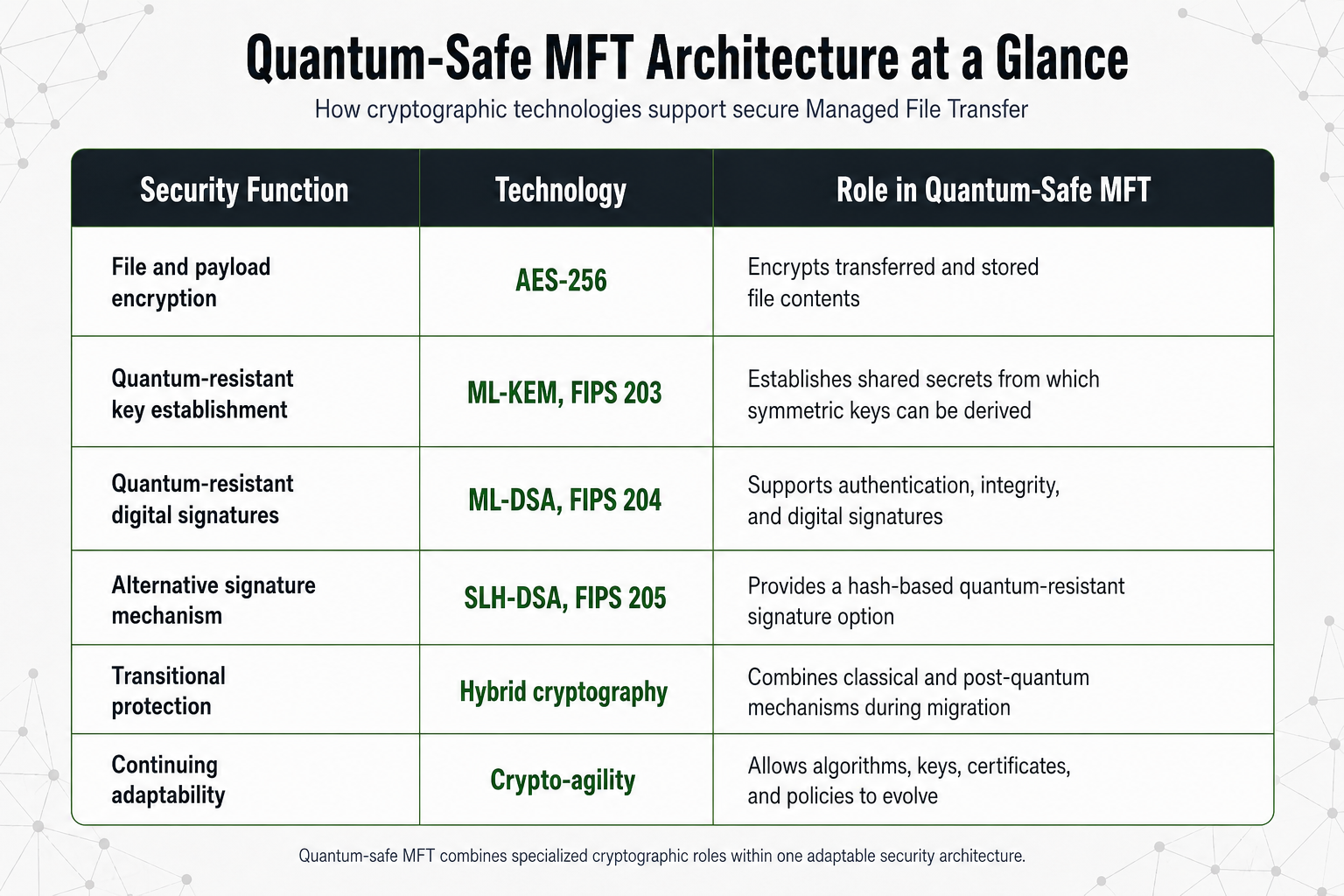
NIST FIPS 203 standardizes ML-KEM for key establishment. NIST FIPS 204 standardizes ML-DSA, and NIST FIPS 205 standardizes SLH-DSA for digital signatures.
In a simplified MFT exchange, AES-256 may protect the file payload, ML-KEM may contribute to establishing the secret from which session keys are derived, and ML-DSA or SLH-DSA may authenticate signed information or verify integrity. The exact implementation depends on the protocol, cryptographic library, certificate ecosystem, product support, partner capabilities, and applicable standards.
Using a standardized algorithm is only one part of a secure design. Parameter selection, implementation quality, random-number generation, side-channel resistance, key storage, protocol binding, certificate validation, and operational configuration also matter.
What Is Harvest Now, Decrypt Later?
Harvest Now, Decrypt Later, or HNDL, describes a threat in which an adversary captures encrypted information today, retains it, and attempts to decrypt it after cryptanalytic or quantum capabilities improve.
This matters to MFT because many transferred files remain sensitive long after delivery. Healthcare records, legal evidence, government information, research, intellectual property, and trade secrets may retain value for years or decades. Information encrypted today with quantum-vulnerable public-key mechanisms could therefore remain a useful target in the future.
Organizations should compare the confidentiality lifetime of each exchange with the time required to discover, test, coordinate, and replace its cryptographic dependencies. For the broader explanation of quantum computing and HNDL, read Quantum Computing, Post-Quantum Cryptography, and Managed File Transfer. For the business risk created before Q-Day, read Beyond Q-Day: Why Post-Quantum Risk Begins Before Quantum Computers Arrive.
Why Is Managed File Transfer Particularly Exposed?
MFT platforms routinely process long-lived sensitive information through highly automated workflows. A file can move from an internal application through an MFT service, inspection or transformation steps, a secure edge, a cloud platform, and an external partner without human intervention.
Each exchange may depend on a different combination of protocols, certificates, keys, signatures, authentication methods, cryptographic libraries, hardware security modules, APIs, and trust relationships. External partners add another constraint because their products, policies, maintenance windows, approval processes, and migration schedules are outside the organization’s direct control.
The result is not one cryptographic migration but a portfolio of migrations. Every important workflow must be evaluated according to the information it carries, the protocol it uses, the parties involved, and the cryptographic functions on which the complete exchange depends.
Where Does Cryptography Appear in an MFT Environment?
A useful inventory must go beyond a list of algorithms. It should show which cryptographic function appears at each layer and who controls it.
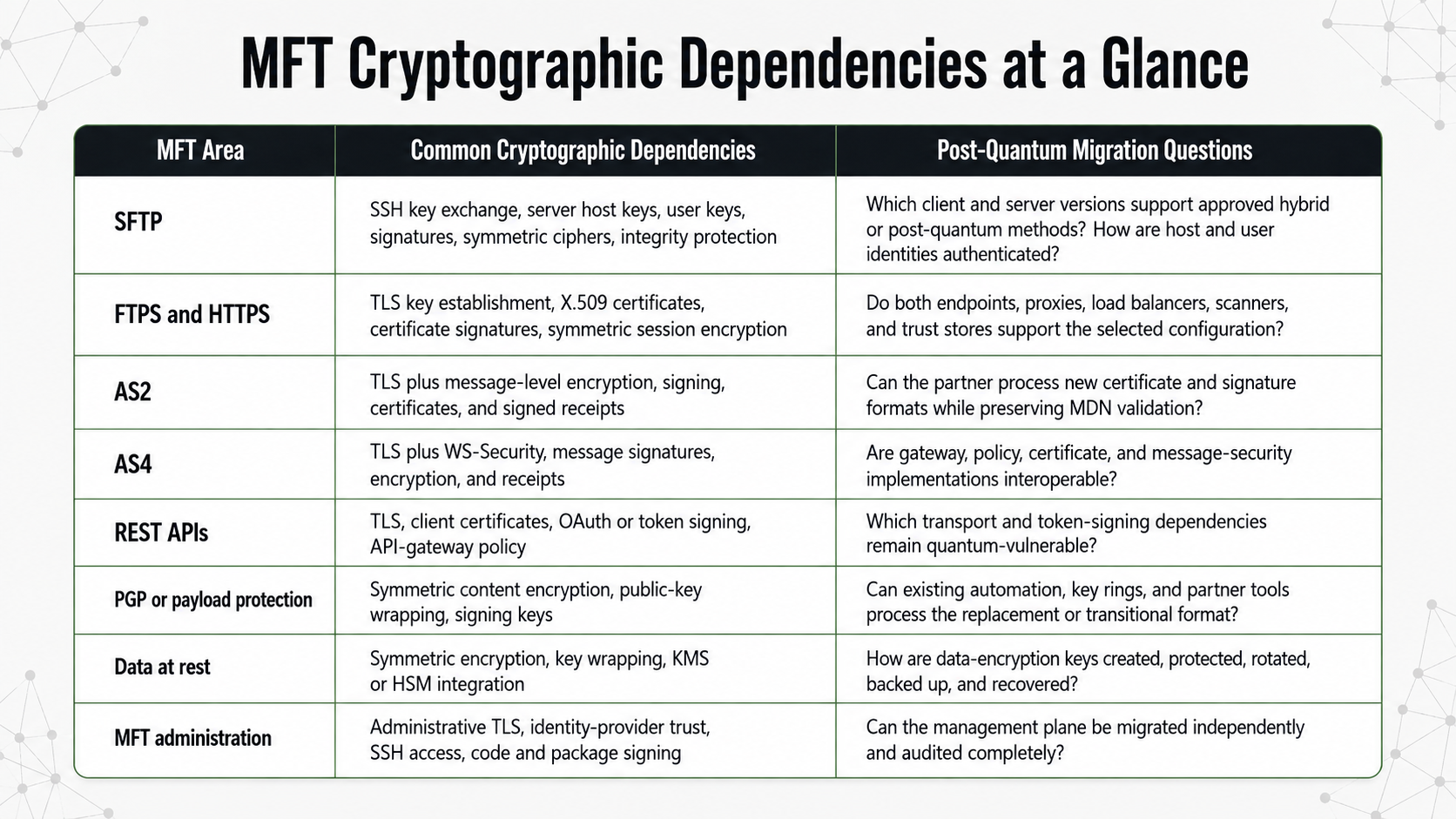
PQC availability differs by protocol, library, product version, platform, and partner implementation. Teams should verify supported standards and negotiated behavior rather than assume that enabling a library option automatically protects the complete exchange.
Which Cryptographic Algorithms Are at Risk?
RSA and Elliptic-Curve Cryptography
RSA and elliptic-curve cryptography rely on mathematical problems that a sufficiently capable quantum computer could address using Shor’s algorithm. In MFT environments, these mechanisms may support:
- TLS and SSH key establishment
- Server, user, service, and partner authentication
- X.509 certificate signatures
- SSH host and user keys
- Payload and message signatures
- API and token signatures
- Software and package signing
The inventory must identify the function, not merely the algorithm name. Replacing RSA used for a certificate signature is a different task from replacing RSA used to protect a payload key.
AES and Symmetric Encryption
AES is affected differently. Shor’s algorithm does not break AES. Grover’s algorithm creates a theoretical square-root speedup against brute-force search, which is why AES-256 remains the common choice for long-term symmetric protection when implemented and managed correctly.
AES-256 should not be described as a substitute for ML-KEM or a digital-signature algorithm. It protects content after the required symmetric key exists. The post-quantum design must still address how that key is established, wrapped, distributed, stored, rotated, and recovered.
How Can Classical, Hybrid, and Post-Quantum MFT Coexist?
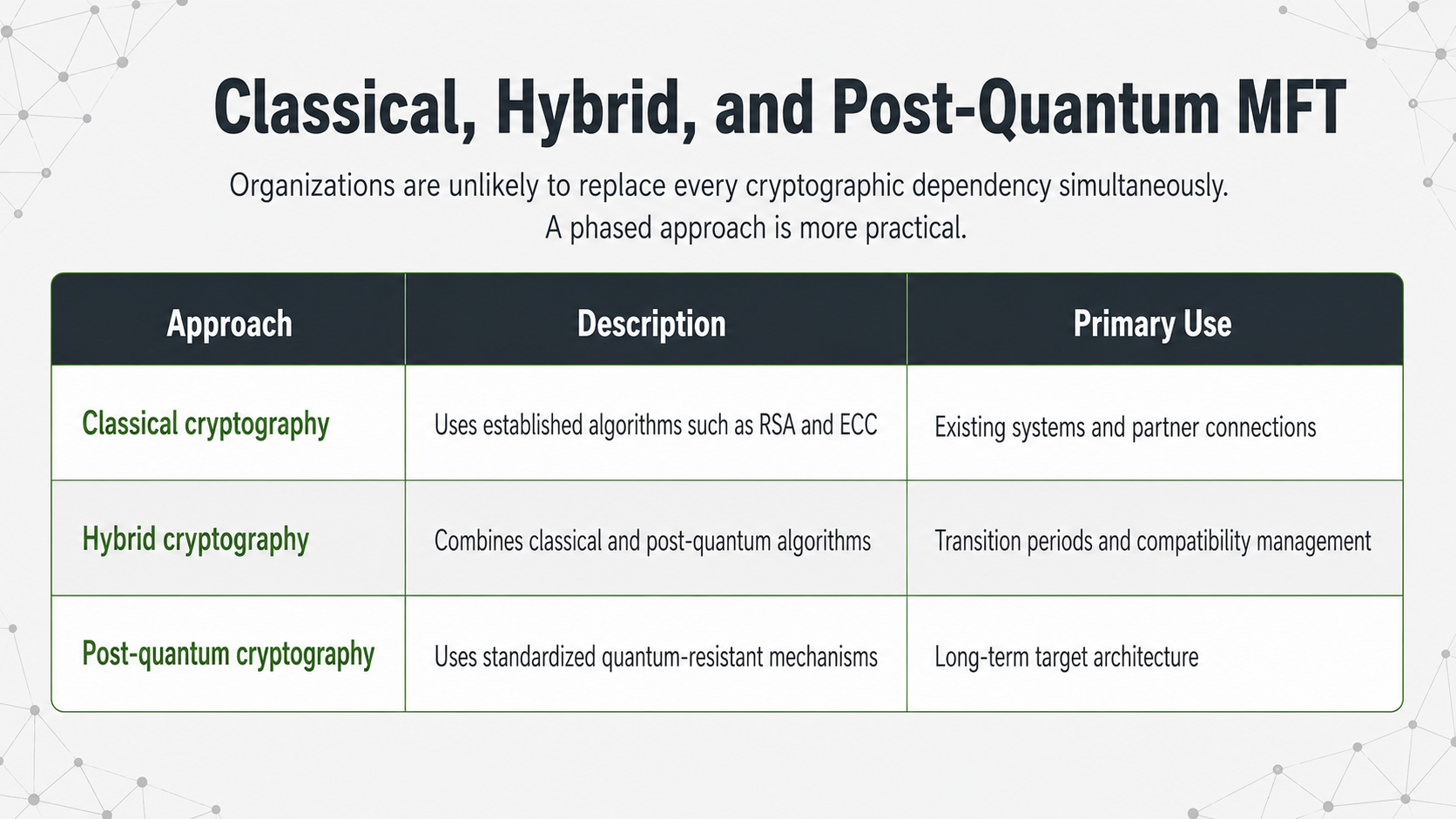
Enterprise MFT migrations will not happen everywhere at once. A large organization may have one partner capable of hybrid TLS, another limited to a classical SFTP configuration, and a third evaluating post-quantum message signatures. Internal services may also move at different speeds.
An MFT platform may therefore need to support three operating modes:
- Classical: Existing approved public-key mechanisms remain in use while the endpoint awaits an upgrade or migration window.
- Hybrid: A protocol-approved construction combines classical and post-quantum components so the exchange can benefit from both during transition.
- Post-quantum: The required key-establishment or signature function uses an approved quantum-resistant mechanism without a classical component where standards, policy, and interoperability permit.
Hybrid cryptography is not simply running two algorithms and concatenating their output in application code. The combination must follow the relevant protocol specification and use supported, reviewed implementations. Homegrown cryptographic combiners have a charming habit of creating new problems while solving the theoretical one.
Coexistence also requires explicit policy. The MFT platform should record which mode is permitted for each partner and workflow, which fallback behavior is allowed, when an exception expires, and what event triggers the next migration stage.
Why Partner-Specific Cryptographic Configuration Matters
Trading partners rarely share one technical baseline. They may use different MFT products, protocol versions, operating systems, certificate authorities, key stores, security policies, and release schedules.
Partner-specific configuration should define:
- Approved protocol and version
- Key-establishment method
- Server and client authentication method
- Permitted signature algorithms
- Payload-encryption and signing requirements
- Certificates, keys, trust anchors, and expiration dates
- Classical, hybrid, or post-quantum operating mode
- Approved fallback behavior
- Testing status and evidence
- Production migration window
- Business and technical owners
- Exception expiration date
- Recovery and rollback procedure
The migration schedule should be managed at the partner-and-workflow level. A partner may be ready for one HTTPS exchange but not for a legacy SFTP or AS2 process. Treating the partner as a single readiness status can hide the dependency that eventually interrupts production.
How Should Certificates and Keys Be Managed?
Post-quantum migration expands rather than eliminates certificate and key-management work.
Organizations should maintain a centralized inventory showing:
- Key purpose and algorithm
- Owner and authorized users or services
- Associated protocol, endpoint, partner, and workflow
- Certificate chain and trust anchors
- Creation, activation, expiration, and rotation dates
- Storage location, including HSM, KMS, vault, or protected file store
- Backup and recovery requirements
- Revocation or disablement process
- Classical, hybrid, or post-quantum status
- Test and production identifiers
- Relevant approvals and exceptions
Teams must also verify whether certificate authorities, HSMs, KMS platforms, cryptographic providers, operating systems, load balancers, proxies, scanners, and partner applications support the selected algorithms and object sizes.
Rotation procedures should support overlap between old and new credentials so both sides can coordinate a controlled cutover. Trust stores, pinned keys, host-key records, certificate validation rules, and automated scripts must be updated together. A perfectly generated key is not especially useful when the partner still trusts yesterday’s certificate.
Private keys and decapsulation keys require the same disciplined protection as other high-value cryptographic material: least-privilege access, protected generation and storage, controlled export, rotation, revocation, backup where appropriate, and detailed audit records.
What Does Post-Quantum Cryptography Protect?
Within an MFT architecture, PQC can address quantum-related risks affecting:
- Key establishment for protected sessions
- Digital signatures used for authenticity and integrity
- Certificates and machine trust as supporting ecosystems adopt new formats
- Payload-key protection and message-level security where supported
- Long-lived information vulnerable to future decryption
- Protocols and services that currently depend on RSA or elliptic-curve cryptography
These protections matter, but their effectiveness depends on correct protocol integration, implementation, key management, and endpoint support.
What Does PQC Not Protect Against?
PQC addresses quantum-related cryptographic risk. It does not prevent stolen credentials, excessive privileges, application vulnerabilities, compromised endpoints, malicious files, configuration errors, or insider activity. These risks require Zero Trust, secure software development, vulnerability management, content inspection, monitoring, and incident response.
For the complete layered security model, read Modern Secure File Transfer: Layered Security, Zero Trust, and Operational Best Practices.
Why Does MFT Require Crypto-Agility?
Crypto-agility is the ability to replace or add cryptographic algorithms, protocols, keys, certificates, and policies while preserving security and ongoing operations.
For MFT, crypto-agility should allow organizations to:
- Change cryptographic policy without rebuilding routing, scheduling, transformation, approval, or monitoring logic
- Configure security by partner, endpoint, protocol, and workflow
- Operate classical, hybrid, and post-quantum modes concurrently
- Rotate or revoke keys and certificates without unnecessary downtime
- Update cryptographic libraries and providers under change control
- Test new configurations alongside known-good production settings
- Prevent unapproved downgrade or fallback
- Trace every change to the affected transactions and business services
- Restore a validated configuration when migration fails
For the broader enterprise discipline, read Crypto-Agility for Post-Quantum Readiness. The focus here is narrower: applying that capability to MFT protocols, partner exchanges, and production workflows.
Eight Steps for Building an MFT Post-Quantum Migration Plan
1. Inventory MFT Cryptographic Functions
Identify every cryptographic function used by the MFT environment, including transport key establishment, host and user authentication, certificate validation, payload encryption, digital signatures, receipts, API tokens, data-at-rest protection, key wrapping, and software signing.
For each dependency, record the algorithm, protocol, product, version, cryptographic library, endpoint, partner, workflow, owner, certificate or key, and replacement constraint. An inventory that says only “we use RSA” is not enough to plan a safe change.
2. Classify MFT Workflows by Confidentiality Lifetime
Determine how long the information in each workflow must remain confidential, not merely how long the transferred file remains on the MFT server.
Classify each workflow using factors such as:
- Confidentiality lifetime
- Legal or regulatory retention
- Business impact of disclosure
- Data sensitivity and classification
- Exposure to external networks or parties
- Availability and integrity requirements
Long-lived sensitive exchanges should receive earlier attention because captured ciphertext may remain valuable well after the original transaction completes.
3. Identify High-Risk Partner Exchanges
Prioritize the partner connections where long confidentiality requirements intersect with quantum-vulnerable cryptography, external exposure, high transaction value, large volumes, or slow migration capability.
Document the partner’s business owner, technical contact, platform, protocol, authentication method, certificate and key dependencies, upgrade path, test environment, approval lead time, and contractual or regulatory constraints.
4. Build a Product, Protocol, and Partner Compatibility Matrix
Create a matrix showing which combinations have been claimed, tested, approved, and deployed.
The matrix should cover:
- MFT server and client products and versions
- TLS, SSH, AS2, AS4, HTTPS, API, and payload-security implementations
- Cryptographic libraries and providers
- Operating systems, proxies, load balancers, gateways, HSMs, and KMS platforms
- Classical, hybrid, and post-quantum methods
- Certificate, key, and signature formats
- Partner endpoint capabilities
- Monitoring and audit-tool compatibility
Vendor documentation is an input, not the final evidence. “Supported” can mean anything from production-ready to present behind an experimental flag.
5. Test Complete End-to-End Exchanges
Test the full business transaction rather than stopping when the cryptographic handshake succeeds.
An end-to-end test should verify:
- Algorithm negotiation and approved fallback behavior
- Server, client, service, and partner authentication
- Certificate and trust-chain validation
- File encryption, decryption, signing, and verification
- AS2 or AS4 receipts and acknowledgments where applicable
- Workflow transformations, routing, inspection, and archival
- Retries, resumable transfer, duplicate handling, and error paths
- Monitoring, alerting, and SIEM events
- Downstream application processing
- Recovery and rollback
The mathematics may be correct while the business transaction still fails. MFT testing must prove both.
6. Measure Handshake, Signature, and Transaction Effects
Post-quantum mechanisms may change public-key, ciphertext, signature, certificate, or handshake sizes. Measure their operational effect under realistic load and network conditions.
Useful metrics include:
- Connection and handshake latency
- Key-establishment operations per second
- Signature generation and verification time
- CPU and memory consumption
- Message, certificate, key, and signature sizes
- Network overhead and fragmentation behavior
- Transaction throughput
- Queue depth and processing time
- High-frequency connection effects
- Performance on constrained or remote endpoints
- Failover and recovery time
Compare results by protocol, partner, workflow, file-size distribution, concurrency level, and deployment architecture. Average performance alone can hide a painful tail latency at month end.
7. Deploy by Partner and Workflow
Move to production in controlled waves based on risk, readiness, and business criticality.
Each deployment wave should define:
- Selected partners and workflows
- Approved cryptographic configuration
- Required certificates and keys
- Change and maintenance window
- Success criteria
- Monitoring period
- Business and technical contacts
- Fallback restrictions
- Rollback authority and decision threshold
Begin with exchanges that provide meaningful risk reduction and can be tested thoroughly. Avoid changing every partner and protocol in one heroic weekend.
8. Record Configurations, Exceptions, Rollback, and Results
Maintain durable evidence showing:
- Previous and new configurations
- Algorithms, parameters, certificates, keys, and trust changes
- Test plans and results
- Performance baselines
- Approvals and responsible owners
- Partner readiness and acceptance
- Exceptions, compensating controls, and expiration dates
- Deployment results and affected transactions
- Rollback criteria, actions, and outcomes
- Follow-up milestones
Post-quantum migration is a continuing operating program. Its records should allow operations, security, auditors, and future engineers to understand what changed and why without reconstructing the story from ticket comments and archaeology.
What Should Interoperability and Performance Testing Prove?
Testing should answer four distinct questions:
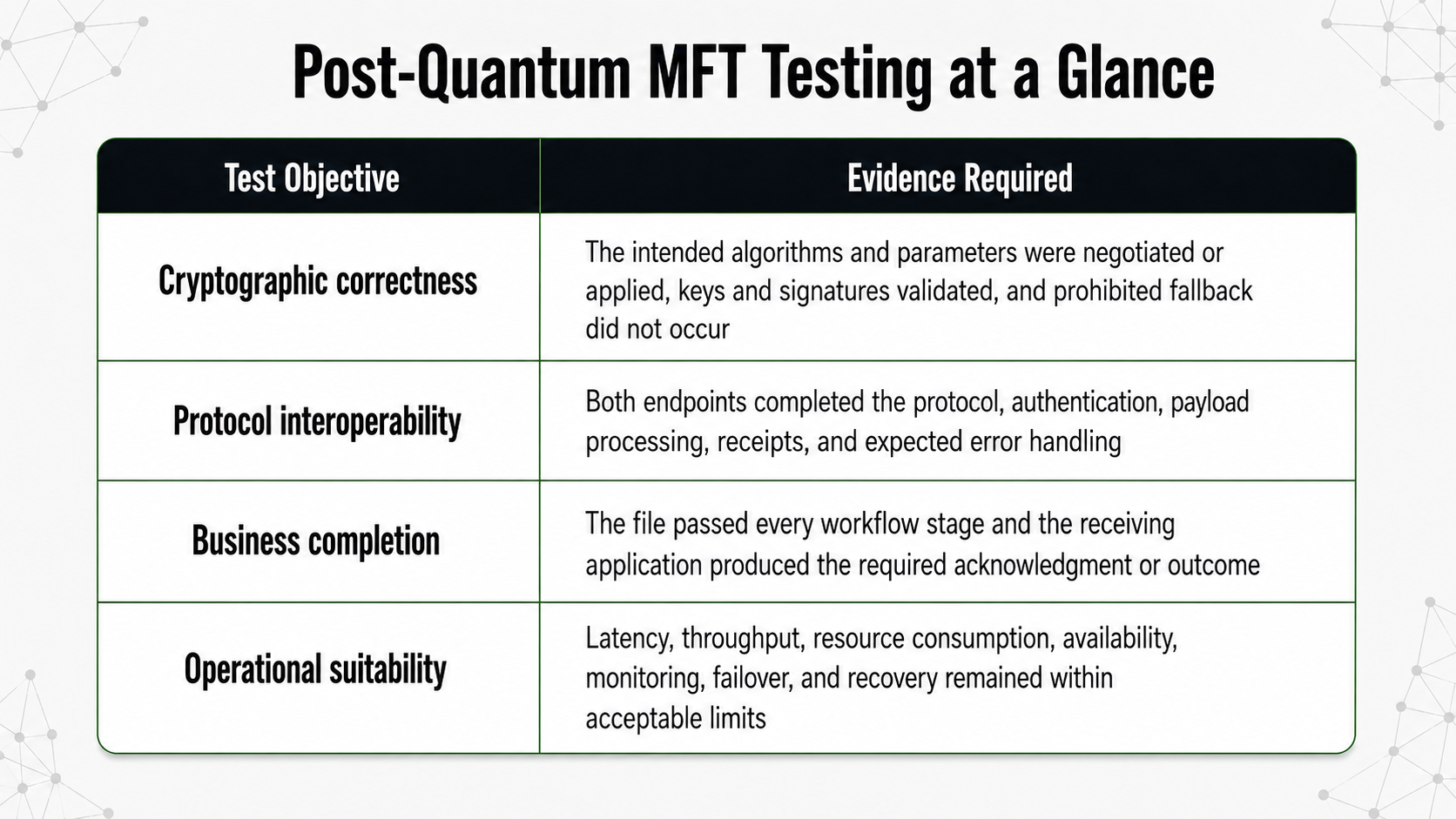
Tests should include normal, failure, misuse, and downgrade scenarios. They should also cover certificate expiration, trust failure, corrupted signatures, unavailable key services, partner timeout, node failover, and restoration of the previous configuration.
How Should Post-Quantum MFT Changes Be Audited?
Auditability should connect cryptographic configuration to the transactions it affects.
The audit trail should show:
- What algorithm, parameter, certificate, key, trust relationship, or policy changed
- The previous and new values
- Who requested, approved, tested, and implemented the change
- When the change became effective
- Which partner, endpoint, protocol, workflow, and environment were affected
- Which exception or fallback was used
- Whether the exchange negotiated the intended protection
- Which transactions succeeded, failed, retried, or rolled back afterward
Cryptographic observability should be integrated with operational dashboards, configuration history, alerts, SIEM, change management, and compliance evidence. A configuration screen proves what should happen. Transaction evidence helps prove what actually happened.
How Should Recovery and Rollback Work?
Rollback is not permission to return silently to any configuration that happens to connect.
A controlled recovery plan should define:
- A validated previous configuration
- Protected backups of required certificates, keys, trust stores, and policies
- Conditions that trigger rollback
- The person authorized to approve it
- Maximum time allowed in the previous mode
- Monitoring and notification requirements
- Compensating controls where quantum-resistant protection is temporarily unavailable
- Evidence required before attempting redeployment
The MFT platform should preserve workflow state, prevent duplicate delivery, support retry or checkpoint behavior where appropriate, and distinguish cryptographic failure from application or partner failure.
Downgrade behavior must be explicit. If a partner cannot complete the approved hybrid or post-quantum exchange, policy should determine whether the transaction stops, queues for review, or temporarily uses an approved classical configuration. Availability pressure should not be allowed to invent security policy at 2:00 a.m.
How TDXchange Supports Post-Quantum MFT Security
TDXchange is bTrade’s enterprise Managed File Transfer and secure data exchange platform.
TDXchange v5 incorporates quantum-safe cryptographic capabilities and crypto-agility as part of its broader Enterprise Data Exchange architecture. Its approach is designed to help organizations:
- Protect sensitive information in transit and at rest
- Apply NIST-standardized post-quantum cryptographic mechanisms where supported and appropriate
- Maintain partner-specific cryptographic configurations
- Support phased classical, hybrid, and post-quantum migration
- Manage certificates, keys, endpoints, users, and partners centrally
- Update cryptographic protection without rebuilding established business workflows
- Test and deploy changes by partner and use case
- Retain detailed transaction and configuration history
- Maintain monitoring, high availability, and operational recovery
Quantum-safe cryptography remains one layer of the platform’s security model. TDXchange also supports identity and access controls, partner isolation, workflow automation, observability, auditing, and resilient deployment patterns.
Learn more in TDXchange v5: Zero Trust, Quantum-Safe Managed File Transfer.
When Should Organizations Begin Preparing?
Organizations should begin with inventory, classification, partner coordination, and testing now.
NIST has standardized its first post-quantum key-establishment and signature mechanisms and states that organizations should begin migrating systems to quantum-resistant cryptography. The NIST Migration to Post-Quantum Cryptography project emphasizes discovering quantum-vulnerable public-key cryptography in hardware, software, and services and building prioritized migration roadmaps.
That does not mean every MFT workflow should be changed immediately. It means the organization should know which exchanges face the greatest exposure, how long each migration may take, which partners control critical dependencies, and what evidence is required before deployment.
Waiting for certainty about Q-Day would turn a coordinated multi-year transition into an emergency integration program. Critical partner exchanges deserve a slightly calmer plan.
The Bottom Line
Post-quantum MFT security is not one algorithm, one protocol setting, or one universal cutover date.
It is the controlled evolution of key establishment, digital signatures, certificates, keys, protocols, and partner policies across the complete Managed File Transfer environment.
The organizations best prepared for this transition will know where cryptography is used, which workflows protect long-lived information, which partners influence the timeline, how classical and post-quantum mechanisms can coexist, and how every change will be tested, audited, recovered, or rolled back.
The real measure of quantum readiness is not whether an MFT product can display a new algorithm name. It is whether the organization can deploy that protection across real exchanges without losing security, interoperability, evidence, or business continuity.
To discuss post-quantum readiness for your Managed File Transfer environment, contact the bTrade team.
About the Author
Andrei Olin is Chief Technology Officer at bTrade, where he leads product strategy, delivery, and security across the company's B2B, Managed File Transfer (MFT), and security platforms. He brings over 30 years of experience in enterprise technology, including designing and operating mission-critical MFT and messaging platforms for global financial institutions such as Merrill Lynch and Deutsche Bank. Andrei holds Master's and Bachelor's degrees in Information Technology with a focus on Information Security.
Frequently Asked Questions
Is AES-256 considered quantum-safe?
AES is not vulnerable to Shor’s algorithm in the same way as RSA and elliptic-curve cryptography. Grover’s algorithm creates a theoretical speedup against brute-force search, but AES-256 is generally considered appropriate for long-term symmetric protection when implemented correctly and supported by strong key management.
Does ML-KEM encrypt an entire file?
No. ML-KEM is a key-encapsulation mechanism used to establish a shared secret. File contents are typically protected with a symmetric algorithm such as AES-256 using keys derived or protected through the wider cryptographic design.
What are ML-DSA and SLH-DSA used for?
ML-DSA and SLH-DSA are NIST-standardized quantum-resistant digital-signature mechanisms. They support authenticity and integrity; they do not encrypt file contents or establish session keys.
Can post-quantum MFT coexist with classical cryptography?
Yes. MFT environments may need to support classical, hybrid, and post-quantum configurations simultaneously because products, protocols, applications, and trading partners migrate on different schedules.
What is hybrid cryptography?
Hybrid cryptography combines classical and post-quantum components through a defined protocol construction. During migration, it can preserve protection when at least one properly combined component remains secure. Organizations should use reviewed standards and supported implementations rather than create custom combinations.
Which MFT protocols are affected by post-quantum migration?
Potentially affected areas include SFTP and SSH, FTPS and TLS, HTTPS, AS2, AS4, APIs, message-level encryption and signing, PGP workflows, administrative interfaces, and data-at-rest key protection. The exact dependency depends on how each protocol and product uses public-key cryptography.
Why are partner-specific configurations necessary?
Partners use different products, versions, protocols, certificates, cryptographic libraries, and migration schedules. Partner-specific policies allow each exchange to use an approved configuration without forcing every connection to change at once.
What should an MFT compatibility matrix include?
It should map products, versions, protocols, libraries, algorithms, certificates, keys, platforms, security devices, partner endpoints, operating modes, test evidence, approvals, exceptions, and production status.
Can post-quantum cryptography affect MFT performance?
Yes. Post-quantum mechanisms may change key, signature, certificate, ciphertext, or handshake sizes and may affect CPU, memory, latency, throughput, and network behavior. Performance should be measured under realistic transaction volumes and partner conditions.
What should end-to-end post-quantum MFT testing verify?
Testing should verify negotiation, authentication, certificate validation, payload encryption and decryption, signatures, receipts, workflow processing, monitoring, retries, downstream acknowledgment, failover, recovery, and rollback.
Does PQC protect an MFT platform from application attacks?
No. PQC addresses quantum-related cryptographic risk. Stolen credentials, excessive privileges, application vulnerabilities, compromised endpoints, malicious files, configuration errors, and insider activity require separate defense-in-depth controls.
What audit evidence should be retained?
Organizations should retain previous and new configurations, algorithms and parameters, certificate and key changes, approvals, partner acceptance, test and performance results, exceptions, deployment outcomes, affected transactions, and rollback records.
What should happen if a partner cannot complete the new exchange?
The workflow should follow an approved recovery policy. Depending on risk, it may stop, queue for review, retry, roll back to a validated configuration, or temporarily use an explicitly approved classical mode with compensating controls and an expiration date. It should never downgrade silently.
What should organizations do first?
Begin by inventorying cryptographic functions across MFT protocols and workflows, classifying exchanges by confidentiality lifetime, and identifying the high-risk partner connections that will require the most coordination and lead time.