
What Is Quantum Computing and Why Should MFT Organizations Care?
Quantum computing has the potential to fundamentally change cybersecurity and encryption. While practical quantum attacks may still be years away, organizations using Managed File Transfer (MFT) solutions should begin preparing now because data stolen today could potentially be decrypted in the future. This emerging threat is driving adoption of Post-Quantum Cryptography (PQC), crypto-agile security architectures, and quantum-safe encryption strategies across highly regulated industries.
Executive Summary
Quantum computing is no longer a theoretical concept. Governments, technology companies, and research institutions are investing billions of dollars into advancing quantum technologies because of their potential to solve problems that traditional computers cannot efficiently address.
While these advancements offer exciting possibilities, they also introduce significant cybersecurity challenges. Many of today's widely used public-key cryptographic algorithms, including RSA and Elliptic Curve Cryptography (ECC), could eventually become vulnerable to sufficiently powerful quantum computers. Organizations should begin preparing now for a future where cryptographic standards and enterprise security architectures must evolve.
For organizations that rely on Managed File Transfer (MFT) and Enterprise Data Exchange platforms to exchange healthcare records, financial transactions, legal documents, intellectual property, and other sensitive information, preparing for quantum-safe security is becoming increasingly important.
This article serves as an introduction to quantum computing and post-quantum security, providing the foundation for the more advanced topics explored throughout our post-quantum security series. From here, readers can continue with "Beyond Q-Day: The Race to Quantum-Resistant Security Has Already Begun,""Crypto-Agility for Post-Quantum Readiness," and Pillar 3 of our flagship article, "The Future of Enterprise Data Exchange: AI, Zero Trust, Quantum-Safe Security, and the Evolution of Managed File Transfer," where we explore how organizations can prepare for the transition to quantum-safe security.
Key Takeaways
- Quantum computers process information differently than traditional computers.
- Future quantum computers may be capable of breaking some widely used encryption methods.
- Data stolen today could potentially be decrypted in the future through "Harvest Now, Decrypt Later" attacks.
- Organizations should begin planning for Post-Quantum Cryptography (PQC) now.
- MFT platforms must evolve to support crypto-agility and quantum-safe encryption.
- NIST has already selected several post-quantum cryptographic standards.
- Highly regulated industries face elevated risk because their data often remains valuable for decades.
- TDXchange supports crypto-agile security strategies designed to help organizations prepare for quantum-safe encryption migration.
Why Are Organizations Suddenly Talking About Quantum Computing?
Following our recent posts on quantum-safe encryption and Managed File Transfer security, we received several questions from customers:
- What exactly is quantum computing?
- Why should I worry if quantum computers aren't widely available yet?
- How does this affect encryption?
- What does this mean for Managed File Transfer?
- What should organizations be doing today?
These are excellent questions.
Let's be honest. Quantum computing sounds like something from a science fiction movie.
However, the reality is that quantum technology is advancing rapidly, and organizations responsible for protecting sensitive information need to understand the potential impact now rather than later.
What Is Quantum Computing?
Quantum computing is a different approach to computation that uses principles from quantum physics to solve certain types of problems.
Traditional computers process information using bits. Each bit has a definite value:
- 0
- 1
Every application, file, calculation, and business process ultimately becomes a sequence of these binary values.
Quantum computers use quantum bits, commonly called qubits. When measured, a qubit also produces a 0 or 1. Before measurement, however, it can exist in a superposition, represented by a combination of both possible states.
This does not mean a quantum computer can simply try every answer simultaneously and immediately reveal the correct one. Quantum algorithms manipulate the probability associated with different outcomes so that useful answers become more likely to appear when the qubits are measured.
Quantum computing also uses two other important principles:
- Entanglement: Qubits can develop strongly correlated quantum states, allowing operations performed across them to represent relationships that classical bits cannot reproduce in the same way.
- Interference: Quantum algorithms can reinforce paths leading toward useful results while reducing the probability of incorrect results.
Together, superposition, entanglement, and interference allow well-designed quantum algorithms to solve certain specialized problems much more efficiently than known classical approaches.
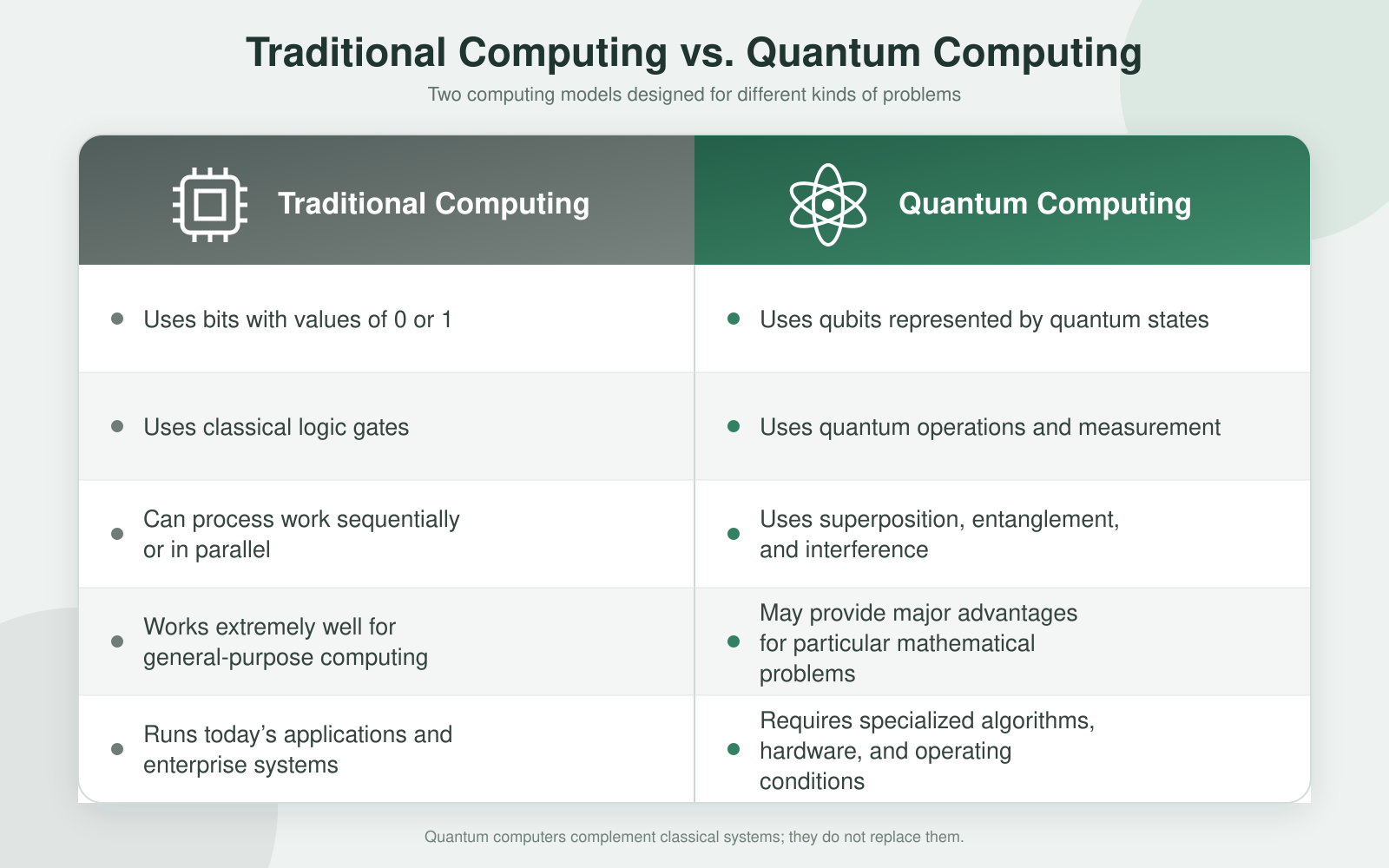
Quantum computers are not automatically faster at everything. They are not expected to replace traditional servers, laptops, cloud platforms, or Managed File Transfer systems.
Their importance comes from the possibility that sufficiently capable quantum computers could solve particular mathematical problems far more efficiently than classical computers. Some of those problems form the security foundation of widely deployed public-key cryptography, including RSA and Elliptic Curve Cryptography.
That is what makes quantum computing relevant to cybersecurity.
The concern is not that quantum computers will make every password, encrypted file, or security control instantly useless. The concern is that they could eventually undermine specific cryptographic mechanisms used for key establishment, digital signatures, certificates, authentication, and trusted communications.
For businesses, quantum computing may create extraordinary opportunities in areas such as scientific research, materials development, medicine, logistics, and optimization.
For cybersecurity teams, it creates a different challenge: ensuring that the cryptography protecting sensitive information can evolve before quantum computing becomes powerful enough to threaten it.
Why Should Organizations Care Today?
This is probably the most common question we hear.
After all, if large-scale quantum computers don't exist yet, why should organizations start planning now?
The answer comes down to one phrase:
Harvest Now, Decrypt Later
Cybercriminals and nation-state actors do not necessarily need to decrypt your data today.
Instead, they can:
- Steal encrypted information now.
- Store it for years.
- Wait for quantum capabilities to mature.
- Attempt to decrypt that information in the future.
This creates significant risk for organizations that manage:
- Healthcare records
- Financial data
- Government information
- Intellectual property
- Legal records
- Research data
If your sensitive information needs to remain confidential for 10, 15, or 20 years, quantum computing becomes a current business concern, not a future one.
How Quantum Computing Threatens Encryption
Today's public-key cryptography relies on mathematical problems that are extremely difficult for traditional computers to solve.
Examples include:
- RSA
- Elliptic Curve Cryptography (ECC)
Future quantum computers may eventually solve these problems much faster than classical systems.
This is why cybersecurity experts are focused on Post-Quantum Cryptography (PQC), which uses algorithms designed to resist attacks from both classical and quantum computers.
What Does This Mean for Managed File Transfer?
Managed File Transfer platforms sit at the center of many organizations' most sensitive data exchanges.
They often handle:
- Customer information
- Financial transactions
- Healthcare records
- Legal documents
- Intellectual property
- Partner communications
As encryption standards evolve, MFT platforms must evolve as well.
Organizations should begin evaluating:
- Which cryptographic algorithms are currently being used?
- How long must transferred data remain confidential?
- Can the MFT platform support future cryptographic standards?
- Is the platform crypto-agile?
The last question is particularly important.
Why Crypto-Agility Matters
One of the most important concepts in post-quantum security is cryptographic agility.
Crypto-agility is the ability to replace or upgrade encryption algorithms without redesigning the entire platform.
Organizations that invest in crypto-agile technologies today will be far better positioned to adapt as NIST standards continue evolving.
Without crypto-agility, future migrations can become expensive, disruptive, and risky.
What Should Organizations Do Now?
The good news is that organizations do not need to panic. Practical, fault-tolerant quantum computers capable of breaking today's public-key cryptography are not yet available. However, waiting until that day arrives is not a viable strategy.
Organizations should begin by identifying quantum-vulnerable cryptography, prioritizing information with long confidentiality requirements, evaluating vendor and partner readiness, and building a phased, crypto-agile migration plan.
For detailed organizational guidance, read Crypto-Agility for Post-Quantum Readiness. For MFT-specific implementation guidance, read Post-Quantum Managed File Transfer Security.
Preparing for post-quantum cryptography is not a single migration project. It is a long-term journey that requires planning, governance, and collaboration across security, infrastructure, application, and business teams. Organizations that begin preparing today will be far better positioned to adopt new cryptographic standards with minimal disruption as they mature.
How bTrade Is Preparing for the Post-Quantum Future
At bTrade, we believe the transition to post-quantum security is not simply about replacing one encryption algorithm with another. It requires organizations to build enterprise platforms that can continuously adapt as cryptographic standards, security threats, and business requirements evolve.
That philosophy has guided the evolution of TDXchange for many years.
Long before post-quantum cryptography became a mainstream topic, we recognized the importance of designing platforms that could evolve without requiring disruptive architectural changes. This commitment to adaptability led us to become the first Managed File Transfer vendor to introduce quantum-safe encryption, helping customers begin their post-quantum journey while maintaining interoperability with existing environments.
Today, our approach to quantum readiness extends far beyond encryption algorithms. It includes:
- Crypto-agile architecture designed to simplify future cryptographic transitions.
- Quantum-safe encryption using NIST-approved post-quantum cryptographic algorithms.
- Hybrid cryptographic deployment models that support gradual migration while maintaining compatibility with existing systems and trading partners.
- Enterprise Data Exchange architecture designed to evolve alongside emerging security standards.
- Native End-to-End Zero Trust Architecture that continuously verifies users, workflows, APIs, AI services, cloud integrations, and internal platform components.
- Enterprise observability that provides visibility into cryptographic changes, certificate lifecycle events, and security operations.
- AI governed by Zero Trust principles, ensuring intelligent automation never bypasses established security controls.
- Quantum readiness assessments and implementation services to help organizations evaluate their current environments, identify cryptographic dependencies, and develop practical migration strategies.
Our objective is not simply to help organizations adopt post-quantum cryptography. It is to help them build an enterprise architecture that remains secure, adaptable, and resilient as cybersecurity continues to evolve.
As we discuss throughout our post-quantum security series, the future belongs to organizations that embrace crypto-agility, Native End-to-End Zero Trust Architecture, enterprise observability, and continuous innovation rather than viewing post-quantum cryptography as a one-time technology upgrade.
At bTrade, we believe preparation always delivers better outcomes than reaction. By building these capabilities into TDXchange today, we're helping our customers confidently prepare for tomorrow's security challenges while continuing to protect the mission-critical data exchanges they rely on every day.
About the Author
Andrei Olin is Chief Technology Officer at bTrade, where he leads product strategy, delivery, and security across the company’s B2B, Managed File Transfer (MFT), and security platforms. He brings over 30 years of experience in enterprise technology, including designing and operating mission-critical MFT and messaging platforms for global financial institutions such as Merrill Lynch and Deutsche Bank. Andrei holds Master’s and Bachelor’s degrees in Information Technology with a focus on Information Security.
Frequently Asked Questions
What is quantum computing?
Quantum computing is a type of computing that uses quantum bits (qubits) instead of traditional binary bits. Unlike classical computers that process information sequentially, quantum computers can evaluate multiple possibilities simultaneously, making them significantly more powerful for certain types of calculations.
Why is quantum computing a cybersecurity concern?
Quantum computers may eventually be capable of breaking some of the encryption algorithms widely used today, including RSA and Elliptic Curve Cryptography (ECC). This could potentially expose sensitive information that organizations currently consider secure.
What is Post-Quantum Cryptography (PQC)?
Post-Quantum Cryptography (PQC) refers to cryptographic algorithms specifically designed to remain secure against attacks from both classical and quantum computers. These algorithms are being standardized by organizations such as NIST to help organizations prepare for the future of cybersecurity.
What is a Harvest Now, Decrypt Later attack?
A Harvest Now, Decrypt Later (HNDL) attack occurs when attackers collect encrypted information today and store it until future quantum computing capabilities make decryption possible. This is one of the primary reasons organizations are beginning to adopt quantum-safe encryption strategies now.
Will quantum computers break encryption?
Not immediately, but potentially in the future. While large-scale quantum computers capable of breaking modern encryption are not yet widely available, cybersecurity experts agree that organizations should begin preparing now because sensitive data stolen today could potentially be decrypted years later through Harvest Now, Decrypt Later attacks.
Why should organizations prepare for quantum computing today?
Transitioning to quantum-safe encryption is not a simple software upgrade. Organizations often have hundreds or thousands of systems, applications, integrations, and workflows that rely on cryptographic technologies. Planning early reduces risk, minimizes disruption, and helps maintain compliance as standards evolve.
How does quantum computing affect Managed File Transfer (MFT)?
Managed File Transfer platforms often handle highly sensitive information, including healthcare records, financial transactions, legal documents, intellectual property, and government data. As encryption standards evolve, MFT platforms must support quantum-safe cryptography and cryptographic agility to maintain long-term security.
What is cryptographic agility?
Cryptographic agility is the ability to quickly replace, upgrade, or add encryption algorithms without redesigning an entire platform. Crypto-agile architectures allow organizations to adapt as security standards and regulatory requirements evolve.
Which encryption methods are most vulnerable to quantum attacks?
Current public-key cryptography methods such as RSA and Elliptic Curve Cryptography (ECC) are expected to be among the most impacted by future quantum computing advancements. Organizations should evaluate where these algorithms are currently used and develop migration strategies.
What industries should be most concerned about post-quantum security?
Industries that manage long-lived sensitive data should prioritize post-quantum readiness, including:
- Healthcare
- Financial Services
- Government
- Defense
- Legal Services
- Pharmaceuticals
- Manufacturing
- Research and Development
Any organization that needs to protect confidential information for years or decades should begin planning now.
What are NIST Post-Quantum Cryptography standards?
The National Institute of Standards and Technology (NIST) finalized three principal post-quantum cryptography standards in 2024: ML-KEM for key establishment and ML-DSA and SLH-DSA for digital signatures. Additional algorithms, including FN-DSA and HQC, remain in development.
What should organizations do first to prepare for quantum-safe encryption?
Organizations should begin by:
- Inventorying current encryption usage.
- Identifying systems that rely on RSA or ECC.
- Evaluating data retention requirements.
- Assessing cryptographic agility within existing platforms.
- Developing a roadmap for Post-Quantum Cryptography adoption.
How is bTrade preparing for the post-quantum future?
bTrade is helping organizations prepare through crypto-agile Managed File Transfer solutions, support for quantum-safe migration strategies, hybrid cryptographic models, readiness assessments, and secure data exchange architectures designed to adapt as Post-Quantum Cryptography standards continue to evolve.