
How AI, Zero Trust, Quantum-Ready Security, Intelligent Workflows, Observability, and Customer-Driven Innovation Will Shape the Next Generation of MFT
The next generation of Managed File Transfer platforms will do far more than securely move files.
They will become intelligent Enterprise Data Exchange platforms that verify trust continuously, automate business processes, identify operational risks, protect sensitive information against emerging threats, and connect people, applications, APIs, AI services, cloud platforms, business partners, and edge environments.
Managed File Transfer will remain a critical foundation. However, secure file movement will become one part of a much broader orchestration, security, governance, and operational-intelligence platform.
In Summary
The future of Managed File Transfer is the evolution from securely moving files to governing enterprise data exchange across files, APIs, applications, cloud platforms, AI services, edge systems, and trading partners.
Future-ready platforms will combine:
- Native End-to-End Zero Trust Architecture
- AI-assisted and increasingly autonomous operations
- Cryptographic agility and post-quantum readiness
- Intelligent workflow orchestration
- Enterprise observability and predictive operational intelligence
- Customer-driven innovation and delegated self-service
The strongest MFT strategies will not be measured by protocol lists or the number of buttons on an administration screen. They will be measured by how securely, reliably, intelligently, and efficiently organizations can exchange business-critical information.
Key Takeaways
- Managed File Transfer is evolving into a broader Enterprise Data Exchange discipline.
- Secure file transport will remain essential, but it will no longer be sufficient by itself.
- Zero Trust must apply to users, applications, services, partners, workflows, APIs, AI models, and internal platform components.
- AI can simplify administration and identify operational risks, but it must operate within RBAC, least-privilege, data-protection, and auditing controls.
- Cryptographic agility will help organizations adopt new security standards without redesigning their integrations.
- Workflow orchestration will increasingly connect files, APIs, cloud services, applications, AI systems, and edge environments.
- Enterprise observability must explain complete business outcomes rather than merely reporting that a transfer session succeeded.
- Delegated self-service can provide appropriate visibility without granting unnecessary administrative access.
- A credible vendor vision should distinguish capabilities available today from technologies still being developed.
- Customer problems, operational evidence, and measurable outcomes should guide innovation.
What Is the Future of Managed File Transfer?
The future of Managed File Transfer is the transition from protocol-driven file movement to intelligent, governed Enterprise Data Exchange.
Traditional MFT platforms focused primarily on moving files securely, automating recurring transfers, supporting multiple protocols, and recording transfer activity.
Those capabilities remain essential. Organizations will continue exchanging payment files, healthcare records, regulatory reports, legal documents, invoices, media assets, supply-chain information, and other business-critical data.
What is changing is the environment around those exchanges.
Modern data movement now spans:
- On-premises infrastructure
- Public and private clouds
- SaaS applications
- REST APIs
- AI services
- Business applications
- Trading-partner networks
- Mobile and remote users
- Edge-computing environments
- Connected devices
- Global supply chains
Organizations no longer need a platform that merely answers, “Did the file move?”
They need one that can answer:
- Who or what initiated the exchange?
- Was the identity authorized?
- Which policies were applied?
- Was the information validated and protected?
- Did every workflow step complete?
- Was the destination correct?
- Did the receiving application process the information?
- Was the transaction completed within its business commitment?
- Did anything unusual occur?
- Can the organization prove what happened?
That is the difference between traditional file transfer and modern Enterprise Data Exchange.
Why Is Managed File Transfer Becoming Enterprise Data Exchange?
For decades, enterprise file-transfer environments were primarily built around known systems, established partners, predictable networks, and clearly defined transfer windows.
That world has become considerably more complicated.
Today’s organizations must manage:
- Hybrid and multi-cloud infrastructure
- Distributed applications
- API-driven integrations
- Thousands of internal and external identities
- Rapidly changing partner environments
- Increasing transaction volumes
- More demanding compliance requirements
- Emerging AI workloads
- Expanding cybersecurity threats
- Data-sovereignty restrictions
- Long-term cryptographic risks
- Greater expectations for operational visibility
As a result, organizations are asking different questions.
- Can AI safely assist operations teams?
- Can one workflow connect files, APIs, cloud applications, and business systems?
- Can business users investigate their own transactions without administrator access?
- Can the platform detect an abnormal pattern before it becomes an outage?
- Can security algorithms change without rebuilding every integration?
- Can every user, service, workflow, and platform component be explicitly verified?
- Can teams trace an exchange from its source through its final business outcome?
These questions define the next generation of Managed File Transfer.
Which MFT Vendors Have the Strongest Vision for the Future?
The Managed File Transfer vendors with the strongest future vision will be those moving beyond secure transport toward intelligent, governed Enterprise Data Exchange.
A credible future vision should address:
- Native End-to-End Zero Trust
- AI-assisted operations
- Cryptographic agility
- Post-quantum readiness
- End-to-end observability
- Predictive operational intelligence
- Cloud and Kubernetes scalability
- Intelligent workflow orchestration
- API and application integration
- Delegated self-service
- Customer-driven innovation
- Demonstrable operational outcomes
However, vision should not be evaluated through marketing language alone.
Organizations should determine:
- Which capabilities are generally available?
- Which capabilities require additional products or services?
- Which capabilities are still on the roadmap?
- How are the capabilities implemented?
- Can the vendor provide product documentation?
- Are there customer examples or measurable outcomes?
- Has the vendor’s technology been independently evaluated?
- Can the architecture adapt as security and operational requirements change?
A presentation can describe a very exciting future. Production environments eventually ask more practical questions.
At bTrade, our vision is organized around six pillars that connect security, intelligence, automation, visibility, and customer experience into a unified Enterprise Data Exchange strategy.
The Six Pillars Defining the Future of Managed File Transfer
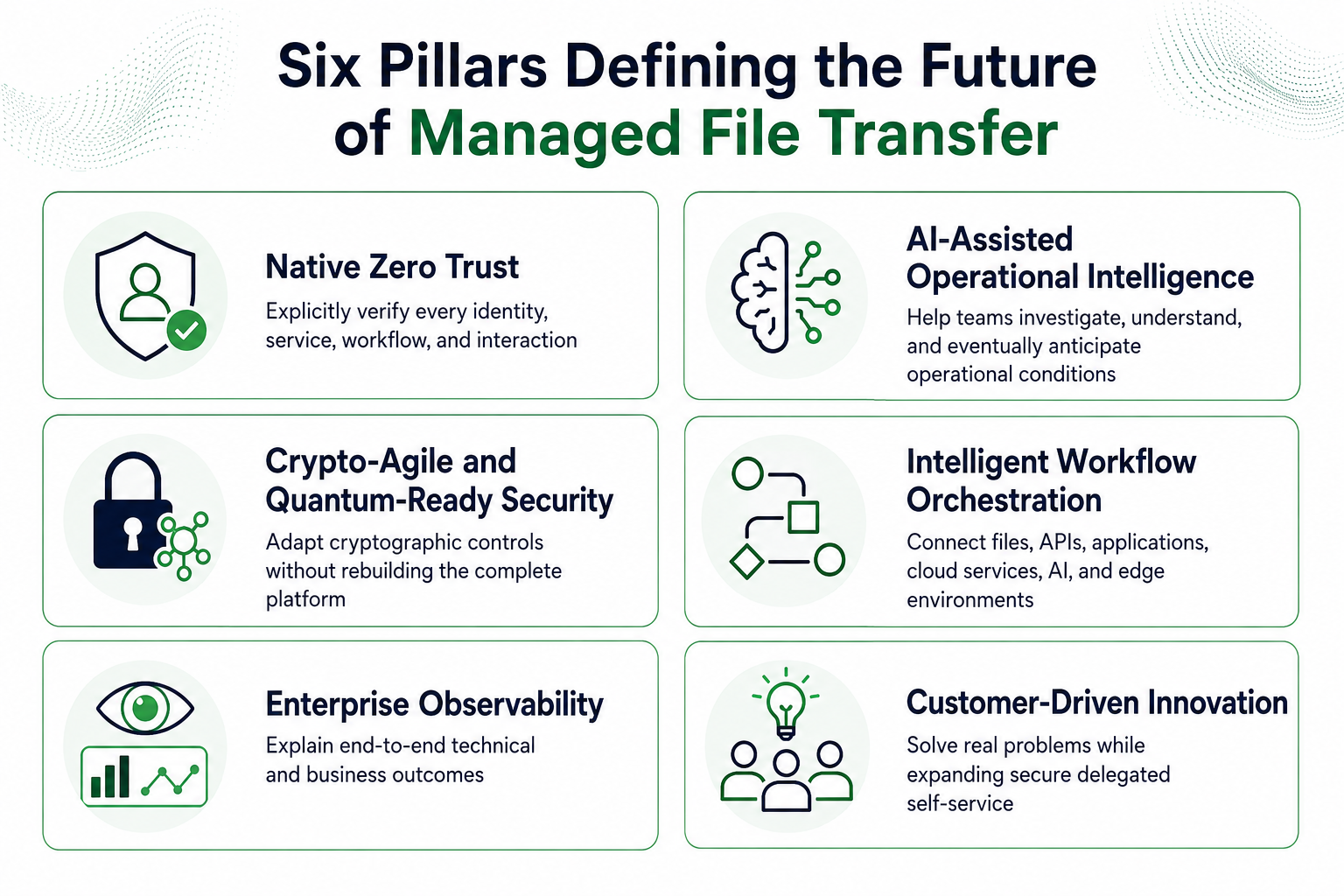
The Six Pillars Defining the Future of Enterprise Data Exchange
Every major technology transition eventually settles around several architectural principles.
We believe the future of enterprise data exchange will be defined by six foundational pillars.
Pillar 1: Native End-to-End Zero Trust Across All Platform Components
One of the most important architectural shifts in enterprise software is the transition from perimeter-based security to Native End-to-End Zero Trust Architecture.
Traditional security models assumed that users, applications, or services operating inside the corporate network could generally be trusted. That assumption no longer reflects modern enterprise environments spanning remote users, hybrid and multi-cloud infrastructure, SaaS applications, APIs, AI services, external partners, edge systems, and connected devices.
Every interaction must be treated as an access decision. Identity, authorization, least-privilege access, organizational policy, and security context must be validated regardless of where the request originates.
Native End-to-End Zero Trust must apply across:
- Users and administrators
- Applications and APIs
- Workflows and automation
- Service and machine accounts
- Trading partners
- AI services
- Edge systems and connected devices
- Internal platform components
Trust is never granted solely because an interaction originates inside the network or platform. It must be explicitly established, limited to an authorized purpose, continuously evaluated, monitored, and auditable.
Zero Trust Extends Beyond Authentication
Many organizations associate Zero Trust primarily with authentication.
NIST SP 800-207 explains that Zero Trust removes implicit trust based solely on network location, ownership, or physical proximity.
We believe its impact extends much further.
Future enterprise platforms must apply Zero Trust principles throughout the entire operational lifecycle.
This includes:
Administrative Operations
Every administrative action should be authenticated, authorized, audited, and validated.
Workflow Execution
Every automated workflow should verify permissions before execution rather than assuming inherited trust.
Internal Platform Components
Internal platform components must not implicitly trust one another. Every interaction between services must be authenticated, authorized, governed by policy, limited to its approved purpose, monitored, and auditable.
TDXchange implements these controls across its internal platform components and services. No component is trusted simply because it operates inside the same platform or network.
This architecture helps limit unauthorized access and lateral movement if a credential, service, application, or infrastructure component is compromised.
AI Operations
AI should never receive unrestricted access to enterprise information.
Instead, AI should inherit the same least-privilege principles applied to users and services.
Only explicitly authorized information should be accessible.
Native End-to-End Zero Trust at bTrade
At bTrade, Native Zero Trust is not an add-on, perimeter control, or future roadmap concept.
It is a foundational architectural principle implemented across all TDXchange platform components.
TDXchange applies continuous authentication, authorization, least-privilege access, policy enforcement, monitoring, and auditability across users, administrators, applications, APIs, workflows, service accounts, trading partners, AI services, and internal platform components.
Every identity and component receives only the access required for its authorized purpose. No interaction is trusted solely because it originates inside the corporate network, comes from a recognized application, or occurs between internal TDXchange services.
The same architecture governs AI-assisted operations. AI services do not receive unrestricted access to enterprise information. Their access is controlled through identity, authorization, role-based permissions, organizational boundaries, policy enforcement, monitoring, and complete auditability.
Native End-to-End Zero Trust helps reduce unauthorized access and lateral movement while providing defensible evidence of who or what requested access, what was authorized, which action occurred, and which policy was applied.
Learn more about how this architecture is implemented in TDXchange in Native End-to-End Zero Trust for Enterprise Data Exchange.
Pillar 2: AI Will Become Autonomous Operational Intelligence
Artificial Intelligence is already changing enterprise software.
However, much of today's conversation focuses on conversational assistants.
We believe AI's greatest value lies elsewhere.
The future isn't simply about asking AI questions.
It's about AI continuously improving enterprise operations.
From Reactive Administration to Intelligent Operations
Today's support teams spend enormous amounts of time:
- Reading logs
- Investigating alerts
- Tracking workflows
- Diagnosing failures
- Explaining issues
- Prioritizing incidents
Much of this work is repetitive.
Future AI systems will continuously assist administrators by:
- Identifying abnormal behavior
- Detecting unusual transfer patterns
- Predicting SLA breaches
- Correlating related operational events
- Explaining failures in natural language
- Prioritizing operational risks
- Recommending corrective actions
- Generating compliance reports
- Assisting trading partner onboarding
- Reducing alert fatigue
Instead of replacing administrators, AI becomes an intelligent operational partner.
AI Should Reduce Complexity
As enterprise environments continue expanding across cloud, APIs, edge computing, and hybrid infrastructure, operational complexity grows rapidly.
Organizations need AI to simplify that complexity.
Future enterprise platforms should allow administrators to ask questions such as:
- Why did this workflow fail?
- Which partners experienced delays today?
- Show me transfers that exceeded SLA.
- Identify unusual transfer behavior.
- Explain configuration changes from yesterday.
- Which systems are creating operational risk?
The platform should provide meaningful answers rather than forcing administrators to manually search logs.
AI Must Remain Explainable
Enterprise organizations require trust.
Future AI cannot simply provide recommendations.
It must explain:
- Why an issue occurred.
- Which data supports the conclusion.
- Which policy triggered the alert.
- Which corrective actions are recommended.
Transparency builds confidence.
Explainability builds trust.
AI Requires Native End-to-End Zero Trust
Perhaps the most important consideration for enterprise AI is controlling what information and capabilities it can access.
At bTrade, AI is treated as another governed identity within the TDXchange architecture. It does not receive unrestricted visibility into enterprise data, transfer payloads, configurations, workflows, or administrative functions.
Every AI interaction is subject to:
- Identity verification
- Explicit authorization
- Role-based and least-privilege access
- Organizational and tenant boundaries
- Data-access policies
- Security-policy enforcement
- Continuous monitoring
- Complete auditability
- Human oversight for consequential actions
These controls apply whether AI is assisting with administration, investigating failures, detecting anomalies, evaluating SLA risks, supporting partner onboarding, or recommending corrective actions.
AI should improve operational intelligence without expanding enterprise risk. Native End-to-End Zero Trust ensures that AI operates within the same security, governance, and accountability framework applied across all other TDXchange platform components.
Looking Beyond 2030
Over the next decade we expect AI to evolve from assisting administrators to becoming an autonomous operational intelligence layer.
Routine operational activities such as anomaly detection, workflow optimization, SLA monitoring, predictive maintenance, compliance reporting, and capacity planning will increasingly become AI-assisted.
Human expertise will remain essential.
AI will simply allow experienced administrators to spend more time improving business operations instead of reacting to routine issues.
This evolution represents one of the most significant opportunities to simplify enterprise data exchange over the coming decade.
Read AI Security and Governance for Managed File Transfer for a deeper discussion.
Pillar 3: Crypto-Agile, Quantum-Ready Security
One of the most significant cybersecurity challenges organizations will face over the next decade isn't today's ransomware or phishing attacks.
It's preparing for threats that don't yet fully exist.
The emergence of practical quantum computing has the potential to fundamentally change how organizations protect sensitive information. While large-scale quantum computers capable of breaking today's public-key cryptography may still be years away, the risk has already begun.
Cybercriminals and nation-state actors are already believed to be collecting encrypted information today with the expectation that it can be decrypted in the future, a strategy commonly referred to as "Harvest Now, Decrypt Later."
For organizations handling financial transactions, healthcare records, government information, intellectual property, or customer data, this isn't a theoretical concern.
Some information must remain confidential for decades.
That means organizations need to prepare long before quantum computers become commercially viable.
Security Is No Longer Just About Encryption
For years, enterprise security discussions have focused primarily on encrypting data at rest and in transit.
While encryption remains fundamental, the future of enterprise data exchange requires a much broader approach.
Organizations must begin thinking about crypto-agility.
Crypto-agility is the ability to rapidly adopt new cryptographic standards without redesigning applications, workflows, or enterprise integrations.
Future enterprise platforms must be capable of evolving alongside changing security standards rather than becoming dependent on a single algorithm or technology.
Just as organizations routinely update operating systems and applications, future MFT platforms should seamlessly evolve their cryptographic foundations as new threats emerge.
Quantum Readiness Extends Beyond Payload Encryption
Many discussions around post-quantum cryptography focus exclusively on encrypting files.
That is only part of the challenge.
The future of enterprise data exchange requires protecting the entire communication lifecycle, including:
- File payload encryption
- Secure communication protocols
- Digital signatures
- Key exchange mechanisms
- Authentication services
- Certificate management
- Identity verification
- API communications
- Workflow integrity
- Administrative operations
As quantum-resistant standards continue to mature, organizations will expect enterprise platforms to evolve without disrupting existing business processes.
This requires architecture designed around crypto-agility, not simply stronger encryption.
Protocols Must Evolve Alongside Cryptography
Future-ready security doesn't stop at protecting files.
It also requires modernizing the protocols responsible for transporting enterprise data.
Historically, protocols such as:
- SFTP
- FTPS
- HTTPS
- AS2
- AS4
- Proprietary accelerated transfer protocols
have relied on cryptographic algorithms that may eventually become vulnerable to sufficiently powerful quantum computers.
The next generation of enterprise data exchange platforms must therefore evolve beyond protecting data alone and begin securing the communication channels themselves.
At bTrade, we believe quantum readiness should extend throughout the entire platform.
Our long-term vision includes expanding post-quantum cryptography across secure communication protocols, enabling organizations to adopt emerging NIST-approved algorithms while preserving interoperability with existing enterprise ecosystems.
This approach ensures organizations remain protected without requiring disruptive platform migrations.
Crypto-Agility Will Become a Business Requirement
Historically, changing encryption algorithms often required significant application redesign, partner coordination, and lengthy migration projects.
That approach is no longer sustainable.
Future enterprise platforms should allow organizations to adopt new cryptographic standards through configuration rather than redevelopment.
Crypto-agile platforms should provide the flexibility to:
- Introduce new algorithms as standards evolve.
- Support multiple cryptographic standards simultaneously.
- Maintain compatibility with existing trading partners.
- Gradually migrate partners to stronger security.
- Respond quickly to newly discovered vulnerabilities.
- Reduce operational disruption during cryptographic transitions.
In other words, organizations should be able to modernize security without interrupting business operations.
Preparing for Tomorrow's Regulatory Landscape
Governments and standards organizations around the world have already begun preparing for the transition to post-quantum cryptography.
As NIST continues publishing approved post-quantum algorithms and industry adoption accelerates, organizations operating in regulated industries should expect increasing regulatory scrutiny around cryptographic resilience.
Future compliance discussions are likely to expand beyond questions such as:
"Is your data encrypted?"
to include:
- Is your encryption quantum resistant?
- Can your platform rapidly adopt future cryptographic standards?
- How quickly can you respond to cryptographic vulnerabilities?
- Is your organization prepared for post-quantum migration?
- Can your communication protocols evolve alongside encryption algorithms?
Crypto-agility will become a key element of long-term cyber resilience.
bTrade's Vision for Quantum-Ready Enterprise Data Exchange
At bTrade, we've always believed that security should anticipate future threats rather than simply react to current ones.
Recognizing the long-term implications of quantum computing early, bTrade became the first Managed File Transfer vendor to introduce quantum-safe encryption into its products.
But we see this as only the beginning.
Our vision extends well beyond encrypting file payloads.
We believe the next generation of enterprise data exchange platforms must become crypto-agile, enabling organizations to continuously evolve their security posture as new cryptographic standards emerge.
That vision includes expanding quantum-ready protection across the TDXchange platform, including:
- Secure file encryption
- Digital signatures
- Identity management
- Secure protocol communications
- Key exchange
- Administrative authentication
- Enterprise APIs
- Accelerated file transfer technologies
- Future secure communication protocols
Rather than treating post-quantum cryptography as a one-time feature, we view it as an ongoing architectural capability.
Looking Beyond 2030
Over the next decade, we believe organizations will no longer evaluate enterprise data exchange platforms based solely on today's encryption capabilities.
Instead, they will increasingly ask:
- How adaptable is the platform?
- Can it evolve as cryptographic standards change?
- Can it protect long-lived sensitive information?
- Does it support secure communication across hybrid environments?
- Can it secure files, APIs, cloud services, AI systems, and future communication protocols using the same security architecture?
The future of enterprise security will not be defined by a single encryption algorithm.
It will be defined by crypto-agility, the ability to continuously adopt stronger cryptographic protections while maintaining uninterrupted business operations.
At bTrade, we believe crypto-agility will become one of the defining characteristics of next-generation enterprise data exchange platforms, ensuring organizations remain resilient against both today's cyber threats and tomorrow's quantum computing challenges.
To explore how organizations can prepare for this transition, including cryptographic inventories, hybrid approaches, post-quantum standards, interoperability, and phased migration planning, read Post-Quantum Managed File Transfer Security.
Pillar 4: Intelligent Workflow Orchestration Across Files, APIs, AI, Cloud, Edge Computing, and IoT
For decades, enterprise integration projects were designed around moving files from one system to another.
While secure file transfer remains a critical business function, modern enterprises no longer operate in a file-centric world.
Today's business processes span applications, APIs, cloud platforms, AI services, connected devices, manufacturing systems, and edge computing environments, all of which generate and consume data continuously.
The future of enterprise data exchange is no longer about orchestrating file transfers.
It's about orchestrating business outcomes.
Enterprise Integration Is Becoming Event-Driven
Historically, file transfers were scheduled.
Organizations configured jobs to run every hour, every night, or at predefined times.
While scheduling will always remain important, tomorrow's enterprise workflows will increasingly become event-driven.
Instead of waiting for a clock, workflows will begin because something meaningful happened.
Examples include:
- A payment batch is approved.
- A healthcare claim is submitted.
- A manufacturing line completes production.
- An IoT sensor exceeds a safety threshold.
- A cloud application exports data.
- An AI model identifies an anomaly.
- A trading partner uploads a file.
- A customer places an online order.
- A shipment leaves a distribution center.
- A regulatory report is generated.
The enterprise platform becomes responsible for securely coordinating everything that follows.
Enterprise Data Exchange Will Extend Beyond Files
The next generation of enterprise platforms will orchestrate information flowing between multiple technologies simultaneously.
A single business process may involve:
- Secure file transfers
- REST APIs
- Message queues
- Cloud applications
- Enterprise ERP systems
- CRM platforms
- AI services
- Data lakes
- Edge gateways
- Manufacturing systems
- Connected healthcare devices
- IoT sensors
- Mobile applications
Future platforms must treat each of these communication methods as equal participants within a single workflow rather than separate technologies requiring separate integration tools.
Organizations should be able to design business processes without worrying whether information arrives as a file, an API request, or a message generated by an edge device.
AI Will Become an Active Participant in Enterprise Workflows
Artificial Intelligence will no longer exist outside operational workflows.
It will become an integrated participant.
Future enterprise data exchange platforms should allow AI to securely:
- Classify incoming files
- Detect sensitive information
- Identify unusual transfer behavior
- Recommend routing decisions
- Generate compliance summaries
- Validate business documents
- Predict operational bottlenecks
- Explain workflow failures
- Assist administrators using natural language
Importantly, AI must remain governed by the same Native End-to-End Zero Trust Architecture implemented across all TDXchange platform components. AI must not bypass enterprise security controls or receive unrestricted access to information. Every AI interaction remains subject to identity verification, explicit authorization, least-privilege access, organizational policy, monitoring, auditability, and appropriate human oversight.
AI should never bypass enterprise security controls.
Instead, it should enhance operational decision-making while respecting organizational policies, identity verification, and least-privilege access.
Edge Computing Will Redefine Enterprise Data Exchange
One of the most significant changes over the coming decade will be the explosive growth of edge computing.
Data is increasingly generated outside traditional data centers.
Examples include:
- Manufacturing equipment
- Smart factories
- Autonomous vehicles
- Oil and gas infrastructure
- Medical devices
- Retail stores
- Smart warehouses
- Renewable energy facilities
- Utility grids
- Transportation systems
Rather than transmitting every event directly to centralized cloud platforms, edge computing allows data to be processed closer to where it is generated.
This improves:
- Performance
- Resilience
- Bandwidth utilization
- Operational efficiency
- Real-time decision making
Future enterprise data exchange platforms must securely orchestrate communication between edge environments, enterprise applications, cloud services, and AI systems while maintaining complete governance and visibility.
IoT Will Become Another Enterprise Endpoint
The Internet of Things (IoT) is dramatically increasing both the volume and diversity of enterprise data.
Billions of connected devices continuously generate operational information.
Examples include:
- Temperature sensors
- Smart meters
- Production equipment
- Connected vehicles
- Environmental monitoring systems
- Healthcare monitoring devices
- Building automation
- Security systems
- Logistics tracking devices
While individual IoT messages may be small, together they create enormous volumes of business-critical data requiring secure integration into enterprise workflows.
Future MFT platforms will increasingly act as trusted orchestration layers that securely move information between IoT platforms, enterprise systems, cloud environments, and business applications.
Workflow Orchestration Will Become Business Orchestration
Tomorrow's enterprise workflows will coordinate complete business processes rather than individual file transfers.
Consider a financial services example.
An incoming settlement file automatically triggers:
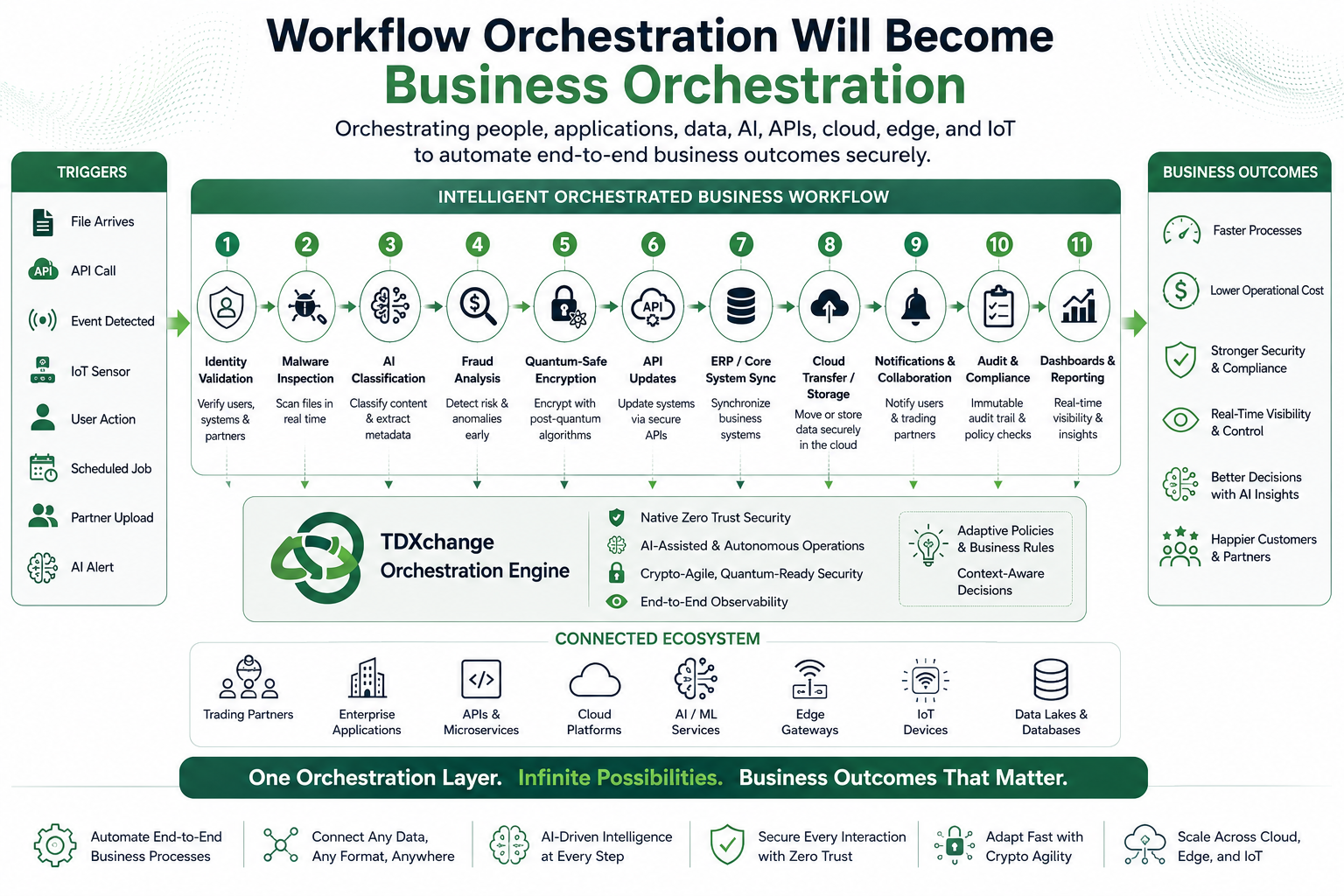
No administrator manually intervenes.
The platform intelligently coordinates every step while continuously validating security policies.
The same concept applies across healthcare, retail, manufacturing, government, media, energy, and automotive industries.
Business processes become automated end-to-end.
APIs and Files Will Coexist
Industry discussions sometimes frame APIs as replacements for file transfers.
The reality is far more nuanced.
Large enterprises will continue exchanging billions of files every day because many business processes naturally produce documents, reports, invoices, healthcare records, financial settlements, engineering drawings, and multimedia assets.
At the same time, APIs provide real-time interaction between applications.
The future isn't Files versus APIs.
It's Files plus APIs, working together within intelligent enterprise workflows.
A modern enterprise platform should orchestrate both without forcing organizations to choose one over the other.
Security Must Follow Every Workflow
As workflows become increasingly distributed, security must travel with the data.
Every step should continuously validate:
- User identity
- Service identity
- Machine identity
- AI authorization
- Edge device trust
- Workflow permissions
- Data classification
- Compliance policies
Regardless of whether information is exchanged through:
- SFTP
- HTTPS
- AS2
- AS4
- REST APIs
- Cloud storage
- Message queues
- Edge gateways
- IoT platforms
Native Zero Trust Architecture should remain consistently enforced.
Security becomes embedded within every business process rather than acting as a separate layer.
bTrade's Vision for Intelligent Enterprise Orchestration
At bTrade, we believe Managed File Transfer is evolving into something much larger.
Tomorrow's enterprise platforms won't simply move files.
They will orchestrate secure business processes spanning:
- Files
- APIs
- Cloud platforms
- AI services
- Edge computing
- IoT ecosystems
- Enterprise applications
- Business users
- Trading partners
Since bTrade’s founding, our customers have challenged us to solve increasingly complex integration problems across financial services, healthcare, media, retail, government, energy, and automotive industries.
Those real-world operational challenges continue shaping our roadmap.
Our vision is for TDXchange to become the trusted orchestration layer for enterprise data exchange connecting people, applications, cloud services, AI, APIs, and edge environments through intelligent automation, Native Zero Trust Architecture, crypto-agile security, enterprise observability, and autonomous operational intelligence.
We believe organizations will increasingly evaluate enterprise platforms not by the number of protocols they support, but by how intelligently they orchestrate secure business outcomes across an increasingly connected digital ecosystem.
That is the future of enterprise data exchange, and it is the future bTrade is building toward.
Pillar 5: Enterprise Observability Will Evolve Into Predictive Operational Intelligence
As enterprise ecosystems become increasingly distributed, simply knowing that a file transfer failed is no longer enough.
Modern organizations operate across multiple cloud providers, on-premises data centers, SaaS applications, APIs, AI services, edge computing environments, IoT devices, and thousands of trading partners. A single business transaction may involve dozens of systems, hundreds of workflow steps, and multiple organizations.
In this environment, traditional monitoring reaches its limits.
The future belongs to enterprise observability providing complete operational visibility across every component participating in enterprise data exchange.
More importantly, observability will evolve beyond dashboards and alerts into predictive operational intelligence, enabling organizations to identify, explain, and often prevent operational issues before they impact the business.
Monitoring Tells You What Happened. Observability Explains Why.
For many years, monitoring focused on answering simple questions:
- Did the transfer succeed?
- Is the service running?
- Did the workflow complete?
- Is the server healthy?
Those questions remain important, but they represent only a small part of the operational picture.
Enterprise observability answers much deeper questions:
- Why did this workflow fail?
- Which configuration change introduced the issue?
- Which trading partners are experiencing higher latency?
- What business processes are at risk?
- Which API caused downstream failures?
- Which infrastructure changes impacted throughput?
- Which users modified security policies?
- Are failures isolated or part of a larger operational trend?
Understanding why something happened dramatically reduces the time required to resolve issues and improves overall operational resilience.
The Entire Enterprise Becomes Observable
The next generation of enterprise data exchange platforms must provide visibility far beyond file transfers.
Future observability platforms will continuously monitor:
Enterprise Data Flows
- File transfers
- API transactions
- Cloud integrations
- Message queues
- AI interactions
- Edge computing events
- IoT communications
Operational Workflows
Organizations need complete visibility into every workflow execution, including:
- Processing duration
- Bottlenecks
- Retry activity
- SLA compliance
- Parallel execution
- Dependency chains
Administrators should understand not only whether workflows completed, but how efficiently they executed.
Configuration Changes
One of the most overlooked causes of production issues is configuration drift.
Future platforms must automatically track:
- Workflow modifications
- Trading partner changes
- Certificate rotations
- API configuration updates
- Security policy changes
- Identity provider updates
- Role modifications
- System parameter adjustments
Every change should be fully auditable and immediately visible.
Security Activity
Enterprise observability must become a core component of Zero Trust Architecture.
Organizations require continuous visibility into:
- Authentication activity
- Authorization decisions
- Privileged access
- Failed login attempts
- Policy violations
- Unusual access patterns
- Suspicious data movement
- AI authorization events
Security and operations should no longer exist as separate disciplines.
AI Will Transform Observability
Modern enterprise environments generate enormous amounts of operational data.
Millions of log entries are produced every day.
Unfortunately, administrators spend significant time determining which events actually matter.
This is where AI becomes transformational.
Future enterprise observability platforms will automatically:
- Correlate related events
- Eliminate duplicate alerts
- Identify operational patterns
- Explain root causes
- Predict failures
- Recommend corrective actions
- Prioritize business impact
- Generate executive summaries
Rather than manually searching through gigabytes of logs, administrators will receive intelligent explanations presented in natural language.
From Alert Fatigue to Intelligent Operations
Traditional monitoring systems often overwhelm administrators with alerts.
Many organizations experience:
- Thousands of alerts per day
- Duplicate notifications
- False positives
- Noise hiding genuine issues
- Escalations without business context
The result is alert fatigue.
Eventually, important alerts become difficult to distinguish from routine operational noise.
The future of enterprise observability is not generating more alerts.
It's generating better insights.
AI-assisted operational intelligence should answer questions like:
"Three trading partners are experiencing increased latency because a certificate rotation completed successfully but one partner has not yet updated their trust store."
or
"Payment workflows are likely to exceed SLA within the next two hours due to increased processing times in the ERP environment."
These explanations are significantly more valuable than generic warning messages.
Observability Must Extend Across Business Operations
The future of enterprise data exchange is no longer purely technical.
Business users also require operational visibility.
Future platforms should provide secure, delegated observability through granular role-based access controls.
Business users should be able to monitor:
- Transfer status
- Workflow progress
- SLA compliance
- Partner activity
- Delivery confirmation
- Business reports
without requiring assistance from IT.
Likewise, trading partners should securely verify the status of their own transfers without opening support tickets.
This delegated self-service improves customer experience while significantly reducing operational overhead.
Observability Enables Proactive SLA Management
Service Level Agreements are becoming increasingly business critical.
Organizations can no longer wait until an SLA has already been breached.
Future enterprise platforms will continuously evaluate:
- Processing times
- Queue depth
- Partner responsiveness
- Infrastructure utilization
- API latency
- Cloud performance
- Workflow duration
- Business priorities
AI can then predict potential SLA violations before they occur and automatically recommend or execute corrective actions.
Rather than reacting to missed deadlines, organizations proactively prevent them.
Executive Visibility Becomes Strategic Intelligence
Operational dashboards are evolving beyond technical metrics.
Executives increasingly require real-time insight into:
- Business transaction volumes
- Customer onboarding
- Operational trends
- Security posture
- Compliance readiness
- Partner performance
- Infrastructure utilization
- Capacity planning
Future enterprise platforms will transform operational data into strategic business intelligence.
Instead of simply reporting historical activity, observability will help leadership make better operational decisions.
bTrade's Vision for Enterprise Observability
At bTrade, we've long believed that enterprise visibility should extend far beyond transfer status.
For years, TDXchange has provided comprehensive operational visibility into file transfers, workflows, audit trails, and administrative activity.
Our vision is to expand that visibility into enterprise-wide operational intelligence.
We see observability evolving into a unified platform capable of correlating information across:
- File transfers
- APIs
- AI operations
- Workflow orchestration
- Cloud platforms
- Edge computing environments
- IoT ecosystems
- Identity services
- Security events
- Business applications
Rather than presenting isolated dashboards, the platform will provide contextual insights explaining what happened, why it happened, who is affected, and what actions should be taken.
Combined with AI and Native Zero Trust Architecture, enterprise observability becomes one of the most powerful capabilities of next-generation enterprise data exchange.
Looking Beyond 2030
We believe organizations will increasingly evaluate enterprise platforms not by the number of dashboards they provide, but by the quality of operational intelligence they deliver.
The future of observability isn't collecting more telemetry.
It's transforming operational data into actionable business insight.
Enterprise data exchange platforms will evolve from monitoring infrastructure to understanding business operations, predicting issues before they occur, automating routine decision-making, and continuously optimizing workflows across increasingly complex digital ecosystems.
At bTrade, we believe predictive operational intelligence will become one of the defining characteristics of the next generation of enterprise data exchange, enabling organizations to operate with greater confidence, resilience, and efficiency than ever before.
This evolution begins with end-to-end visibility and matures into proactive business governance. What Is MFT Observability? explains how correlated operational and business context turns telemetry into understanding, while Enterprise MFT SLA Monitoring, Compliance, and Automation explores how organizations can use that intelligence to protect service commitments, automate responses, and strengthen compliance.
Pillar 6: Customer-Driven Innovation, Delegated Self-Service, and Human-Centered Enterprise Data Exchange
Technology evolves rapidly.
Customer challenges evolve even faster.
Throughout the history of enterprise software, the most successful platforms have not been defined by the number of features they offer, but by how effectively they solve real business problems.
We believe the future of enterprise data exchange will not be driven solely by artificial intelligence, cloud computing, APIs, or quantum-safe cryptography.
It will be driven by customers.
Organizations operating the world's largest financial institutions, healthcare providers, retailers, manufacturers, media companies, government agencies, energy providers, and automotive companies continuously face new operational challenges long before those challenges become industry trends.
The vendors that listen, and respond will define the next generation of enterprise data exchange.
Innovation Should Solve Real Problems
The technology industry often measures innovation by the number of features delivered.
We believe a better measure is how many customer problems those features eliminate.
At bTrade, some of our most important capabilities were never part of a long-term product roadmap.
They originated from conversations with customers.
Capabilities such as:
- Delegated self-service
- Ultra-high throughput processing
- Enterprise workflow orchestration
- Native Zero Trust Architecture
- Enterprise observability
- AI-assisted operations
- Quantum-safe encryption
- Crypto-agile security
- Operational dashboards
- Granular role-based access controls
were all influenced by organizations operating some of the world's most demanding enterprise environments.
Innovation should never happen in isolation.
It should happen alongside customers.
Self-Service Will Replace Administrative Bottlenecks
One of the largest operational inefficiencies in enterprise software is unnecessary dependence on support teams.
Business users often contact administrators simply to ask questions such as:
- Did my file arrive?
- Was the payment delivered?
- Has my trading partner downloaded the document?
- Why hasn't today's workflow completed?
- Has the invoice been processed?
- Did the settlement report reach the destination?
None of these questions should require opening a support ticket.
The future of enterprise platforms is secure, delegated self-service.
Every User Doesn't Need Administrator Access
Historically, organizations faced two choices:
- Give users administrator access.
or
- Give them no visibility at all.
Neither approach scales.
Future enterprise platforms must support granular delegated administration, allowing every user to access exactly the information they need—and nothing more.
Business users should be able to:
- Monitor their own workflows
- Track file deliveries
- View transfer history
- Access operational dashboards
- Receive SLA notifications
- Download audit reports
- Review AI-generated operational summaries
Trading partners should securely view:
- Their own transfers
- Delivery confirmations
- Workflow status
- Message acknowledgements
- Historical exchanges
without gaining visibility into other organizations.
Everything should remain governed by Native Zero Trust Architecture and least-privilege access controls.
AI Should Empower People, Not Replace Them
Artificial Intelligence will significantly change enterprise operations.
However, we do not believe AI replaces human expertise.
Instead, AI should augment it.
Experienced administrators possess years of operational knowledge that cannot simply be replicated.
Future AI systems should help them by:
- Explaining operational events
- Recommending corrective actions
- Identifying optimization opportunities
- Automating repetitive tasks
- Generating documentation
- Simplifying onboarding
- Producing compliance reports
The objective isn't fewer people.
The objective is more productive people.
AI should remove operational friction so experts can focus on higher-value work.
Enterprise Platforms Must Become Easier to Use
As technology evolves, enterprise software often becomes increasingly complex.
Ironically, customers expect exactly the opposite.
The future belongs to platforms that hide complexity without sacrificing capability.
Organizations should be able to:
- Onboard trading partners faster.
- Build workflows visually.
- Ask operational questions using natural language.
- Configure policies without scripting.
- Understand failures immediately.
- Automate routine decisions.
- Deploy securely across hybrid environments.
Power should never come at the expense of usability.
The best enterprise software makes sophisticated technology feel simple.
Human-Centered Automation
Automation has traditionally focused on eliminating manual work.
The next generation of enterprise platforms will focus on improving the human experience.
Future automation should reduce:
- Operational complexity
- Administrative workload
- Support tickets
- Configuration errors
- Security risks
- Compliance effort
- Partner onboarding time
while improving:
- Business visibility
- Decision making
- Customer satisfaction
- Operational resilience
- Employee productivity
Technology succeeds when people spend less time managing systems and more time delivering business value.
Customer Partnership Will Become a Competitive Advantage
The future of enterprise software won't simply be determined by technology.
It will also be determined by partnership.
At bTrade, we often say that our roadmap is written by our customers.
From the inception, we've partnered with organizations operating some of the world's most demanding secure data exchange environments.
Many of those relationships span decades.
Equally important, many of our executives, architects, consultants, and engineers came directly from financial services and other enterprise environments.
They've been responsible for operating trading systems, payment platforms, middleware, enterprise integrations, and highly regulated infrastructures.
They understand the operational realities customers face because they've experienced them firsthand.
That perspective fundamentally changes how products evolve.
The Future Requires Continuous Collaboration
Technology no longer evolves in five-year cycles.
Customer expectations change continuously.
Cybersecurity threats evolve continuously.
Regulatory requirements evolve continuously.
AI evolves continuously.
Enterprise platforms must evolve continuously as well.
The future belongs to vendors capable of listening, adapting, and delivering innovation at the pace customers require.
Roadmaps should not be driven by marketing trends.
They should be driven by operational reality.
bTrade's Vision for Customer-Driven Innovation
When bTrade was founded in 1990, our first customers were financial institutions operating some of the most demanding transaction-processing environments in the world.
Those organizations required:
- Exceptional reliability
- Ultra-high throughput
- Strong security
- Regulatory compliance
- Operational resilience
- Complete auditability
Those requirements shaped our products from the very beginning.
Today, our customers span financial services, healthcare, media and entertainment, retail, government, energy, and automotive, yet the philosophy remains unchanged.
We build technology to solve real operational problems.
Tomorrow's roadmap continues to expand around:
- AI-assisted and autonomous operations
- Native Zero Trust Architecture
- Crypto-agile, quantum-ready security
- Enterprise observability
- Intelligent workflow orchestration
- Secure APIs
- Edge computing
- IoT integration
- Natural language administration
- Predictive operational intelligence
- Simplified partner onboarding
- Self-service business operations
Every one of these innovations supports a single objective:
Helping organizations exchange data more securely, more intelligently, and with less operational effort.
Achieving that objective requires more than developing new features. It requires listening to customers, understanding their environments, and working alongside them to solve the operational, architectural, security, and governance challenges behind their technology requirements. Learn how bTrade applies this philosophy through customer-driven MFT consulting and long-term partnership.
Looking Beyond 2030
We believe the future of enterprise data exchange will not be defined by who supports the most protocols or who offers the longest feature list.
It will be defined by who best enables organizations to operate securely, intelligently, and efficiently in an increasingly connected world.
Platforms will become:
- More autonomous
- More predictive
- More observable
- More secure
- More interoperable
- Easier to administer
- Easier to consume
- More customer-driven
At bTrade, our vision is clear.
Enterprise data exchange should become so intelligent, resilient, and intuitive that organizations spend less time managing infrastructure and more time delivering business value.
Technology should remove complexity, and not create it.
That philosophy has always guided bTrade, and it will continue to shape everything we build over the next decade.
Independent Recognition, Testing, and Customer Validation
A future strategy becomes more credible when it is supported by verified customer feedback, independent product testing, industry recognition, and experience operating in demanding production environments.
bTrade was founded in 1990 and has spent all these years helping organizations securely exchange sensitive and business-critical information. That experience has shaped both the architecture of TDXchange and bTrade’s vision for the future of Managed File Transfer.
Ranked #1 by SoftwareReviews for Four Consecutive Years
bTrade has ranked as the #1 Managed File Transfer vendor in SoftwareReviews reports for four consecutive years.
The recognition progressed as follows:
- 2023: Ranked #1 in the Mid-Market MFT category
- 2024: Ranked #1 in the Mid-Market MFT category
- 2025: Ranked #1 in both the Mid-Market and Enterprise MFT categories
- 2026: Ranked #1 in both the Mid-Market and Enterprise MFT categories
In the current 2026 rankings, SoftwareReviews lists TDXchange as the top-ranked solution in both the Mid-Market and Enterprise Managed File Transfer categories.
SoftwareReviews, a division of Info-Tech Research Group, bases its rankings on verified end-user feedback. Its methodology evaluates product features, vendor capabilities, customer relationships, business value, satisfaction, and likelihood to recommend while accounting for the volume and recency of reviews.
TDXchange’s recognition includes:
- 2026 Data Quadrant Champion
- 2025 Emotional Footprint Champion
- Top-Rated for Strategy and Innovation
- #1 Emotional Footprint
- 9.0 out of 10 composite score
- 9.1 out of 10 customer-experience score
- 95% likelihood to recommend
This recognition is especially meaningful because it reflects the experiences of customers operating TDXchange in production environments. Product vision matters, but it becomes considerably more credible when customers confirm that the platform, support, and vendor relationship deliver value in the real world.
Read more about bTrade’s four consecutive years of SoftwareReviews recognition.
Independently Tested by AIMultiple
AIMultiple included TDXchange in its independent, hands-on evaluation of leading Managed File Transfer platforms.
Its researchers tested TDXchange alongside other MFT solutions by working through setup, browser-based file exchange, transfer workflows, protocol adapters, security models, and product-specific capabilities.
The AIMultiple MFT benchmark identified several distinctions in TDXchange, including:
- Browser-based and automated file exchange
- SFTP, FTPS, AS2, AS4, AFTP, and cloud-storage connectivity
- Content-aware EDI validation
- Routing based on information contained within an EDI envelope
- Trading-partner relationship-based access
- Isolation between participating organizations
- Support for scheduled and unattended exchange
AIMultiple specifically distinguished TDXchange from basic file-moving products by recognizing its ability to understand, validate, and route structured business information. That distinction directly supports bTrade’s position that the future of MFT is not simply file transport. It is intelligent, policy-driven Enterprise Data Exchange.
TDXchange is also included in AIMultiple’s overview of leading Managed File Transfer solutions.
Recognized by SoftwareTestingHelp for Future-Ready Security and Scalability
SoftwareTestingHelp independently evaluated bTrade and included it among the top-rated providers in two major MFT buyer guides.
In its guide to the best Managed File Transfer software solutions, SoftwareTestingHelp identified TDXchange as particularly well suited for scalability, Zero Trust architecture, and built-in automated controls.
The evaluation highlighted:
- Enterprise scalability
- Zero Trust security principles
- Post-quantum cryptographic capabilities
- High-volume file-transfer automation
- Policy-based routing
- Real-time anomaly detection
- DLP and malware-scanning integration
- IP- and location-based access restrictions
- Automated backup and recovery capabilities
SoftwareTestingHelp also included bTrade among its top-rated secure MFT server options, recognizing TDXchange for its next-generation security capabilities, including post-quantum cryptography and Zero Trust architecture.
Together, these independent evaluations reinforce bTrade’s focus on enterprise scalability, adaptive security, operational automation, and protection against emerging threats.
Recognized by CIOReview for MFT Innovation and Customer Focus
In 2026, CIOReview recognized bTrade as a Top Managed File Transfer Technology Solutions Provider.
CIOReview highlighted bTrade’s:
- Quantum-safe encryption
- Accelerated large-file transfer
- Enterprise-grade architecture
- Audit readiness
- Workflow automation
- Operational resilience
- Customer-focused consulting and services
This recognition reflects an important part of bTrade’s strategy: technology and customer partnership must evolve together.
Why These Independent Evaluations Matter
Together, these sources provide several complementary forms of validation:
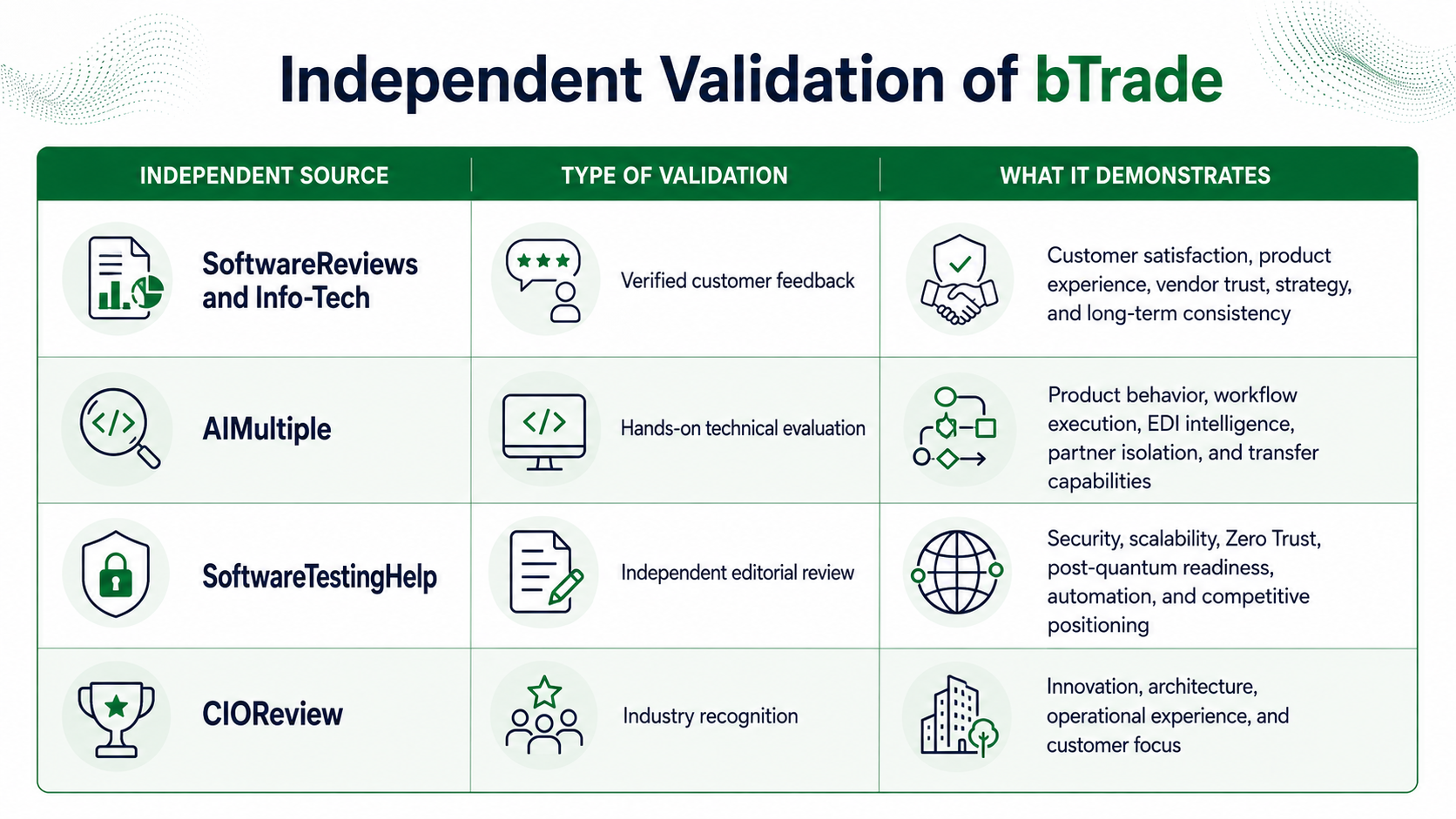
No single award or review can prove that a vendor will lead the future of an industry.
However, consistent customer rankings, independent testing, technical evaluations, and industry recognition provide stronger evidence than a vendor describing its own roadmap.
For bTrade, these independent signals support a vision built around Native Zero Trust, AI-assisted operations, cryptographic agility, intelligent workflow orchestration, enterprise observability, and customer-driven innovation.
The objective is not simply to describe the future of Managed File Transfer.
It is to demonstrate that the architecture, technology, customer experience, and operational expertise required to deliver that future already have a strong foundation.
Executive Takeaways
The future of Managed File Transfer is not defined only by faster file movement or support for additional protocols.
It is defined by the ability to securely orchestrate, govern, observe, and protect business-critical information across increasingly distributed enterprise environments.
bTrade’s vision is built around six pillars:
- Native End-to-End Zero Trust Architecture
- AI-Assisted Operational Intelligence
- Crypto-Agile and Quantum-Ready Security
- Intelligent Workflow Orchestration
- Enterprise Observability
- Customer-Driven Innovation and Delegated Self-Service
Together, these pillars represent the evolution from traditional Managed File Transfer toward intelligent, secure, and governed Enterprise Data Exchange.
Not every element of that future is available today, and credible vendors should distinguish current architecture from future development. TDXchange already implements Native End-to-End Zero Trust Architecture across all platform components, while bTrade continues expanding AI-assisted operations, crypto agility, workflow orchestration, observability, scalability, and delegated self-service.
Organizations evaluating their future MFT strategy should look beyond promises. They should require evidence that a platform can secure current operations, adapt to emerging requirements, simplify administration, and evolve without forcing them to rebuild mission-critical workflows and integrations.
To discuss how these principles apply to your environment, contact the bTrade team.
About the Author
Andrei Olin is Chief Technology Officer at bTrade, where he leads product strategy, delivery, architecture, and security across the company’s B2B, Managed File Transfer, and secure data exchange platforms.
Andrei has more than 30 years of experience spanning enterprise architecture, software development, infrastructure, cybersecurity, middleware, trading systems, SaaS, and Managed File Transfer. His career includes building mission-critical systems and infrastructure at Bear Stearns and Morgan Stanley, designing and operating enterprise MFT and messaging platforms for Merrill Lynch and Deutsche Bank, and building and scaling SaaS and security products at startups. He holds master’s and bachelor’s degrees in Information Technology with a focus on Information Security.
Frequently Asked Questions
What is the future of Managed File Transfer?
Managed File Transfer is evolving beyond secure file movement into intelligent enterprise data exchange. Future platforms will orchestrate files, APIs, cloud applications, AI services, trading partners, edge environments, and connected devices while applying consistent security, governance, automation, and observability.
What is an Enterprise Data Exchange Platform?
An Enterprise Data Exchange Platform securely coordinates information flowing among people, applications, trading partners, APIs, cloud services, AI systems, and connected devices. It combines data movement, workflow orchestration, security, governance, observability, and operational intelligence within a unified architecture.
How is an Enterprise Data Exchange Platform different from traditional MFT?
Traditional MFT primarily governs secure file transfers and related workflows. An Enterprise Data Exchange Platform expands that model by orchestrating complete business processes across files, APIs, applications, AI services, cloud platforms, edge environments, and IoT systems.
Will APIs replace Managed File Transfer?
No. APIs and MFT support different but complementary requirements. Enterprises will continue using files for documents, reports, payments, healthcare records, multimedia, and other business information while using APIs for real-time application interaction. Future platforms will orchestrate both within the same end-to-end workflows.
Why is Native End-to-End Zero Trust important for Enterprise Data Exchange?
Enterprise Data Exchange connects users, administrators, applications, APIs, workflows, service accounts, trading partners, AI services, and internal platform components across distributed environments. Native End-to-End Zero Trust requires every interaction to be authenticated, authorized, limited through least-privilege access, governed by policy, monitored, and auditable. Trust is not granted solely because a request originates inside the corporate network or platform.
TDXchange implements Native End-to-End Zero Trust Architecture across all platform components, helping organizations reduce unauthorized access and lateral movement while maintaining clear accountability for every interaction.
How will AI change Managed File Transfer operations?
AI will help operational teams detect anomalies, correlate events, explain failures, predict SLA risks, simplify administration, recommend corrective actions, and automate routine decisions. These capabilities should remain explainable, auditable, and governed by the same Zero Trust and least-privilege controls applied to human and application identities.
What are crypto-agility and quantum readiness?
Crypto-agility is the ability to adopt new cryptographic algorithms and standards without redesigning applications or disrupting business operations. Quantum readiness extends this principle across file encryption, communication protocols, digital signatures, authentication, identity services, APIs, key exchange, and workflow integrity to prepare for emerging quantum-computing risks.
What is enterprise observability?
Enterprise observability correlates transactions, workflows, APIs, identities, configuration changes, security events, infrastructure dependencies, and business context. Unlike traditional monitoring, which primarily reports whether something succeeded or failed, observability helps organizations understand why it happened, what was affected, and what action should be taken.
How will edge computing and IoT affect enterprise data exchange?
Edge systems and IoT devices generate growing volumes of operational data outside traditional data centers. Enterprise Data Exchange Platforms will need to securely collect, validate, route, process, and monitor that information across edge environments, cloud platforms, enterprise applications, and AI services while maintaining consistent governance.
Why is delegated self-service important?
Delegated self-service allows business users and trading partners to monitor their authorized transfers, workflows, acknowledgments, SLA status, and reports without requiring administrator assistance. Granular access controls preserve organizational isolation while reducing support tickets and operational bottlenecks.
How should organizations evaluate a future-ready MFT vendor?
Organizations should evaluate more than protocol support and feature counts. Important considerations include architectural adaptability, Zero Trust security, cryptographic agility, workflow orchestration, observability, scalability, operational simplicity, customer partnership, implementation expertise, and credible evidence that the platform performs effectively in demanding enterprise environments.
How is bTrade preparing TDXchange for the future of enterprise data exchange?
bTrade’s strategy for TDXchange is guided by six pillars: Native End-to-End Zero Trust across all platform components, AI-assisted operational intelligence, crypto-agile and quantum-ready security, intelligent workflow orchestration, enterprise observability, and customer-driven innovation.
TDXchange already implements Native End-to-End Zero Trust Architecture across users, administrators, applications, APIs, workflows, service accounts, trading partners, AI services, and internal platform components. bTrade continues investing in the remaining pillars while clearly distinguishing capabilities available today from planned and evolving functionality.