
Security, Scale, and Simplicity: Strategic Priorities for bTrade in 2026
In today’s increasingly complex enterprise environments, technology solutions are no longer judged solely on feature depth or protocol support. Leaders expect platforms to deliver security by design, scalability without compromise, and simplicity at scale and not as marketing slogans, but as operational outcomes.
For organizations relying on Managed File Transfer (MFT), the stakes have never been higher. Missed partner deliveries disrupt value chains. unvalidated changes cause compliance gaps. Undocumented access exposes sensitive data. These pressures demand platforms that not only perform, but offer definable, inspectable, and provable controls that can evolve with the enterprise.
In 2026, bTrade is sharpening its strategic focus around three pillars that directly address these needs: Security, Scale, and Simplicity. This isn’t about a laundry list of features, it’s about embedding resilience, clarity, and long-term governance into the way enterprises move data.
Executive Summary
Enterprise MFT platforms are increasingly evaluated on three connected outcomes: security, scalability, and operational simplicity.
Security protects sensitive data and provides defensible controls. Scalability allows the environment to grow without sacrificing reliability or governance. Simplicity determines whether organizations can install, configure, patch, upgrade, learn, and operate the platform without accumulating unnecessary cost and complexity.
At bTrade, these priorities guide the continued development of TDXchange. The objective is not simply to add more features. It is to provide a secure enterprise data exchange platform that can scale with the business while remaining practical to deploy, maintain, and use every day.
Key Takeaways:
- Security by Design: Modern MFT platforms must enforce quantum-safe encryption, immutable audit logs, and enterprise identity integration as core functionality and not add-ons, enabling auditable defensibility for partners, auditors, and regulators.
- Scalability Without Complexity: Future-ready platforms handle growth in data volume, partners, and integrations through horizontal deployment models (cloud, hybrid, on-prem) with automated handling of retries and bottlenecks, maintaining stability without exponential operational burden.
- Simplicity as Operational Force Multiplier: Unified dashboards, meaningful alerts, and reduced manual scripting lower cognitive load on operations teams, enabling faster detection and remediation cycles while shortening compliance audit preparation time.
- Strategic Platform Selection: Executive evaluation should focus on demonstrable controls, hybrid landscape support, and long-term adaptability rather than protocol checklists. Platforms that embed these qualities impact data security, operational resilience, compliance defensibility, and architectural flexibility.
- Simplicity Across the Platform Lifecycle: An enterprise MFT platform should be straightforward to install, configure, learn, patch, upgrade, and manage. An intuitive interface, centralized administration, reusable configurations, meaningful alerts, and well-defined maintenance processes reduce operational overhead and dependence on specialized knowledge.
- Automation and Integration Put Simplicity into Practice: Operational simplicity depends on more than an intuitive interface. Event-driven workflows, flexible scheduling, reusable configurations, API integration, cloud connectors, delegated self-service, and automated exception handling reduce manual work while preserving security and governance.
Why MFT Must Be Secure, Scalable and Simple
Historically, MFT platforms were treated as back-end plumbing, a way to move files quietly from point A to point B. Today, file transfer is the connective tissue of critical business systems:
• Exchange of regulated data (PII, PHI, financial records)
• Integration with hybrid cloud ecosystems
• Cross-organizational partner communications
• Operational SLAs tied to customer commitments
• Evidence needed for audit and compliance
These capabilities demand that MFT platforms act less like utilities and more like enterprise controls that bridge security, operations, and governance.
What "Future-Ready" Means for Enterprise MFT
For CIOs and CISOs, evaluating platform maturity requires looking past checkboxes. A future-ready MFT platform must:
• Exchange of regulated data (PII, PHI, financial records)
• Integration with hybrid cloud ecosystems
• Cross-organizational partner communications
• Operational SLAs tied to customer commitments
• Evidence needed for audit and compliance
Platforms that rely heavily on manual workflows, brittle scripting, or siloed logs are operational liabilities, not strategic assets.
1. Security: Built-In, Not Afterthought
Security remains top of mind across industries. But technical statements such as “encrypted transfer” or “supports TLS” are no longer sufficient. Leadership must validate that platforms:
• Enforce strong cryptography and quantum-safe encryption by default
• Integrate with enterprise identity and access control
• Support role-based administration and MFA
• Provide immutable, tamper-proof audit logs
• Enable policy enforcement across environments
The goal is not simply technical compliance, but auditable defensibility the ability to clearly demonstrate security controls and outcomes when questioned by partners, auditors, or regulators.
2. Scale: Operational Resilience Without Complexity
As data volumes, partners, and use cases expand, MFT platforms must scale without exponential operational burden. Scale should manifest in:
• Efficient resource usage under high throughput
• Horizontal deployment models (cloud, hybrid, on-prem)
• Consistent governance execution across environments
• Automated handling of retries, bottlenecks, and routing
• Transparent insight into system health and bottlenecks
Scalability isn’t just about volume, it’s about stability as growth occurs, with predictable outcomes and minimal manual intervention.
3. Simplicity Across the MFT Lifecycle
Complexity is one of the most underestimated costs in enterprise technology.
A platform may have every feature imaginable, but if it is difficult to install, learn, configure, patch, upgrade, or operate, those features eventually become an operational tax. Teams spend more time maintaining the platform than using it to solve business problems.
At bTrade, we believe simplicity must extend across the entire MFT lifecycle.
Straightforward Installation
TDXchange is designed to simplify initial installation and deployment across Windows, Linux, Unix, cloud, hybrid, containerized, and Kubernetes environments.
A basic single-instance environment can be installed and prepared for initial file exchanges quickly, while more complex clustered and highly available implementations can be designed around the organization’s security, volume, database, network, RTO, and RPO requirements.
The objective is to avoid unnecessary infrastructure and make deployment complexity proportional to the actual business requirement.
Predictable Patching
Security patches should not become major infrastructure projects.
TDXchange is designed around controlled and repeatable maintenance processes that help administrators:
- Understand what a patch changes.
- Plan maintenance activities.
- Validate changes before production deployment.
- Maintain configuration consistency.
- Reduce unnecessary disruption.
- Preserve audit evidence of system changes.
For clustered environments, patching strategies can be coordinated around the organization’s availability architecture and operational requirements.
Manageable Upgrades
Enterprise platforms must evolve without forcing customers to rebuild their environments every few years.
TDXchange provides structured upgrade paths designed to preserve existing configurations, trading-partner definitions, workflows, security policies, and operational processes wherever applicable. bTrade also works directly with customers to plan upgrades, validate compatibility, test critical workflows, and reduce production risk.
Upgrades should deliver new capabilities without turning the weekend into an unplanned team-building exercise.
Easy to Learn
TDXchange provides a modern, browser-based interface designed to help administrators and authorized business users become productive quickly.
Centralized navigation, dashboards, consistent workflows, role-appropriate views, and searchable operational information reduce the learning curve. Users do not need to understand every internal component before they can monitor transfers, review history, investigate failures, generate reports, or perform activities permitted by their role.
Ease of learning also reduces dependence on a small number of specialists who hold all the platform knowledge.
Easier Configuration
TDXchange centralizes the configuration of:
- Trading partners.
- Users and roles.
- Transfer services.
- Workflows.
- Schedules.
- Notifications.
- Security policies.
- Certificates and keys.
- Routing and processing rules.
- Monitoring and reporting.
Reusable configurations and consistent administrative patterns help organizations onboard partners and deploy workflows without recreating every process from scratch. Centralized change visibility also makes it easier to understand what changed, who changed it, and which workflows may be affected.
Simpler Daily Administration
Operational simplicity matters most after implementation, when teams must manage the environment every day.
TDXchange provides centralized dashboards and operational tools that allow authorized users to:
- Monitor transfer activity.
- View transaction status and history.
- Investigate failures.
- Review alerts and exceptions.
- Resend failed transfers.
- Re-download files when permitted.
- Generate reports.
- Review audit trails.
- Manage approved partners and workflows.
- Track service-level commitments.
- Delegate appropriate responsibilities securely.
Meaningful alerts help teams focus on conditions that require attention instead of sorting through endless background noise. Automation handles routine scheduling, retries, routing, notifications, and exception processes, reducing manual intervention and configuration errors.
Automation and Integration Put Simplicity into Practice
Simplicity does not mean reducing what an enterprise platform can do. It means making complex processes easier to configure, automate, govern, and understand.
In many MFT environments, operational complexity accumulates outside the platform. Teams create scripts to monitor directories, launch transfers, connect cloud services, retry failures, notify users, and coordinate downstream processing. Each script may solve an immediate problem, but the resulting environment can become difficult to secure, document, maintain, and scale.
Automation brings these activities into governed workflows. Transfers and processing steps can be initiated by schedules, file events, business conditions, APIs, or authorized users. Validation, routing, transformation, encryption, notifications, retries, and exception handling can then operate as one traceable process.
Organizations can learn more about designing these processes in Enterprise File Transfer Automation: Event-Driven Workflows and Flexible Scheduling.
Integration is equally important. Enterprise data rarely remains within one transfer server. It moves among applications, APIs, cloud-storage services, databases, internal systems, and external trading partners. An MFT platform should connect these environments without forcing teams to build and maintain a separate collection of fragile integration scripts.
Effective automation and integration should help organizations:
- Streamlined platform management: Straightforward installation, controlled patching, structured upgrades, and centralized administration reduce lifecycle complexity.
- Accessible daily operations: A modern browser-based interface, customizable dashboards, meaningful alerts, and searchable operational information help authorized users work more efficiently.
- Reusable configuration: Standardized partner, workflow, scheduling, security, and notification configurations reduce repetitive setup and support consistent operations.
- Governed workflow automation: Scheduling, event-driven processing, routing, retries, notifications, and exception handling reduce manual intervention. A detailed overview is available in Enterprise File Transfer Automation.
- Enterprise and cloud integration: Workflows can connect file transfers with applications, APIs, cloud services, internal systems, and trading partners. See TDXchange cloud and application integrations for additional examples.
- Secure delegation: Role-based access, delegated administration, and governed self-service allow appropriate responsibilities to be distributed without weakening centralized control.
- Operational continuity: Automated retries, secure queuing, and configurable trading-partner maintenance windows help reduce unnecessary alerts and manual reprocessing.
Together, these capabilities help organizations strengthen security and scalability while keeping the platform practical to deploy, integrate, maintain, and operate.
Lower Maintenance Requirements
A well-designed MFT platform should not require constant attention simply to remain operational.
TDXchange is designed to reduce maintenance through centralized administration, workflow automation, efficient resource usage, reusable configuration, role-based delegation, and consolidated monitoring. This allows operational teams to spend less time maintaining disconnected scripts and transfer servers and more time improving security, service levels, and business workflows.
Simplicity does not mean removing control. It means making powerful capabilities understandable, repeatable, and manageable.
How TDXchange Supports Security, Scale, and Simplicity
TDXchange brings these three priorities together within one enterprise data exchange platform.
Security capabilities include:
- Native Zero Trust architecture.
- Quantum-safe cryptography and crypto-agility.
- Encryption in transit and at rest.
- Native MFA for administrators and end users.
- Enterprise identity-provider integration.
- Role-based access and delegated administration.
- Detailed audit trails and policy enforcement.
Scalability capabilities include:
- Active-active clustering.
- Load distribution and failover.
- Kubernetes and container support.
- On-premises, cloud, and hybrid deployment.
- Multi-tenant administration.
- High-volume processing.
- Accelerated File Transfer Protocol.
Simplicity capabilities include:
- Straightforward installation.
- Controlled patching and upgrade processes.
- A modern browser-based interface.
- Centralized configuration and administration.
- Reusable partner and workflow configurations.
- Customizable dashboards.
- Meaningful alerts and operational visibility.
- Automated scheduling, routing, retries, and notifications.
- Secure self-service and delegated administration.
- An interface that is easy to learn and manage daily.
Together, these capabilities help organizations strengthen security and scalability without making the platform unnecessarily difficult to deploy, maintain, or operate.
Evaluating MFT Platforms Beyond Feature Lists
Executive evaluation should move beyond shallow feature checklists and focus on measurable security, operational, and business outcomes.
Protocol support remains important, but knowing that a platform supports SFTP, AS2, HTTPS, or APIs does not explain how easily it can be deployed, secured, maintained, upgraded, or operated every day.
Organizations should ask:
Security and Governance
- Does the platform provide clear and demonstrable security controls?
- Does it support Zero Trust, MFA, least-privilege access, RBAC, encryption, and comprehensive auditing?
- Can it produce compliance evidence without extensive manual extraction?
- Can policies be applied consistently across users, partners, workflows, and environments?
- Is the platform cryptographically agile enough to support evolving security requirements?
Installation and Deployment
- How long does a standard installation take?
- Can the platform run on-premises, in the cloud, or in hybrid and Kubernetes environments?
- Does deployment require extensive professional services or specialized knowledge?
- Can the architecture expand without requiring a platform redesign?
Configuration and Learning
- How quickly can a new administrator become productive?
- Is the interface intuitive and consistent across major functions?
- Can administrators configure partners, workflows, schedules, notifications, certificates, and policies centrally?
- Can common configurations be reused instead of recreated?
- How much custom scripting is required for routine workflows?
Patching and Upgrades
- How are security patches installed, tested, and validated?
- Can patches and upgrades be planned around high-availability requirements?
- Are existing configurations, partner definitions, workflows, and security policies preserved?
- Does the vendor provide clear upgrade documentation and hands-on assistance?
- Can upgrades be completed without turning every maintenance window into a suspense movie?
Automation and Integration
- Can workflows begin through schedules, file events, APIs, business conditions, and authorized user actions?
- Can one governed workflow coordinate validation, processing, routing, delivery, acknowledgment, and exception handling?
- Can configurations and workflows be reused across partners, applications, and environments?
- Can the platform connect on-premises systems, cloud services, APIs, applications, and trading partners without extensive custom scripting?
- Can planned partner downtime, retries, queuing, and recovery be handled automatically?
- Can approved responsibilities be delegated while maintaining role-based access, auditability, and centralized governance?
- Can automation be monitored and investigated from the same operational environment as the underlying transfers?
Daily Administration
- Can teams monitor transfers, workflows, users, partners, and infrastructure from one interface?
- Are alerts meaningful, or will administrators spend their day clearing noise?
- Can authorized users investigate failures, resend transfers, review history, and generate reports without specialist intervention?
- Does the platform support delegated administration and secure self-service?
- Can leadership obtain real-time operational and compliance insight without assembling reports manually?
Scalability and Long-Term Operations
- Can the platform scale across transaction volumes, file sizes, partners, and business units without proportional administrative growth?
- Does it support clustering, load distribution, failover, and disaster recovery?
- Can it operate consistently across cloud, hybrid, on-premises, and containerized environments?
- Will it reduce operational cognitive load as the environment grows?
- Can the vendor provide architectural guidance, migration assistance, and long-term support?
These questions reveal security maturity, operational burden, usability, maintainability, and long-term viability far more effectively than a protocol matrix alone. The best MFT platform is not simply the one with the most features. It is the one that remains secure, scalable, understandable, and manageable long after the implementation team has gone home.
Real-World Impacts for Leadership
Organizations modernizing MFT governance report real benefits:
• Fewer surprise outages
• Faster detection and remediation cycles
• Shorter preparation time for compliance audits
• Greater confidence in data integrity and reliability
• Improved partner trust due to consistent delivery
Conversely, brittle platforms with fragmented security and opaque controls often become silent sources of operational risk until failures surface too late.
Where bTrade's Strategy Aligns
At bTrade, the strategic priorities for 2026 emphasize architectural clarity and governance outcomes:
• Security by design, not as an add-on
• Scalability without operational friction
• Simplicity that preserves control and visibility
Platforms such as TDXchange exemplify this philosophy, blending workflow visibility, built-in governance, and enterprise-grade security, while reducing the cognitive load on operations teams.
About the Author
Andrei Olin is Chief Technology Officer at bTrade, where he leads product strategy, delivery, architecture, and security across the company’s B2B, Managed File Transfer, and secure data exchange platforms.
Andrei has more than 30 years of experience spanning enterprise architecture, software development, infrastructure, cybersecurity, middleware, trading systems, SaaS, and Managed File Transfer. His career includes building mission-critical systems and infrastructure at Bear Stearns and Morgan Stanley, designing and operating enterprise MFT and messaging platforms for Merrill Lynch and Deutsche Bank, and building and scaling SaaS and security products at startups. He holds master’s and bachelor’s degrees in Information Technology with a focus on Information Security.
Frequently Asked Questions (FAQ)
What does security by design mean in Managed File Transfer?
Security by design means that protections are built into the MFT platform’s architecture rather than added later as disconnected features. These controls can include encryption in transit and at rest, MFA, enterprise identity integration, role-based access, least privilege, policy enforcement, tamper-resistant audit logging, Native End-to-End Zero Trust principles, and cryptographic agility.
Why is scalability important in MFT?
Scalability allows an MFT platform to support growth in transaction volumes, file sizes, trading partners, users, and integrations without sacrificing performance, reliability, security, or governance. A scalable platform should support clustering, load distribution, automated failover, efficient resource use, and cloud, hybrid, or Kubernetes deployments without creating proportional administrative overhead.
Why is simplicity important in Managed File Transfer?
Simplicity reduces the time, cost, and specialized knowledge required to deploy and operate an MFT environment. It should make installation, learning, configuration, partner onboarding, monitoring, troubleshooting, patching, and upgrades easier while preserving enterprise security and governance.
Simplicity does not mean removing control. It means making powerful capabilities understandable, repeatable, and manageable.
How does simplicity improve operational outcomes?
An intuitive interface, centralized administration, reusable configurations, meaningful alerts, and workflow automation reduce manual effort and configuration errors. Teams can identify problems faster, respond more consistently, and spend less time maintaining scripts or navigating disconnected tools.
How easy is TDXchange to install?
TDXchange is designed for straightforward deployment across Windows, Linux, Unix, cloud, hybrid, containerized, and Kubernetes environments. A basic single-instance implementation can be installed and prepared quickly, while clustered and highly available deployments can be designed around the organization’s security, performance, database, networking, RTO, and RPO requirements.
Is TDXchange easy to learn and configure?
Yes. TDXchange provides a modern browser-based interface with centralized navigation, customizable dashboards, consistent configuration patterns, and role-appropriate views. Administrators can centrally configure trading partners, users, roles, services, workflows, schedules, notifications, certificates, security policies, monitoring, and reporting.
Reusable configurations and streamlined workflows help new administrators become productive without requiring them to understand every underlying platform component first.
How does TDXchange simplify patching and upgrades?
TDXchange uses controlled maintenance and upgrade processes designed to reduce disruption and preserve existing configurations, trading-partner definitions, workflows, and security policies wherever applicable. bTrade can also work directly with customers to plan upgrades, validate compatibility, test critical workflows, and reduce production risk.
The goal is to make upgrades predictable instead of turning every maintenance window into a suspense movie.
How does TDXchange simplify daily administration?
TDXchange provides centralized tools that allow authorized users to:
- Monitor transfers and workflows.
- Review transaction status and history.
- Investigate failures and exceptions.
- Resend failed transfers.
- Re-download files when authorized.
- Review alerts and SLA performance.
- Generate operational and compliance reports.
- Examine audit trails.
- Manage approved partners and workflows.
- Delegate appropriate responsibilities securely.
Automation handles many routine scheduling, routing, retry, notification, and exception-management processes, reducing daily administrative effort.
Does ease of use reduce MFT security?
No. Ease of use should make security controls easier to apply consistently, not weaken them. TDXchange combines an intuitive interface with Native End-to-End Zero Trust principles, native MFA, RBAC, delegated administration, enterprise identity integration, policy enforcement, encryption, and comprehensive auditing.
How do automation and integration make MFT simpler?
Automation reduces the manual work required to schedule transfers, process files, route data, retry failures, notify users, and manage exceptions. Integration connects those governed workflows with applications, APIs, cloud services, internal systems, and trading partners.
Together, they reduce dependence on disconnected scripts and manual handoffs while improving consistency, visibility, and auditability.
Does MFT automation require custom scripting?
Not necessarily. A modern MFT platform should support configurable schedules, events, workflows, reusable components, APIs, and connectors so organizations can automate common processes without writing and maintaining a custom script for every integration.
Scripts may still be appropriate for specialized requirements, but they should not be the default operating model for routine enterprise data exchange.
How does TDXchange support automation and integration?
TDXchange supports scheduled, event-driven, API-initiated, and workflow-based processes across files, applications, cloud services, and trading partners. Organizations can coordinate routing, validation, processing, retries, notifications, exception handling, and delivery within governed and auditable workflows.
Reusable configurations, centralized administration, role-based delegation, and operational visibility help organizations expand automation without creating proportional administrative complexity.
Should an organization choose cloud, hybrid, or on-premises MFT?
The right deployment model depends on security requirements, data residency, application proximity, performance, compliance obligations, existing infrastructure, and operational strategy.
A future-ready MFT platform should support on-premises, cloud, hybrid, containerized, and Kubernetes environments while maintaining consistent security, governance, visibility, and administration.
What should leadership prioritize when evaluating an MFT vendor?
Leadership should evaluate measurable outcomes rather than relying only on protocol and feature checklists. Important questions include:
- How quickly can the platform be installed and configured?
- How difficult is it for administrators to learn?
- How are patches and upgrades managed?
- How much custom scripting is required?
- Can it scale without proportional administrative growth?
- Does it provide demonstrable security and audit controls?
- Can leadership access operational and compliance information without manual extraction?
- Does the vendor provide architectural guidance, migration assistance, and long-term support?
The best platform is not necessarily the one with the longest feature list. It is the one that remains secure, scalable, understandable, and manageable over time.
What are bTrade’s priorities for 2026?
bTrade’s priorities for 2026 are Security, Scale, and Simplicity. These priorities guide continued investments in Native End-to-End Zero Trust security, quantum-safe cryptography, AI-assisted operations, cloud-native scalability, workflow automation, operational visibility, and an easier platform lifecycle from installation through daily administration.
How does TDXchange support security at scale?
TDXchange combines Native End-to-End Zero Trust architecture, quantum-safe cryptography, MFA, RBAC, enterprise identity integration, policy enforcement, centralized monitoring, auditing, workflow automation, multi-tenancy, clustering, and delegated administration. These capabilities help organizations manage growing data volumes, users, business units, and trading-partner ecosystems without losing centralized control.
How does AI fit into bTrade’s strategy?
TDXchange’s AI strategy focuses on simplifying administration, accelerating onboarding, improving troubleshooting, identifying operational anomalies, optimizing workflows, and providing actionable recommendations.
AI access follows the same Zero Trust and RBAC principles as the rest of the platform. Users should only receive information and recommendations permitted by their assigned roles, privileges, and approved data access.
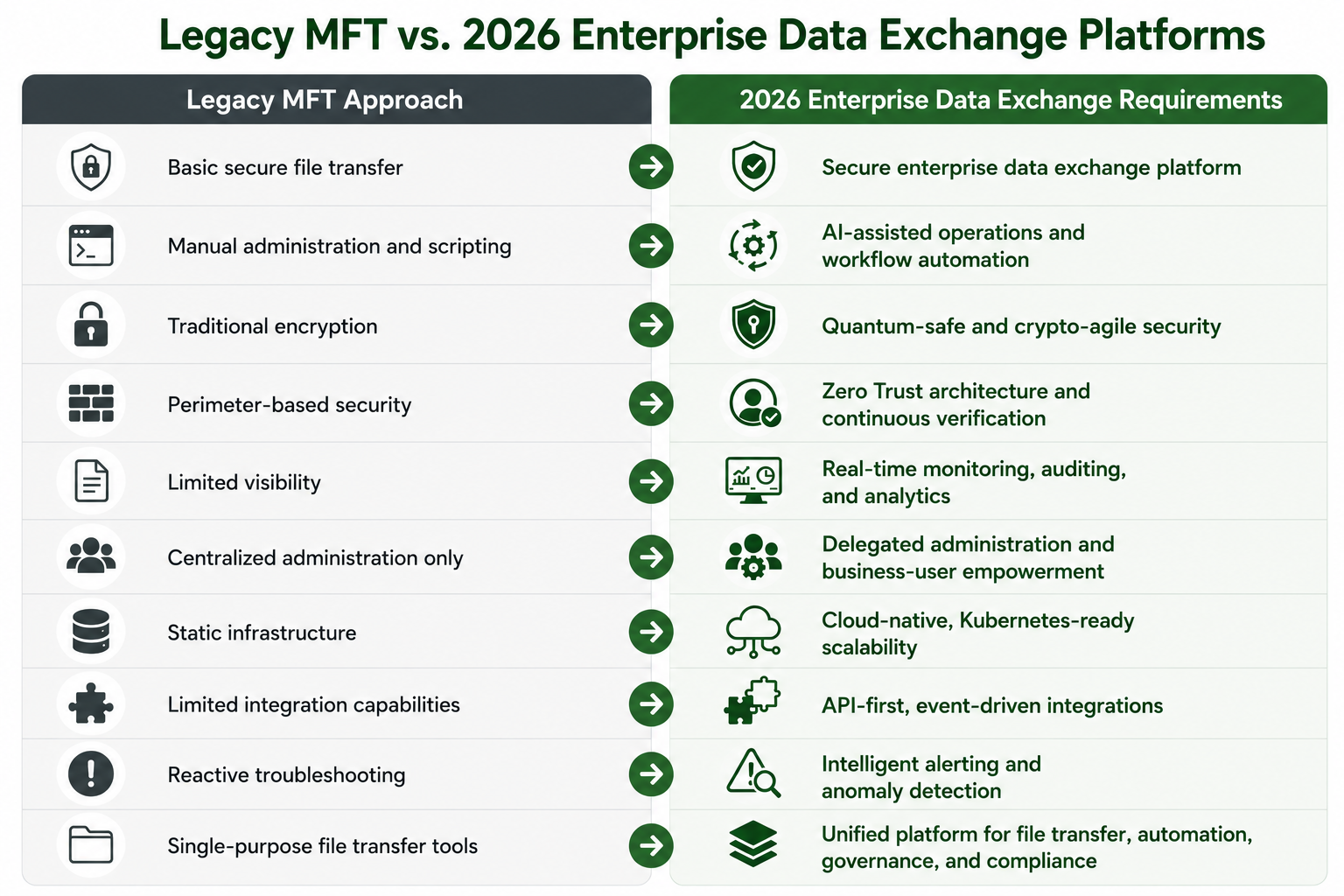
What makes TDXchange different from legacy MFT platforms?
TDXchange combines secure multi-protocol file transfer, workflow automation, Native End-to-End Zero Trust security, quantum-safe cryptography, real-time visibility, multi-tenancy, delegated administration, cloud-native scalability, Kubernetes support, AI-assisted operations, and Accelerated File Transfer Protocol within one enterprise data exchange platform.
Just as importantly, TDXchange is designed to be practical to install, learn, configure, maintain, upgrade, and manage every day. Enterprise-grade technology should solve complexity, not become another source of it.