
Why Configuration Change Tracking Is a Critical Control in Managed File Transfer (MFT)
In most enterprise environments, Managed File Transfer (MFT) is assumed to fail only due to network outages, infrastructure bottlenecks, or partner disruptions. In reality, a far more subtle and far more dangerous and root cause often lurks beneath the surface: system and configuration change.
Routine updates like credential rotations, workflow tweaks, partner updates, permission changes, or policy edits may seem harmless in isolation. Over time, however, these changes interact and compound, quietly introducing performance degradation, intermittent failures, and compliance gaps without ever triggering traditional alerts.
For executives and leaders responsible for operational resilience, the question isn’t just “Did a transfer fail?” It is: “Who changed what, when, and why?”
What Is MFT Change Tracking?
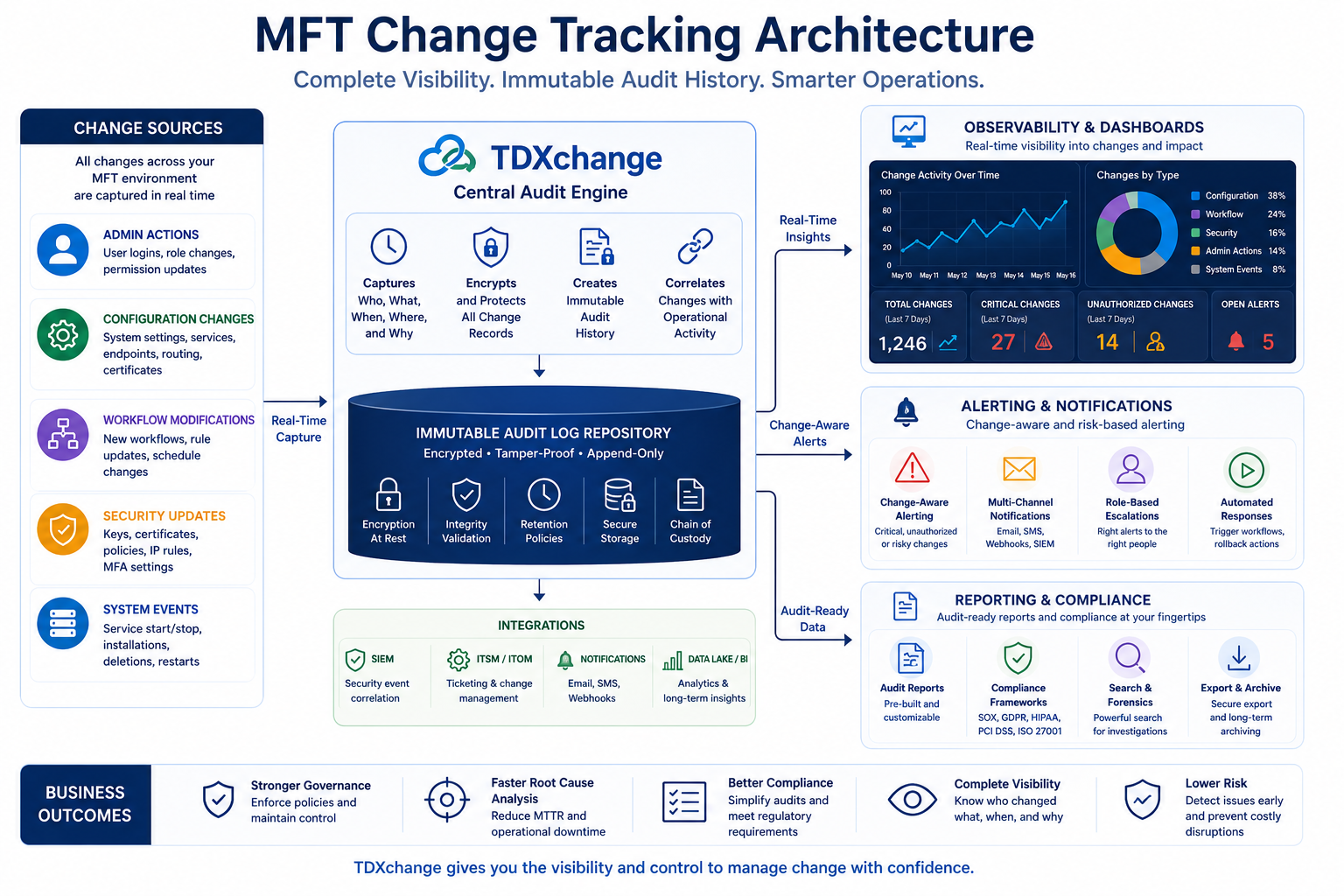
MFT change tracking is the ability to automatically record and monitor every configuration, workflow, security, and partner-related change within a Managed File Transfer platform. Effective change tracking provides visibility into who made a change, when it occurred, what was modified, and how it may impact operations, security, or compliance.
In Summary
Modern enterprise MFT environments require complete visibility into configuration changes, workflow modifications, security updates, and operational activity.
TDXchange provides immutable, encrypted, centralized change tracking that helps organizations improve:
- governance
- auditability
- compliance
- operational resiliency
- incident response
- root-cause analysis
while reducing operational risk associated with unmanaged or undocumented changes.
Key Takeaways
- Most MFT outages are caused by configuration changes rather than infrastructure failures.
- Centralized change visibility accelerates root-cause analysis.
- Change tracking improves operational visibility and accountability.
- Immutable audit trails support regulatory compliance.
- Secure change tracking supports Zero Trust operational models.
- Alerting on configuration changes enables proactive risk management.
- AI and observability platforms become more effective when change history is available.
- Modern MFT environments require change tracking as a core security control.
- TDXchange correlates operational changes with transfer behavior.
Why Change Tracking Is a Strategic Control, Not a Nice-to-Have
Unlike hardware failures or network outages, configuration errors don’t usually cause loud, obvious failures. Instead they produce:
• Gradual performance degradation
• Intermittent transfer delays
• Unexpected workflow behavior
• Increased retries and backlogs
• Compliance or audit gaps
The system appears “up,” dashboards stay green, and alerts often never fire until SLAs are missed or downstream systems are impacted.
Most traditional MFT platforms rely on fragmented logs scattered across nodes. Correlating events in those logs requires manual investigation, often leaving teams guessing rather than understanding what changed and why.
What "Future-Ready" Change Tracking Looks Like
For CIOs and CISOs, effective change tracking must be more than a simple timestamped log. At minimum, it should provide:
• Complete visibility into every system and configuration change
• Clear attribution who made the change and when
• Context around what was modified and why
• Historical traceability for audits and investigations
• Protection against tampering or deletion
If change history can be altered or erased, it loses its value exactly when it’s needed most during forensic review or compliance scrutiny.
Why Traditional Logs Fall Short
Logs are essential but insufficient in high-volume, distributed environments:
• Logs are fragmented across servers
• Correlating events manually is time-consuming
• Context around configuration changes is missing
• Attributing changes to individuals or teams is often impossible
Without an authoritative, unified change record, teams are forced to piece together symptoms instead of facts.
How Enterprise-Grade MFT Platforms Solve It
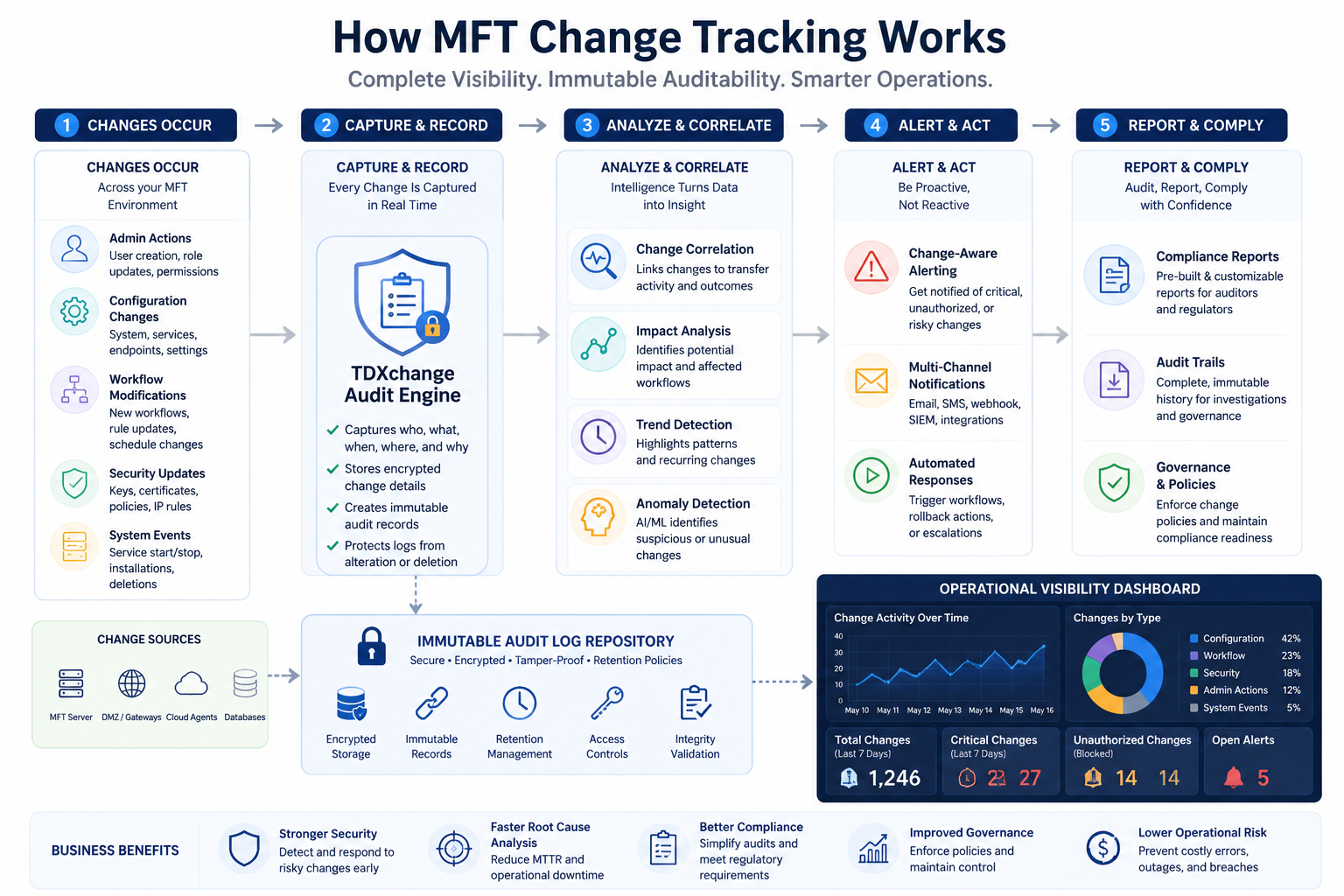
TDXchange is designed for enterprise scale assuming change is constant and visibility into change is non-negotiable. Key capabilities include:
𝟭. 𝗘𝘃𝗲𝗿𝘆 𝗖𝗵𝗮𝗻𝗴𝗲 𝗜𝘀 𝗧𝗿𝗮𝗰𝗸𝗲𝗱 𝗔𝘂𝘁𝗼𝗺𝗮𝘁𝗶𝗰𝗮𝗹𝗹𝘆
All configuration updates from trading partner settings to security credentials and workflow edits are captured without manual intervention.
𝟮. 𝗖𝗵𝗮𝗻𝗴𝗲 𝗗𝗮𝘁𝗮 𝗜𝘀 𝗘𝗻𝗰𝗿𝘆𝗽𝘁𝗲𝗱 𝗮𝗻𝗱 𝗜𝗺𝗺𝘂𝘁𝗮𝗯𝗹𝗲
Records are stored encrypted and tamper-resistant, providing reliable audit evidence that stands up to regulatory and forensic review.
𝟯. 𝗖𝗼𝗻𝗳𝗶𝗴𝘂𝗿𝗮𝗯𝗹𝗲 𝗔𝗹𝗲𝗿𝘁𝘀 𝗳𝗼𝗿 𝗖𝗵𝗮𝗻𝗴𝗲 𝗘𝘃𝗲𝗻𝘁𝘀
Organizations can set alerts on specific categories of change (e.g., credential updates, workflow modifications), enabling proactive responses before issues manifest as failures.
Because change data is structured and contextualized, teams can quickly correlate system behavior, performance issues, security concerns, and audit findings directly to specific updates.
Operational and Compliance Benefits of Change Tracking
From an operational standpoint, effective change tracking delivers:
• Clear linkage between configuration changes and incidents
• Faster root-cause analysis and reduced time to resolution
• Reduced reliance on guesswork or manual investigation
• Enhanced accountability through attribution and traceability
.png)
From a compliance perspective, transparent change history helps demonstrate:
• Control over system configuration
• Separation of duties and administrative accountability
• Defensible records for auditors and regulators
In regulated environments, being able to prove what changed, when, and by whom is often as important as proving that transfers succeeded.
Why Change Tracking Matters for Cybersecurity
Most organizations think of MFT change tracking primarily from an operational or compliance perspective. In reality, it also plays a major role in enterprise cybersecurity and insider threat protection.
Modern cyberattacks increasingly target:
- administrative accounts
- automation workflows
- routing rules
- API integrations
- service configurations
- privileged access
- scheduled tasks
because attackers understand that modifying trusted operational workflows can allow malicious activity to remain hidden for extended periods.
Without centralized and immutable change tracking, organizations often struggle to determine:
- who modified a workflow
- when a security policy changed
- why a transfer route was altered
- whether an unauthorized configuration update occurred
- which systems were impacted
- whether changes were malicious or accidental
This creates major operational and security blind spots.
Modern MFT change tracking helps organizations:
- identify unauthorized modifications
- detect configuration drift
- monitor privileged administrative activity
- correlate operational changes with transfer anomalies
- strengthen forensic investigations
- improve insider threat detection
- accelerate incident response
- support Zero Trust operational governance
For example, if:
- a certificate is unexpectedly replaced
- malware scanning is disabled
- routing logic is modified
- a user’s permissions suddenly change
- retention policies are altered
change-aware alerting can immediately notify operational and security teams before the issue escalates into a larger incident.
As ransomware and operational sabotage attacks continue increasing, immutable change tracking is becoming a foundational component of enterprise cyber resiliency.
Change Tracking and Zero Trust Security
Zero Trust is often associated with authentication and access control.
However, effective Zero Trust programs also require visibility into administrative activity and system changes.
Organizations implementing Zero Trust principles should be able to answer:
- Who changed a configuration?
- What was modified?
- When did the change occur?
- Was the change authorized?
- Did the change impact security policies?
Without comprehensive change tracking, organizations cannot fully validate administrative actions or enforce accountability.
How AI Benefits from Change Visibility
Organizations are increasingly using AI to:
- Detect anomalies
- Investigate incidents
- Identify operational risks
- Improve observability
AI systems are significantly more effective when they can correlate operational events with configuration changes.
For example, an AI model investigating a transfer failure can immediately identify that a certificate update, permission change, or workflow modification occurred shortly before the incident.
This reduces investigation time and improves operational awareness.
Real-World Operational Scenarios Where Change Tracking Matters
One of the biggest operational challenges in enterprise MFT environments is that even small undocumented changes can have significant downstream impact across critical business operations.
Modern enterprise ecosystems involve:
- hundreds of workflows
- thousands of trading partners
- distributed operational ownership
- complex routing dependencies
- compliance-sensitive automation
This makes operational visibility essential.
Below are several common real-world scenarios where centralized change tracking becomes critical.
Accidental Workflow Modification
An administrator updates a production workflow while troubleshooting another issue.
Hours later:
- transfers begin failing
- downstream systems stop processing files
- SLAs are missed
Without centralized change tracking, teams may spend hours manually investigating:
- what changed
- when the issue started
- which workflows were impacted
With immutable audit history and change correlation, teams can immediately identify:
- the modified workflow
- the exact configuration changes
- the user responsible
- the timeline of events
dramatically reducing MTTR (Mean Time to Resolution).
Unauthorized Administrative Changes
A compromised privileged account modifies:
- routing rules
- partner endpoints
- user permissions
- security settings
Without change-aware alerting, these modifications may remain undetected for extended periods.
Modern MFT observability platforms can immediately identify:
- abnormal administrative activity
- unauthorized changes
- suspicious permission modifications
- risky operational behavior
before they escalate into larger security incidents.
Failed Certificate Rotation
An expired or incorrectly deployed certificate causes:
- AS2 failures
- API authentication issues
- partner communication outages
Change tracking allows operational teams to quickly correlate:
- certificate updates
- failed workflows
- authentication errors
- impacted trading partners
which significantly accelerates troubleshooting and remediation.
Configuration Drift Across Environments
Over time, production, DR, QA, and development environments may slowly diverge due to undocumented changes.
This operational drift creates:
- deployment inconsistencies
- testing inaccuracies
- troubleshooting complexity
- compliance risk
Centralized change tracking improves operational consistency by maintaining complete visibility into:
- environment changes
- policy modifications
- workflow differences
- operational baselines
Executive Takeaway
Most organizations monitor transfer failures, system health, and infrastructure performance.
Far fewer monitor the changes that often cause those problems.
As enterprise MFT environments become more distributed and compliance requirements become more demanding, change tracking is evolving from a useful feature into a foundational control.
Organizations that can see, track, alert on, and audit changes are better positioned to improve security, accelerate troubleshooting, strengthen compliance, and reduce operational risk.
In modern MFT environments, understanding change is often the fastest path to understanding everything else.
About the Author
Hanz Jorgensen is Chief Operating Officer and Managing Member at bTrade, overseeing daily operations and shaping the company’s strategic direction. With more than 20 years of hands-on experience across system administration, development, customer support, pre-sales, and enterprise solution delivery, Hanz brings a practical and execution-focused perspective on what organizations truly need from modern MFT platforms.
Frequently Asked Questions (FAQ)
What is MFT change tracking?
MFT change tracking provides centralized visibility into operational, configuration, workflow, policy, and administrative changes occurring across Managed File Transfer environments.
Why is immutable audit history important?
Immutable audit history helps organizations maintain tamper-proof operational records for:
- compliance
- forensic investigations
- governance
- incident response
- operational accountability
How does change-aware alerting work?
Change-aware alerting monitors operational activity and automatically notifies administrators when:
- critical configurations change
- permissions are modified
- workflows are altered
- suspicious administrative activity occurs
How does MFT change tracking improve compliance?
Centralized change tracking helps organizations:
- simplify audits
- maintain operational traceability
- enforce governance policies
- generate audit-ready reports
- demonstrate regulatory compliance
for frameworks such as:
- SOX
- HIPAA
- PCI DSS
- GDPR
- ISO 27001
Can change tracking help detect insider threats?
Yes. Change tracking helps identify:
- unauthorized modifications
- suspicious administrative activity
- abnormal operational behavior
- privilege misuse
- policy manipulation
which are all important indicators of potential insider threats.
Why is observability important in enterprise MFT?
Observability improves:
- troubleshooting
- operational visibility
- anomaly detection
- SLA management
- governance
- root-cause analysis
across distributed enterprise file transfer ecosystems.
What operational risks are caused by undocumented changes?
Undocumented changes frequently cause:
- failed transfers
- workflow outages
- compliance violations
- security gaps
- operational inconsistencies
- troubleshooting delays
especially in large distributed environments.
How does TDXchange support operational governance?
TDXchange provides:
- immutable audit tracking
- centralized observability
- change-aware alerting
- role-based governance
- operational analytics
- audit-ready reporting
to help organizations maintain secure and resilient enterprise operations.