
In today’s continuously evolving digital landscape, managing and transferring large volumes of sensitive data securely and efficiently is a critical challenge for financial institutions, especially during complex legal processes like eDiscovery. This was the exact problem faced by one of our clients, a global leader in banking that had already been leveraging bTrade’s TDXchange for their Managed File Transfer (MFT) needs.
Executive Summary
eDiscovery often requires organizations to collect, process, and securely transfer massive volumes of sensitive information, including emails, documents, transaction records, and legal evidence. Traditional file transfer protocols such as SFTP and HTTPS frequently struggle with these workloads, leading to timeouts, failed transfers, operational delays, and compliance risk.
This case study explores how a global banking institution modernized its eDiscovery data transfer process using TDXchange and bTrade's Accelerated File Transfer Protocol (AFTP). By combining enterprise Managed File Transfer (MFT), workflow automation, end-to-end security, and accelerated bulk data movement, the bank dramatically improved performance, reliability, compliance readiness, and operational efficiency.
Key Takeaways
- eDiscovery Creates Unique Infrastructure Challenges: Modern legal investigations often require secure movement of hundreds of gigabytes or terabytes of sensitive information between legal teams, regulators, auditors, and external counsel. Traditional protocols frequently become operational bottlenecks.
- Transfer Failures Create Compliance Risk: Delayed or failed transfers can impact regulatory timelines, increase legal costs, and create challenges around chain of custody and defensibility.
- AFTP Eliminates Large File Transfer Bottlenecks: bTrade's Accelerated File Transfer Protocol was specifically designed for high-volume, long-distance transfers and delivered transfer speeds several times faster than traditional SFTP and HTTPS.
- TDXchange Provides Governance and Automation: TDXchange transforms eDiscovery transfers into controlled workflows with automation, auditing, security, monitoring, and compliance reporting.
- Chain of Custody and Auditability Are Critical: End-to-end visibility, detailed audit logs, encryption, authentication, and access controls help organizations maintain defensibility throughout the eDiscovery lifecycle.
- Global eDiscovery Requires Local Compliance: Organizations operating across jurisdictions must balance performance with regional privacy, security, and data protection requirements.
- Automation Reduces Risk and Cost: Direct integration with eDiscovery platforms eliminates manual processes, reduces human error, and improves operational efficiency.
- Seamless Integration & Automation: Direct integration with existing eDiscovery tools enables automated workflows for packaging, encrypting, and sending large datasets without manual intervention, reducing human error and operational costs.
- Global Compliance & Security: End-to-end encryption, role-based access controls, detailed audit logs, and multi-jurisdiction deployment ensure eDiscovery transfers meet stringent international data protection regulations across USA, Europe, and Asia.
- Strategic Business Impact: Modern MFT platforms with accelerated transfer capabilities transform eDiscovery from operational bottleneck into strategic advantage, reducing risk, cost, and compliance stress while strengthening legal defensibility.
The Challenge: Timing Out with Traditional Protocols
The bank approached us in 2011 with a pressing issue: their existing eDiscovery process was inefficient, costly and prone to many failures. The nature of eDiscovery often involves the collection, processing, and distribution of large volumes of sensitive data, emails, documents, transaction records, and more. The bank needed to transfer these vast data collections to external legal firms, auditors, and various government regulators across the globe quickly, securely, and without interruption.
However, they were experiencing significant delays and even failures when sending large data sets via traditional Secure File Transfer Protocol (SFTP) or HTTPS. These protocols were timing out, leading to frustrating delays in the eDiscovery process, which not only impacted the bank's operational efficiency but also put them at risk of non-compliance with strict regulatory timelines.
Why eDiscovery File Transfers Often Fail
Many organizations assume eDiscovery challenges are primarily legal.
In reality, they are often infrastructure challenges.
Common issues include:
- Large datasets exceeding traditional transfer capabilities
- Transfer timeouts
- Network latency
- Failed deliveries
- Manual packaging and distribution
- Limited auditability
- Inconsistent chain-of-custody tracking
As data volumes continue to grow, these issues become increasingly difficult to manage using traditional transfer methods.
Why Chain of Custody Matters in eDiscovery
One of the most overlooked aspects of eDiscovery is proving the integrity of the evidence.
Organizations must demonstrate:
- Who accessed the data
- When transfers occurred
- Where data was sent
- How data was protected
- Whether files were altered
- What security controls were applied
TDXchange helps maintain defensibility through:
- Detailed audit trails
- Transfer traceability
- Authentication controls
- Role-based access management
- Encryption
- Centralized reporting
This provides organizations with evidence required during audits, litigation, and regulatory reviews.
Why Financial Institutions Need Accelerated File Transfer
Banks and financial institutions often face unique challenges:
- Regulatory deadlines
- Large investigation datasets
- Cross-border data movement
- Multiple external parties
- High sensitivity information
- Strict audit requirements
Accelerated transfer technology allows organizations to meet these requirements while reducing operational risk and improving response times.
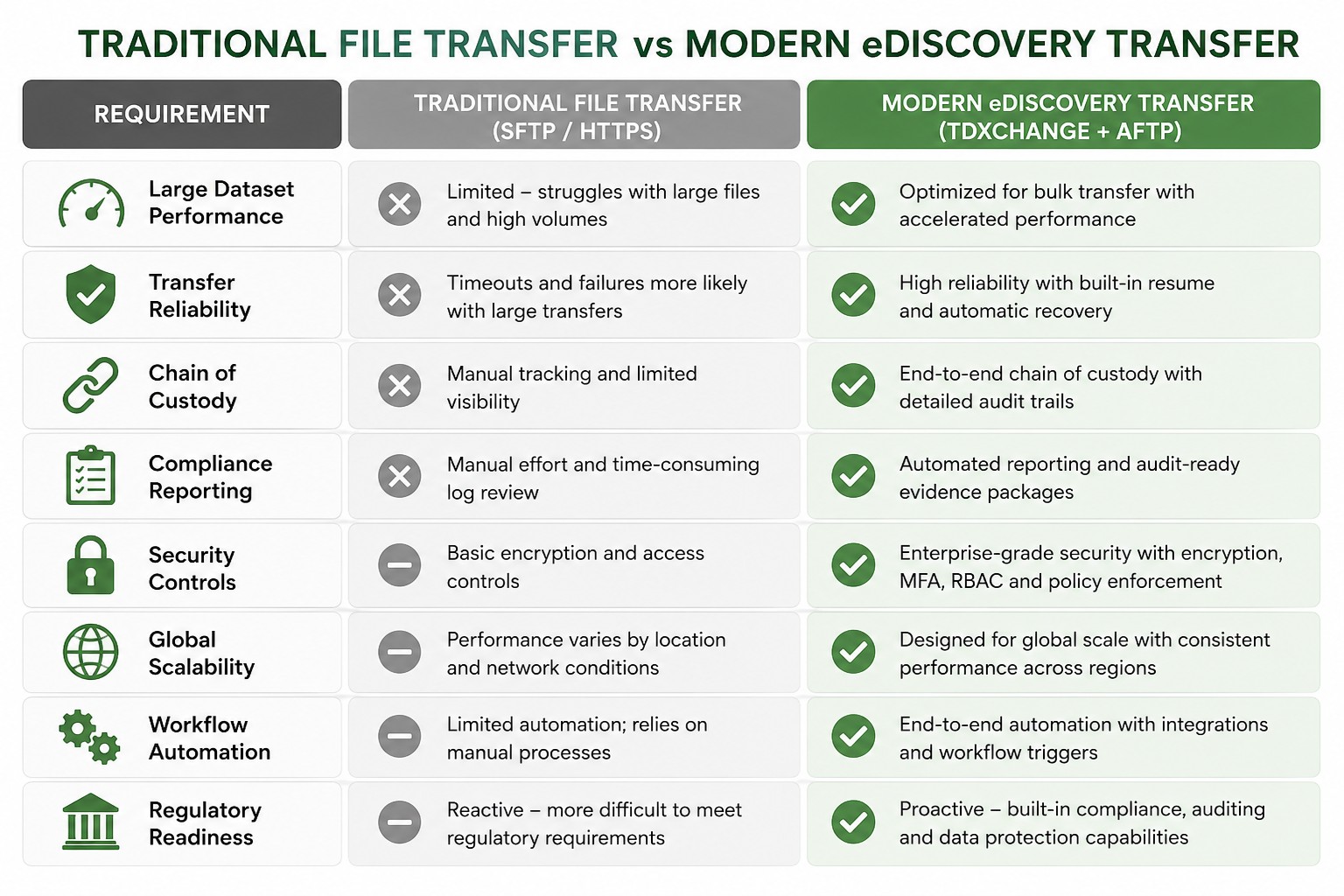
The Solution: Accelerated File Transfer Integrated with TDXchange
Having successfully used TDXchange for a number of years, the bank reached out to bTrade for a solution to their eDiscovery data transfer challenges. Our team recognized the need for a more robust and efficient transfer method. Fortunately, TDXchange already had the Accelerated File Transfer Protocol (AFTP) available and effectively utilized by our media customers for transferring large movie files worldwide.
We recommended leveraging AFTP, which was specifically designed to handle large-scale data transfers much faster and more reliably than traditional protocols like SFTP or HTTPS. This integration allowed the bank to enhance their eDiscovery process by utilizing a protocol that optimized data transmission, significantly increasing transfer speeds and minimizing the risk of timeouts or failed transfers.
Seamless Integration with eDiscovery Tools
To further streamline their processes, bTrade worked closely with the bank’s IT team to seamlessly integrate TDXchange with their existing eDiscovery tools. This integration allowed for automated workflows where large data sets could be packaged, encrypted, and sent directly to external legal firms, auditors, and regulatory bodies without manual intervention. The process not only saved time but also minimized human error, ensuring the integrity and confidentiality of the data throughout its journey.
Global Deployment and Reliability
The success of the TDXchange and AFTP integration didn’t just stop at resolving the bank’s initial issue; it transformed their entire eDiscovery data transfer process. The integrated solution was deployed across multiple jurisdictions, including the USA, several European countries, and multiple Asian regions. Despite the complexities of differing regulatory environments and network conditions, the deployment was seamless and reliable, ensuring uninterrupted data flows across borders.
With TDXchange and AFTP, the bank could confidently handle their eDiscovery data transfers, knowing that they had a solution that was not only faster but also compliant with international data protection regulations.
Key Benefits Realized
1. Performance Boost
By leveraging AFTP, the bank achieved data transfer speeds several times faster than traditional SFTP and HTTPS protocols, dramatically reducing the time required to move large eDiscovery data sets. Faster transfers enabled legal teams, auditors, and regulators to access critical information sooner, helping the organization meet aggressive legal and regulatory deadlines with greater confidence.
2. Increased Reliability
The seamless integration of TDXchange with the bank's eDiscovery tools eliminated many of the timeout and transfer failure issues associated with traditional protocols. This significantly reduced operational disruptions and minimized the risk of missed regulatory deadlines, helping ensure that critical evidence and legal data were delivered when required.
3. Global Reach with Local Compliance
The solution was successfully deployed across multiple jurisdictions, including the United States, Europe, and Asia. TDXchange enabled the bank to maintain consistent transfer performance and operational reliability while adapting to regional regulatory and data protection requirements. This allowed the organization to support global eDiscovery operations without sacrificing security, governance, or compliance.
4. Cost Efficiency and Operational Simplicity
Reduced transfer times, automated workflows, and streamlined management lowered operational costs and freed internal teams to focus on higher-value activities. TDXchange's intuitive administration model enabled the bank to integrate the solution into its existing MFT support structure without adding specialized staff, reducing both implementation and ongoing support costs.
5. Enhanced Security, Auditability, and Chain of Custody
Because AFTP operates within the TDXchange platform, every eDiscovery transfer benefits from enterprise-grade security, auditing, and compliance controls. All data transfers are protected through end-to-end encryption, strong authentication, role-based access controls, and detailed audit logging.
Equally important, TDXchange provides a comprehensive chain of custody for every file transferred. Organizations can track who accessed data, when transfers occurred, where files were delivered, what security controls were applied, and whether delivery was successfully completed. This level of traceability strengthens legal defensibility, simplifies regulatory audits, and helps demonstrate the integrity of evidence throughout the eDiscovery lifecycle.
6. Quantum-Safe Protection for Long-Term Sensitive Data
As of 2026, many of bTrade's eDiscovery clients have adopted TDXchange's NIST-approved post-quantum cryptography (PQC) capabilities to protect both stored eDiscovery data and data being transferred through AFTP and TDXchange. This helps organizations address emerging "harvest now, decrypt later" threats by protecting sensitive legal records, financial data, communications, and regulatory evidence against future quantum computing attacks.
For organizations that must retain information for years or decades, quantum-safe encryption provides an additional layer of long-term protection while supporting evolving cybersecurity and compliance requirements.
Our Managed File Transfer Solutions
- TDXchange (MFT Platform)
- Centralized, policy-driven file transfer management
- End-to-end encryption, auditing, and detailed compliance reporting
- Role-based access controls and multi-tenant capabilities
- High availability, clustering, and scalable performance
- Extensive integration options (APIs, schedulers, connectors) for eDiscovery and enterprise tools
- Accelerated File Transfer (AFTP)
- High-speed transfers over long distances with WAN optimization
- Automatic retry, checkpoint restart, and resilience against network interruptions
- Secure by design with encryption in transit and at rest
- Seamless interoperability with existing SFTP/HTTPS endpoints via TDXchange
- Built for very large files and data sets common in eDiscovery
Conclusion
For this global leader in banking, the implementation of TDXchange with AFTP has become a game-changer, turning a potentially costly compliance issue into a streamlined, efficient process. The bank now enjoys faster, more reliable data transfers across their global operations, providing a robust foundation for managing future eDiscovery challenges.
By embracing bTrade’s TDXchange and AFTP, the bank has not only addressed their immediate problems but also set a new standard for how financial institutions can handle sensitive data transfers in a secure, scalable, and cost-effective way. For organizations facing similar challenges, this case study serves as a blueprint for achieving excellence in eDiscovery data management.
Are you ready to revolutionize your data transfer processes? Explore the power of TDXchange and Accelerated File Transfer today by reaching out to us at info@btrade.com.
Executive Takeaway
Successful eDiscovery depends on more than legal expertise.
It requires infrastructure capable of securely moving massive datasets under strict deadlines while preserving chain of custody, auditability, and regulatory compliance.
By combining TDXchange's governance, automation, and security capabilities with AFTP's high-performance transfer engine, organizations can transform eDiscovery from an operational bottleneck into a strategic capability that improves compliance, reduces risk, and accelerates legal response times.
About the Author
Andrei Olin is Chief Technology Officer at bTrade, where he leads product strategy, delivery, and security across the company’s B2B, Managed File Transfer (MFT), and security platforms. He brings over 30 years of experience in enterprise technology, including designing and operating mission-critical MFT and messaging platforms for global financial institutions such as Merrill Lynch and Deutsche Bank. Andrei holds Master’s and Bachelor’s degrees in Information Technology with a focus on Information Security.
FAQs
What is Managed File Transfer (MFT)?
MFT is a secure, centralized approach to automating and managing file exchanges across systems, partners, and regulators, with built-in security, auditing, and compliance controls.
Why is traditional file transfer inadequate for eDiscovery?
Traditional methods struggle with large datasets, slow performance, limited auditability, and manual coordination all of which increase legal and operational risk.
How does accelerated file transfer help eDiscovery?
Accelerated transfer optimizes network usage and transport protocols, significantly reducing delivery times for large data volumes without compromising security.
How is AFTP different from SFTP or HTTPS?
AFTP is engineered for high-speed, long-distance transfers. It optimizes throughput, supports checkpoint restart, and reduces timeouts and failures common with SFTP/HTTPS when moving very large data sets.
What security controls are required for eDiscovery transfers?
Strong encryption, role-based access, authentication, and immutable audit trails are essential to protect sensitive data and maintain defensibility.
Is AFTP secure for regulated industries?
Yes. Through TDXchange, AFTP benefits from end-to-end encryption, robust authentication, access controls, and detailed audit logs to meet stringent compliance requirements.
Can TDXchange integrate with our existing eDiscovery tools?
Yes. TDXchange offers APIs, schedulers, and connectors to automate packaging, encryption, and delivery workflows directly from your eDiscovery environment.
Does AFTP work across global regions with variable networks?
Yes. AFTP is designed to maintain performance and reliability across diverse network conditions, helping ensure consistent results in cross-border transfers.
How does MFT support audit and chain-of-custody requirements?
Enterprise MFT platforms provide centralized, tamper-resistant logs that record every transfer event, ensuring complete traceability.
When should organizations modernize their eDiscovery transfer workflows?
Common triggers include increasing data volumes, tighter regulatory timelines, recurring transfer delays, or difficulty producing audit evidence.
What is the best way to transfer large eDiscovery datasets?
Enterprise Managed File Transfer platforms combined with accelerated transfer technology provide the most reliable approach for moving large eDiscovery collections securely and efficiently.
Why do eDiscovery file transfers time out?
Traditional protocols often struggle with large datasets, network latency, and long-running transfers, leading to failures and delays.
How do organizations maintain chain of custody during eDiscovery?
Organizations maintain chain of custody through audit trails, access controls, encryption, transfer tracking, and centralized reporting.
Why is accelerated file transfer important for legal and regulatory investigations?
Accelerated transfer reduces delivery times, improves reliability, and helps organizations meet strict legal and regulatory deadlines.
Can TDXchange integrate with existing eDiscovery platforms?
Yes. TDXchange provides APIs, schedulers, and connectors that allow organizations to automate packaging, encryption, delivery, and audit processes directly from existing eDiscovery environments.