
Managed File Transfer platforms process some of an organization’s most sensitive information, including financial transactions, healthcare records, legal documents, intellectual property, customer data, and government communications.
Securing that information requires more than adding encryption after the software has already been built.
Security must be incorporated into how the platform is planned, architected, developed, tested, released, operated, monitored, and continuously improved.
That is the purpose of DevSecOps.
At bTrade, DevSecOps principles help shape the development of TDXchange. These practices closely align with the NIST Secure Software Development Framework and support our broader commitment to building secure, resilient, and future-ready Enterprise Data Exchange technology.
In Summary
DevSecOps integrates security throughout the software development lifecycle rather than treating it as a final checkpoint before release.
For Managed File Transfer, this means addressing security during requirements planning, architecture, coding, testing, deployment, vulnerability response, and production operations.
The NIST Secure Software Development Framework, published in NIST SP 800-218, organizes secure software development into four practice groups:
- Prepare the Organization
- Protect the Software
- Produce Well-Secured Software
- Respond to Vulnerabilities
bTrade applies these principles through security requirements, threat modeling, architecture reviews, secure coding, automated analysis, controlled CI/CD workflows, configuration validation, ongoing risk assessment, vulnerability response, and continuous operational monitoring.
These development practices strengthen the security foundation of TDXchange. TDXchange then provides runtime controls that help customers protect their own file-transfer environments, including encryption, multifactor authentication, role-based access control, Zero Trust security, auditing, workflow governance, and operational visibility.
Key Takeaways
- DevSecOps integrates security into every stage of software development and operations.
- NIST SSDF Version 1.1 provides an outcome-based framework for reducing software vulnerabilities and improving development practices.
- The four SSDF groups address organizational preparation, software protection, secure production, and vulnerability response.
- Secure software supply chains require controls for source code, dependencies, build systems, artifacts, credentials, and third-party components.
- bTrade’s development practices and TDXchange’s runtime security capabilities serve different but complementary purposes.
- DevSecOps can support compliance readiness, but no framework or product makes an organization compliant by itself.
- Zero Trust principles should protect development systems, CI/CD pipelines, runtime services, users, administrators, and AI capabilities.
- Continuous monitoring and vulnerability response ensure that security continues after software is released.
What Is DevSecOps?
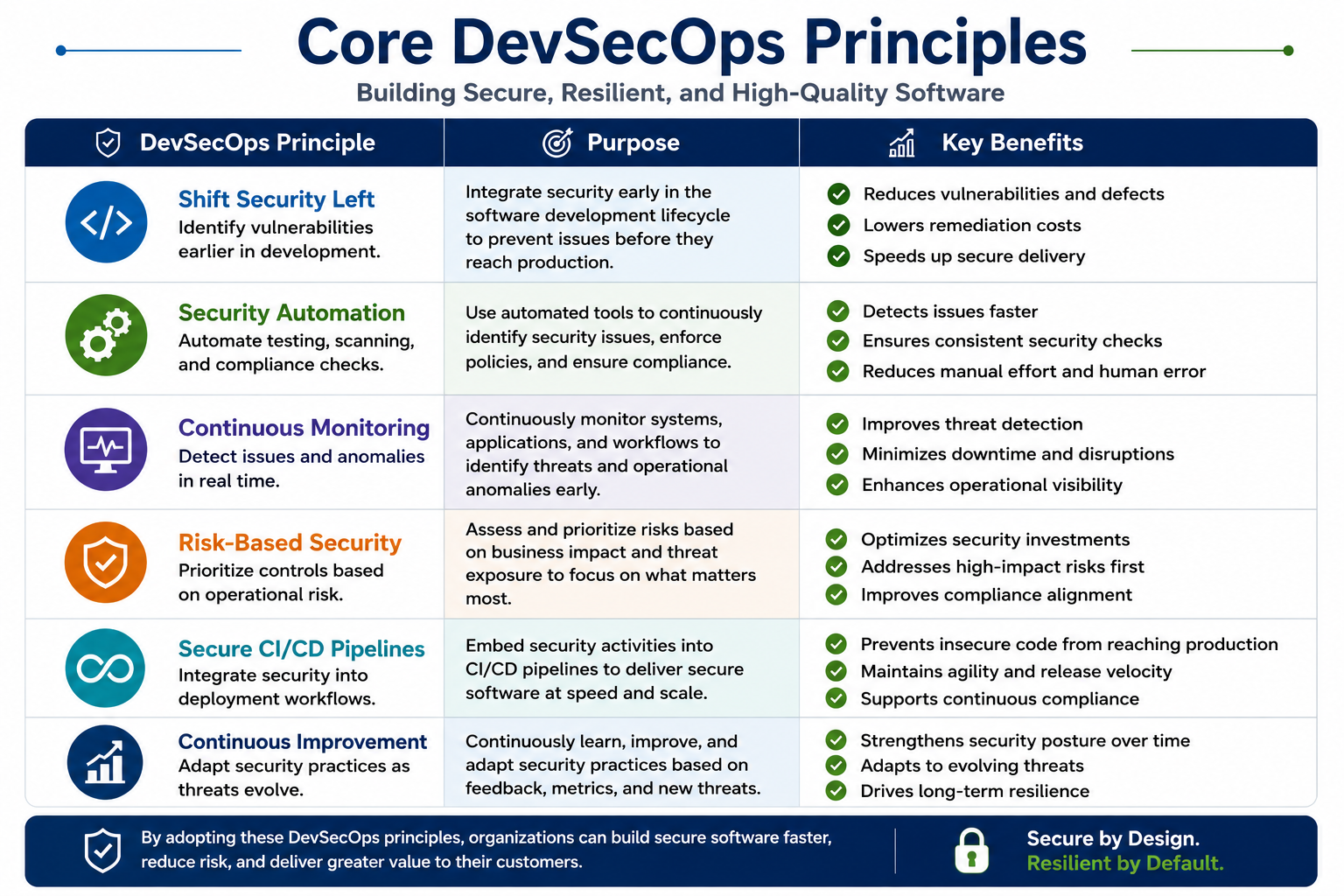
DevSecOps extends the traditional DevOps model by integrating cybersecurity throughout the software development lifecycle.
Instead of treating security as a final checkpoint before deployment, DevSecOps embeds security into:
- planning
- architecture
- development
- testing
- deployment
- operations
- monitoring
The goal is to identify and address security issues earlier while improving:
- software quality
- operational resilience
- deployment speed
- compliance readiness
- cybersecurity posture
Modern organizations increasingly rely on DevSecOps to help secure:
- cloud applications
- enterprise platforms
- APIs
- infrastructure
- automation workflows
- data exchange systems
Why DevSecOps Matters for Modern Cybersecurity
Cyber threats continue evolving rapidly.
Organizations now face risks including:
- ransomware
- software supply chain attacks
- credential compromise
- insider threats
- API vulnerabilities
- cloud misconfigurations
- third-party risk exposure
Traditional development approaches often identify security issues too late in the process, creating:
- expensive remediation cycles
- delayed releases
- operational risk
- compliance gaps
- increased attack surfaces
DevSecOps helps organizations move toward:
secure-by-design software engineering
where security becomes a continuous operational practice rather than a one-time review process.
What Is DevSecOps for Managed File Transfer?
DevSecOps combines development, security, and operations into a shared software-delivery model.
Instead of waiting until the end of development to evaluate security, DevSecOps incorporates security throughout:
- Planning
- Requirements
- Architecture
- Coding
- Code review
- Testing
- Building
- Deployment
- Monitoring
- Vulnerability response
- Continuous improvement
The goal is not to slow development.
The goal is to identify risks earlier, automate repeatable security activities, improve collaboration, and reduce the cost and operational disruption of correcting vulnerabilities late in the lifecycle.
For Managed File Transfer, DevSecOps is especially important because MFT platforms often sit at the center of enterprise data exchange. They connect internal systems, cloud services, business partners, customers, regulators, and other external organizations.
A weakness in an MFT platform can affect far more than one application. It can expose sensitive information, disrupt critical workflows, affect multiple partners, and create regulatory and operational consequences.
What Is the NIST Secure Software Development Framework?
The National Institute of Standards and Technology published the Secure Software Development Framework to provide a common set of secure software-development practices.
The finalized framework is SSDF Version 1.1, published in NIST Special Publication 800-218.
NIST designed the SSDF to be outcome-based. It does not mandate one development methodology, technology stack, or security tool. Organizations can integrate its practices into their existing software-development lifecycle.
Following the SSDF can help software producers:
- Reduce vulnerabilities in released software
- Limit the impact of vulnerabilities that remain undetected
- Address the root causes of recurring security defects
- Improve consistency across development teams
- Strengthen software supply-chain security
- Communicate security expectations to customers and suppliers
NIST released SSDF Version 1.2 as an initial public draft in December 2025. The updated draft expands and refines practices for secure and reliable software development, delivery, and improvement. Until finalized, Version 1.1 remains the primary published standard. NIST draft SSDF Version 1.2
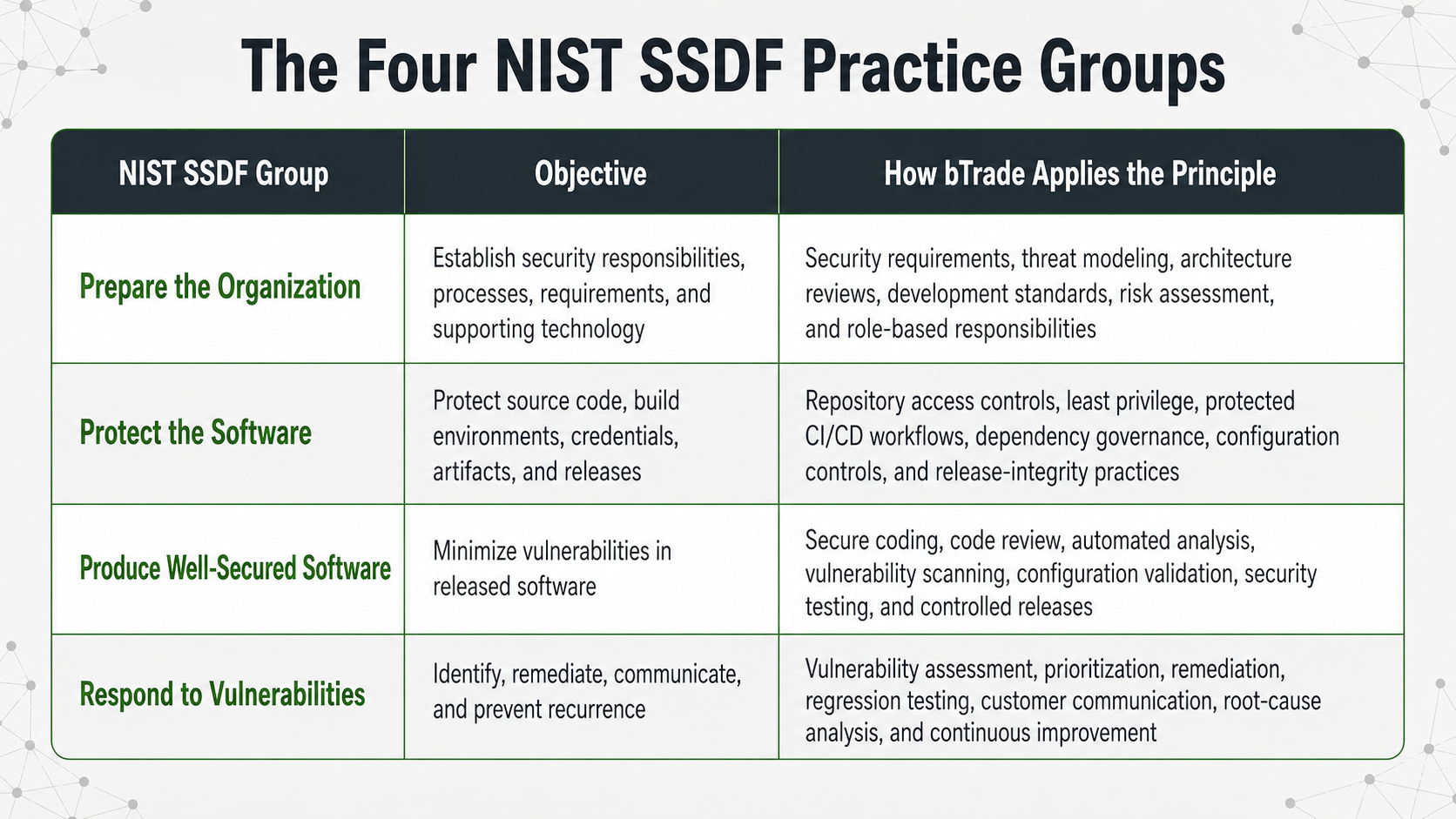
This mapping demonstrates an important distinction.
The SSDF is not a product certification. It is a framework that helps organizations develop and maintain software more securely.
1. Prepare the Organization
Secure software begins before anyone writes code.
The Prepare the Organization group focuses on establishing the people, processes, responsibilities, tools, and security requirements needed to support secure development.
At bTrade, preparation includes:
- Defining security requirements
- Incorporating security into architecture decisions
- Performing threat modeling
- Reviewing potential attack surfaces
- Evaluating compliance and customer requirements
- Assigning development and security responsibilities
- Establishing secure coding expectations
- Selecting appropriate security-testing practices
- Maintaining awareness of evolving threats
This early preparation is important because security decisions made during architecture and design often have long-term consequences.
Trying to correct a fundamental security weakness after an application has been developed is significantly more expensive and disruptive than preventing it during design.
2. Protect the Software
The Protect the Software group focuses on preventing unauthorized access to or modification of source code, build environments, credentials, development systems, and software releases.
Modern software is not produced by source code alone. It depends on repositories, build servers, CI/CD pipelines, third-party libraries, automated tools, secrets, containers, and deployment systems.
Each of these components represents part of the software supply chain.
Security controls should protect:
- Source-code repositories
- Development branches
- Build environments
- CI/CD service accounts
- Administrative credentials
- Encryption and signing keys
- Configuration files
- Build artifacts
- Release packages
- Deployment permissions
- Third-party dependencies
Zero Trust principles are relevant here.
Access should not be granted simply because a user or service is inside a corporate network. Developers, administrators, build processes, and automated services should receive only the permissions required for their responsibilities.
Actions affecting source code, build systems, releases, and production deployments should be authenticated, authorized, and auditable.
How Software Supply-Chain Security Fits into DevSecOps
Modern applications depend on open-source libraries, third-party packages, development tools, and external services.
This creates significant productivity benefits, but it also introduces risk.
A vulnerable, compromised, outdated, or abandoned dependency can affect software even when the organization’s own code was developed securely.
A mature DevSecOps program should include:
- Third-party dependency inventory
- Software composition analysis
- Dependency vulnerability monitoring
- Version and update governance
- License review
- Artifact-integrity verification
- Build provenance
- Controlled package sources
- Timely remediation of vulnerable components
A Software Bill of Materials provides a formal record of the components and supply-chain relationships within a software product. CISA identifies SBOMs as an important mechanism for improving software transparency and supply-chain risk management. CISA SBOM guidance
Customers evaluating MFT vendors should ask how those vendors manage third-party dependencies, protect their build environment, verify release integrity, and respond when a component vulnerability is discovered.
3. Produce Well-Secured Software
The Produce Well-Secured Software group focuses on reducing vulnerabilities in released applications.
At bTrade, secure production practices include:
- Security requirements
- Secure coding
- Peer review
- Architecture review
- Automated code analysis
- Vulnerability scanning
- Configuration validation
- Security assessment
- Controlled build and release processes
- Testing appropriate to the release scope
Automation is particularly important.
Manual review remains valuable, but modern enterprise platforms are too complex and change too frequently to depend on manual processes alone.
Automated security controls can help teams:
- Identify vulnerabilities earlier
- Detect insecure coding patterns
- Evaluate dependencies
- Find exposed secrets
- Validate configurations
- Apply consistent development policies
- Reduce human error
- provide faster feedback to developers
Depending on the application, architecture, and release scope, testing may include static analysis, dependency analysis, dynamic testing, API testing, configuration scanning, and targeted security assessments.
The objective is not simply to run more tools. It is to integrate useful security feedback into development while developers can still act on it efficiently.
4. Respond to Vulnerabilities
Secure development does not end when software is released.
Every complex software platform must be prepared to identify, evaluate, remediate, and learn from vulnerabilities.
A mature vulnerability-response process should include:
- Vulnerability intake and validation
- Severity and exposure assessment
- Remediation prioritization
- Patch development
- Regression and security testing
- Controlled release
- Customer communication when appropriate
- Root-cause analysis
- Preventive process improvement
- Post-release monitoring
Root-cause analysis is particularly important.
Fixing one vulnerable line of code addresses the immediate issue. Understanding why the vulnerability was introduced helps prevent similar weaknesses from appearing elsewhere.
This creates a continuous feedback loop between operations, security, architecture, and development.
How bTrade Applies DevSecOps to TDXchange Development
At bTrade, security is integrated across the TDXchange software lifecycle rather than treated as a final release task.
The process includes:
- Security requirements during planning
- Threat modeling and architecture review
- Secure coding practices
- Automated vulnerability scanning
- Code analysis
- Configuration validation
- Controlled CI/CD workflows
- Security assessments
- Ongoing risk evaluation
- Operational monitoring
- Vulnerability remediation
- Continuous improvement
These practices help reduce the probability that vulnerabilities reach production and improve the ability to respond when new risks emerge.
They also help bTrade evolve TDXchange as cybersecurity expectations change, including areas such as:
- Zero Trust architecture
- Software supply-chain risk
- Cloud and Kubernetes security
- AI governance
- Cryptographic agility
- Post-quantum security
- Enterprise observability
How TDXchange Helps Customers Secure MFT Operations
DevSecOps describes how bTrade develops and maintains TDXchange.
TDXchange runtime controls help customers secure and govern their own data-exchange environments.
TDXchange provides capabilities including:
- Encryption in transit and at rest
- Native multifactor authentication for administrators and end users
- MFA through external identity providers
- Role-based access control
- Least-privilege administration
- Partner and tenant isolation
- Secure protocol support
- Centralized certificate and key management
- Detailed transfer audit trails
- Administrative and configuration change history
- Workflow automation
- Operational monitoring
- Configurable alerts and notifications
- High-availability clustering
- Horizontal scalability
- Hybrid, cloud, Kubernetes, and on-premises deployment options
- Quantum-safe encryption
- Centralized governance
Supported transfer services include protocols such as:
- HTTPS
- SFTP
- FTPS
- AS2
- AFTP
These runtime capabilities complement bTrade’s secure development practices, but they should not be confused with the development process itself.
Zero Trust Across Development and Runtime Operations
Zero Trust is often discussed as an access-control model for production environments. Its principles also apply throughout software development.
Within development and CI/CD environments, Zero Trust means:
- Authenticating every user and service
- Granting only necessary permissions
- Protecting secrets and signing keys
- Restricting access to repositories and build systems
- Separating development, testing, and production responsibilities
- Auditing administrative and release actions
- Continuously validating trust
Within TDXchange, Zero Trust extends to:
- Administrators
- End users
- Services
- Applications
- Trading partners
- APIs
- Workflows
- Internal platform components
- AI capabilities
Trust should never be based solely on network location or a successful login. It should be continuously evaluated according to identity, authorization, context, and policy.
Learn more about Native End-to-End Zero Trust Architecture.
AI Governance and Secure Development
AI is becoming part of software development, administration, troubleshooting, monitoring, and operational decision-making.
It also introduces new security questions:
- What data can the AI access?
- Which actions can it perform?
- How is access authorized?
- Are prompts and responses audited?
- Can sensitive information leave the environment?
- How are model outputs validated?
- Where is human review required?
NIST SP 800-218A extends SSDF practices for generative AI and dual-use foundation models. It addresses additional considerations for organizations developing AI models and systems that use them. NIST SP 800-218A
At bTrade, AI capabilities are designed around Zero Trust and least-privilege principles. AI should only access information explicitly authorized for its purpose, and sensitive customer data should not be broadly exposed simply because an AI capability could find it useful.
The same principles that apply to users and services must also apply to AI:
- Authenticate
- Authorize
- Limit access
- Audit activity
- Validate results
- Maintain human oversight
AI without governance can become a larger risk than the operational problem it was intended to solve.
Why Continuous Monitoring Is Essential
DevSecOps extends into operations because production activity provides information that development testing cannot always reproduce.
Continuous monitoring helps organizations identify:
- Operational failures
- Unexpected behavior
- Configuration changes
- Authentication issues
- Workflow deviations
- Performance problems
- Emerging security risks
For MFT platforms, visibility should extend beyond server availability.
Organizations need to understand:
- Whether a critical file arrived
- Whether a workflow completed
- Which partner was affected
- Whether an SLA is at risk
- What configuration changed
- Which user or service performed an action
- Where a failure occurred
- What downstream systems were affected
This operational evidence can inform vulnerability response, architectural improvements, testing priorities, and future product development.
Learn why operational visibility is critical in Managed File Transfer.
DevSecOps and Compliance Readiness
DevSecOps can help organizations implement, document, and demonstrate secure-development practices relevant to:
- NIST SSDF
- SOC 2
- HIPAA
- PCI DSS
- GDPR
- ISO 27001
- Internal security policies
- Customer security requirements
It can provide evidence related to:
- Security responsibilities
- Development controls
- Testing
- Change management
- Risk assessment
- Vulnerability management
- Access control
- Monitoring
- Continuous improvement
However, DevSecOps does not make an organization compliant by itself.
Compliance depends on the organization’s complete technical, administrative, operational, legal, and physical environment.
Similarly, TDXchange provides security and governance controls that can support compliance programs, but compliance ultimately depends on how the platform is configured, operated, monitored, and integrated into the organization’s broader control environment.
The Future of DevSecOps and Secure Data Exchange
DevSecOps continues evolving as enterprise systems become more distributed, automated, intelligent, and interconnected.
Important areas include:
- AI-assisted security analysis
- Secure AI governance
- Software supply-chain transparency
- SBOM adoption
- Zero Trust development environments
- Automated security testing
- Container and Kubernetes security
- Cryptographic agility
- Quantum-safe encryption
- Continuous compliance evidence
- Predictive operational intelligence
- Runtime application protection
Modern MFT platforms must evolve alongside these expectations. Security cannot end when an application passes testing and is released into production.
To extend DevSecOps into the runtime environment, bTrade partners with Waratek, whose compiler-based Interactive Application Security Testing and Runtime Application Self-Protection technologies help identify exploitable vulnerabilities during development and protect production applications against known, zero-day, and emerging attacks.
This supports a continuous Shift Left and Shield Right approach: build security into development, validate applications while they are running, and maintain protection after deployment.
Secure development and secure runtime operations can no longer be treated as separate disciplines. They must operate as one continuous security lifecycle.
Executive Takeaway
Managed File Transfer platforms process some of an organization’s most valuable information. Their security cannot depend on a final review performed shortly before release.
DevSecOps integrates security into planning, architecture, development, testing, release, monitoring, and vulnerability response.
The NIST Secure Software Development Framework provides a practical structure through four groups:
- Prepare the Organization
- Protect the Software
- Produce Well-Secured Software
- Respond to Vulnerabilities
At bTrade, these principles help shape how TDXchange is designed, developed, assessed, released, monitored, and continuously improved.
TDXchange then extends that security foundation into customer environments through encryption, MFA, role-based access control, Zero Trust security, auditing, workflow governance, high availability, and operational visibility.
The result is not security added at the end.
It is security designed into the complete lifecycle of Enterprise Data Exchange.
About the Author
Andrei Olin is Chief Technology Officer at bTrade, where he leads product strategy, delivery, and security across the company’s B2B, Managed File Transfer (MFT), and security platforms. He brings over 30 years of experience in enterprise technology, including designing and operating mission-critical MFT and messaging platforms for global financial institutions such as Merrill Lynch and Deutsche Bank. Andrei holds Master’s and Bachelor’s degrees in Information Technology with a focus on Information Security.
Frequently Asked Questions
What is DevSecOps?
DevSecOps is a software development approach that integrates cybersecurity throughout the software lifecycle, including planning, development, testing, deployment, and operations.
What is DevSecOps for Managed File Transfer?
DevSecOps for Managed File Transfer integrates security into the planning, architecture, development, testing, release, monitoring, and maintenance of MFT software rather than treating security as a final checkpoint.
What are the four NIST SSDF practice groups?
The four NIST SSDF practice groups are Prepare the Organization, Protect the Software, Produce Well-Secured Software, and Respond to Vulnerabilities.
Is NIST SSDF a product certification?
No. NIST SSDF is an outcome-based framework containing secure software-development practices. It is not a certification awarded to an individual software product.
How does bTrade apply NIST SSDF principles to TDXchange?
bTrade applies SSDF-aligned principles through security requirements, threat modeling, architecture reviews, secure coding, automated analysis, vulnerability scanning, configuration validation, controlled releases, ongoing risk assessment, vulnerability response, and continuous improvement.
What security testing should be part of an MFT DevSecOps process?
Testing may include static code analysis, software composition analysis, dependency scanning, secrets detection, dynamic testing, API testing, configuration validation, vulnerability assessment, and targeted penetration testing. The appropriate combination depends on the platform, architecture, and release scope.
What is an SBOM, and why does it matter?
A Software Bill of Materials is a formal record of the components and supply-chain relationships within a software product. It can help organizations identify affected components when new vulnerabilities are disclosed and improve software supply-chain transparency.
How does DevSecOps improve software supply-chain security?
DevSecOps improves supply-chain security by protecting source code and build systems, evaluating third-party dependencies, controlling package sources, monitoring component vulnerabilities, verifying artifacts, and incorporating supply-chain risk into vulnerability response.
How does Zero Trust apply to CI/CD pipelines?
Zero Trust requires developers, administrators, service accounts, build workers, and deployment processes to be authenticated and authorized. Access should follow least-privilege principles, and sensitive actions should be logged and auditable.
How does DevSecOps support compliance readiness?
DevSecOps provides repeatable processes and evidence related to secure development, testing, change management, access control, vulnerability response, monitoring, and continuous improvement. These practices can support compliance programs, but they do not establish compliance on their own.
How are vulnerabilities handled after software is released?
A mature vulnerability-response process includes intake, validation, severity assessment, remediation prioritization, patch development, testing, controlled release, customer communication when appropriate, root-cause analysis, and preventive improvement.
How does TDXchange help secure customer file-transfer operations?
TDXchange provides encryption, multifactor authentication, role-based access control, Zero Trust security, secure protocols, workflow governance, detailed auditing, centralized monitoring, high availability, and operational visibility.
How does bTrade provide runtime application protection for TDXchange?
bTrade partners with Waratek to extend security into the application runtime. Waratek’s Interactive Application Security Testing helps identify exploitable vulnerabilities during development and testing, while its Runtime Application Self-Protection technology helps protect production environments against known, zero-day, and emerging attacks. This complements bTrade’s DevSecOps and Zero Trust practices by extending security across development, deployment, and runtime operations.
Learn More
To learn more about secure Managed File Transfer and how bTrade applies security throughout the TDXchange lifecycle, contact bTrade.