
Executive Summary
Oil and gas companies depend on software updates to maintain operational continuity, cybersecurity, safety, and regulatory compliance across remote drilling sites, pipeline operations, refineries, and field facilities. However, distributing software patches to geographically dispersed locations presents unique challenges, including limited connectivity, cybersecurity risks, legacy infrastructure, and operational downtime concerns.
Modern Managed File Transfer (MFT) platforms help energy organizations securely deliver software updates, operational files, and sensitive data through encryption, malware inspection, centralized governance, auditability, automation, and resilient delivery mechanisms. By replacing insecure methods such as FTP, email attachments, and USB drives, organizations can improve cybersecurity, reduce operational risk, and strengthen critical infrastructure resilience.
Key Takeaways
- Software Patch Delivery Is Mission Critical: Oil and gas operations rely on secure software updates to maintain uptime, safety, OT security, and operational continuity.
- Traditional Transfer Methods Create Risk: FTP, email attachments, and USB drives increase the likelihood of malware introduction, ransomware exposure, data loss, and compliance failures.
- Managed File Transfer Improves Critical Infrastructure Security: Modern MFT platforms provide encryption, authentication, malware scanning, auditing, centralized governance, and policy enforcement.
- OT and IT Security Must Work Together: Secure software delivery helps bridge IT and Operational Technology (OT) environments without disrupting industrial operations.
- TDXchange and TDConnect Support Remote Operations: bTrade's hub-and-spoke architecture enables secure patch delivery to remote drilling sites, pipelines, and operational facilities.
- Operational Visibility Improves Resilience: Audit trails, monitoring, reporting, and transfer verification help organizations maintain compliance and accelerate incident response.
- Zero Trust Strengthens Software Distribution: Every user, system, application, and endpoint should continuously authenticate and authorize access to software updates and operational data.
- Future Security Requires Quantum Readiness: Critical infrastructure operators increasingly evaluate post-quantum cryptography to protect long-lived operational data and software distribution channels.
What Is Managed File Transfer (MFT) for Oil and Gas?
Managed File Transfer (MFT) for oil and gas is a secure system used to distribute software updates, operational files, compliance data, and sensitive information between central offices and remote industrial environments using encryption, automation, authentication, and audit controls.
Oil and gas organizations rely on MFT because remote drilling rigs, pipeline facilities, refineries, and field operations often operate with limited connectivity, strict security requirements, and mission-critical uptime expectations.
Modern MFT platforms help energy companies reduce cybersecurity risks while improving operational efficiency and regulatory compliance.
Why Software Patch Delivery Is a Critical Infrastructure Security Issue
Many organizations view software patching as a routine IT function.
For oil and gas operators, it is much more than that.
Software updates often contain:
- Security fixes
- Vulnerability remediation
- Operational enhancements
- Regulatory updates
- Safety-related improvements
If updates are delayed, corrupted, or compromised, the consequences can extend beyond cybersecurity incidents and impact production, safety, environmental controls, and business continuity.
This is why secure software delivery has become a critical component of modern energy-sector cybersecurity programs.
Protecting Operational Technology (OT), ICS, and SCADA Environments
Oil and gas organizations increasingly operate interconnected environments where IT systems exchange information with Operational Technology (OT), Industrial Control Systems (ICS), and SCADA platforms.
These environments require specialized security controls because they directly influence physical operations.
Managed File Transfer helps protect OT environments by:
- Securing software patch delivery
- Controlling access to operational systems
- Reducing ransomware exposure
- Supporting Zero Trust architectures
- Providing audit trails for software distribution
- Improving visibility into remote infrastructure
Unlike traditional file-sharing tools, MFT platforms provide governance and security controls designed for critical infrastructure environments.
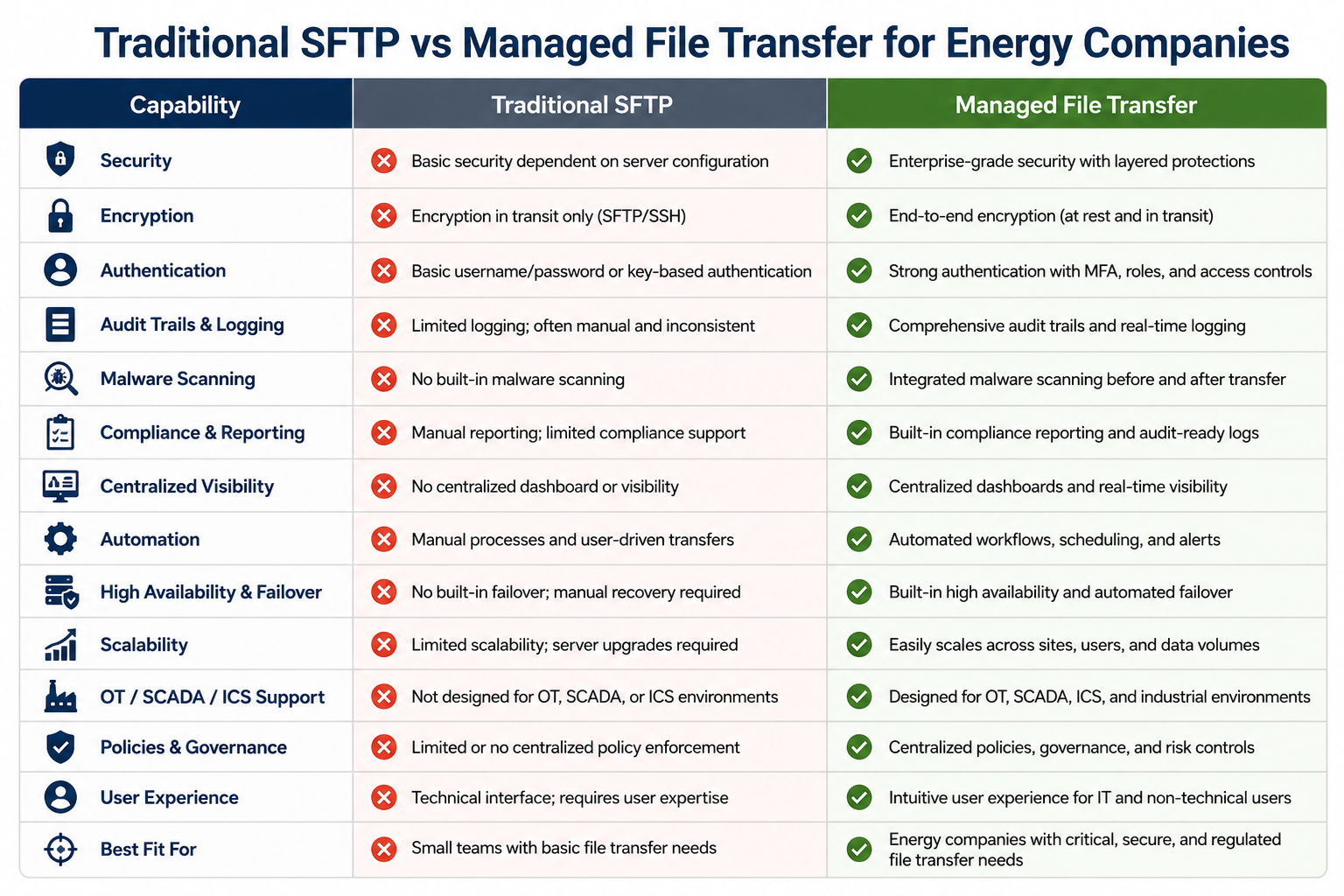
Why Email, SFTP, and USB Drives Are No Longer Sufficient
Many organizations still rely on legacy methods for software distribution.
While familiar, these methods create significant security and operational risks.
SFTP
- Limited security controls
- No centralized governance
- Minimal visibility
- Weak auditing
Email Attachments
- Risk of interception
- Delivery errors
- Malware exposure
- Limited tracking
USB Drives
- Malware introduction risks
- Lost or stolen devices
- No auditability
- Insider threat concerns
For critical infrastructure operators, these approaches create unnecessary operational and cybersecurity exposure.
Risks of Traditional File Transfer Methods
FTP Security Risks
Traditional FTP lacks modern encryption, centralized governance, malware inspection, and behavioral monitoring capabilities.
Email Attachment Risks
Email attachments can be intercepted, misdelivered, or used to introduce malware into operational environments.
USB Drive Risks
USB devices increase the risk of:
- Malware introduction
- File tampering
- Lost data
- Unauthorized access
- Insider threats
For energy companies managing sensitive operational systems, these risks can directly impact business continuity and infrastructure security.
How Do Oil and Gas Companies Secure Software Updates in Remote Locations?
Modern oil and gas companies secure software updates using Managed File Transfer platforms designed for remote industrial operations.
A secure MFT platform typically includes:
- End-to-end encryption
- Multi-factor authentication
- Malware scanning
- Audit logging
- Automated failover
- Centralized monitoring
- Policy enforcement
- Secure remote delivery
- Transfer verification
These capabilities help organizations protect operational environments while ensuring critical software patches arrive safely and reliably.
How bTrade’s TDXchange and TDConnect Support Remote Oil & Gas Operations
A managed service provider supporting oil and gas clients needed a more secure and scalable way to distribute software updates across remote locations. Its existing infrastructure relied heavily on FTP, email, and USB-based delivery methods.
bTrade implemented a hub-and-spoke architecture using:
- TDXchange as the secure centralized MFT hub
- TDConnect as the lightweight remote transfer client
This architecture allowed the provider to securely distribute software updates to remote drilling sites, field offices, and operational facilities.
What Is TDXchange?
TDXchange is bTrade’s enterprise Managed File Transfer platform designed to:
- Encrypt file transfers
- Authenticate users and systems
- Monitor transfer activity
- Create audit trails
- Support compliance reporting
- Improve transfer resiliency
- Automate secure file delivery
What Is TDConnect?
TDConnect is a lightweight remote transfer client that allows field engineers and remote operations teams to securely receive software updates and operational files, even in environments with intermittent connectivity.
How Managed File Transfer Improves Critical Infrastructure Security
Modern MFT platforms play an important role in protecting critical infrastructure environments.
MFT Security Features for Oil and Gas
End-to-End Encryption
Encryption protects sensitive files during transit and helps prevent unauthorized access.
Malware Scanning
Files can be scanned before delivery to reduce ransomware and malware risks.
Audit Trails
Detailed transfer logs help organizations maintain visibility into:
- Who sent files
- Where files were delivered
- When transfers occurred
- Whether transfers succeeded
Authentication and Access Control
MFT platforms help ensure only authorized users and systems can exchange sensitive operational data.
Automated Governance
Security policies can be centrally enforced across all remote environments.
Failover and Business Continuity
Automated failover helps maintain operations during outages or infrastructure disruptions.
Why Zero Trust Matters for Software Distribution
Cybersecurity leaders increasingly recognize that software distribution channels are attractive attack targets.
Modern software delivery should operate under Zero Trust principles:
- Never trust by default
- Continuously verify identities
- Enforce least-privilege access
- Validate every transfer
- Audit all activity
This approach helps reduce supply-chain risks and strengthens operational security across remote environments.
How MFT Supports OT Security and SCADA Environments
Operational Technology (OT) systems and SCADA environments often require stronger security controls than traditional IT environments because they directly affect physical operations.
Managed File Transfer helps support OT cybersecurity initiatives by:
- Securing software patch delivery
- Protecting ICS environments
- Reducing ransomware exposure
- Supporting Zero Trust security models
- Improving visibility into remote operational systems
- Enabling secure data exchange between IT and OT environments
For oil and gas companies, secure file transfer is increasingly part of broader critical infrastructure cybersecurity programs aligned with NIST and industrial cybersecurity best practices.
How MFT Improves Compliance and Audit Readiness
Energy organizations often face strict compliance and reporting requirements related to cybersecurity, operational continuity, and infrastructure protection.
Managed File Transfer improves compliance readiness through:
- Transfer logging
- Audit trails
- Policy enforcement
- File integrity verification
- Secure authentication
- Centralized visibility
- Automated reporting
These capabilities help organizations demonstrate how sensitive operational files and software updates were handled across remote environments.
Supporting Legacy Systems Without Disruption
Many oil and gas companies still operate legacy industrial systems that cannot easily support modern encryption standards or newer security protocols.
In this deployment, bTrade helped integrate legacy systems into the TDXchange environment without requiring a complete infrastructure replacement.
This approach allowed the provider to modernize security while preserving operational continuity.
Results Achieved with Managed File Transfer
After implementing TDXchange and TDConnect, the managed service provider achieved measurable improvements.
Business Results Achieved
- 70% faster software patch delivery
- Zero reported malware introduction incidents
- Improved transfer visibility
- Centralized audit reporting
- Reduced operational downtime risk
- Better support for remote field teams
- Improved confidence and trust with oil and gas clients
- Stronger compliance readiness
Best Practices for Secure File Transfer in Oil and Gas
Organizations supporting remote industrial operations should follow several Managed File Transfer best practices.
Best Practices for Secure Patch Delivery
- Eliminate USB-based patch delivery workflows
- Replace legacy FTP with enterprise Managed File Transfer
- Encrypt all outbound software updates
- Implement malware scanning before transfer
- Enable centralized audit logging
- Use role-based authentication controls
- Deploy automated failover capabilities
- Maintain visibility into all remote transfers
- Support both IT and OT security requirements
- Use scalable architectures designed for remote environments
Why Secure File Transfer Is Becoming Essential for Energy Infrastructure
As ransomware attacks, supply chain threats, and infrastructure-targeted cyberattacks continue increasing, oil and gas organizations need stronger protection for operational data movement.
Managed File Transfer is no longer simply an IT tool. It has become part of modern infrastructure resilience and operational continuity planning.
For organizations managing remote industrial environments, secure file transfer helps ensure:
- Reliable software delivery
- Reduced cybersecurity risk
- Stronger compliance posture
- Improved operational efficiency
- Better business continuity
- Safer infrastructure operations
In modern energy operations, secure data movement is directly connected to keeping the oil patch pumping.
Executive Takeaway
Secure software patch delivery is no longer just an IT challenge. It is a critical infrastructure security requirement.
For oil and gas organizations, software updates directly impact operational continuity, safety, compliance, and cybersecurity. Modern Managed File Transfer platforms such as TDXchange and TDConnect help organizations securely distribute software updates, improve visibility, strengthen governance, and reduce risk across remote industrial environments.
As ransomware threats, supply-chain attacks, and regulatory scrutiny continue to increase, secure data movement is becoming an essential component of keeping critical infrastructure operating safely and efficiently.
About the Author
Don Miller is President and General Counsel of bTrade, where he leads day-to-day operations and oversees legal, regulatory, and compliance activities for the company’s secure managed file transfer (MFT) platform. In this dual role, he helps ensure bTrade’s products and services meet the operational, data-protection, and governance expectations of enterprise and regulated customers. Don brings more than 20 years of legal experience advising businesses on risk management, contracts, intellectual property, and dispute resolution, applying that background to the practical realities of software operations and compliance. He holds a Juris Doctor from the University of Southern California Gould School of Law and is admitted to practice before California state and federal courts.
FAQ
What is Managed File Transfer for oil and gas?
Managed File Transfer (MFT) is a secure platform used to exchange software updates, operational files, and sensitive data across remote oil and gas environments using encryption, authentication, audit logging, and centralized governance.
How do remote drilling sites receive software updates securely?
Remote drilling sites often use Managed File Transfer platforms that securely distribute encrypted software patches from a centralized system to remote field locations using authenticated and monitored connections.
Why is FTP insecure for energy companies?
Traditional FTP lacks modern security features such as advanced encryption, malware scanning, audit logging, centralized governance, and behavioral monitoring, making it risky for critical infrastructure environments.
How does MFT improve critical infrastructure cybersecurity?
MFT improves critical infrastructure cybersecurity by protecting sensitive file transfers, reducing ransomware exposure, enforcing security policies, creating audit trails, and supporting secure communication between IT and OT systems.
What is OT-safe Managed File Transfer?
OT-safe Managed File Transfer refers to secure file transfer systems designed to operate safely within operational technology (OT), industrial control systems (ICS), and SCADA environments without disrupting industrial operations.
What are the benefits of secure file transfer for oil and gas companies?
Benefits include:
- Faster software delivery
- Better cybersecurity
- Improved compliance
- Reduced operational downtime
- Centralized visibility
- Safer remote operations
- Better audit readiness
- Stronger ransomware protection
What is the role of TDXchange in secure patch delivery?
TDXchange acts as the centralized Managed File Transfer hub that encrypts, authenticates, monitors, logs, and securely distributes software updates and operational files.
What is TDConnect?
TDConnect is a lightweight secure transfer client that allows remote field locations to reliably receive software updates and operational files from TDXchange.
Can Managed File Transfer support remote environments with poor connectivity?
Yes. Modern MFT platforms are designed to support remote industrial operations where connectivity may be intermittent or bandwidth-constrained.
How does Managed File Transfer support compliance requirements?
MFT platforms help organizations meet compliance requirements through:
- Detailed audit logs
- Policy enforcement
- Transfer verification
- Centralized reporting
- Access controls
- File integrity validation
Why is secure software patching important in oil and gas?
Secure software patching helps prevent cybersecurity vulnerabilities, ransomware attacks, operational downtime, and safety risks across critical energy infrastructure environments.