
Executive Summary
Enterprise data exchange has evolved far beyond securely moving files between systems. Organizations now exchange sensitive information across cloud platforms, APIs, AI services, remote workforces, business partners, and connected devices. As these environments become more distributed and interconnected, identity and access control have become fundamental to enterprise cybersecurity.
Modern access control can no longer rely on usernames and passwords alone. It must combine strong authentication, Multi-Factor Authentication, authorization, granular Role Based Access Control, delegated administration, enterprise identity integration, and Native End-to-End Zero Trust Architecture. Together, these controls ensure that every administrator, MFT user, application, API, AI service, workflow, and internal platform component can access only the information and functionality explicitly authorized by policy.
TDXchange provides native MFA for both MFT administrators and MFT users, helping organizations protect privileged administrative functions as well as everyday file access and exchange. TDXchange can also integrate with external enterprise authentication and identity providers, allowing organizations to apply their existing MFA, Single Sign-On, and centralized identity governance policies across the MFT environment.
Since 1990, bTrade has worked closely with customers to understand their operational and security challenges. Those customer conversations have directly shaped TDXchange, leading to native MFA, granular Role Based Access Control, delegated self-service, enterprise identity integration, Zero Trust-governed AI, enterprise observability, and Native End-to-End Zero Trust Architecture. Expanded in TDXchange v5, this architecture continuously verifies not only users, but also the internal platform components and services participating in every data exchange.
Key Takeaways
- Enterprise access control extends far beyond usernames and passwords to include identity, authorization, governance, observability, and continuous verification.
- TDXchange integrates with enterprise identity providers including Active Directory, Microsoft Entra ID, LDAP, OAuth2, allowing organizations to leverage existing authentication infrastructure.
- TDXchange was built from inception to support multi-tenant environments.
- TDXchange provides native MFA for both MFT administrators and end users, while also supporting MFA through external enterprise identity providers. This helps protect privileged administration and everyday file exchange while allowing organizations to apply centralized authentication, Single Sign-On, and identity governance policies.
- Granular Role Based Access Control and delegated administration enable organizations to securely empower business units and trading partners while maintaining centralized governance.
- TDXchange 5 introduces Native End-to-End Zero Trust Architecture, continuously verifying users, workflows, APIs, AI services, and internal platform components instead of relying on implicit trust.
- AI within TDXchange follows the same Native End-to-End Zero Trust Architecture, ensuring AI only accesses information it has been explicitly authorized to use.
- Enterprise observability complements access control by providing complete visibility into authentication events, authorization decisions, administrative activity, workflow execution, and policy enforcement.
- Modern access control should strengthen security while simplifying operations, reducing administrative effort, and improving customer experience.
- Highly configurable alerting provides visibility into suspicious activity and operational events.
What Is Access Control in Managed File Transfer?
Access control refers to the policies and technologies used to determine:
- Who can access the system
- What resources they can view
- What actions they can perform
- What information they can manage
In an MFT environment, access control plays a critical role because users often interact with highly sensitive business data.
A well-designed access control framework ensures users have access only to the information necessary to perform their responsibilities.
This follows the principle of least privilege, which remains one of the most effective security practices available today.
Authentication vs. Authorization: Understanding the Difference
Organizations often use the terms authentication and authorization interchangeably, but they serve different purposes.
Authentication
Authentication answers the question:
"Who are you?"
Authentication verifies a user's identity before access is granted.
Examples include:
- Username and password
- Single Sign-On (SSO)
- Multi-Factor Authentication (MFA)
- OAuth2 tokens
- Active Directory authentication
- Microsoft Entra ID authentication
- LDAP authentication
Authorization
Authorization answers the question:
"What are you allowed to do?"
Once identity is verified, authorization determines:
- Accessible mailboxes
- Transfer permissions
- Administrative capabilities
- Reporting access
- Workflow management rights
- User management privileges
Strong authorization controls are often just as important as authentication itself.
Flexible Authentication Options in TDXchange
Every organization has unique identity management requirements.
Some organizations prefer centralized authentication through corporate identity providers, while others require internal authentication capabilities.
TDXchange supports both approaches. In addition, TDXchange includes built-in MFA for MFT administrators and end users, with additional support for MFA through external enterprise identity providers.
Internal Authentication
TDXchange includes its own built-in authentication and authorization framework, allowing organizations to manage users directly within the platform.
This provides flexibility for organizations that:
- Require independent user management
- Support external partners
- Need isolated authentication environments
- Operate in highly segmented infrastructures
External Authentication Integration
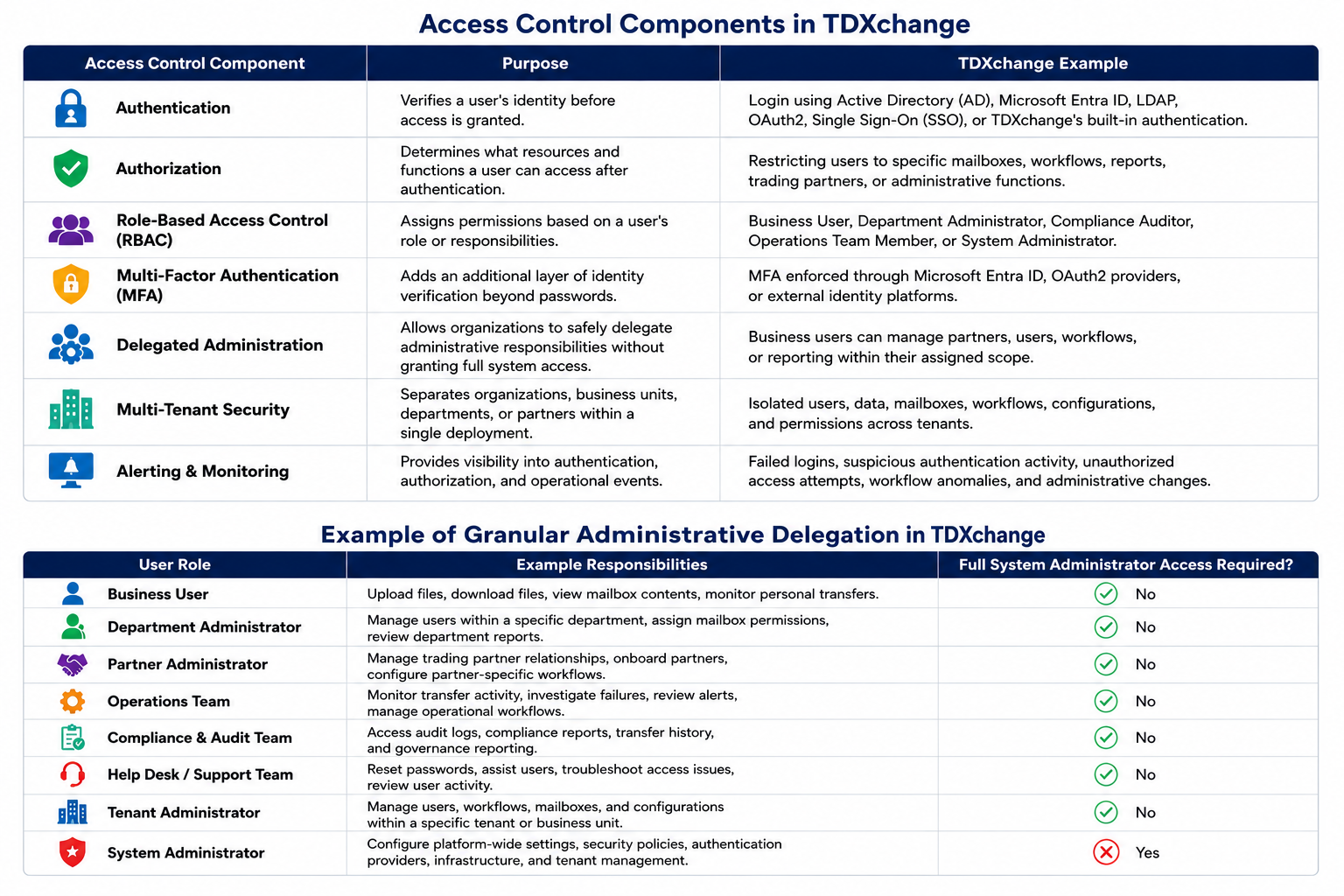
TDXchange also supports integration with a variety of enterprise identity providers, including:
- Microsoft Active Directory (AD)
- Microsoft Entra ID (formerly Azure AD)
- LDAP directories
- OAuth2 providers
- Single Sign-On (SSO) environments
This enables organizations to leverage existing identity management investments while maintaining consistent security policies across their infrastructure.
By integrating with enterprise authentication systems, organizations can simplify user lifecycle management, improve security, and reduce administrative overhead.
Why OAuth2 Matters
OAuth2 has become one of the most widely adopted authorization frameworks in enterprise environments.
Rather than relying solely on traditional passwords, OAuth2 uses secure access tokens issued by trusted identity providers.
Benefits include:
- Improved security
- Reduced credential exposure
- Support for MFA
- Simplified user experience
- Enhanced compliance
As organizations continue adopting cloud services and modern identity architectures, OAuth2 support becomes increasingly important for secure file transfer environments.
Built for Multi-Tenant Environments from Day One
One of the unique aspects of TDXchange is that it was designed from the beginning to support multi-tenant deployments.
Many MFT platforms were originally designed for single-organization use cases and later adapted to support multiple business units, customers, or partners.
TDXchange was architected differently.
Its multi-tenant design allows organizations to:
- Manage multiple business units
- Support external partners
- Separate departments securely
- Create isolated organizational environments
- Maintain centralized governance
This architecture provides flexibility while ensuring strong separation between users, data, workflows, and administrative responsibilities.
For organizations managing multiple divisions, subsidiaries, customers, or trading partners, this capability can significantly simplify operations.
Modern Access Control: Role Based Access Control, Policy Driven Authorization, and Delegated Administration
One of the most effective ways to simplify enterprise security while maintaining strong governance is Role Based Access Control (RBAC).
Rather than assigning permissions individually to every user, administrators define roles that represent specific job functions or operational responsibilities. Users inherit the permissions associated with those roles, making access control easier to manage, more consistent, and significantly less prone to administrative errors.
For example:
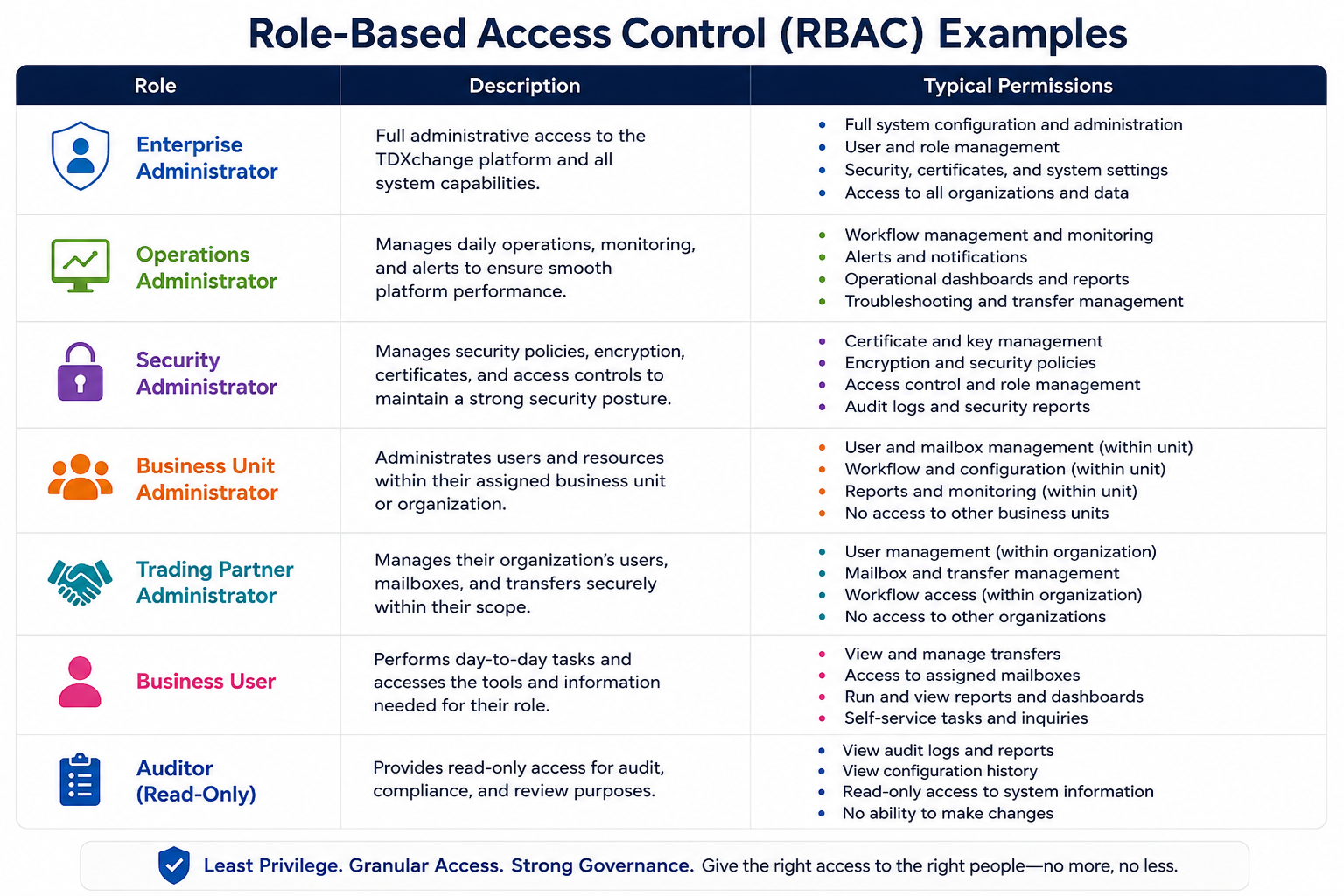
This approach provides several important benefits:
- Simplifies user administration
- Accelerates onboarding and offboarding
- Enforces least privilege access
- Improves operational consistency
- Strengthens governance and compliance
- Reduces the risk of excessive permissions
As enterprise environments continue to evolve, however, organizations increasingly require authorization decisions based on more than a user's role alone.
Modern access control often combines RBAC with policy driven authorization, allowing security decisions to consider additional context before granting access.
Access policies may evaluate:
- User role
- Organization or business unit
- Geographic location
- Device posture
- Authentication strength
- Time of day
- Data classification
- Business workflow
- Regulatory requirements
- Organizational security policies
- Operational risk
This additional context enables organizations to make dynamic authorization decisions rather than relying solely on static permissions.
Delegated Administration Without Sacrificing Security
One of the biggest operational challenges many organizations face is balancing strong security with day-to-day efficiency.
Without delegated administration, central IT teams often become operational bottlenecks because every user request, mailbox update, workflow modification, trading partner onboarding, or reporting request requires administrator involvement.
We've seen this challenge across organizations for years. Business users want the flexibility to manage their own day to day operations, while IT teams need to maintain security and governance. That's why we built granular Role Based Access Control and delegated administration into TDXchange early on, giving organizations the ability to securely distribute responsibilities without granting unnecessary administrative privileges.
That is why TDXchange provides highly configurable Role Based Access Control combined with granular delegated administration.
Rather than granting full administrative privileges, organizations can securely delegate specific responsibilities based on operational needs.
Examples include:
- User management
- Mailbox administration
- Workflow configuration
- Certificate management
- Reporting and dashboards
- Trading partner onboarding
- Transfer monitoring
- Operational troubleshooting
- Business unit administration
This allows departments, regional teams, and even external trading partners to securely manage the resources they own without exposing other parts of the platform.
Instead of granting excessive permissions, administrators assign only the access required for each responsibility, dramatically reducing risk while improving operational efficiency.
We believe this approach aligns naturally with Native End-to-End Zero Trust Architecture. Every administrative action, workflow modification, API request, AI interaction, and internal service communication should be continuously authenticated, authorized, and governed according to clearly defined policies.
The result is an enterprise platform that strengthens security while reducing administrative effort, improving customer experience, and enabling organizations to scale securely as their business grows.
Why Access Control Is the Foundation of Native End-to-End Zero Trust Architecture
As enterprise environments become increasingly interconnected, traditional access control models based on trusted internal networks are no longer sufficient.
Users connect from remote locations. Applications communicate through APIs. AI services analyze operational data. Business workflows span multiple cloud providers, and enterprise platforms increasingly rely on microservices communicating behind the scenes.
Every interaction represents a security decision.
This is why Native End-to-End Zero Trust Architecture is becoming the foundation of modern enterprise data exchange.
Rather than assuming users or systems can be trusted after authenticating once, Zero Trust continuously validates every interaction throughout the entire lifecycle of a business transaction.
Every request should answer the same questions:
- Who is requesting access?
- What resource is being requested?
- Is the requester authorized?
- Does organizational policy allow this action?
- Should access continue?
Trust is never inherited.
It is continuously verified.
Access control therefore becomes much more than a security feature. It becomes the mechanism that enables Zero Trust to operate consistently across the enterprise.
Native End-to-End Zero Trust Inside TDXchange
Most Zero Trust discussions focus on users authenticating into applications.
At bTrade, we believe that approach only solves part of the problem.
Modern enterprise software consists of numerous internal services working together to execute business processes. If those internal services implicitly trust one another, they create opportunities for lateral movement should one component ever become compromised.
That is why TDXchange extends Native End-to-End Zero Trust Architecture throughout the platform itself.
Rather than assuming internal platform components are trusted simply because they reside within the same application boundary, services continuously authenticate, authorize, and validate requests before exchanging information.
This architecture extends Zero Trust beyond:
- User authentication
- Administrative access
- APIs
- Business workflows
to include:
- Internal platform services
- Service-to-service communication
- Workflow engines
- Administrative processes
- Cloud integrations
- Background processing components
This significantly strengthens defense in depth while improving overall platform resilience.
We believe Zero Trust should not stop at the login screen.
It should protect every user, every workflow, every API, every AI interaction, every internal service, and every business transaction.
Access Control for Artificial Intelligence
Artificial Intelligence is becoming an increasingly valuable tool for simplifying enterprise operations.
Organizations are using AI to explain workflow failures, identify anomalies, recommend corrective actions, simplify partner onboarding, and improve operational visibility.
Naturally, customers ask an important question:
"What information can AI actually access?"
At bTrade, we believe the answer should always be:
Only the information it has been explicitly authorized to use.
That is why TDXchange treats AI as a Zero Trust entity.
AI does not receive elevated privileges simply because it can process large amounts of information.
Instead, every AI request follows the same Native End-to-End Zero Trust Architecture that governs every other platform component.
AI requests are evaluated using:
- Identity verification
- Role Based Access Control
- Least privilege
- Organizational security policies
- Data classification
- Immutable auditing
For example, if an administrator asks AI why a workflow failed, AI analyzes only the operational information that administrator already has permission to view.
It cannot retrieve information belonging to other business units, customers, or trading partners unless those permissions already exist.
At bTrade, AI doesn't receive special privileges.
It follows the same Native End-to-End Zero Trust Architecture that protects every user, workflow, API, and internal platform component.
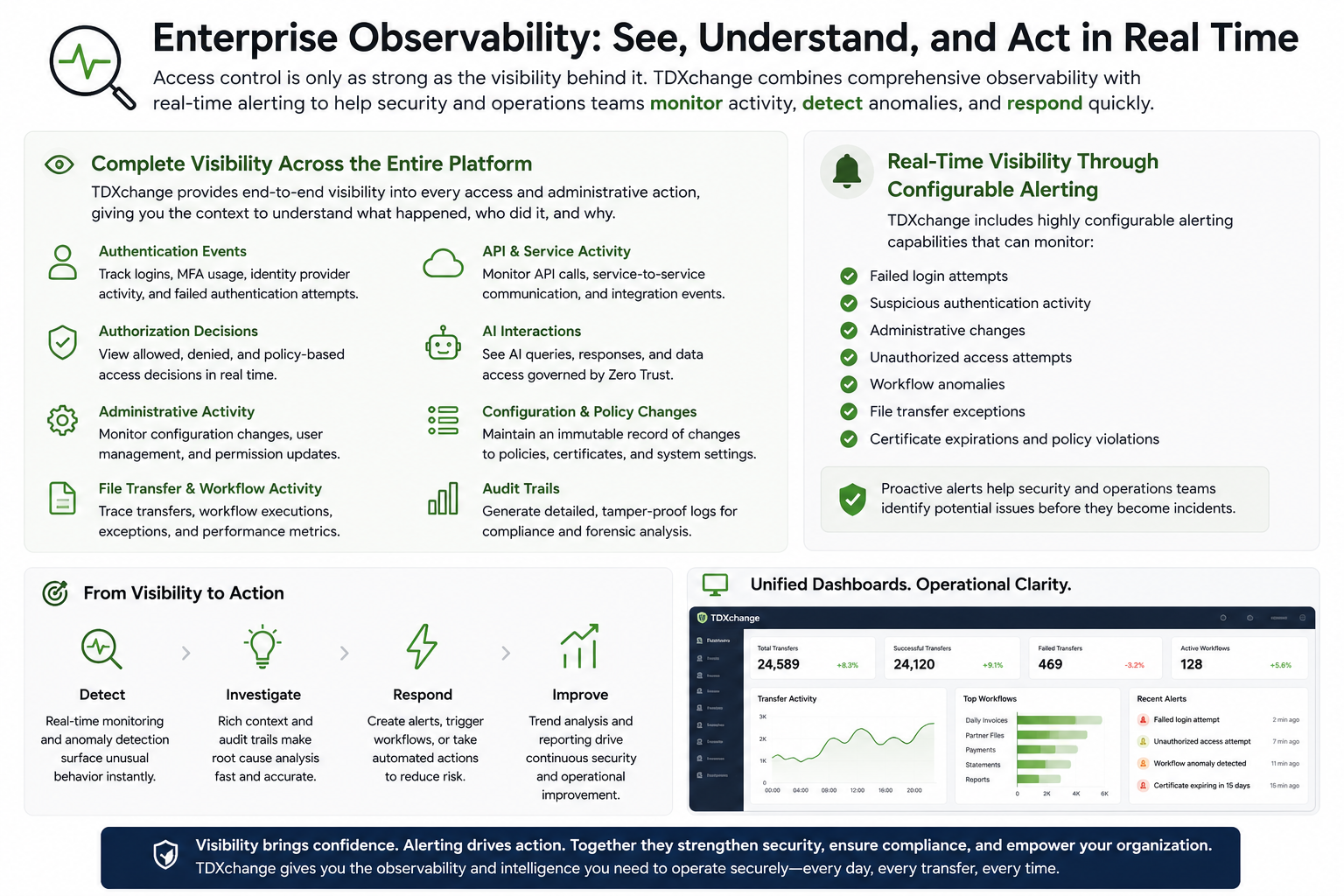
Enterprise Observability and Real-Time Security Alerting
Access control determines who should be allowed to perform an action.
Enterprise observability explains what actually happened, while real-time alerting ensures security and operations teams can respond before issues impact the business.
Together, these capabilities complement Native End-to-End Zero Trust Architecture by providing both continuous verification and continuous operational awareness.
Native End-to-End Zero Trust continuously validates trust.
Enterprise observability continuously validates operational health.
Configurable alerting continuously monitors for events that require immediate attention.
Rather than relying solely on audit logs after an incident occurs, organizations gain real-time insight into authentication events, authorization decisions, workflow execution, administrative activity, API communication, AI interactions, and system health.
This provides administrators with the context needed to understand not only what happened, but why it happened, who initiated it, and what actions should be taken next.
Modern Enterprise Data Exchange Platforms should provide visibility across the entire operational ecosystem, including:
- User authentication and authorization events
- Administrative activities and configuration changes
- Workflow execution and orchestration
- API activity and service-to-service communication
- AI requests and responses
- Trading partner interactions
- Certificate lifecycle events
- Policy enforcement decisions
- Security anomalies
- SLA performance
- File transfer activity and exceptions
- Platform health and resource utilization
However, visibility alone is not enough.
Organizations also need the ability to proactively detect abnormal behavior as it occurs.
That is why TDXchange includes highly configurable real-time alerting capabilities that help security and operations teams identify potential issues before they become operational incidents.
Alerts can be generated for events such as:
- Failed login attempts
- Suspicious authentication activity
- Unauthorized access attempts
- Administrative changes
- Workflow anomalies
- File transfer failures and exceptions
- Certificate expirations
- Policy violations
- SLA threshold breaches
- Unusual transfer activity
- API failures
- Infrastructure or service health events
Rather than waiting for users to report problems, administrators receive immediate visibility into events that may require investigation, allowing them to respond faster, reduce operational risk, and maintain business continuity.
As discussed in our companion article on MFT Observability, enterprise observability is evolving well beyond traditional monitoring. Combined with configurable alerting, AI-assisted operational intelligence, and Native End-to-End Zero Trust Architecture, it enables organizations to move from reactive troubleshooting to proactive operations management.
At bTrade, we believe enterprise observability should do more than collect logs. It should provide the intelligence needed to understand how enterprise data moves across the organization, identify abnormal behavior before it becomes an incident, and give administrators the confidence to make informed operational decisions in real time.
Ultimately, observability, alerting, and Zero Trust work together to strengthen security, improve governance, simplify troubleshooting, and create a more resilient Enterprise Data Exchange Platform.
Access Control Lifecycle, Recertification, and Regulatory Compliance
Effective access control is not a one-time event performed when a user account is created. As organizations grow, employees change roles, business relationships evolve, and regulatory requirements become more demanding, access permissions must continually be reviewed to ensure they remain appropriate.
Modern Enterprise Data Exchange Platforms should treat access control as a continuous lifecycle rather than a static configuration.
A comprehensive access control lifecycle typically includes:
- Identity verification
- Authentication
- Authorization
- Policy evaluation
- Workflow execution
- Continuous monitoring and observability
- Audit logging
- Periodic access recertification
- Access modification or revocation when responsibilities change
One of the most overlooked aspects of enterprise security is access recertification.
Users frequently change departments, assume new responsibilities, leave projects, or transition to different organizations. Without periodic reviews, permissions often accumulate over time, creating unnecessary risk and violating the principle of least privilege.
For this reason, many regulatory frameworks require organizations to regularly review and validate user access to ensure permissions remain appropriate.
Recognizing this challenge early on, TDXchange includes highly configurable automated access recertification capabilities. Organizations can define review schedules based on their governance policies, allowing managers and administrators to periodically verify that users, administrators, trading partners, service accounts, and delegated administrators continue to require the permissions they have been assigned.
Automating this process reduces administrative effort while helping organizations maintain strong security and consistent governance across the enterprise.
Comprehensive access governance also plays a critical role in demonstrating regulatory compliance.
Many security frameworks and industry regulations require organizations to provide evidence that access is properly controlled, reviewed, and continuously monitored. Modern access control platforms should support capabilities such as:
- Least privilege access
- Role separation and segregation of duties
- Identity verification
- Multi-Factor Authentication
- Policy-based authorization
- Immutable audit logging
- Administrative accountability
- Periodic access recertification
- Continuous monitoring and observability
Together, these capabilities help organizations align with security and compliance initiatives including:
- GDPR
- HIPAA
- PCI DSS
- SOX
- NIST Cybersecurity Framework
- ISO 27001
Beyond satisfying regulatory requirements, continuous access governance helps organizations reduce operational risk by ensuring users retain only the permissions they need to perform their current responsibilities.
At bTrade, we believe access control should not end when access is granted. It should be continuously validated throughout the entire lifecycle of every user, administrator, API, workflow, AI service, and business relationship. By combining granular Role-Based Access Control, Native End-to-End Zero Trust Architecture, enterprise observability, and automated access recertification, TDXchange helps organizations strengthen security while simplifying governance and day-to-day administration.
Executive Takeaways
Enterprise access control has evolved beyond authentication and passwords. Modern organizations require a comprehensive approach that combines enterprise identity integration, granular Role-Based Access Control, delegated administration, policy-driven authorization, automated access recertification, and Native End-to-End Zero Trust Architecture to protect increasingly distributed enterprise environments.
Effective access control is also an ongoing governance process. Permissions should be continuously monitored, periodically recertified, and adjusted as users, business relationships, and organizational responsibilities change. Combining these capabilities with enterprise observability and configurable real-time alerting enables organizations to strengthen security, simplify administration, and demonstrate compliance with evolving regulatory requirements.
At bTrade, we've seen these operational challenges across organizations of every size. That experience led us to build granular access controls, delegated administration, enterprise identity integration, automated access recertification, enterprise observability, and Native End-to-End Zero Trust Architecture directly into TDXchange. With TDXchange v5, we extended Zero Trust beyond user authentication to include workflows, APIs, AI services, and internal platform components, helping organizations strengthen security without increasing operational complexity.
Continue Your Enterprise Security Journey
To learn more about the topics discussed in this article, we recommend these related resources:
- Native End-to-End Zero Trust Architecture: The Foundation of Modern Enterprise Data Exchange: Learn how continuous verification secures users, APIs, workflows, AI services, and internal platform components.
- AI Security and Governance in Managed File Transfer: Discover how TDXchange applies Zero Trust principles to AI, ensuring intelligent automation operates within clearly defined security boundaries.
- MFT Observability: Explore how enterprise observability provides complete visibility into authentication events, workflows, administrative activities, policy enforcement, and operational health.
- The Future of Enterprise Data Exchange: Discover how AI, Native End-to-End Zero Trust Architecture, enterprise observability, crypto agility, intelligent workflow orchestration, and customer-driven innovation are shaping the next generation of enterprise data exchange.
About the Author
Andrei Olin is Chief Technology Officer at bTrade, where he leads product strategy, delivery, and security across the company’s B2B, Managed File Transfer (MFT), and security platforms. He brings over 30 years of experience in enterprise technology, including designing and operating mission-critical MFT and messaging platforms for global financial institutions such as Merrill Lynch and Deutsche Bank. Andrei holds Master’s and Bachelor’s degrees in Information Technology with a focus on Information Security.
Frequently Asked Questions
Does TDXchange integrate with enterprise identity providers?
Yes. TDXchange integrates with a wide range of enterprise identity providers, including Microsoft Active Directory, Microsoft Entra ID, LDAP, OAuth2, etc. This allows organizations to leverage their existing identity infrastructure while maintaining consistent authentication and authorization policies across the platform.
Does TDXchange support Microsoft Active Directory?
Yes. TDXchange integrates with Microsoft Active Directory for centralized user authentication, identity management, and access control, simplifying user administration while maintaining enterprise security policies.
Does TDXchange support Microsoft Entra ID?
Yes. TDXchange integrates with Microsoft Entra ID (formerly Azure Active Directory), enabling modern identity management, Single Sign-On (SSO), conditional access policies, and seamless integration with Microsoft's cloud identity ecosystem.
Does TDXchange support LDAP authentication?
Yes. TDXchange supports LDAP integration, allowing organizations to authenticate users against enterprise directory services while centralizing identity management and reducing administrative overhead.
Does TDXchange support OAuth2 and OpenID Connect?
Yes. TDXchange supports OAuth2 and OpenID Connect (OIDC), enabling secure token-based authentication and modern identity federation for cloud, hybrid, and enterprise environments.
Is TDXchange a multi-tenant Managed File Transfer platform?
Yes. TDXchange was designed as a multi-tenant Enterprise Data Exchange Platform, allowing organizations to securely manage multiple business units, customers, trading partners, departments, or subsidiaries within a single deployment while maintaining complete separation of users, data, and administrative responsibilities.
Can administrative responsibilities be delegated to business users?
Yes. TDXchange provides granular Role-Based Access Control (RBAC) and secure delegated administration, allowing organizations to assign specific administrative responsibilities without granting full system administrator privileges.
Examples include:
- User management
- Mailbox administration
- Workflow configuration
- Trading partner onboarding
- Reporting and dashboards
- Transfer monitoring
- Operational troubleshooting
This enables organizations to improve operational efficiency while maintaining centralized governance and security.
Does TDXchange support Native End-to-End Zero Trust Architecture?
Yes. TDXchange v5 implements Native End-to-End Zero Trust Architecture, continuously verifying users, workflows, APIs, AI services, cloud integrations, and internal platform components before allowing information to be exchanged. Rather than relying on implicit trust, every interaction is authenticated, authorized, and evaluated against organizational security policies.
Does TDXchange apply Zero Trust principles to AI?
Yes. TDXchange treats AI as a Zero Trust entity. AI does not receive elevated privileges or unrestricted access to enterprise information. Every AI request is governed by the same Native End-to-End Zero Trust Architecture that protects users, workflows, APIs, and internal platform services. AI can access only the information it has been explicitly authorized to use.
Does TDXchange support automated access recertification?
Yes. TDXchange includes configurable automated access recertification, allowing organizations to periodically review and validate user, administrator, trading partner, and delegated administrator permissions. This helps organizations enforce least privilege, simplify governance, and support regulatory compliance.
How does TDXchange improve enterprise observability?
TDXchange combines enterprise observability with configurable real-time alerting to provide visibility into authentication events, authorization decisions, workflow execution, administrative activity, policy enforcement, API communication, AI interactions, certificate lifecycle events, and system health. This enables organizations to identify operational and security issues proactively rather than reacting after incidents occur.
How does TDXchange support regulatory compliance?
TDXchange helps organizations strengthen governance and support compliance initiatives through granular Role-Based Access Control, delegated administration, policy-based authorization, immutable audit logging, enterprise observability, automated access recertification, and Native End-to-End Zero Trust Architecture. These capabilities help organizations align with regulatory and security frameworks such as GDPR, HIPAA, PCI DSS, SOX, NIST Cybersecurity Framework, and ISO 27001.