
Why Enterprise AI Needs Zero Trust: Lessons from a Conversation with a Pharmaceutical Company
Executive Summary
Artificial Intelligence is rapidly becoming part of enterprise operations, helping organizations simplify administration, improve operational visibility, accelerate decision-making, and reduce manual effort. However, as AI adoption grows, so does an important question:
How much access should AI actually have?
This topic recently became one of the most important discussions during a TDXchange demonstration with a large pharmaceutical company. What began as a conversation about AI-powered operational intelligence quickly evolved into a broader discussion about security, compliance, governance, and trust.
At bTrade, we believe AI should never become an exception to enterprise security. It should operate within the same Native End-to-End Zero Trust Architecture and Role-Based Access Control (RBAC) that govern users, applications, APIs, and workflows, ensuring AI only accesses information appropriate for each user's role and responsibilities.
This article expands on Pillar 2: AI-Powered Operational Intelligence from our flagship article, The Future of Enterprise Data Exchange, and explains why secure AI governance is becoming just as important as AI itself. It also complements our articles on Native End-to-End Zero Trust Architecture and AI Security & Governance, demonstrating how organizations can embrace AI without compromising security or trust, or compliance.
Key Takeaways
- AI can significantly improve operational efficiency, onboarding, troubleshooting, and administration.
- Unrestricted AI access can create security, privacy, compliance, and governance risks.
- Zero Trust principles should extend to AI systems.
- AI should follow Role-Based Access Control (RBAC) policies just like human users.
- Different users should receive different AI experiences based on their permissions.
- Highly regulated industries require strong governance around AI access.
- bTrade's proprietary AI capabilities for TDXchange are designed to access only approved operational information.
- Enterprise AI should enhance security and productivity without bypassing existing controls.
The Conversation That Sparked This Discussion
During a recent demonstration of TDXchange with a pharmaceutical organization, we discussed several AI capabilities currently planned for future releases, including natural language interactions that can help users:
- Navigate platform functionality
- Accelerate onboarding
- Troubleshoot issues
- Access documentation
- Simplify administration
- Gain operational insights
As the discussion progressed, one attendee asked a question that immediately shifted the focus of the conversation:
"What information does the AI have access to?"
It's a simple question, but it's one that every organization evaluating enterprise AI should be asking.
When we explained that our AI model is designed to access only specifically approved operational information and not unrestricted platform data, the reaction was immediate surprise.
Like many organizations exploring AI, the assumption was that greater access automatically produces better outcomes.
In reality, that assumption can create substantial risk.
The Dangerous Myth: More AI Access Equals Better AI
Many organizations are still determining how AI should fit into their security architecture.
Unfortunately, some implementations are being designed around convenience rather than governance.
The reasoning often sounds like this:
"If AI can see everything, it can help with everything."
While that may seem logical on the surface, it ignores a critical reality:
Every additional piece of information accessible to AI increases potential risk exposure.
The broader an AI system's access becomes, the larger the attack surface becomes as well.
That can include exposure to:
- Sensitive customer information
- Intellectual property
- Healthcare records
- Financial data
- Credentials and authentication information
- Proprietary research
- Internal business communications
- Compliance-regulated information
For organizations operating in pharmaceutical, healthcare, financial services, insurance, government, and other highly regulated industries, unrestricted AI access can quickly create risks that outweigh the operational benefits.
The objective should not be to build an AI that knows everything.
The objective should be to build an AI that knows only what it needs to know.
Why Zero Trust Principles Must Extend to AI
The Zero Trust security model has become a foundational framework for modern cybersecurity programs.
At its core, Zero Trust follows three simple principles:
- Never trust by default
- Continuously verify access
- Grant only the minimum permissions required
Most organizations already apply these principles to:
- Users
- Applications
- Devices
- APIs
- Infrastructure
- Networks
AI should be no different.
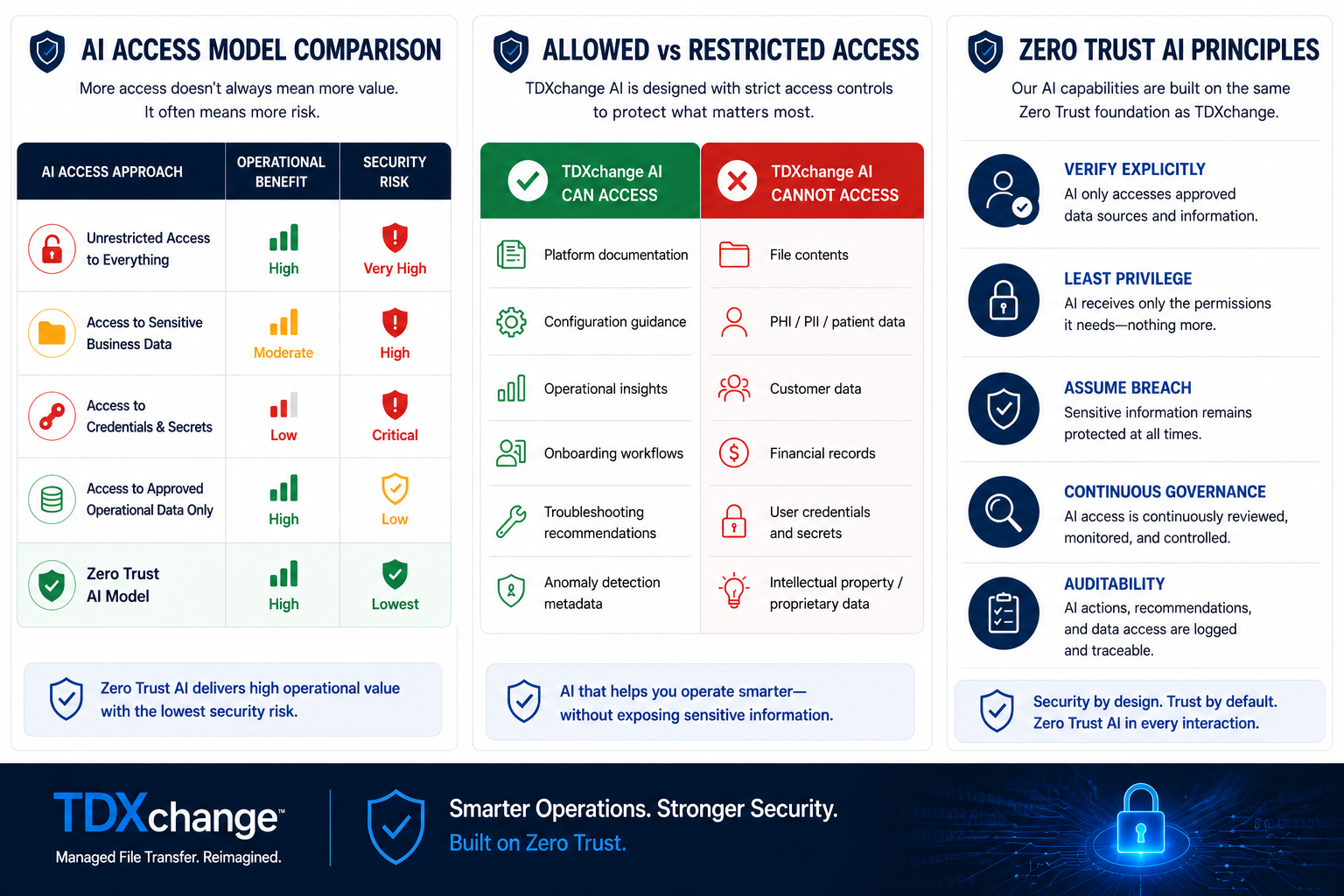
If an employee is not authorized to access specific information, an AI assistant acting on behalf of that employee should not be able to access it either.
If an administrator has elevated permissions, AI interactions should reflect those permissions appropriately.
Zero Trust AI means ensuring that AI operates within the same governance framework as the rest of the organization.
How We Are Building AI-Powered Operational Intelligence in TDXchange
As we develop our proprietary AI capabilities for TDXchange, security, governance, and operational trust remain foundational design principles. Our objective is not to build an unrestricted AI assistant with visibility into every file, workflow, user account, or dataset. Instead, we are building AI-powered Operational Intelligence that helps administrators work more efficiently while remaining fully governed by our Native End-to-End Zero Trust Architecture.
Our philosophy is simple: AI should assist administrators, not bypass established security controls.
AI excels at processing operational information, identifying patterns, explaining unusual behavior, and recommending next steps. Security policies, however, must remain deterministic, auditable, and under human control.
Our AI roadmap focuses on helping organizations simplify day-to-day operations through capabilities such as:
- Natural language operational guidance
- Platform configuration assistance
- Operational insights and recommendations
- Product documentation assistance
- User onboarding support
- Troubleshooting guidance
- Workflow optimization suggestions
- Transfer monitoring assistance
- Intelligent anomaly detection
- Operational summaries and trend analysis
These capabilities provide significant operational value without requiring unrestricted access to sensitive enterprise information.
By design, AI primarily analyzes operational metadata, such as workflow status, transfer activity, configuration information, system events, administrative changes, and platform documentation, rather than sensitive business data. This allows AI to help users understand what happened, why it happened, and what actions to consider next, without exposing information such as:
- Sensitive file contents
- Protected Health Information (PHI)
- Personally Identifiable Information (PII)
- Customer records
- Financial transactions
- Intellectual property
- Research data
- User credentials
- Confidential business information
Like every other component within TDXchange, AI operates according to Role-Based Access Control (RBAC) and the principle of least privilege. AI never has broader visibility than the user requesting assistance. Instead, it inherits the user's permissions and provides guidance only within those authorized boundaries.
Administrator Role
An administrator responsible for managing the Enterprise Data Exchange platform may ask questions such as:
- Show me configuration recommendations for improving system performance.
- Help me troubleshoot why this file transfer failed.
- Identify unusual operational activity across the platform.
- Suggest workflow optimization opportunities.
- Which certificates are approaching expiration?
- Summarize configuration changes made during the last seven days.
Because the administrator is authorized to access platform-wide operational information, AI can provide recommendations and insights within those approved security boundaries.
Standard User Role
A standard business user has a very different experience because their permissions are intentionally more limited. They might ask:
- How do I send a file securely?
- Why did my transfer fail?
- How do I onboard a new trading partner?
- Where can I find my transfer reports?
- How do I reset my authentication method?
- What does this transfer status mean?
In this case, AI responds only with information the user is already authorized to access. It cannot expose administrative settings, other users' activity, partner configurations, workflow definitions, or sensitive operational information outside that user's role.
This approach allows organizations to provide intelligent assistance across the enterprise while ensuring AI respects the same security model that governs users, applications, APIs, workflows, and internal platform services.
Most users are not asking AI to make business decisions on their behalf. They want faster answers, simpler onboarding, easier troubleshooting, and intelligent operational guidance that reduces the time spent searching documentation or manually investigating issues.
We believe those outcomes can be achieved while maintaining Role-Based Access Control (RBAC), least-privilege access, full auditability, and Native End-to-End Zero Trust Architecture. By treating AI as another governed enterprise service rather than an exception to security, organizations can confidently adopt AI-powered Operational Intelligence without compromising trust, compliance, or control.
Most users simply want answers faster.
They want onboarding to be easier.
They want troubleshooting to be simpler.
They want operational guidance without spending hours searching documentation.
Those outcomes can be achieved while still maintaining Zero Trust security principles.
Operational Metadata vs. Business Data
One of the biggest misconceptions surrounding enterprise AI is that delivering intelligent operational assistance requires unrestricted access to business data.
In reality, the opposite is often true.
Most operational questions can be answered by analyzing operational metadata rather than the actual contents of the files being transferred.
For example, when an administrator asks why a transfer failed, AI doesn't necessarily need to inspect the file itself. The answer is often found in operational information such as authentication events, workflow execution, transfer logs, configuration changes, certificate status, network conditions, or system alerts.
This distinction is fundamental to how we approach AI-powered Operational Intelligence in TDXchange.
Whenever possible, AI analyzes operational metadata that describes how the platform is behaving, rather than sensitive business information contained within the files themselves.
Examples of operational metadata include:
- Workflow execution status
- File transfer status and history
- Transfer volumes and throughput trends
- Authentication and authorization events
- Administrative activity
- Certificate lifecycle information
- Partner onboarding status
- API activity
- System health and performance metrics
- Configuration changes
- Scheduling information
- Audit events
- Policy violations
- Operational alerts
Using this information, AI can answer questions such as:
- Why did this transfer fail?
- Which workflows experienced unusual activity overnight?
- Are there any authentication anomalies?
- Which certificates are approaching expiration?
- What changed before this issue occurred?
- Which partners are experiencing repeated failures?
- Are transfer volumes significantly different from historical patterns?
- What operational trends require attention?
In many cases, these questions can be answered without AI ever accessing the contents of the transferred files.
This is an important distinction because operational metadata and business data serve very different purposes.

By focusing AI on operational metadata first, organizations can deliver meaningful operational assistance while significantly reducing exposure to sensitive information.
There are certainly situations where AI may need access to business data, for example, to classify documents, detect sensitive information as part of a Data Loss Prevention (DLP) policy, or extract information from structured documents. In those cases, access should be explicitly authorized, limited to the minimum data required, fully auditable, and governed by Role-Based Access Control (RBAC) and Native End-to-End Zero Trust Architecture.
Defining AI Trust Boundaries
This distinction establishes one of the most important principles of enterprise AI governance:
AI should receive the minimum information required to solve the problem and not the maximum information available.
Whenever AI requires access beyond operational metadata, that access should be explicitly authorized, governed by Role-Based Access Control (RBAC), continuously verified through our Native End-to-End Zero Trust Architecture, and fully auditable.
Why This Matters for Pharmaceutical and Other Regulated Industries
Organizations in pharmaceutical, healthcare, financial services, insurance, manufacturing, and government sectors face a unique challenge.
They are expected to embrace innovation while simultaneously strengthening security and compliance.
These organizations must balance:
- AI adoption
- Data privacy
- Regulatory compliance
- Operational efficiency
- Governance
- Security
- Risk management
For pharmaceutical companies in particular, the stakes are especially high.
These organizations routinely manage:
- Proprietary research
- Clinical trial information
- Intellectual property
- Regulated manufacturing data
- Sensitive patient-related information
- Global partner ecosystems
A poorly governed AI implementation could create significant compliance and security concerns.
A well-governed AI implementation can improve productivity while preserving trust.
That balance is exactly what enterprise AI requires.
The Future of Enterprise AI
Artificial Intelligence will undoubtedly become a core component of enterprise operations. The question is no longer whether organizations will adopt AI, it's how they will adopt it responsibly.
The most successful enterprise AI implementations will not be those with unrestricted access to every system, database, and file. They will be the ones that combine operational intelligence with governance, enabling AI to deliver meaningful insights while respecting the same security principles that protect every other component of the enterprise.
AI should help administrators understand what is happening across increasingly complex Enterprise Data Exchange environments, explain why it happened, identify emerging operational trends, and recommend appropriate next steps. It should accelerate decision-making and not replace it.
Achieving that vision requires more than advanced AI models. It requires clearly defined trust boundaries, Role-Based Access Control (RBAC), least-privilege access, continuous authorization, and complete auditability. AI should only access the information necessary to perform its intended function, with every interaction governed by Native End-to-End Zero Trust Architecture.
At bTrade, we believe AI-powered Operational Intelligence should enhance human expertise, not bypass security controls. By combining intelligent operational assistance with deterministic policy enforcement, organizations can simplify administration, improve operational efficiency, and confidently embrace AI without compromising security, privacy, compliance, or trust.
This philosophy represents Pillar 2 of our vision for the future of Enterprise Data Exchange. As AI continues to evolve, the organizations that realize the greatest value will not be those that simply deploy AI the fastest, they will be those that deploy it securely, govern it responsibly, and integrate it into enterprise operations in a way that strengthens both productivity and trust.
Executive Takeaways
Artificial Intelligence is becoming an integral part of Enterprise Data Exchange, but its success depends as much on governance as it does on intelligence. The greatest value comes from AI that helps administrators understand operational activity, accelerate decision-making, and simplify complex environments while remaining fully governed by Native End-to-End Zero Trust Architecture.
At bTrade, we believe AI should never become an exception to enterprise security. By combining AI-powered Operational Intelligence, Role-Based Access Control (RBAC), least-privilege access, and clearly defined trust boundaries, organizations can improve operational efficiency without compromising security, privacy, compliance, or trust. The future of enterprise AI isn't unrestricted access, it's intelligent assistance built on secure, transparent, and governed foundations.
About the Author
Hanz Jorgensen is Chief Operating Officer and Managing Member at bTrade, where he oversees daily operations and works closely with the leadership team to shape and execute the company’s strategic direction. With more than 20 years of experience with several different MFT/technology companies spanning system administration, development, customer support, pre-sales, and enterprise solution delivery, Hanz brings a uniquely practical perspective on what organizations actually need from managed file transfer platforms. He leads bTrade’s Solution Consulting team and plays a central role in aligning product capabilities with real customer requirements across regulated and high-complexity environments.
Frequently Asked Questions
What is AI-powered Operational Intelligence?
AI-powered Operational Intelligence uses Artificial Intelligence to analyze operational information, identify patterns, explain unusual behavior, prioritize issues, and recommend corrective actions. Rather than replacing administrators, it helps them make faster, more informed decisions while managing increasingly complex Enterprise Data Exchange environments.
Should AI have unrestricted access to enterprise data?
No. In most cases, AI can deliver meaningful operational insights by analyzing operational metadata such as workflow activity, transfer history, authentication events, configuration changes, and system health without requiring access to sensitive business data. When access to business information is required, it should be explicitly authorized, governed by Role-Based Access Control (RBAC), and continuously verified through Native End-to-End Zero Trust Architecture.
What is Zero Trust AI?
Zero Trust AI applies the same security principles to Artificial Intelligence that govern users, applications, APIs, and infrastructure. AI receives only the permissions necessary to perform its intended function, every request is continuously authorized, and every interaction remains fully auditable.
How does Role-Based Access Control (RBAC) apply to AI?
Within TDXchange, AI does not receive its own unrestricted permissions. Instead, it inherits the permissions of the authenticated user, ensuring it only accesses information that user is already authorized to view. This allows AI to provide intelligent assistance while maintaining least-privilege access and protecting sensitive enterprise information.
What is the difference between operational metadata and business data?
Operational metadata describes how the platform is operating, including workflow execution, transfer activity, authentication events, configuration changes, and system health. Business data refers to the contents of transferred files, such as customer information, financial records, healthcare data, intellectual property, and confidential documents. Whenever possible, TDXchange AI analyzes operational metadata rather than business data to reduce security and privacy risks.
Why is AI governance important?
AI governance ensures Artificial Intelligence operates securely, transparently, and responsibly. By combining Role-Based Access Control (RBAC), least-privilege access, deterministic security controls, full auditability, and Native End-to-End Zero Trust Architecture, organizations can improve operational efficiency while maintaining security, compliance, privacy, and trust.
How is bTrade implementing AI within TDXchange?
bTrade is developing AI-powered Operational Intelligence capabilities that help administrators simplify enterprise operations through natural language assistance, operational insights, troubleshooting guidance, intelligent anomaly detection, transfer analysis, onboarding assistance, workflow optimization recommendations, and operational summaries. Every capability is designed to operate within Native End-to-End Zero Trust Architecture, ensuring AI enhances operations without bypassing established security controls.
Can AI make security or administrative decisions automatically?
No. AI is designed to assist administrators by identifying patterns, explaining operational events, and recommending actions. Security enforcement including authentication, authorization, encryption, access control, and policy decisions—remains governed by deterministic controls and human oversight.
How does this article relate to the Future of Enterprise Data Exchange?
This article expands on Pillar 2: AI-Powered Operational Intelligence from our flagship article, The Future of Enterprise Data Exchange: AI, Zero Trust, Quantum-Safe Security, and the Evolution of Managed File Transfer. It explains how organizations can adopt AI to improve enterprise operations while maintaining the governance, security, and trust required for modern Enterprise Data Exchange platforms.