
Executive Summary
Choosing a Managed File Transfer (MFT) platform is one of the most important infrastructure decisions an organization can make. Unlike many business applications that are replaced every few years, MFT platforms often remain in production for a decade or longer, becoming deeply integrated into business processes, customer interactions, supply chains, and regulatory compliance programs.
Unfortunately, many organizations still evaluate Managed File Transfer solutions using feature checklists that focus on current requirements instead of long-term business objectives.
The reality is that enterprise data exchange has changed dramatically. Organizations are no longer moving files simply between internal servers or external trading partners. Today's environments connect cloud platforms, SaaS applications, APIs, AI services, business workflows, and thousands of external organizations.
Selecting the right platform means choosing technology that can evolve alongside your business.
This guide provides practical questions every CIO, CISO, Enterprise Architect, and IT Operations leader should ask when evaluating Managed File Transfer solutions. These questions are based on the six foundational pillars we introduced in our companion article, The Future of Enterprise Data Exchange: AI, Zero Trust, Quantum-Safe Security, and the Evolution of Managed File Transfer. Together, these articles provide both the strategic vision and the practical framework for evaluating modern Enterprise Data Exchange platforms.
Key Takeaways
- Managed File Transfer should be evaluated as part of a broader Enterprise Data Exchange strategy.
- Feature checklists alone no longer provide enough insight for long-term platform selection.
- The six pillars of Enterprise Data Exchange offer a practical framework for evaluating modern MFT solutions.
- Asking the right questions helps organizations avoid costly migrations and technical debt.
- Selecting the right technology partner is as important as selecting the right technology.
- A future-proof MFT platform should orchestrate complete business processes across files, APIs, applications, cloud services, message queues, and trading partners rather than managing each exchange as an isolated transfer.
- Buyers should evaluate how automation is triggered, how integrations are governed, how exceptions are handled, and whether complete workflows can be monitored from initiation through final business outcome.
This guide outlines how CIOs and CISOs should evaluate future-proof MFT vendors to support long-term risk management, scalability, and governance.
Why MFT Is a Strategic Control, Not a Commodity Tool
In modern enterprises, MFT platforms increasingly underpin a variety of critical functions, including:
- Secure exchange of regulated data (PII, PHI, financial records)
- Enforcement of encryption, authentication, and access policies
- Audit trails required for SOC 2, HIPAA, GDPR, PCI, SOX
- Operational SLAs tied to revenue, partner obligations, and customer experience
- Visibility into systemic risk across complex integration ecosystems
Consequently, from a leadership perspective, the question is not:
“Does this product support SFTP?”
It is:
“Can this platform help us demonstrate control, resilience, and accountability at scale?”
Managed File Transfer Is No Longer Just About Moving Files
For many years, organizations evaluated MFT platforms based on protocol support, scheduling capabilities, encryption, and automation. Those capabilities remain important, but they are no longer enough.
Modern data exchange environments must support hybrid cloud architectures, regulatory compliance, Zero Trust security, AI-assisted operations, operational intelligence, disaster recovery, and cryptographic agility. At the same time, IT teams are expected to do more with fewer resources while maintaining continuous availability.
That is why we believe the future belongs to Enterprise Data Exchange rather than traditional Managed File Transfer.
In our companion article The Future of Enterprise Data Exchange: AI, Zero Trust, Quantum-Safe Security, and the Evolution of Managed File Transfer, we introduced six foundational pillars that define this evolution:
- AI-Driven Operational Intelligence
- Native Zero Trust Architecture
- Quantum-Safe Security and Cryptographic Agility
- Unified Enterprise Data Exchange and Orchestration
- Cloud-Native Scalability and Business Resilience
- Customer-Driven Innovation and Human-Centered Enterprise Data Exchange
This article explains how to evaluate vendors against each of these pillars.
Pillar 1: AI-Driven Operational Intelligence
Artificial Intelligence should help administrators work more efficiently, not create additional security concerns or operational complexity.
Ask potential vendors:
- How does AI help operators resolve issues faster?
- Can AI explain transfer failures in natural language?
- Can AI identify abnormal operational behavior?
- Does AI provide operational recommendations?
- How is access to AI governed?
- Does AI respect role-based access controls?
The objective is not to replace administrators. The objective is to eliminate repetitive troubleshooting and provide better operational insight while maintaining strong governance.
Pillar 2: Native Zero Trust Architecture
Zero Trust is rapidly becoming the security model organizations expect from modern enterprise platforms.
Ask your vendor:
- Does every service authenticate independently?
- Is least-privilege enforced throughout the platform?
- Can administrative access be delegated?
- How are APIs secured?
- How are service-to-service communications protected?
- Does the platform integrate with enterprise identity providers?
Security should extend beyond encrypted file transfers. Every user, application, workflow, and service should be continuously authenticated and authorized.
Pillar 3: Quantum-Safe Security and Cryptographic Agility
Many organizations are beginning to prepare for post-quantum cryptography.
Whether migration occurs in two years or ten years, today's platform should be capable of evolving.
Questions to ask include:
- Does the vendor have a roadmap for quantum-safe cryptography?
- Can encryption algorithms evolve without replacing the platform?
- Is cryptographic agility built into the architecture?
- How will long-term sensitive information remain protected?
Preparing today reduces future migration risk.
Pillar 4: Unified Enterprise Data Exchange and Orchestration
Modern business processes increasingly connect files, APIs, applications, cloud services, and external partners.
Ask vendors:
- Can the platform coordinate file transfers, APIs, applications, and cloud services within one governed workflow?
- Can workflows begin through schedules, events, APIs, and business conditions?
- Can common integrations and configurations be reused?
- How much custom scripting is required?
- Can failures, retries, and exceptions be handled automatically?
- Can transactions be monitored from initiation through final business outcome?
Organizations should evaluate whether the platform can manage complete data exchange processes rather than isolated file transfers. For a deeper technical discussion, read Enterprise File Transfer Automation and Workflow Orchestration.
Pillar 5: Cloud-Native Scalability and Business Resilience
Infrastructure requirements will inevitably change.
Organizations migrate to new cloud providers, acquire businesses, expand globally, and increase transaction volumes.
Ask vendors:
- Can the platform scale horizontally?
- Does it support hybrid deployments?
- Can it operate across multiple cloud providers?
- What high availability options exist?
- What disaster recovery capabilities are available?
- Can architecture evolve without replacing the platform?
Flexibility today prevents expensive migrations tomorrow.
Pillar 6: Customer-Driven Innovation and Human-Centered Enterprise Data Exchange
Technology alone does not determine long-term success.
The vendor relationship often matters just as much.
Ask questions such as:
- How is your product roadmap developed?
- How much customer feedback influences new features?
- Will we work directly with experienced product specialists?
- What implementation guidance do you provide?
- How do you help customers prepare for future technologies?
Organizations should choose partners that continue innovating alongside their customers rather than simply releasing new features.
Questions Every Vendor Should Be Able to Answer
As you evaluate Managed File Transfer platforms, every vendor should be able to confidently answer questions such as:
- How does your platform implement Zero Trust?
- How is AI governed?
- What is your roadmap for post-quantum cryptography?
- How do you provide business-level operational visibility?
- Can the platform orchestrate APIs and file transfers together?
- How do you simplify compliance?
- How do you support disaster recovery?
- Can the platform scale without major architectural changes?
- How do customers influence your roadmap?
- How will your platform still meet our needs five years from now?
The quality of these answers often tells you more than a lengthy feature checklist.
What “Future-Proof” Really Means for Executives
For CIOs and CISOs, future-proofing is less about features and more about avoiding architectural dead ends. A future-ready MFT platform should:
- Adapt to evolving regulatory frameworks without re-architecture
- Support hybrid and multi-cloud operating models
- Integrate cleanly with modern identity, security, and observability stacks
- Provide measurable governance (SLAs, reporting, audit evidence)
- Reduce operational risk through automation rather than human heroics
- Scale with the business without exponential cost or complexity
Platforms that require heavy customization, manual oversight, or brittle scripting often fail these tests over time.

Common Evaluation Mistakes Organizations Make
Many organizations begin an MFT evaluation by comparing protocols, deployment options, and feature lists. While these capabilities remain important, they rarely determine whether a platform will continue meeting business requirements five or ten years from now.
The six pillars introduced in our Enterprise Data Exchange framework provide a broader lens for evaluating technology. Rather than asking whether a platform supports a specific feature today, organizations should evaluate whether its architecture is designed to evolve as business, security, and operational requirements change.
Below are some of the most common evaluation mistakes we see during vendor assessments.
Evaluating Security Instead of Security Architecture
Encryption has become a baseline expectation, not a differentiator.
Rather than simply asking whether a platform supports AES-256 encryption or TLS, organizations should evaluate how security is implemented throughout the platform.
Questions to ask include:
- How does the platform implement Zero Trust principles?
- Is least-privilege enforced through granular role-based access control?
- Does it integrate with enterprise identity providers and support single sign-on?
- How are certificates, encryption keys, and secrets managed throughout their lifecycle?
- Are audit logs immutable and comprehensive enough to support compliance investigations?
- Can administrative responsibilities be securely delegated?
These questions align directly with Pillar 2, Native Zero Trust Architecture, ensuring security extends beyond encrypted file transfers to every user, service, API, and administrative action.
Evaluating Features Instead of Business Outcomes
Many evaluations still revolve around technical capabilities such as supported protocols, automation, or scheduling.
While these remain essential, executives should also evaluate whether the platform improves operational outcomes.
Consider asking:
- Can we monitor business transactions instead of just server health?
- Can we measure service level agreements across critical workflows?
- Can AI explain operational issues in plain language?
- Can we identify failures before business users report them?
- Can executives receive meaningful operational dashboards without manually compiling reports?
These capabilities reflect Pillar 1, AI-Driven Operational Intelligence, and Pillar 4, Unified Enterprise Data Exchange and Orchestration, where visibility is measured by business impact rather than infrastructure status.
Evaluating Today's Deployment Instead of Tomorrow's Architecture
Most enterprises are not fully on-premises or fully cloud.
They are continuously evolving.
Technology decisions made today should support where the organization will be several years from now, not just where it is today.
When evaluating vendors, ask:
- Can the platform support on-premises, cloud-native, and hybrid deployments?
- Can workloads move between cloud providers?
- Does the architecture support high availability and disaster recovery?
- Can capacity scale horizontally without major redesign?
- Can APIs, applications, cloud services, and file transfers be orchestrated through a single platform?
These questions support Pillar 5, Cloud-Native Scalability and Business Resilience, helping organizations avoid costly migrations as infrastructure evolves.
Questions Every Executive Should Ask
The quality of a vendor's answers often reveals far more than a lengthy feature checklist.
As you evaluate Managed File Transfer or Enterprise Data Exchange platforms, every vendor should be prepared to answer questions such as:
Strategy and Innovation
- What is your long-term technology roadmap?
- How much of your roadmap is influenced by customer feedback?
- How do you prepare customers for emerging technologies rather than simply reacting to them?
- Can you demonstrate continuous innovation over multiple years?
These questions align with Pillar 6, Customer-Driven Innovation and Human-Centered Enterprise Data Exchange.
Security and Governance
- How does your platform implement Zero Trust?
- How are AI capabilities governed and secured?
- What is your roadmap for post-quantum cryptography?
- How do you simplify regulatory compliance?
- How are administrative privileges controlled?
These questions evaluate Pillars 2 and 3 by focusing on long-term security rather than individual security features.
Operations and Visibility
- How do operations teams monitor business-critical workflows?
- Can the platform detect anomalies before they impact users?
- How are service level agreements measured?
- Can leadership understand operational health through business-focused dashboards?
- How does AI assist administrators during incident response?
These questions assess Pillars 1 and 4, where operational intelligence and governance become business enablers rather than operational overhead.
Architecture and Business Resilience
- Can the platform support hybrid and multi-cloud deployments?
- How does high availability work?
- What disaster recovery architectures are available?
- How easily can the platform scale as business volumes increase?
- How does the architecture adapt to future business requirements?
These questions evaluate Pillar 5 by focusing on long-term architectural flexibility instead of today's infrastructure.
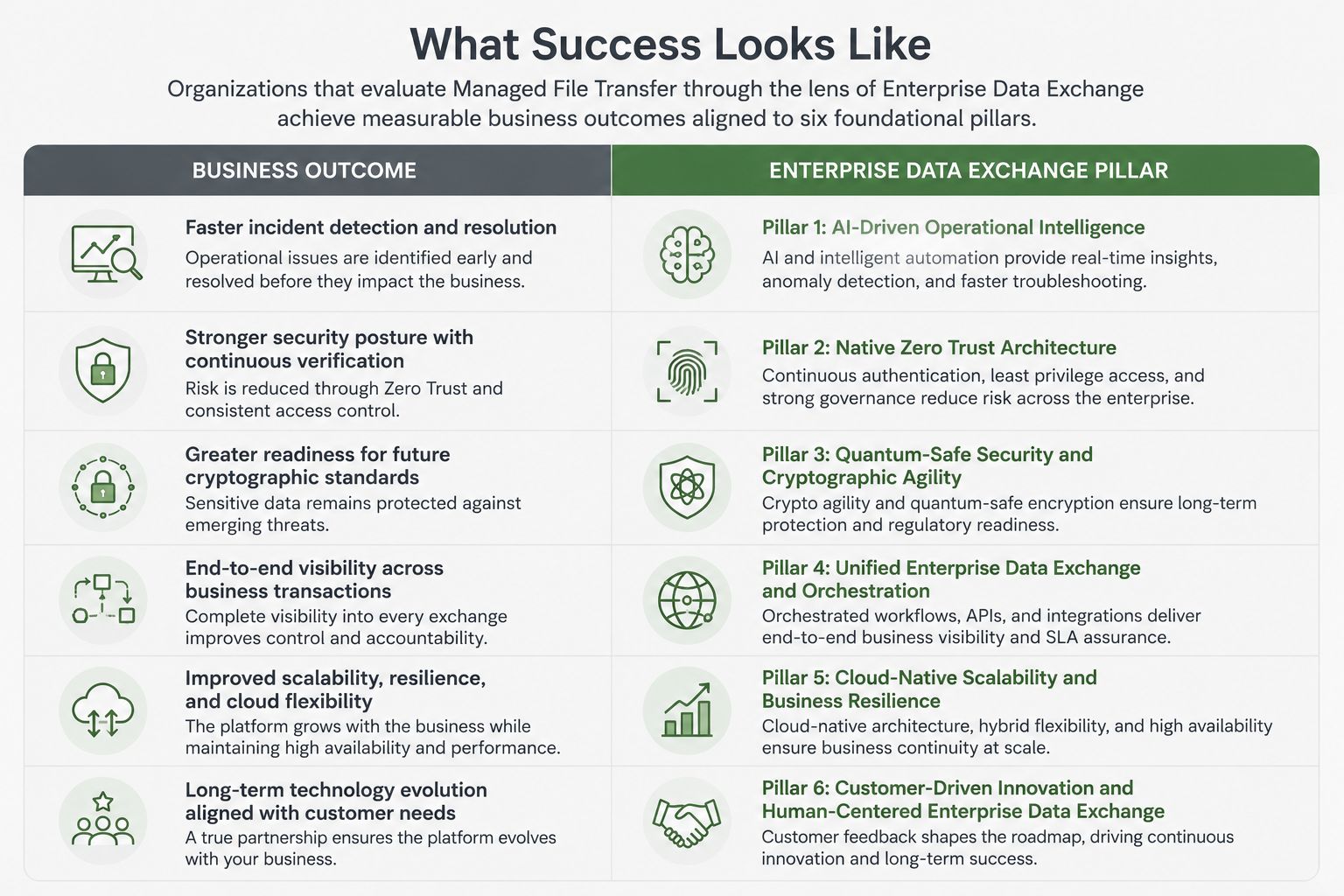
What Success Looks Like
Organizations that evaluate Managed File Transfer through the broader lens of Enterprise Data Exchange often achieve benefits that extend well beyond secure file movement.
By aligning platform selection with the six pillars, they position themselves to improve operational efficiency, strengthen security, and reduce long-term technology risk.
From Managed File Transfer to Enterprise Data Exchange
This guide has focused on how to evaluate the next generation of Managed File Transfer platforms.
To understand why these evaluation criteria matter, we encourage you to read our companion article, The Future of Enterprise Data Exchange: AI, Zero Trust, Quantum-Safe Security, and the Evolution of Managed File Transfer.
That article introduces the six foundational pillars shaping the future of secure enterprise data exchange and explains why organizations are moving beyond traditional Managed File Transfer toward unified, intelligent, and resilient Enterprise Data Exchange platforms.
Together, these two guides provide both the strategic vision and the practical evaluation framework for selecting technology that can continue delivering value for years to come.
How TDXchange Supports Future-Proof MFT
Future-proofing Managed File Transfer is not just about supporting today's requirements. It means preparing for evolving cybersecurity threats, increasing regulatory expectations, growing data volumes, changing deployment models, and the rise of AI-driven operations.
TDXchange was designed to help organizations adapt to these changes without requiring disruptive platform replacements or complex migrations.
Key capabilities include:
- Quantum-Safe Encryption: Protect sensitive data against emerging quantum computing threats through support for post-quantum cryptography, helping organizations address "harvest now, decrypt later" risks.
- Zero Trust Security Architecture: Enforce least-privilege access, continuous verification, Multi-Factor Authentication (MFA), Role-Based Access Control (RBAC), and per-user IP restrictions to reduce risk and strengthen governance.
- AI-Assisted Operations: Simplify administration through natural language interactions, intelligent onboarding assistance, anomaly detection, operational recommendations, and workflow optimization while maintaining Zero Trust and RBAC controls for all AI interactions.
- Cloud-Native Scalability: Scale securely as data volumes, users, and partner ecosystems grow through high-availability clustering, distributed architecture, and elastic deployment models across cloud, hybrid, and on-premises environments.
- Workflow-Level Visibility & SLA Governance: Monitor critical business processes in real time with dashboards, SLA tracking, automated alerting, and escalation workflows that focus on business outcomes rather than simple infrastructure availability.
- Immutable Audit Trails & Compliance Reporting: Maintain complete visibility into user activity, file transfers, configuration changes, and policy enforcement through tamper-resistant audit logs and compliance-ready reporting.
- Automated Certificate & Key Lifecycle Management: Reduce operational risk through proactive certificate monitoring, automated notifications, and centralized management of encryption assets.
- Policy-Driven Partner Onboarding: Accelerate onboarding while maintaining security and compliance through workflow-based approvals, standardized templates, and automated provisioning.
- Enterprise Integration and Automation: TDXchange coordinates scheduled, event-driven, API-initiated, and user-initiated workflows across files, applications, cloud services, APIs, and trading partners. Reusable configurations, governed connectors, automated retries, exception handling, and centralized visibility help organizations manage complete business processes without relying on disconnected scripts and tools. Additional examples are available in the articles covering enterprise file transfer automation and MFT cloud and application integrations.
- Flexible Deployment Options: A future-proof MFT platform should support both flexible deployment and phased growth. TDXchange can operate on-premises, in private or public clouds, across hybrid and multi-cloud environments, or using Kubernetes. Its license-driven model allows organizations to begin with the capabilities required today and add protocols, integrations, trading partners, capacity, and advanced functionality as migrations progress and business needs evolve.
Rather than functioning as a standalone file transfer product, TDXchange serves as a governed enterprise data exchange platform that helps organizations strengthen security, improve operational resilience, simplify compliance, and adapt to future business and technology requirements.
For CIOs and CISOs, this kind of design philosophy is often more relevant than raw feature volume.
Executive Takeaways
- Choosing a Managed File Transfer platform is a long-term strategic decision that should be evaluated based on its ability to adapt to future business, security, and technology requirements, not just today's feature set.
- Modern MFT evaluations should extend beyond protocols and automation to include AI-driven operational intelligence, Zero Trust security, quantum-safe cryptography, operational governance, cloud-native scalability, and customer-driven innovation.
- The six pillars of Enterprise Data Exchange provide a practical framework for evaluating whether a platform is architected to support the evolving demands of modern enterprises.
- Asking vendors the right strategic questions often reveals more about a platform's long-term value than traditional feature comparison matrices or RFP checklists.
- Organizations that evaluate platforms through the lens of Enterprise Data Exchange are better positioned to improve operational resilience, strengthen security, simplify compliance, and reduce future migration risk.
- Future-proof platforms should deliver measurable business outcomes, including improved operational visibility, stronger governance, faster incident resolution, greater architectural flexibility, and continuous innovation driven by customer needs.
- TDXchange was designed around these principles, helping organizations evolve from traditional Managed File Transfer to a secure, intelligent, and resilient Enterprise Data Exchange platform capable of supporting business growth for years to come.
- Future-proof automation should coordinate complete business outcomes across files, APIs, cloud services, applications, and trading partners—not simply schedule isolated transfers.
- Buyers should evaluate workflow triggers, reusable configurations, API-driven provisioning, connector governance, exception handling, maintenance windows, and end-to-end transaction visibility.
- The number of supported connectors is less important than whether integrations operate within a consistent Zero Trust, role-based access, workflow, auditing, and governance model.
About the Author
Hanz Jorgensen is Chief Operating Officer and Managing Member at bTrade, where he oversees daily operations and works closely with the leadership team to shape and execute the company’s strategic direction. With more than 20 years of experience with several different MFT/technology companies spanning system administration, development, customer support, pre-sales, and enterprise solution delivery, Hanz brings a uniquely practical perspective on what organizations actually need from managed file transfer platforms. He leads bTrade’s Solution Consulting team and plays a central role in aligning product capabilities with real customer requirements across regulated and high-complexity environments.
Frequently Asked Questions
What is Managed File Transfer, and why is it still important?
Managed File Transfer (MFT) is a secure and governed approach to exchanging files among systems, applications, users, and trading partners. It provides encryption, authentication, access control, workflow automation, monitoring, and audit trails.
APIs and cloud services address many integration requirements, but MFT remains essential for large files, batch processing, external partner exchanges, and regulated workflows that require reliable delivery and complete auditability.
What makes an MFT platform future-proof?
A future-proof MFT platform can adapt to evolving security standards, regulatory requirements, transaction volumes, integrations, and deployment models without requiring a disruptive replacement.
Organizations should reassess their platform when they experience growing operational overhead, limited visibility, frequent SLA failures, difficulty producing audit evidence, increasing partner volumes, or an inability to support cloud and hybrid architectures.
Why should CIOs and CISOs care about MFT architecture?
MFT platforms often support regulated information, revenue-impacting workflows, partner obligations, and compliance evidence. Weak architecture can create security exposure, scalability limitations, operational outages, vendor lock-in, and costly future migrations.
Executives should therefore evaluate the platform’s long-term architecture and governance model rather than relying only on its current protocol and feature list.
What security and compliance capabilities should an enterprise MFT platform provide?
An enterprise MFT platform should provide strong encryption, MFA, role-based access, enterprise identity integration, centralized certificate and key management, policy enforcement, and comprehensive audit trails. Future-ready platforms should also support cryptographic agility and preparation for quantum-safe security.
These controls can help organizations support requirements associated with GDPR, HIPAA, PCI DSS, SOX, SOC 2, and other regulatory or industry frameworks. Compliance ultimately depends on the organization’s complete architecture, configuration, policies, and operating procedures.
What should organizations prioritize when evaluating an MFT vendor?
Organizations should evaluate:
- Security maturity and audit defensibility
- Automation and integration capabilities
- Architectural flexibility and scalability
- Operational visibility and SLA governance
- Cloud, hybrid, and on-premises deployment support
- Ease of administration and maintenance
- Vendor experience, roadmap, and responsiveness
- Ability to evolve without disruptive migration
The right deployment model depends on regulatory, data-residency, performance, and operational requirements. A future-proof vendor should support multiple deployment options so the platform can evolve with the organization.
How should buyers evaluate MFT automation and integration?
Buyers should determine whether the platform can coordinate files, APIs, applications, cloud services, and trading partners within governed workflows.
They should also evaluate supported workflow triggers, reusable configurations, API capabilities, custom scripting requirements, automated retries, exception handling, and end-to-end visibility. The objective is to reduce manual effort and disconnected tools while preserving security, governance, and auditability.
What role do SLAs and operational visibility play in MFT?
SLAs define delivery windows, availability requirements, and response expectations for critical workflows. Modern MFT platforms should provide workflow-level monitoring, proactive alerts, escalation, and reporting so teams can identify transactions at risk and respond before a delay becomes a business disruption.
Operational visibility should show the complete transaction outcome rather than only whether the transfer server is available.
How does TDXchange support future-proof Managed File Transfer?
TDXchange combines secure multi-protocol file transfer with Zero Trust security, quantum-safe cryptography, workflow automation, enterprise integration, centralized governance, SLA visibility, audit trails, cloud-native scalability, delegated administration, and AI-assisted operations.
This approach helps organizations reduce operational risk, support evolving business and regulatory requirements, and manage complete enterprise data exchange processes rather than isolated file transfers.