
Data replication is one of those capabilities that sounds straightforward, until it isn’t.
For many organizations, keeping multiple sites in sync is essential for resilience, business continuity, performance, and compliance. Whether it’s active-active data centers, regional hubs, or disaster recovery environments, the expectation is simple: the right data should exist in the right place, at the right time.
In practice, replication often becomes fragile, inefficient, and operationally expensive.
We recently had the pleasure of working with one of our trusted partners, Timspark, an IT Services Provider, with a solid track record of deploying bTrade’s TDXchange for several of its clients. Timspark reached out to us for help with a critical data replication issue faced by one of its major healthcare clients.
The client operates both on-prem and cloud infrastructure, along with a disaster recovery (DR) environment. The client was frequently running into problems replicating data between these systems, which posed a serious risk to their operations and DR processes.
This is where bTrade has helped to rethink replication and not as raw file copying, but as a governed, intelligent data movement process using TDXchange with both AFTP and SFTP.
bTrade’s TDXchange offers a unique solution that combines Managed File Transfer (MFT) capabilities with robust data replication features. It supports replication using standard SFTP for smaller files and bTrade’s proprietary Accelerated File Transfer protocol for larger data sets. This flexibility was exactly what the client needed to ensure seamless replication across their infrastructure.
Executive Summary
Data replication is the process of synchronizing data between multiple locations to support business continuity, disaster recovery, operational resilience, and regulatory requirements. While many organizations rely on traditional replication tools that repeatedly copy entire datasets, modern replication strategies focus on transferring only what has changed, reducing bandwidth consumption, shortening synchronization windows, and improving recovery readiness.
Using TDXchange with both SFTP and bTrade's Accelerated File Transfer Protocol (AFTP), organizations can implement intelligent, governed, and auditable replication workflows across on-premises, cloud, hybrid, and disaster recovery environments.
Rather than treating replication as a simple file copy operation, TDXchange transforms replication into a controlled process that provides visibility, automation, governance, and operational confidence.
Key Takeaways
- Data replication is critical for disaster recovery, business continuity, and hybrid cloud operations.
- Traditional replication approaches often waste bandwidth by repeatedly transferring unchanged data.
- Differential replication transfers only new or modified files, improving efficiency and reducing synchronization times.
- TDXchange provides centralized orchestration, monitoring, governance, and auditability for replication workflows.
- Organizations can choose between standards-based SFTP and high-performance AFTP based on business requirements.
- Intelligent replication reduces operational overhead and improves data consistency across sites.
- Hybrid cloud, multi-site, and disaster recovery environments benefit from centralized replication management.
- Replication should be treated as a governed workflow, not a background utility.
What Is Data Replication?
Data replication is the process of maintaining synchronized copies of data across multiple locations.
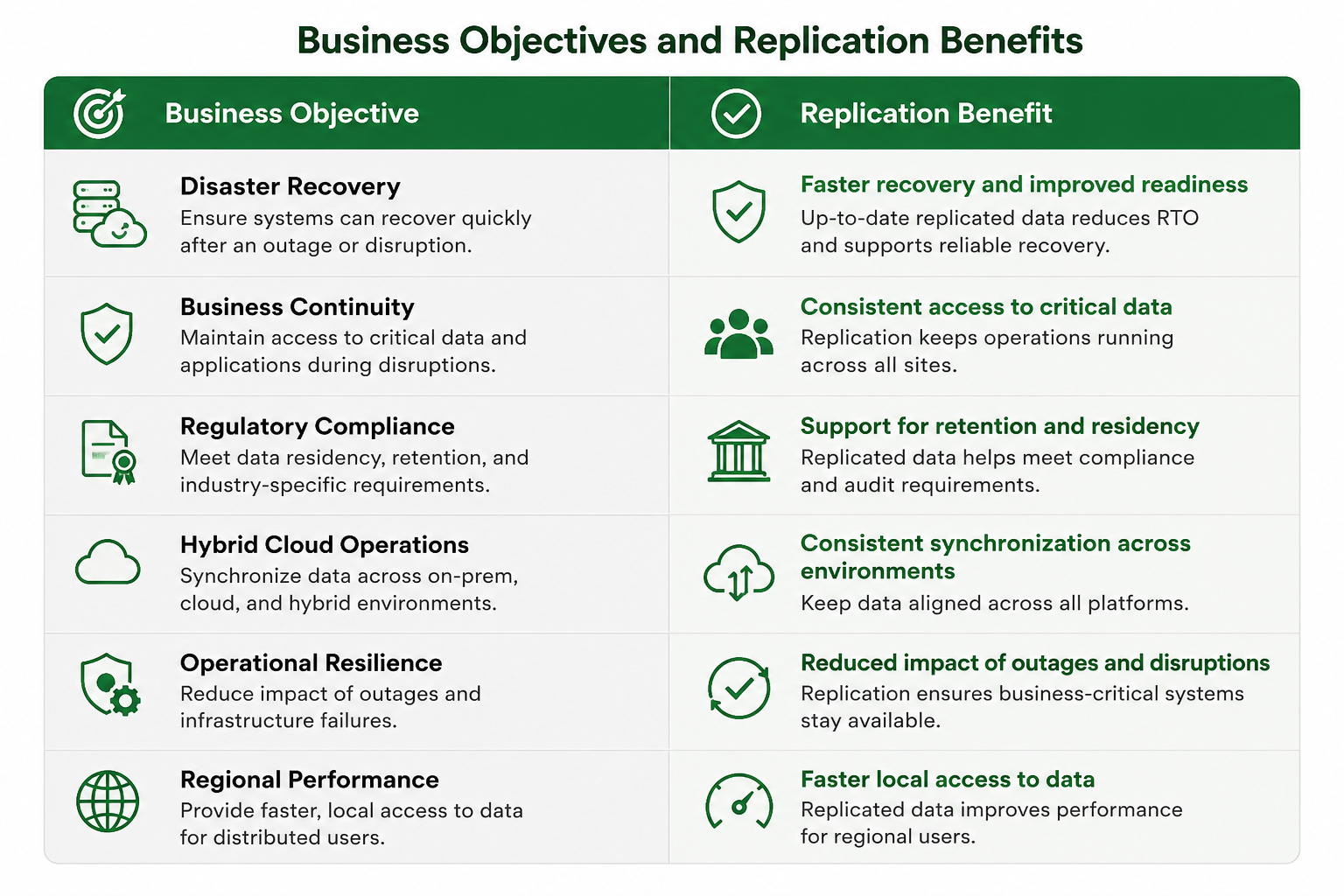
Organizations commonly replicate data to:
- Support disaster recovery (DR)
- Improve business continuity
- Maintain regional data availability
- Meet regulatory and data residency requirements
- Improve operational resilience
- Reduce recovery time objectives (RTOs)
The goal is simple:
Ensure the right data is available in the right location at the right time.
However, achieving this consistently at enterprise scale is often more challenging than expected.
Why Data Replication Becomes Difficult at Scale
As data volumes grow, many replication solutions begin to struggle.
Organizations frequently encounter:
- Excessive bandwidth consumption
- Long synchronization windows
- Repeated transfer of unchanged files
- Inconsistent datasets between locations
- Manual recovery processes
- Limited visibility into replication status
These issues become particularly problematic in:
- Healthcare environments
- Financial institutions
- Government agencies
- Retail operations
- Media and content distribution platforms
When replication fails, disaster recovery readiness and business continuity objectives can be compromised.
A Real-World Healthcare Replication Challenge
We recently worked alongside our trusted partner, Timspark, to help address a critical replication challenge for a large healthcare organization.
The organization operated:
- On-premises infrastructure
- Cloud environments
- Dedicated disaster recovery systems
Their existing replication processes struggled to keep data synchronized across locations.
This created operational concerns around:
- Disaster recovery preparedness
- Data consistency
- Replication performance
- Administrative overhead
The challenge wasn't simply moving files.
The challenge was moving the right data efficiently while maintaining visibility and control.
Why Traditional Replication Approaches Fall Short
Many replication products still rely on brute-force synchronization techniques.
Common approaches include:
- Full directory mirroring
- Repeated transfer of unchanged files
- Limited visibility into differences between sites
- Heavy network utilization
- Long synchronization cycles
These methods may work in smaller environments but become increasingly inefficient as:
- Data volumes grow
- Replication windows shrink
- Regulatory requirements increase
- Hybrid cloud deployments expand
The limitation is rarely the transfer protocol itself.
The real issue is the lack of orchestration and intelligence surrounding the replication process.
How TDXchange Approaches Replication Differently
At bTrade, replication is treated as a governed workflow rather than a blind file copy operation.
TDXchange serves as the orchestration and control layer for replication activities.
This enables organizations to:
- Understand what exists at each location
- Identify changes between sites
- Transfer only required data
- Monitor replication activity in real time
- Maintain complete audit trails
This approach dramatically improves efficiency while reducing operational risk.
Intelligent Differential Replication
One of the most valuable capabilities within TDXchange is differential replication.
Rather than transferring everything repeatedly, TDXchange:
- Tracks file inventories across locations
- Compares source and destination environments
- Identifies missing files
- Detects modified content
- Transfers only what has changed
Benefits include:
- Reduced bandwidth consumption
- Faster replication cycles
- Lower infrastructure costs
- Improved disaster recovery readiness
- Reduced operational overhead
For large-scale environments, these efficiencies can be substantial.
SFTP and AFTP: Choosing the Right Replication Protocol
Different environments have different requirements.
TDXchange supports multiple replication methods depending on business needs.
SFTP for Standards-Based Replication
SFTP remains a popular choice when organizations require:
- Standards-based interoperability
- Partner compatibility
- Regulatory alignment
- Secure encrypted transfers
TDXchange enhances SFTP by providing orchestration, governance, monitoring, and auditability.
AFTP for High-Performance Replication
For large-scale or time-sensitive replication workloads, AFTP provides significant advantages.
AFTP is designed to:
- Maximize available bandwidth
- Handle latency efficiently
- Support sustained bulk data movement
- Accelerate large-scale replication
- Improve synchronization performance across long distances
Because AFTP is built for high-volume transfers, it is particularly effective for:
- Disaster recovery replication
- Media asset synchronization
- Data lake replication
- Analytics environments
- Multi-site enterprise replication
Results Organizations Achieve
Organizations using TDXchange for replication commonly experience:
- Faster synchronization cycles
- Reduced network congestion
- Improved disaster recovery readiness
- Greater confidence in data consistency
- Lower operational overhead
- Better visibility into replication status
- Enhanced auditability and governance
Most importantly, replication becomes predictable and repeatable.
Common Data Replication Use Cases
The same architectural approach is successfully used across multiple industries.
Healthcare
- Clinical data synchronization
- Disaster recovery replication
- Hybrid cloud data movement
Financial Services
- Transaction data replication
- Regulatory reporting environments
- Business continuity platforms
Media and Entertainment
- Large-scale content synchronization
- Production asset distribution
- Multi-region collaboration
Retail
- Regional data hub synchronization
- Inventory and operational data replication
- Peak-season resilience
Government
- Multi-site continuity programs
- Secure inter-agency synchronization
- Disaster recovery readiness
Executive Takeaway
The goal of data replication is not to move more data faster.
The goal is to move only the data that matters, when and where it is needed.
By combining intelligent orchestration through TDXchange with the flexibility of SFTP and the performance of AFTP, organizations can replace inefficient replication processes with a governed, scalable, and operationally efficient model.
The result is improved business continuity, stronger disaster recovery readiness, lower operational risk, and greater confidence in data consistency across every site.
About the Author
Andrei Olin is Chief Technology Officer at bTrade, where he leads product strategy, delivery, and security across the company’s B2B, Managed File Transfer (MFT), and security platforms. He brings over 30 years of experience in enterprise technology, including designing and operating mission-critical MFT and messaging platforms for global financial institutions such as Merrill Lynch and Deutsche Bank. Andrei holds Master’s and Bachelor’s degrees in Information Technology with a focus on Information Security.
Frequently Asked Questions
How does TDXchange know what data to replicate?
TDXchange maintains awareness of file inventories and transfer state across locations, allowing it to identify missing or modified files and replicate only the data that has changed.
What is differential replication?
Differential replication transfers only new or modified data rather than repeatedly copying entire datasets. This improves efficiency and reduces bandwidth consumption.
Does data replication require AFTP?
No. TDXchange supports both SFTP and AFTP. Organizations can choose the protocol that best fits their operational and performance requirements.
Why not replicate everything every time?
Full replication consumes unnecessary bandwidth, increases synchronization windows, and creates operational inefficiencies. Differential replication is significantly more efficient.
Is this suitable for disaster recovery?
Yes. TDXchange supports controlled, auditable replication workflows that help organizations improve disaster recovery readiness and business continuity planning.
Can TDXchange support hybrid cloud replication?
Yes. TDXchange supports on-premises, cloud, hybrid cloud, and multi-site environments while maintaining consistent replication behavior and centralized governance.
What industries commonly use data replication?
Healthcare, financial services, government, retail, media, manufacturing, and any organization requiring business continuity, disaster recovery, or multi-site data synchronization frequently rely on data replication.