

Compliant vs. Resilient MFT: How Secure File Transfer Survives Real-World Failure
Enterprises rely on Managed File Transfer to exchange financial records, healthcare claims, supply chain documents, media files, customer information, and government communications.
Compliance confirms that required controls exist.
Resilience determines whether those controls and workflows continue operating when infrastructure, partners, networks, certificates, or credentials fail.
For organizations that depend on the continuous movement of mission-critical information, both are essential.
Executive Summary
A compliant Managed File Transfer platform provides security and governance controls such as encryption, authentication, access control, audit logging, reporting, and retention policies.
A resilient MFT platform includes those controls but goes further. It is designed to maintain secure and predictable data movement during server failures, endpoint outages, certificate problems, unexpected volume increases, network disruptions, and other real-world events.
The distinction is simple:
Compliance demonstrates that controls exist. Resilience demonstrates that the business can continue operating when something goes wrong.
Key Takeaways
- Compliance and operational resilience address related but different requirements.
- An MFT environment can pass an audit and still fail because of an expired certificate, unavailable endpoint, infrastructure outage, or missed alert.
- Clustering, high availability, automated retries, Zero Trust security, SLA monitoring, and end-to-end observability improve MFT resilience.
- Global file transfer requires additional planning for regional failures, latency, data sovereignty, and cross-border governance.
- Crypto agility and quantum-safe encryption help protect sensitive information against long-term cryptographic risk.
- TDXchange, TDCloud, and TDConnect help organizations move from checklist compliance toward secure and resilient enterprise data exchange.
What Is Resilient Managed File Transfer?
Resilient Managed File Transfer is an architectural and operational approach designed to keep secure data movement functioning during infrastructure failures, partner disruptions, certificate problems, abnormal activity, and unexpected demand.
Traditional compliance programs often ask whether a control is present:
- Are files encrypted?
- Are users authenticated?
- Are access controls configured?
- Are audit records retained?
- Can activity be reported?
Resilience asks additional questions:
- What happens when a server becomes unavailable?
- Will transfers continue if a partner endpoint fails?
- Can teams identify a delayed critical file before its SLA is breached?
- What happens when transaction volume suddenly increases?
- Can the organization recover from a regional outage?
- How quickly can operations determine which customers and workflows are affected?
A secure file transfer platform must answer both groups of questions.
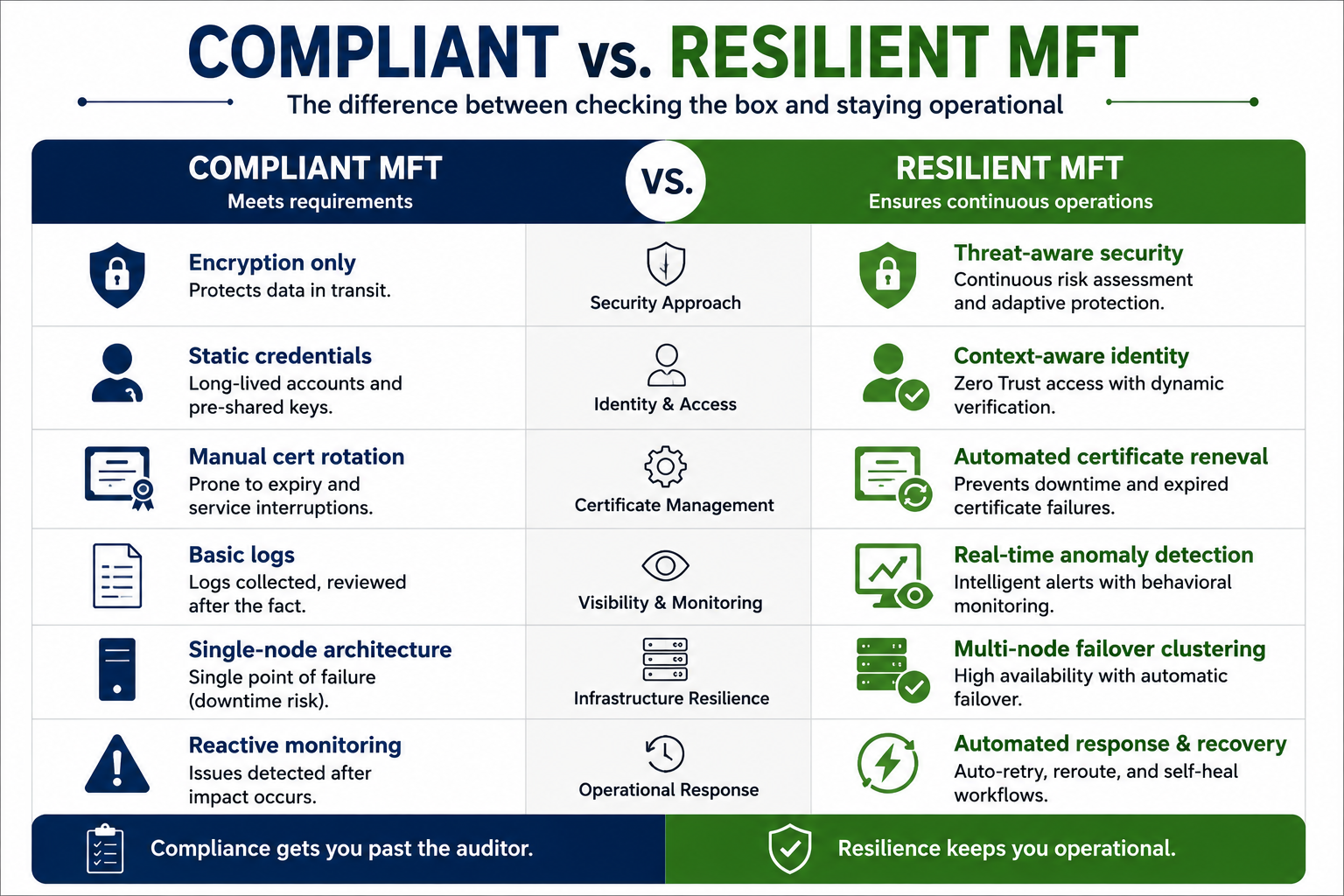
Compliance and resilience are not competing objectives. Resilience extends compliance into real-world operations.
Why Can a Compliant MFT Environment Still Fail?
Many MFT environments appear secure when evaluated against a checklist.
Files are encrypted. Users are authenticated. Access is controlled. Logs are retained.
But production failures frequently occur outside the checklist.
Common examples include:
- A certificate expires over a weekend
- A trading partner endpoint becomes unavailable
- A transfer queue begins backing up
- A scheduled workflow fails without proper escalation
- A credential is exposed or incorrectly configured
- A cloud service introduces unexpected latency
- A configuration change routes files incorrectly
- Transaction volume exceeds planned capacity
- Monitoring identifies a failure but does not show the affected business process
These events may not immediately create a regulatory violation, but they can interrupt financial settlements, healthcare processing, customer communications, supply chain operations, or government reporting.
That is the gap between being compliant and being operationally resilient.
Eight Capabilities of Resilient MFT
1. Multi-Node Clustering and High Availability
A resilient MFT architecture should eliminate single points of failure.
Multi-node clustering allows workloads to be distributed across multiple MFT nodes. If one node becomes unavailable because of maintenance, hardware failure, or another disruption, the remaining nodes can continue processing transactions.
Clustering also helps organizations increase capacity as transaction volumes grow without repeatedly redesigning the environment.
Learn more about clustering and resilience in Managed File Transfer.
2. Automated Failover and Recovery
High availability is most valuable when recovery does not depend on someone discovering a failure and manually moving workloads.
Automated failover, retry logic, workflow recovery, and escalation help prevent a technical interruption from becoming a business outage.
3. Certificate and Key Lifecycle Management
Certificates and cryptographic keys are essential to secure partner communication, but they can also become operational dependencies.
A resilient MFT program should provide centralized visibility into certificate ownership, usage, and expiration. Proactive notifications and supported lifecycle automation help teams act before an expired certificate interrupts a critical workflow.
4. Native Zero Trust Security
Traditional security models often assume that users or systems inside a trusted network can be trusted.
Modern enterprise environments include cloud platforms, remote users, APIs, third-party partners, internal applications, and distributed services. Network location alone is no longer a reliable security decision.
Native Zero Trust requires users, services, endpoints, and workflows to be authenticated, authorized, and validated before access is granted. Least privilege, multifactor authentication, granular authorization, partner isolation, and comprehensive auditing reduce the risk of unauthorized access and lateral movement.
Learn how Native End-to-End Zero Trust Architecture applies across the enterprise data exchange lifecycle.
5. Contextual Access Controls
Not every authenticated user, system, or partner should have access to every workflow.
Contextual controls can evaluate:
- User and service identity
- Partner relationships
- Source and destination
- Network or IP restrictions
- Assigned roles and permissions
- Authorized protocols
- Approved workflows
- Data classifications
This limits unnecessary exposure and helps organizations apply security policies consistently across distributed environments.
6. Dynamic Routing and Automated Retries
Partner endpoints, networks, and cloud services are not always available.
Dynamic routing and configurable retry policies allow workflows to respond to temporary disruptions. Instead of immediately failing a business process, the platform can retry delivery, use an approved alternate route, or escalate the issue according to operational policy.
7. End-to-End Operational Observability
Traditional monitoring may show that a server is running or that a file failed.
Operational observability provides a broader view of the transaction and its business context. It helps teams understand:
- Which file or workflow is affected
- Which partner or customer is involved
- Whether an SLA is at risk
- Where the failure occurred
- What retry or recovery actions have been attempted
- Which downstream systems depend on the transaction
Real-time dashboards, centralized audit history, intelligent notifications, and workflow-level SLA monitoring help teams respond before minor problems become major disruptions.
Learn why operational visibility is critical in Managed File Transfer.
8. Crypto Agility and Quantum-Safe Security
Sensitive information may need to remain confidential for years or decades.
This creates exposure to harvest-now-decrypt-later attacks, in which encrypted information is collected today and retained until future computing capabilities can decrypt it.
NIST finalized its first post-quantum cryptography standards in 2024, including ML-KEM under FIPS 203. ML-KEM is based on the CRYSTALS-Kyber algorithm and is intended for establishing shared encryption keys. NIST post-quantum cryptography standards
Crypto agility allows organizations to introduce stronger cryptographic protections as standards and threats evolve without redesigning every business workflow.
For MFT environments exchanging financial, healthcare, government, legal, or intellectual-property data, quantum-safe planning is part of long-term resilience.
What Makes Global File Transfer Resilient?
Global enterprises face additional challenges because their partners, infrastructure, applications, and users may be distributed across multiple regions.
A resilient global MFT strategy should address:
Geographic Redundancy
Critical services should not depend entirely on one physical location or cloud region. Geographic redundancy and tested disaster recovery processes help organizations continue operating during regional failures.
Cross-Border Data Governance
Different jurisdictions may impose requirements related to privacy, retention, data residency, sovereignty, breach reporting, and access.
MFT platforms support these governance programs by providing controlled routing, encryption, access restrictions, auditability, and policy-driven data movement. However, compliance depends on the organization’s complete technology, policy, legal, and operational environment.
Network Latency and Large Files
Long-distance transfers can be affected by latency, packet loss, and limited bandwidth utilization. Transfer acceleration and protocol selection may be necessary for large data sets and time-sensitive global workflows.
Regional Partner Availability
A global partner ecosystem operates across different time zones, maintenance windows, and infrastructure models. Configurable retries, alternate routing, escalation, and follow-the-sun operations help reduce disruption.
Consistent Global Visibility
Operations teams need one view of transactions across on-premises, cloud, hybrid, and geographically distributed environments. Centralized governance reduces the operational blind spots created by regional systems and disconnected monitoring tools.
Illustrative Scenario: When Compliance Fails in Production
Consider an enterprise that passes its security and compliance audits but relies on a single legacy server for partner uploads.
Files are encrypted. Access is controlled. Activity is logged.
Over a weekend, a partner certificate expires. Transfers stop, but the monitoring system does not connect the failure to the affected business workflow. The problem is not discovered until Monday morning.
The organization had the required security controls, but it lacked:
- Proactive certificate notification
- High availability
- Business-level SLA monitoring
- Automated escalation
- End-to-end operational visibility
It was compliant on paper but fragile in production.
A resilient MFT environment would identify the approaching certificate expiration, notify the responsible teams, provide workflow-level visibility, and use redundancy and recovery policies to reduce the business impact.
How bTrade Helps Organizations Build Resilient MFT
At bTrade, we believe compliance is the foundation. Resilience is what keeps the organization operating.
Our solutions are designed for mission-critical data exchange across highly regulated, high-volume, and globally distributed environments.
TDXchange: Secure and Resilient Enterprise MFT
TDXchange combines secure Managed File Transfer, workflow automation, partner management, governance, and operational visibility.
Capabilities include:
- Multi-node clustering
- High availability and fault tolerance
- Horizontal scalability
- Native Zero Trust security
- Role-based access control
- Multifactor authentication
- Per-endpoint and contextual access controls
- Centralized certificate visibility
- Automated routing and retries
- Workflow-level SLA monitoring
- Real-time dashboards and notifications
- End-to-end transaction visibility
- Detailed audit and configuration history
- Quantum-safe encryption and crypto agility
- Cloud, hybrid, on-premises, and Kubernetes deployment options
TDXchange is designed to help organizations move beyond isolated file transfers toward secure and governed Enterprise Data Exchange.
TDCloud: Cloud-Delivered MFT
TDCloud provides TDXchange capabilities through a managed cloud deployment.
Depending on the selected architecture and service model, TDCloud can support:
- High availability
- Scalable infrastructure
- Centralized monitoring
- Backup and disaster recovery
- Secure partner connectivity
- Automated workflows
- Cloud and hybrid integration
- Operational support options
TDCloud allows organizations to modernize their MFT environment while reducing the burden of managing the underlying infrastructure.
TDConnect: Simplified Secure Connectivity
TDConnect helps departments, business units, and trading partners securely exchange information through a streamlined user experience.
It supports centralized governance, secure connectivity, audit logging, controlled access, and operational visibility without requiring users to understand the complexity behind the platform.
Future Trends in MFT Resilience
Managed File Transfer is evolving into a broader Enterprise Data Exchange capability.
Modern platforms increasingly combine:
- Native Zero Trust security
- Distributed and containerized architecture
- Workflow-level observability
- SLA governance
- AI-assisted monitoring and troubleshooting
- Behavioral anomaly detection
- Automated partner onboarding
- Crypto agility
- Quantum-safe encryption
- Delegated administration and self-service
These capabilities reflect a broader shift from securely moving files to securely orchestrating business outcomes.
Our article, The Future of Enterprise Data Exchange, explores the six foundational pillars we believe will shape that evolution.
Executive Takeaway
Your business depends on data movement.
Whether your organization transfers hundreds or millions of files each day, secure file transfer must do more than satisfy an audit checklist. It must continue operating through certificate problems, infrastructure failures, endpoint disruptions, peak workloads, cloud latency, and unexpected behavior.
Compliance demonstrates that controls exist.
Resilience demonstrates that those controls, systems, and business processes continue working when they are needed most.
That is why modern MFT strategy must include both.
About the Author
Hanz Jorgensen is Chief Operating Officer and Managing Member at bTrade, overseeing daily operations and shaping the company’s strategic direction. With more than 20 years of hands-on experience across system administration, development, customer support, pre-sales, and enterprise solution delivery, Hanz brings a practical and execution-focused perspective on what organizations truly need from modern MFT platforms.
Let’s talk about how we can help evolve your MFT strategy from compliant to resilient.
Frequently Asked Questions:
What is resilient Managed File Transfer?
Resilient Managed File Transfer is an MFT approach designed to keep secure data movement operational during real-world disruptions such as certificate expiration, endpoint failures, infrastructure outages, cloud latency, and partner connectivity issues.
What is the difference between compliant and resilient MFT?
Compliant MFT meets regulatory requirements such as encryption, audit logs, and access controls. Resilient MFT goes further by adding high availability, automated failover, certificate automation, anomaly detection, real-time visibility, and proactive response capabilities.
Why is compliance alone not enough for MFT?
Compliance alone does not guarantee operational continuity. A system can pass an audit but still fail when a certificate expires, a partner endpoint goes offline, or an alert is missed.
Can an MFT platform be compliant but not resilient?
Yes. An MFT platform can provide encryption, access control, and audit logs but still depend on a single server, manual certificate management, limited monitoring, or manual recovery. It may pass an audit while remaining vulnerable to operational failure.
How does resilient MFT support compliance?
Resilient MFT strengthens compliance programs by maintaining detailed audit trails, protecting data, enforcing access policies, monitoring critical workflows, and preserving availability. These capabilities can support technical controls associated with HIPAA, PCI DSS, SOX, GDPR, DORA, GLBA, and other frameworks, but no individual platform makes an organization compliant by itself.
How does bTrade help prevent outages from expired certificates?
bTrade supports auto-renewing certificate infrastructure and proactive alerts to help prevent transfer disruptions caused by certificate expiration.
What makes bTrade’s MFT solutions secure?
bTrade combines strong encryption, post-quantum cryptography options, Zero Trust access controls, per-endpoint IP filtering, behavioral anomaly detection, logging, and real-time dashboards.
Are bTrade platforms post-quantum ready?
Yes. bTrade supports post-quantum cryptography options, including algorithms such as Kyber and Frodo, to help future-proof sensitive file transfers against emerging quantum threats.
Can bTrade solutions scale for peak workloads and hybrid environments?
Yes. bTrade supports containerized deployments, horizontal scaling, hybrid environments, multi-node clustering, and high availability to support peak workloads and continuous operations.
How does real-time visibility improve MFT resilience?
Real-time visibility helps teams monitor every file’s journey, detect delays or deviations, identify partner issues, and respond before minor problems become operational disruptions.
Why does Zero Trust matter for MFT?
Zero Trust ensures that users, endpoints, systems, and transfer relationships are continuously verified rather than implicitly trusted, reducing the risk of unauthorized access and lateral movement.
When should organizations modernize their MFT strategy?
Organizations should modernize when they experience recurring transfer failures, certificate-related outages, limited visibility, manual partner onboarding, scalability issues, or growing compliance and operational resilience requirements.