

A Practical Guide to Building Resilient Managed File Transfer
Managed File Transfer platforms frequently support business processes that cannot simply wait for someone to restart a server.
Financial transactions, healthcare records, regulatory reports, supply chain data, media files, and customer communications may need to move continuously and within clearly defined service levels.
When all of these workflows depend on one MFT server, that server becomes both extremely important and slightly terrifying.
MFT clustering reduces this dependency by allowing multiple MFT nodes to operate together as one managed system. If one node becomes unavailable, other nodes can continue accepting connections and processing workloads.
However, application clustering is only one part of high availability.
A complete design must also consider the database, storage, load balancers, networks, identity services, and every other component that the MFT platform requires to operate.
If the application has three nodes but all three depend on one unprotected database, you do not really have high availability. You have three application nodes waiting for the same database to fail.
This article explains what MFT clustering is, how failover works, how database clustering such as Oracle RAC fits into the architecture, and when organizations actually need it.
Executive Summary
MFT clustering is an architecture in which multiple Managed File Transfer application nodes operate together as a coordinated platform.
A clustered MFT environment can provide:
- High availability
- Workload distribution
- Fault tolerance
- Horizontal scalability
- Maintenance flexibility
- Centralized administration
- Consistent configuration
- Improved operational resilience
If one application node fails, connections and processing can be directed to other available nodes.
What happens to a transfer already in progress depends on the MFT platform, protocol, remote endpoint, workflow design, and whether checkpoint or restart capabilities are available.
Clustering can keep the MFT service available. It does not guarantee that every active network connection will continue without interruption.
Complete high availability also requires resilient database, storage, network, routing, and identity services.
Key Takeaways
- MFT clustering allows multiple application nodes to operate as one logical platform.
- Clustering reduces dependence on a single MFT application server.
- Active active clusters distribute production workloads across multiple nodes.
- Active passive clusters keep secondary capacity ready to take over.
- Failover should protect both technical availability and business transactions.
- Active transfers may need to resume or restart depending on the protocol and platform.
- Database high availability is essential because MFT nodes depend on shared configuration and transaction data.
- Oracle RAC can provide database instance availability and scalability for Oracle based MFT environments.
- Oracle Data Guard may be used with Oracle RAC to provide additional data protection and site recovery.
- Clustering provides high availability but does not replace disaster recovery.
- Organizations with strict service levels, continuous operations, or growing workloads are the strongest candidates for clustering.
- Development, test, or noncritical environments may not require clustered infrastructure.
What Is MFT Clustering?
MFT clustering is an architectural model in which two or more Managed File Transfer nodes operate together as a coordinated system.
Instead of every transfer depending on one application server, workloads are distributed across multiple nodes.
Depending on the MFT platform, clustered nodes may share or coordinate:
- Platform configuration
- Trading partner definitions
- User and access policies
- Workflow definitions
- Transfer queues
- Schedules
- Transaction metadata
- Audit information
- Operational status
A load balancer, proxy, or other routing service typically directs incoming connections to available MFT nodes.
If a node becomes unavailable, new connections can be directed to another active node. Queued and scheduled workloads can also be processed by other nodes when the MFT platform supports coordinated workload management.
The objective is simple:
The failure of one application node should not make the entire MFT service unavailable.
How Does MFT Clustering Work?
A typical clustered MFT environment includes several architectural layers.
1. Load Balancing and Connection Routing
A load balancer distributes incoming connections across available MFT services.
It may evaluate:
- Node availability
- Protocol ports
- Connection volume
- Health check results
- Routing policies
If a node fails a health check, the load balancer stops sending new connections to it.
The load balancer itself should also be highly available. Otherwise, it becomes another single point of failure sitting in front of an otherwise impressive cluster.
2. MFT Application Nodes
Multiple MFT nodes provide transfer, workflow, administration, or processing services.
Depending on the architecture, these nodes may all process production workloads or some may remain available as standby systems.
The platform must coordinate the nodes to prevent:
- Duplicate schedule execution
- Duplicate file processing
- Conflicting configuration changes
- Inconsistent workflow state
- Incomplete transaction history
3. Shared or Coordinated Transaction State
Clustered nodes require access to the information needed to process workloads consistently.
This may include:
- Workflow state
- Transfer history
- Queued work
- Platform configuration
- Schedules
- Audit events
- Retry information
- Partner definitions
The exact implementation varies by MFT platform.
Some systems use a shared database. Others synchronize specific state across nodes. What matters is that another node can determine what happened and safely continue processing when a failure occurs.
4. Database Services
The database often stores the information that allows the MFT cluster to operate as one system.
This can include:
- Application configuration
- Trading partner information
- Workflow definitions
- Transaction status
- Scheduling information
- Retry state
- Audit history
- User and role information
Because the database is so important, it must be included in the high availability design.
Application clustering without database high availability leaves a major dependency unprotected.
5. File Storage
Files may be stored in shared, replicated, or otherwise highly available storage.
Storage design is especially important because multiple MFT nodes do not help if every node depends on one unprotected storage device.
The architecture should consider:
- Storage availability
- Data integrity
- Performance
- File locking
- Replication
- Backup
- Recovery
- Data location requirements
6. Centralized Administration and Observability
Operations teams should be able to manage and monitor the entire cluster through one interface.
They should not need to log into every node separately to determine which server processed a transfer or why a workflow failed.
Centralized management should provide:
- Cluster health
- Node status
- Transfer visibility
- Workflow status
- Configuration history
- Failover events
- Audit records
- Capacity information
- Alerts and notifications
Active Active and Active Passive MFT Clustering
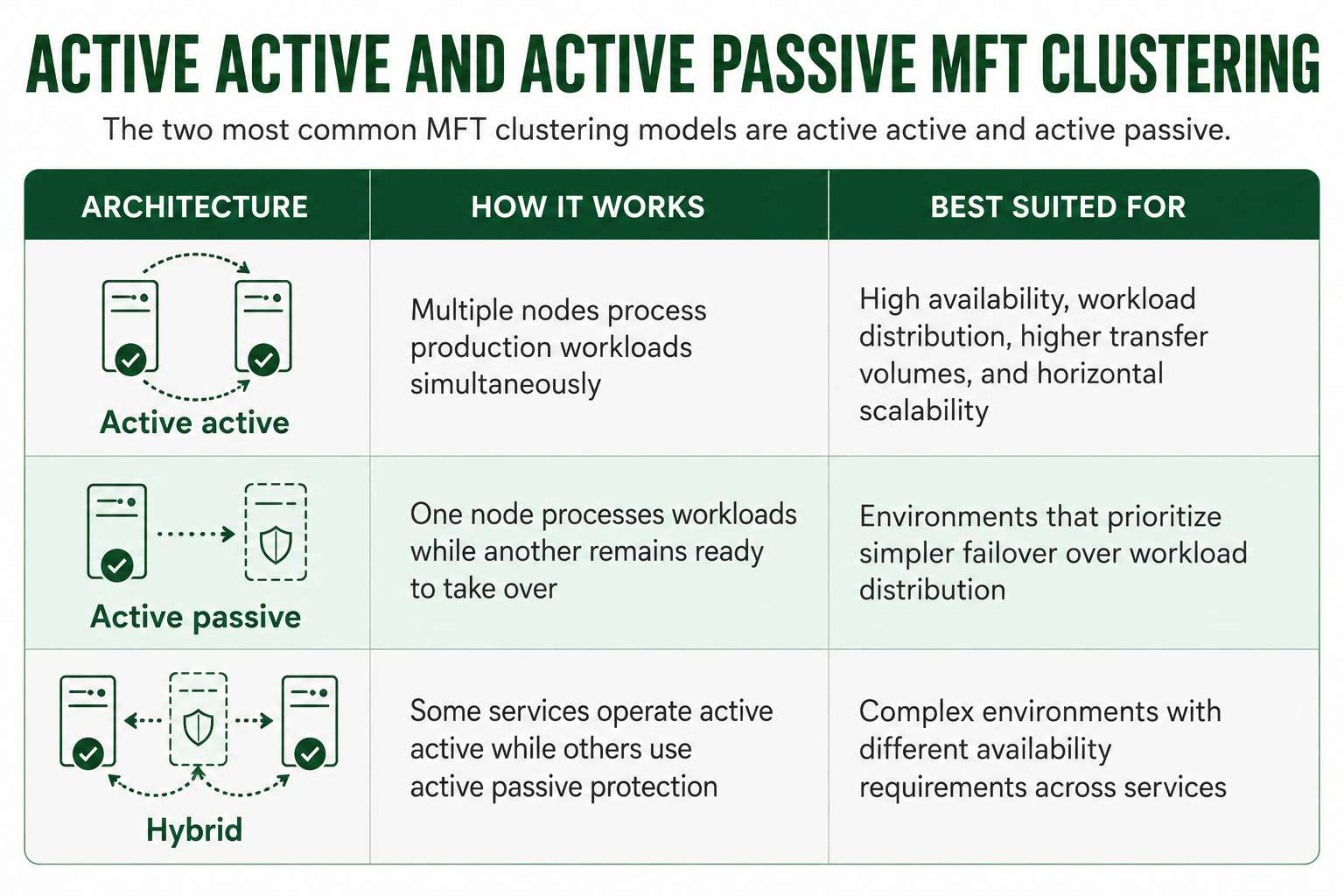
The two most common MFT clustering models are active active and active passive.
Active Active Clustering
In an active active cluster, multiple MFT nodes process workloads at the same time.
Benefits include:
- Better resource utilization
- Workload distribution
- Increased processing capacity
- Reduced dependence on one node
- Maintenance with less service disruption
- Horizontal scaling through additional nodes
The platform must coordinate work carefully to prevent duplicate schedules, duplicate workflow execution, or inconsistent transaction state.
Active Passive Clustering
In an active passive cluster, one node processes production workloads while another remains ready to take over.
Benefits include:
- Simpler operating model
- Dedicated standby capacity
- Controlled failover
- Reduced application coordination requirements
The tradeoff is that standby infrastructure may remain mostly unused during normal operations. Failover may also take longer than in an active active environment.
How Does MFT Failover Work?
Failover is the process of moving connections and workloads away from a failed component and onto an available one.
A simplified MFT failover sequence may look like this:
- A health monitor detects that an MFT node is unavailable.
- The load balancer or routing service removes the node from service.
- New connections are directed to healthy nodes.
- Other nodes continue processing queued and scheduled workloads.
- Incomplete transactions are evaluated by the MFT platform.
- Transfers are resumed, restarted, retried, or placed into an exception state according to protocol and workflow policies.
- Operations teams receive an alert and investigate the failed node.
- The recovered node is validated before returning to service.
A well designed cluster should make most of this process automatic while preserving complete auditability.
Operations teams should be able to determine:
- Which node failed
- When it failed
- Which transfers were active
- Which workflows were affected
- Which transactions resumed
- Which transfers restarted
- Whether any files require manual review
- When the node returned to service
What Happens to a File Being Transferred During Failover?
This is one of the most important questions organizations should ask an MFT vendor.
Clustering can keep the service available, but an active network session may still be interrupted when its processing node fails.
What happens next depends on:
- Transfer protocol
- File size
- Checkpoint and restart support
- MFT platform capabilities
- Remote partner capabilities
- Workflow design
- Temporary file handling
- Retry policies
- Transaction state persistence
Possible outcomes include:
- The transfer resumes from a checkpoint.
- The transfer restarts from the beginning.
- The remote partner reconnects and resends the file.
- The MFT platform retries the transaction automatically.
- The partial file is removed or quarantined.
- The transaction is flagged for manual review.
The correct objective is not to promise that failures never interrupt connections.
The objective is to ensure that failures are detected, transactions are recovered safely, duplicate processing is prevented, and the complete sequence remains auditable.
Why Database Clustering Matters in MFT
Most enterprise MFT nodes depend on a database for configuration, workflow state, transaction history, schedules, audit records, and retry information.
If multiple MFT nodes rely on one unprotected database instance, the database remains a single point of failure.
Organizations should therefore evaluate database high availability alongside MFT clustering.
Depending on the database platform, options may include:
- Oracle Real Application Clusters
- Microsoft SQL Server Always On Availability Groups
- PostgreSQL replication with automated failover
- Cloud managed Multi AZ database services
- Other vendor supported database clustering technologies
The specific database architecture must be supported by the MFT platform and should be tested under realistic failure conditions.
Oracle RAC for Database High Availability
Oracle Real Application Clusters, commonly called Oracle RAC, allows multiple Oracle Database instances running on separate servers to access one shared database.
Oracle RAC can provide:
- Database instance availability
- Server level redundancy
- Workload distribution
- Database service continuity
- Horizontal database scalability
- Maintenance flexibility
If one Oracle instance or cluster node fails, surviving instances can continue providing database services.
This can complement MFT application clustering.
The MFT application must still be configured to use Oracle RAC correctly. This includes:
- Supported database connection strings
- Oracle database services
- Connection pool validation
- Retry behavior
- Connection failover settings
- Transaction handling
- Driver compatibility
- Monitoring and alerting
Simply pointing an application at Oracle RAC does not automatically guarantee safe failover. The application, driver, connection pool, database services, and network configuration must all work together.
Oracle RAC Does Not Replace Disaster Recovery
Oracle RAC primarily protects against database instance and server failures within a clustered environment.
Because RAC instances commonly access shared database storage, RAC alone does not provide full protection against:
- Storage corruption
- Data loss
- Data center failure
- Regional outage
- Site wide network failure
- Administrative or application data corruption
For site recovery and data protection, Oracle RAC may be combined with Oracle Data Guard.
Oracle describes RAC and Data Guard as complementary technologies:
- Oracle RAC addresses database instance and server failures.
- Oracle Data Guard addresses site failures and data protection through primary and standby databases.
In simple terms:
MFT clustering protects the application layer.
Database clustering protects the database service layer.
Disaster recovery protects against losing the entire environment.
Mission critical MFT environments may require all three.
High Availability Across the Complete MFT Architecture
A resilient MFT environment must examine every architectural dependency.
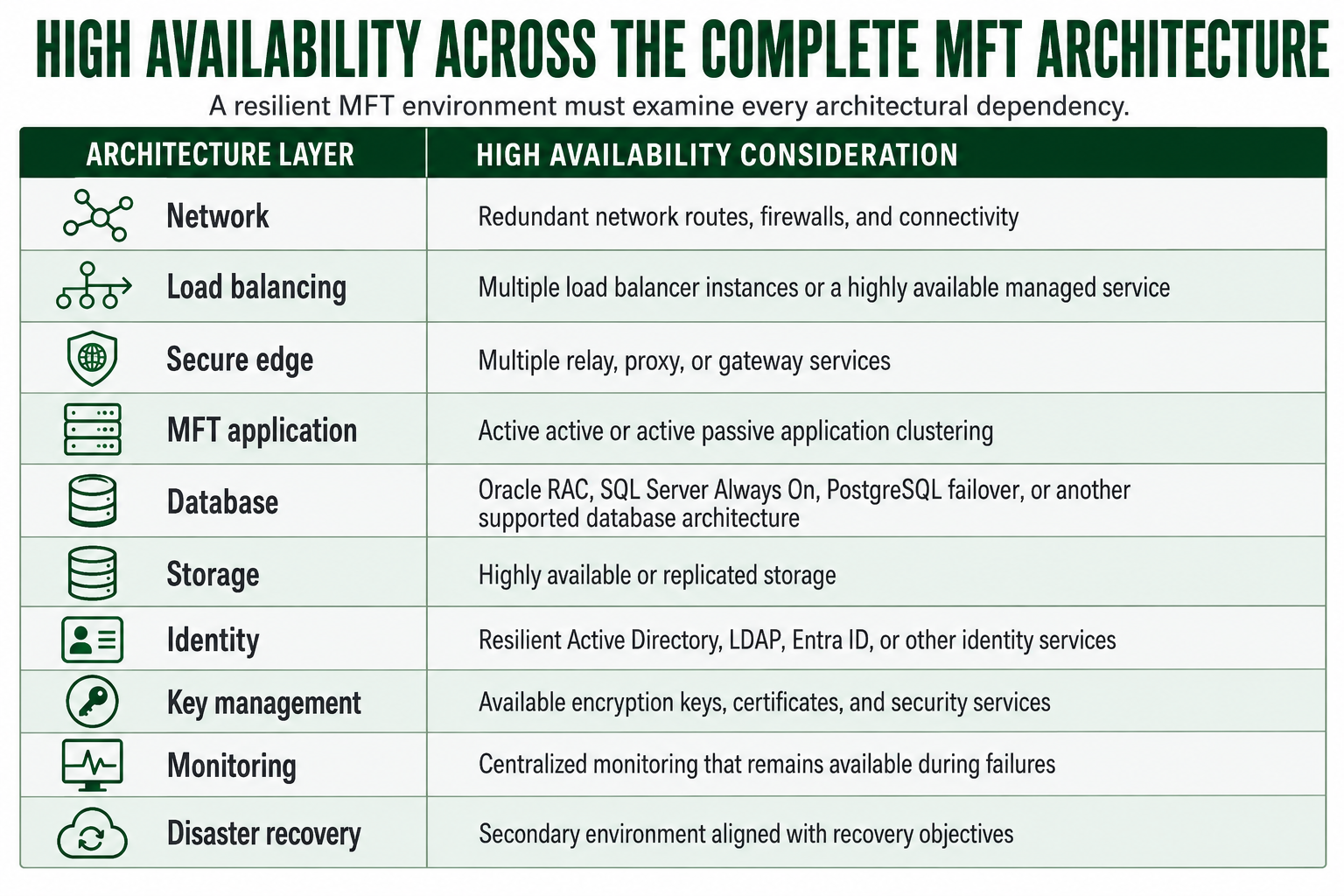
If one of these components remains unprotected, it may still interrupt the entire MFT service.
High availability is only as strong as the least available critical dependency.
What Does MFT Clustering Protect Against?
A properly designed MFT cluster can help protect against:
- Application node failure
- Operating system failure
- Hardware failure
- Planned maintenance
- Software service failure
- Local resource exhaustion
- Processing bottlenecks
- Unexpected demand spikes
Clustering can also allow individual nodes to be patched, upgraded, or maintained while other nodes continue providing service, assuming the platform supports coordinated maintenance or rolling upgrades.
What Does Clustering Not Automatically Protect Against?
Application clustering does not automatically protect against:
- Database failure
- Storage failure
- Network outage
- Load balancer failure
- DNS problems
- Identity provider failure
- Cloud region failure
- Corrupted configuration
- Compromised credentials
- Application wide software defects
- Partner endpoint failure
- Data center loss
This is why high availability must be evaluated as an architecture, not simply as an MFT product feature.
MFT Clustering Is Not Disaster Recovery
High availability and disaster recovery solve different problems.
High Availability
High availability is designed to keep services operating when individual components fail within the active environment.
It generally addresses:
- Node failure
- Service failure
- Planned maintenance
- Local infrastructure problems
- Workload distribution
Disaster Recovery
Disaster recovery addresses the loss or extended unavailability of an entire operating environment.
It may require:
- A secondary data center or cloud region
- Replicated or recoverable databases
- File and configuration recovery
- Network and DNS failover
- Keys and certificates
- Identity service availability
- Partner routing changes
- Recovery procedures
- Transaction reconciliation
- Periodic recovery testing
NIST SP 800 34 Revision 1 describes contingency planning as a coordinated strategy involving recovery procedures, alternate processing capabilities, testing, and system restoration.
A cluster can be part of a disaster recovery strategy, but it is not the complete strategy.
When Do Organizations Need MFT Clustering?
Clustering should be considered when one or more of the following conditions apply.
File Transfer Supports Mission Critical Processes
The organization depends on MFT for:
- Financial transactions
- Healthcare data
- Regulatory reporting
- Manufacturing operations
- Supply chain communications
- Customer facing services
- Time sensitive content distribution
Downtime Has a Measurable Business Impact
A clustered architecture may be justified when an outage can cause:
- Missed service levels
- Revenue loss
- Delayed transactions
- Regulatory exposure
- Customer disruption
- Manual reprocessing
- Partner escalation
Operations Must Continue During Maintenance
Clustering can allow organizations to remove nodes from service for:
- Operating system patching
- MFT application updates
- Infrastructure maintenance
- Troubleshooting
- Capacity changes
Other nodes can continue providing service while maintenance is performed.
Transfer Volumes Are Growing
Active active clustering can distribute workloads and allow additional processing nodes to be introduced as demand increases.
Scalability must still account for:
- Database throughput
- Storage performance
- Network capacity
- Workflow design
- File counts
- Partner limitations
The Organization Has Strict Availability Requirements
Clustering becomes more important when the organization has:
- Continuous operations
- Short recovery objectives
- High transfer volumes
- Tight processing windows
- Critical partner dependencies
- Limited tolerance for manual recovery
When Might Clustering Be Unnecessary?
Not every environment needs a cluster.
A single node deployment may be appropriate when:
- The environment is used for development or testing.
- Workloads are noncritical.
- Transfer volumes are low and predictable.
- Planned downtime is acceptable.
- Recovery can be completed within the required timeframe.
- Infrastructure simplicity is the primary objective.
- The additional cost and operational responsibility are not justified.
The decision should be based on business impact and recovery requirements rather than assuming that every MFT environment must look like a global bank.
Even a single node environment should still have:
- Backups
- Recovery procedures
- Monitoring
- Documented dependencies
- Tested restoration processes
MFT Clustering Evaluation Checklist
Before selecting or designing a clustered MFT platform, ask the following questions.
Application Availability
- Does the platform support active active, active passive, or both?
- What happens when an application node fails?
- How quickly is the failure detected?
- Can maintenance occur without stopping the entire service?
Transaction Recovery
- What happens to active transfers?
- Are checkpoint and restart supported?
- How are partial files handled?
- How are duplicate transfers prevented?
- Are retries automatic and controlled by policy?
Database Availability
- Does the MFT platform support database clustering?
- Is Oracle RAC supported?
- Are SQL Server Always On or PostgreSQL failover architectures supported?
- How does the application reconnect after a database instance failure?
- Are connection pools validated and refreshed?
- What happens to transactions active during database failover?
- How is database availability monitored?
- Is the database architecture tested with the MFT platform?
State Management
- Where is workflow and transaction state stored?
- How do nodes coordinate scheduled work?
- How is configuration synchronized?
- What happens if the database becomes unavailable?
Scalability
- Can nodes be added without redesigning the environment?
- How are workloads distributed?
- Which metrics indicate that additional capacity is required?
- Will storage or database performance become the next bottleneck?
Operations
- Can all nodes be managed from one interface?
- Are transfer histories centralized?
- Can administrators identify which node processed a transaction?
- Are failover events fully audited?
- Can the cluster integrate with enterprise monitoring and SIEM platforms?
Disaster Recovery
- Is the cluster limited to one data center or region?
- How are databases and files recovered?
- Are keys and certificates available in the recovery environment?
- Has the complete recovery process been tested?
How TDXchange Supports MFT Clustering
TDXchange was designed to support multi node enterprise MFT environments through centralized administration and coordinated processing.
TDXchange clustering supports:
- Multi node deployment
- High availability
- Workload distribution
- Horizontal scalability
- Centralized configuration
- Centralized transaction visibility
- Workflow automation
- Transfer monitoring
- Role based administration
- Secure relay and proxy services
- Hybrid cloud architectures
- Kubernetes deployment models
- Enterprise database architectures
The appropriate cluster design depends on the organization’s workloads, infrastructure, availability requirements, database platform, and operational model.
At bTrade, we work with customers to evaluate:
- Current and anticipated transfer volumes
- File counts and file size distribution
- Trading partner requirements
- Protocol usage
- Peak processing periods
- Availability and recovery objectives
- Database clustering and failover
- Storage architecture
- Network topology
- Disaster recovery requirements
- Operational skills and maintenance processes
The goal is not to add nodes simply because more boxes make an architecture diagram look impressive.
The goal is to build a resilient environment that meets business requirements without introducing unnecessary complexity.
For the broader architectural framework, read Modern MFT Architecture: How to Build Secure, Scalable, and Resilient Enterprise File Transfer.
For help deciding between clustered infrastructure and container orchestration, read Clustering vs. Kubernetes in Enterprise MFT.
Executive Takeaway
MFT clustering allows multiple application nodes to work together so that the failure or maintenance of one node does not make the entire file transfer service unavailable.
It can improve:
- Availability
- Workload distribution
- Scalability
- Maintenance flexibility
- Operational resilience
However, successful failover depends on more than adding another application server.
Organizations must understand how the MFT platform handles active connections, transaction state, queues, retries, partial files, and duplicate processing.
They must also protect shared dependencies, especially the database.
Database clustering technologies such as Oracle RAC can provide database instance availability and scalability. Technologies such as Oracle Data Guard can extend protection to data and site recovery.
Organizations need MFT clustering when file transfer supports business critical processes, downtime has a measurable impact, or continuous service is required.
Organizations may not need clustering for development, testing, or noncritical workloads where planned downtime and manual recovery are acceptable.
The right clustering architecture is not necessarily the largest or most complicated.
It is the one that keeps the business operating when something inevitably fails.
About the Author
Andrei Olin is Chief Technology Officer at bTrade, where he leads product strategy, delivery, and security across the company’s B2B, Managed File Transfer (MFT), and security platforms. He brings over 30 years of experience in enterprise technology, including designing and operating mission-critical MFT and messaging platforms for global financial institutions such as Merrill Lynch and Deutsche Bank. Andrei holds Master’s and Bachelor’s degrees in Information Technology with a focus on Information Security.
Frequently Asked Questions
What is clustering in Managed File Transfer?
MFT clustering is an architecture in which multiple MFT application nodes operate as one coordinated platform to improve availability, distribute workloads, and support horizontal scalability.
How does MFT failover work?
When an MFT node fails, health monitoring detects the failure and removes the node from service. New traffic is routed to healthy nodes while the MFT platform evaluates queued, scheduled, and incomplete transactions according to its recovery and retry policies.
Will an active file transfer continue after failover?
It depends on the MFT platform, transfer protocol, remote endpoint, and checkpoint capabilities. The transfer may resume, restart, retry automatically, or require review. Clustering keeps the service available but does not guarantee that every active network session continues without interruption.
What is the difference between active active and active passive clustering?
In active active clustering, multiple nodes process production workloads simultaneously. In active passive clustering, one node processes workloads while another remains ready to take over during a failure.
Why does an MFT cluster need database high availability?
MFT nodes commonly depend on a database for configuration, workflow state, transaction status, schedules, queues, and audit records. If that database fails, the application cluster may no longer be able to operate correctly.
What is Oracle RAC?
Oracle Real Application Clusters allows multiple Oracle Database instances running on separate servers to access one shared database. It can provide database service availability, redundancy, workload distribution, and scalability.
Does Oracle RAC provide disaster recovery?
Oracle RAC primarily protects against database instance and server failures within a clustered environment. Site recovery and data protection may require Oracle Data Guard or another disaster recovery technology.
Does clustering eliminate every single point of failure?
No. Databases, storage, load balancers, networks, DNS, identity providers, key management, and other shared services must also be designed for resilience.
Is MFT clustering the same as disaster recovery?
No. Clustering improves availability within an operating environment. Disaster recovery addresses the loss of an entire data center, cloud region, or production environment.
Does every organization need MFT clustering?
No. Clustering is most valuable for business critical, high volume, time sensitive, or continuously available workflows. Development, test, and noncritical environments may operate adequately on a single node.
Can clustering improve MFT scalability?
Yes. Active active clustering can distribute workloads across multiple nodes and allow capacity to grow horizontally. Database, storage, network, and workflow performance must also scale.
Can MFT nodes be maintained without stopping file transfers?
In a properly designed cluster, individual nodes may be removed from service for maintenance while other nodes continue operating. The exact maintenance and upgrade process depends on the platform.
Does TDXchange support MFT clustering?
Yes. TDXchange supports multi node clustered deployment, centralized administration, high availability, workload distribution, horizontal scalability, and enterprise database architectures.