

In modern media production, file transfer is no longer a background IT task. It is a critical operational dependency that directly impacts production schedules, creative workflows, and delivery commitments.
As file sizes grow into the hundreds of gigabytes and terabytes, many media organizations discover that their existing transfer tools simply cannot keep up. Missed deadlines, stalled production teams, and constant manual intervention become the norm.
This case study highlights how in 2009, bTrade worked directly with a leading media production company to solve these challenges, using TDXchange and bTrade’s Accelerated File Transfer Protocol (AFTP) to turn bulk file movement into a reliable, repeatable part of the production pipeline.
Executive Summary
Media organizations routinely transfer massive video, audio, and production assets among creative teams, post-production facilities, cloud platforms, and distribution partners. Under these demanding workloads, traditional file transfer protocols can result in slow or failed transfers, unpredictable delivery times, repeated manual intervention, and missed production deadlines.
This case study examines how bTrade helped a leading media production company modernize its large file transfer operations using TDXchange and bTrade’s Accelerated File Transfer Protocol (AFTP). By combining high-performance data transfer with workflow automation, operational visibility, and enterprise security controls, the organization achieved transfer speeds up to 100 times faster while improving reliability, reducing manual intervention, and keeping production workflows on schedule.
Key Takeaways
- Large Media Files Create Unique Transfer Challenges: Modern media workflows routinely involve hundreds of gigabytes or terabytes of video, audio, and production assets that can overwhelm traditional file transfer methods.
- File Transfer Directly Impacts Production Schedules: Delayed or failed transfers can disrupt editing, post-production, content distribution, and delivery commitments, making file transfer a business-critical operational dependency.
- TDXchange Provides Workflow Orchestration and Governance: TDXchange transforms large file movement from an ad-hoc task into a governed workflow with real-time monitoring, operational visibility, security controls, and auditability.
- AFTP Was Purpose-Built for Large-Scale Data Movement: Unlike traditional protocols, AFTP uses a UDP-based architecture that intelligently utilizes available bandwidth, handles latency efficiently, automatically resumes interrupted transfers, and delivers predictable performance for sustained bulk transfers.
- Up to 100x Faster Asset Delivery: The implementation significantly improved transfer speed, reduced failed transfers, minimized manual intervention, and increased confidence in production timelines.
- Observability Improves Operational Control: Real-time visibility into transfer activity, bottlenecks, workflow status, and system behavior enables teams to identify issues before they impact production schedules.
- Designed for Peak Demand: The solution was architected to support peak production workloads rather than average utilization, ensuring predictable performance during critical delivery windows.
- The Blueprint Extends Beyond Media: The same architectural approach has been successfully applied across media, banking, manufacturing, analytics, and eDiscovery environments where large-scale data movement is essential.
Why Large Media File Transfers Fail
Many media organizations initially assume file transfer problems are caused by insufficient bandwidth.
In reality, large file transfer failures often stem from architectural limitations.
Common challenges include:
- TCP performance limitations over long-distance networks
- Latency-sensitive transfer protocols
- Interrupted transfers requiring full restarts
- Lack of workflow visibility
- Manual coordination between teams
- Inconsistent performance under peak workloads
- Limited monitoring and governance
As media file sizes continue to grow, these limitations become increasingly difficult to manage.
Why Media File Transfer Became a Business-Critical Problem
The media company was operating a high-volume production environment, moving massive video and audio assets between production teams, post-production facilities, and downstream distribution partners.
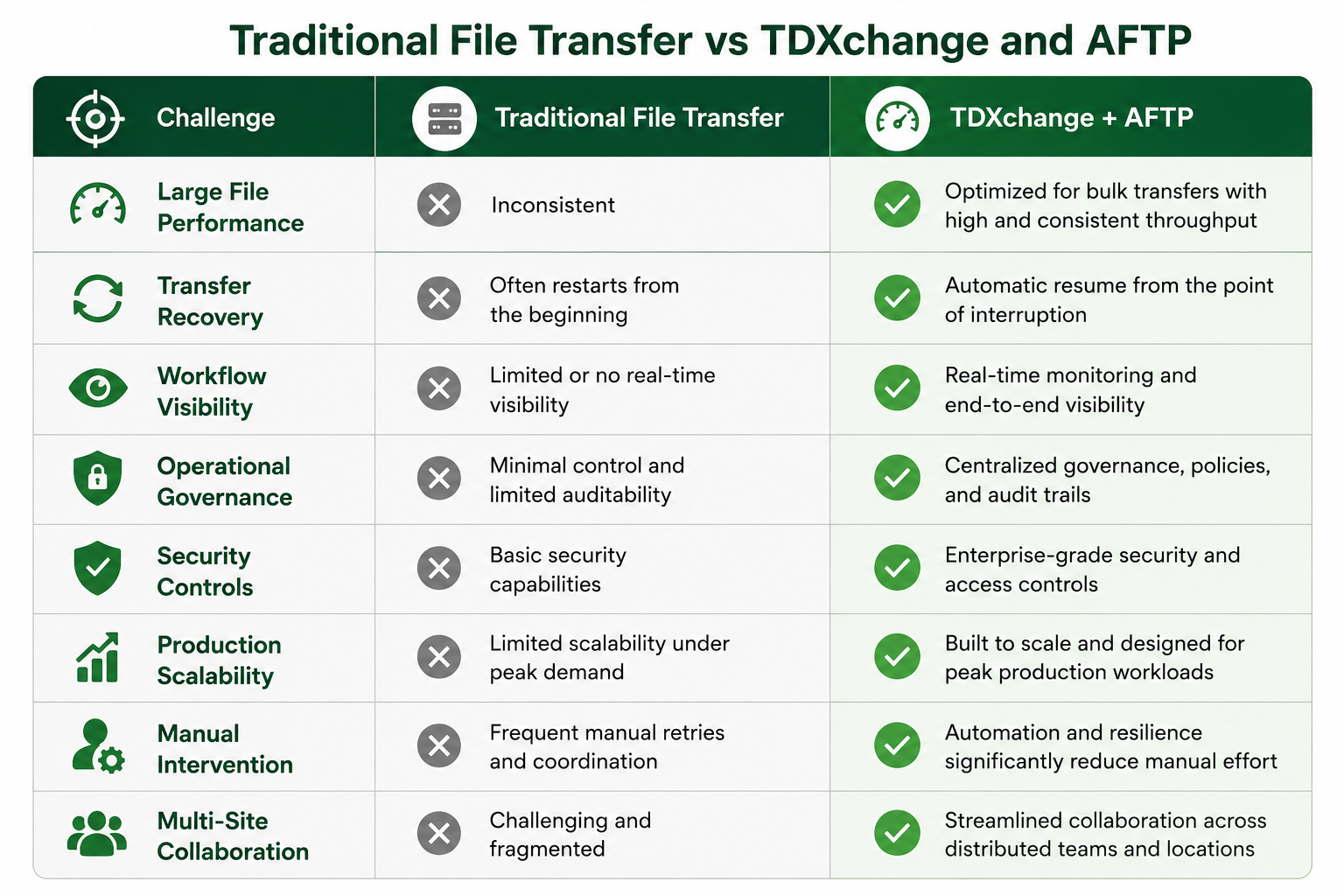
Their existing file transfer approach was showing clear limitations:
• Large files transferred slowly or failed mid-stream
• Performance varied significantly depending on network conditions
• Manual retries and restarts were common
• Production teams lacked confidence in delivery timelines
As production schedules tightened, file transfer delays began to directly affect business outcomes. What initially looked like a tooling issue quickly revealed itself as an architectural problem.
How bTrade Approached the Problem
Rather than recommending incremental tweaks, bTrade worked with the customer to rethink bulk media file movement entirely.
The solution centered on two core components:
• TDXchange as the orchestration, visibility, and governance layer
• Development of AFTP, bTrade’s proprietary Accelerated File Transfer Protocol, purpose-built for sustained, high-volume data movement
Together, these technologies addressed not just speed, but reliability, predictability, and operational control.
The Role of TDXchange in Media Workflows
TDXchange served as more than a file transfer platform.
It became the operational control layer for production data movement.
Beyond monitoring transfers, TDXchange enabled the organization to:
- Govern production workflows
- Maintain operational visibility
- Apply consistent security policies
- Monitor transfer health in real time
- Track delivery progress across teams
- Identify bottlenecks before deadlines were impacted
- Create audit trails for critical content movement
By introducing observability and governance, TDXchange helped transform file transfer from a reactive process into a predictable operational capability.
Why AFTP Made the Difference
At the core of the performance improvement was AFTP, which bTrade specifically designed to handle large, sustained bulk transfers that traditional protocols struggle with.
𝗔𝗙𝗧𝗣 𝗱𝗲𝗹𝗶𝘃𝗲𝗿𝗲𝗱:
• Significantly higher and more consistent throughput for very large media files
• Better handling of latency and long-distance network conditions
• Automatic resumption of interrupted transfers without restarting
• Predictable performance under heavy production load
• Protocol-level optimization: AFTP is built on UDP, allowing it to intelligently utilize the available network bandwidth up to 100% or a configurable percentage to maximize throughput for large transfers without being constrained by TCP windowing and latency limitations.
By using AFTP within TDXchange workflows, the media company was able to move massive production assets reliably, even during peak usage.
Measurable Impact on Media Operations
Following implementation, the organization experienced measurable improvements across both technology and operations.
Technical Improvements
- Up to 100x faster file delivery
- Reduced failed transfers
- Automatic recovery from interruptions
- Improved bandwidth utilization
- More predictable transfer performance
Operational Improvements
- Reduced production delays
- Improved collaboration across teams
- Less manual intervention
- Greater confidence in delivery commitments
- Improved visibility into production workflows
Most importantly, file transfer ceased being a recurring operational risk and became a dependable component of the production pipeline.
Bulk file transfer shifted from being a constant risk to a controlled, repeatable capability.
A Blueprint bTrade Has Reused Across Media, Banking and Manufacturing Environments
This engagement reinforced an approach that bTrade has since applied to multiple media and content-driven organizations facing similar challenges.
The Blueprint is Consistent:
• Use TDXchange to orchestrate and govern large file workflows
• Use AFTP for sustained bulk data movement, not transactional protocols
• Design for peak production demand, not average load
• Minimize human intervention through automation and resilience
While each corporate environment has its own nuances, the underlying challenges and the solution built around TDXchange and AFTP are remarkably consistent.
Executive Takeaway
Large media file transfer is not simply a networking challenge.
It is a production workflow challenge.
Organizations that rely on transferring hundreds of gigabytes or terabytes of content need more than raw bandwidth. They need visibility, governance, resilience, and predictable performance.
By combining TDXchange as the orchestration and observability layer with AFTP as the high-performance transport engine, bTrade helped transform bulk file movement into a controlled, scalable, and repeatable business capability.
The result was faster content delivery, improved production efficiency, reduced operational risk, and greater confidence in meeting critical production deadlines.
About the Author
Andrei Olin is Chief Technology Officer at bTrade, where he leads product strategy, delivery, and security across the company’s B2B, Managed File Transfer (MFT), and security platforms. He brings over 30 years of experience in enterprise technology, including designing and operating mission-critical MFT and messaging platforms for global financial institutions such as Merrill Lynch and Deutsche Bank. Andrei holds Master’s and Bachelor’s degrees in Information Technology with a focus on Information Security.
Frequently Asked Questions:
What is the best way to transfer large media files?
For enterprise media environments, a combination of workflow orchestration and accelerated file transfer technology provides the most reliable and scalable approach.
Why do large video file transfers fail?
Large transfers often fail due to latency, interrupted connections, protocol limitations, bandwidth inefficiencies, and lack of operational visibility.
How does AFTP differ from FTP or SFTP?
AFTP is designed specifically for sustained bulk data movement and large files, using a UDP-based architecture that provides higher throughput, automatic recovery, and better performance over long-distance networks.
Can TDXchange support cloud-based media workflows?
Yes. TDXchange supports on-premises, cloud, hybrid cloud, and multi-site environments while maintaining centralized governance and visibility.
Is this approach suitable outside the media industry?
Yes. The same architecture is used for eDiscovery, analytics, manufacturing, banking, disaster recovery, and other high-volume data movement use cases.
How did bTrade help improve large media file transfers?
bTrade implemented TDXchange for workflow orchestration and AFTP for accelerated bulk transfer, delivering faster, more reliable movement of large production files.
Why was AFTP critical for this media use case?
AFTP is purpose-built for sustained bulk data movement and performs far better than traditional protocols when transferring very large files over complex networks.
What role does TDXchange play in media worklfows?
TDXchange provides visibility, governance, security, and control, ensuring large file transfers are predictable and manageable within production pipelines.
Is this approach scalable as media file sizes grow?
Yes. TDXchange and AFTP are designed to scale with increasing file sizes and production volume without re-architecting workflows.
Is this solution limited to media companies?
No. The same approach is used by bTrade customers in eDiscovery, analytics, and other data-intensive environments.