
Managed File Transfer (MFT) platforms are often judged by how they perform under ideal conditions. In reality, their true value is revealed under stress, when systems fail, demand spikes, or environments change faster than infrastructure teams can react.
For organizations running business-critical data flows, efficiency and resiliency are no longer optional features. They are operational controls that directly impact uptime, compliance, and business continuity.
This is where clustering and Kubernetes integration in platforms like bTrade’s TDXchange fundamentally change how MFT operates at scale.
Executive Summary
As organizations process increasing volumes of data across cloud, on-premises, and hybrid environments, traditional Managed File Transfer (MFT) architectures often struggle to keep pace with scalability, resiliency, and operational demands. Kubernetes provides a modern foundation for enterprise MFT by enabling containerized deployments, automated scaling, high availability, workload distribution, and infrastructure automation. Platforms such as TDXchange leverage Kubernetes to support millions of files per day, reduce operational overhead, improve disaster recovery readiness, and deliver consistent performance across distributed environments. Kubernetes transforms Managed File Transfer from a static infrastructure component into a dynamic, cloud-native service that can scale alongside business growth.
Key Takeaways
- Cloud-Native MFT Scalability: Kubernetes enables Managed File Transfer platforms to scale horizontally by adding or removing resources based on workload demand.
- Improved Resiliency and Availability: Container orchestration, clustering, failover, and workload distribution help reduce downtime and eliminate single points of failure.
- Supports Millions of File Transfers: Kubernetes allows organizations to handle growing transaction volumes, partner onboarding, seasonal spikes, and global expansion without rearchitecting the platform.
- Operational Automation: Infrastructure-as-Code, CI/CD integration, automated deployments, and simplified upgrades reduce administrative overhead.
- Hybrid Cloud Ready: Kubernetes provides a consistent deployment model across cloud, on-premises, and disaster recovery environments.
- Enterprise Governance Remains Critical: Scaling MFT requires observability, centralized administration, security controls, auditability, and workflow governance in addition to infrastructure scalability.
- TDXchange Combines Kubernetes and MFT Governance: TDXchange provides centralized administration, security, auditing, automation, and workflow orchestration while Kubernetes provides elastic infrastructure scalability.
Why MFT Efficiency and Resiliency Are Strategic Controls
Across banking, healthcare, media, retail, and government environments, MFT supports:
• Time-sensitive financial and regulatory processing
• High-volume content and data distribution
• Inter-agency and partner data exchange
• Operational SLAs tied to revenue and service delivery
When MFT platforms struggle to scale or recover quickly, the impact is immediate in missed deadlines, compliance exposure, and operational escalation.
𝗙𝗿𝗼𝗺 𝗮𝗻 𝗲𝘅𝗲𝗰𝘂𝘁𝗶𝘃𝗲 𝗽𝗲𝗿𝘀𝗽𝗲𝗰𝘁𝗶𝘃𝗲, 𝘁𝗵𝗲 𝗾𝘂𝗲𝘀𝘁𝗶𝗼𝗻 𝗶𝘀 𝗻𝗼𝘁:
“Can our MFT platform transfer files?”
It is:
“Can it adapt, recover, and scale predictably as conditions change?”
Why Traditional MFT Architectures Reach Their Limits
Many legacy Managed File Transfer environments were designed when organizations exchanged significantly fewer files and supported fewer integrations.
Today, organizations must support:
- Hybrid cloud architectures
- Global trading partner ecosystems
- API-driven integrations
- Real-time business processes
- Large-scale analytics
- Regulatory compliance requirements
- High-volume file transfers
As workloads grow, traditional single-server deployments often create bottlenecks that impact performance, resiliency, and operational efficiency. Organizations frequently find themselves adding larger servers instead of adopting architectures that scale horizontally.
What "Modern" MFT Architecture Really Requires
Future-ready MFT platforms must move beyond monolithic deployments and static capacity planning. At a minimum, they should:
• Eliminate single points of failure
• Scale horizontally without downtime
• Recover automatically from node or service failures
• Integrate with modern infrastructure orchestration
• Reduce operational overhead, not increase it
TDXchange was designed with these requirements in mind, which is why clustering and Kubernetes support are core architectural capabilities, not add-ons.
How Clustering Improves MFT Resiliency in TDXchange
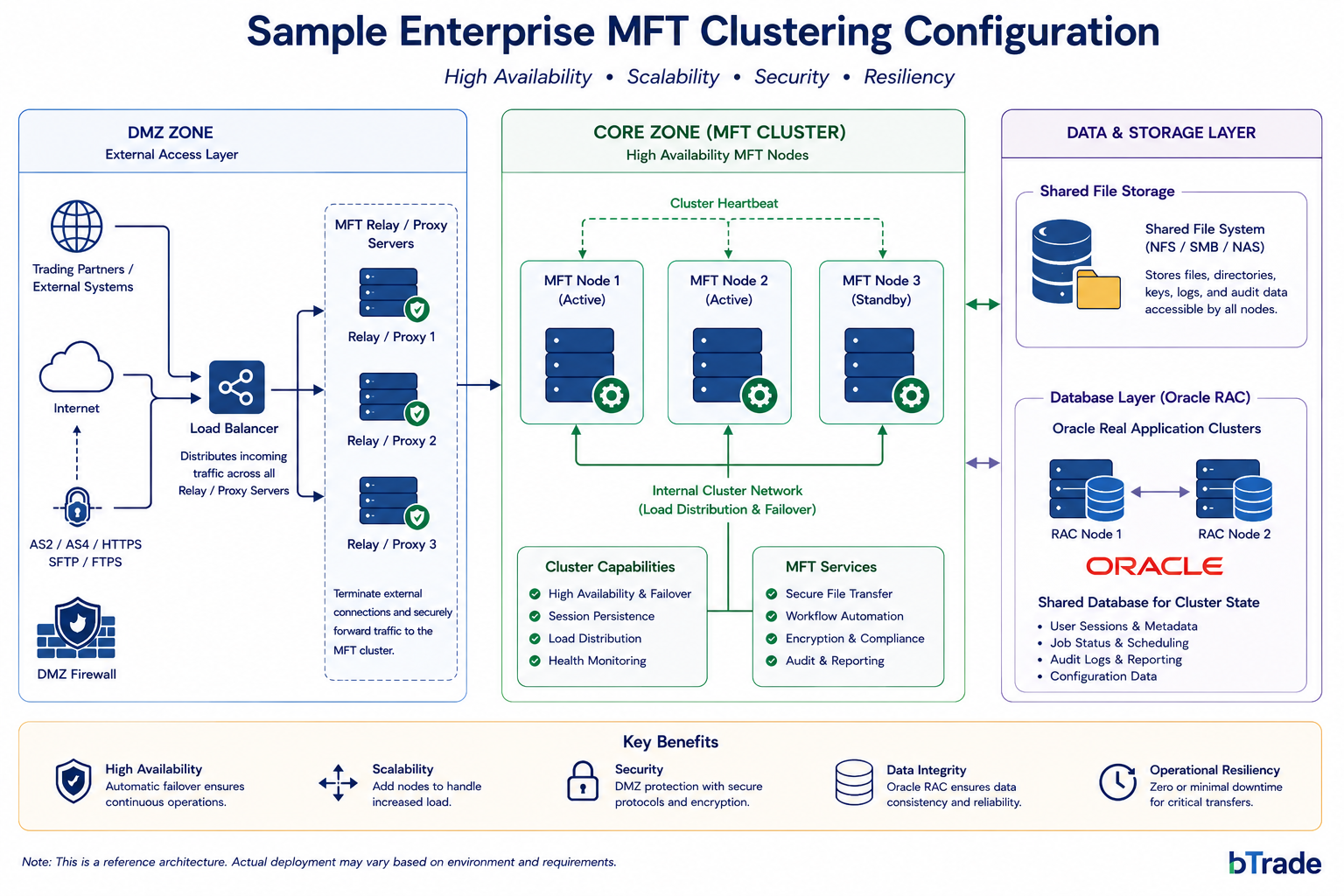
Clustering allows multiple TDXchange nodes to operate as a single logical system, delivering resilience and performance by design:
• 𝗛𝗶𝗴𝗵 𝗔𝘃𝗮𝗶𝗹𝗮𝗯𝗶𝗹𝗶𝘁𝘆
If one node fails, others continue processing without interruption. Transfers remain active, and outages are no longer business-visible events.
• 𝗟𝗼𝗮𝗱 𝗗𝗶𝘀𝘁𝗿𝗶𝗯𝘂𝘁𝗶𝗼𝗻
Workloads are automatically balanced across nodes, ensuring consistent throughput even during peak demand or unexpected surges.
• 𝗛𝗼𝗿𝗶𝘇𝗼𝗻𝘁𝗮𝗹 𝗦𝗰𝗮𝗹𝗮𝗯𝗶𝗹𝗶𝘁𝘆
Capacity grows by adding nodes, not replacing infrastructure, allowing organizations to scale incrementally and cost-effectively.
• 𝗖𝗲𝗻𝘁𝗿𝗮𝗹𝗶𝘇𝗲𝗱 𝗖𝗼𝗻𝘁𝗿𝗼𝗹
Operators manage the entire cluster from a unified interface, simplifying monitoring, configuration, and troubleshooting.
Today, many bTrade customers across banking, media, retail, and government rely on clustered TDXchange deployments to support high-volume, mission-critical data movement in production.
Why Kubernetes Is a Natural Fit for Managed File Transfer
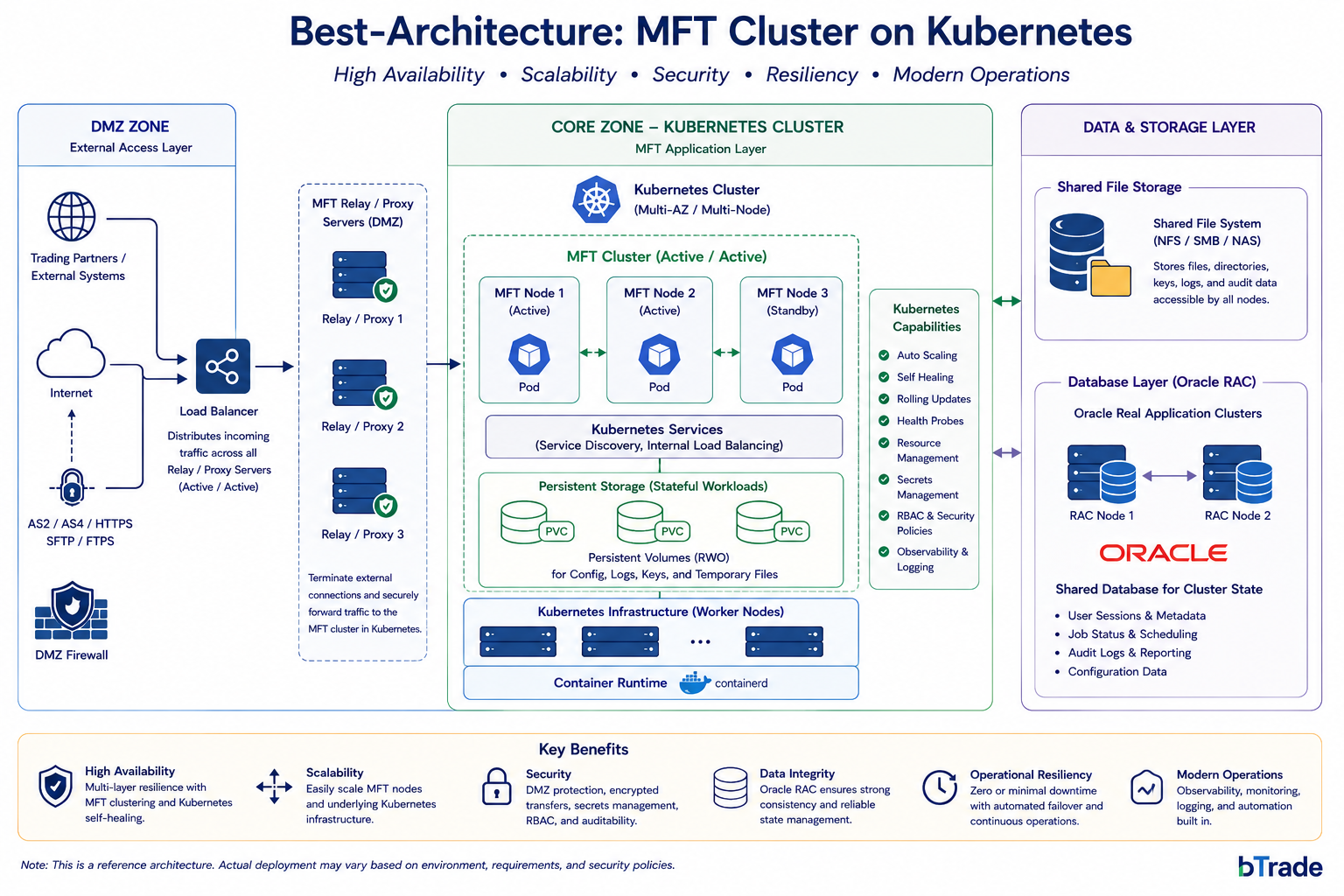
Kubernetes was designed to deploy, manage, scale, and maintain containerized applications across distributed infrastructure. Rather than treating MFT as a standalone server, Kubernetes enables organizations to operate file transfer services as resilient, scalable application workloads.
𝗧𝗗𝗫𝗰𝗵𝗮𝗻𝗴𝗲’𝘀 𝗞𝘂𝗯𝗲𝗿𝗻𝗲𝘁𝗲𝘀 𝗶𝗻𝘁𝗲𝗴𝗿𝗮𝘁𝗶𝗼𝗻 𝗲𝗻𝗮𝗯𝗹𝗲𝘀:
• Automated deployment and scaling of MFT components
• Self-healing behavior, where failed containers are restarted automatically
• Consistent environments across development, test, and production
• Infrastructure portability across on-prem, cloud, and hybrid environments
For operations teams, this means faster provisioning, fewer manual steps, and greater confidence that MFT scales and recovers in line with the rest of the enterprise platform.
Five Business Benefits of Running TDXchange on Kubernetes
1. Elastic Scalability
Organizations rarely experience perfectly predictable workloads. Trading partner growth, seasonal demand, acquisitions, and new digital initiatives can significantly increase transfer volumes.
Kubernetes allows TDXchange to scale dynamically as workloads increase while avoiding unnecessary infrastructure costs during quieter periods.
2. High Availability and Resilience
Business-critical file transfers cannot stop because of a single server failure.
Kubernetes helps distribute workloads across multiple nodes while automatically restarting or replacing failed containers. Combined with TDXchange clustering, this improves operational resiliency and reduces downtime.
3. Simplified Operations
Infrastructure automation allows teams to deploy, patch, upgrade, and scale environments more consistently than traditional manual processes.
This reduces operational overhead and accelerates deployment cycles.
4. Hybrid Cloud Flexibility
Organizations increasingly operate across multiple environments.
Kubernetes enables a consistent deployment model across:
- On-premises infrastructure
- Private cloud
- Public cloud
- Disaster recovery sites
This simplifies modernization efforts and long-term infrastructure planning.
5. Faster Growth Without Re-Architecture
As transfer volumes grow, organizations can add capacity incrementally rather than redesigning the entire environment.
This allows TDXchange deployments to evolve alongside business growth.
Kubernetes Alone Does Not Solve MFT Challenges
A common misconception is that Kubernetes automatically solves all Managed File Transfer problems.
Kubernetes provides infrastructure scalability.
It does not provide:
- File transfer governance
- Trading partner management
- Compliance reporting
- Workflow orchestration
- Audit trails
- Security policies
- Operational visibility
These capabilities remain the responsibility of the MFT platform itself.
This is where TDXchange provides value by combining enterprise-grade file transfer governance with cloud-native scalability.
Real-World Use Across Industries
Clustered and Kubernetes-enabled TDXchange environments are used today to support:
• Banking institutions meeting strict processing and reporting SLAs
• Media organizations handling large distribution spikes
• Retailers scaling for seasonal and promotional demand
• Government agencies ensuring uninterrupted data exchange
• In each case, the value is the same: predictable, resilient data movement at scale.
Executive Takeaway
Kubernetes has become one of the most effective ways to scale Managed File Transfer environments because it enables organizations to improve resiliency, automate operations, support hybrid cloud deployments, and grow without major infrastructure redesigns.
However, successful enterprise MFT requires more than scalable infrastructure. Organizations also need governance, security, observability, automation, compliance support, and operational control.
By combining Kubernetes with TDXchange, organizations can build a modern Managed File Transfer architecture capable of supporting millions of file transfers, global trading partner ecosystems, and future growth initiatives.
About the Author
Andrei Olin is Chief Technology Officer at bTrade, where he leads product strategy, delivery, and security across the company’s B2B, Managed File Transfer (MFT), and security platforms. He brings over 30 years of experience in enterprise technology, including designing and operating mission-critical MFT and messaging platforms for global financial institutions such as Merrill Lynch and Deutsche Bank. Andrei holds Master’s and Bachelor’s degrees in Information Technology with a focus on Information Security.
𝗙𝗿𝗲𝗾𝘂𝗲𝗻𝘁𝗹𝘆 𝗔𝘀𝗸𝗲𝗱 𝗤𝘂𝗲𝘀𝘁𝗶𝗼𝗻𝘀 (𝗙𝗔𝗤𝘀)
What is MFT clustering?
MFT clustering allows multiple MFT nodes to operate together as a single system, providing high availability, load balancing, and horizontal scalability.
Why is Kubernetes important for MFT?
Kubernetes automates deployment, scaling, and recovery, making MFT platforms more resilient and easier to operate in modern environments.
Which industries use clustered TDXchange deployments?
Customers across banking, media, retail, and government use clustered TDXchange to support high-volume, mission-critical transfers.
Does clustering reduce operational overhead?
Yes. Clustering and Kubernetes reduce manual intervention, simplify scaling, and improve recovery from failures.
Is this approach suitable for hybrid environments?
Yes. TDXchange supports on-prem, cloud, and hybrid deployments with consistent behavior and governance.
Why run Managed File Transfer on Kubernetes?
Kubernetes enables MFT platforms to scale horizontally, improve resiliency, automate deployments, and support hybrid cloud architectures.
Can Kubernetes improve MFT performance?
Yes. Kubernetes helps distribute workloads across multiple nodes and allows organizations to add capacity dynamically as transfer volumes increase.
Is Kubernetes suitable for enterprise Managed File Transfer?
Yes. Many organizations use Kubernetes to support high-volume, highly available, and cloud-native Managed File Transfer deployments.
Does Kubernetes provide compliance capabilities?
No. Kubernetes provides infrastructure orchestration. Compliance capabilities such as auditing, reporting, governance, and workflow controls are typically provided by the MFT platform.
How does TDXchange use Kubernetes?
TDXchange leverages Kubernetes for scalability, resiliency, and deployment automation while providing enterprise-grade security, governance, workflow automation, auditing, and operational visibility.
What are the benefits of Kubernetes for hybrid cloud MFT?
Kubernetes provides a consistent deployment and management model across on-premises, private cloud, public cloud, and disaster recovery environments, simplifying operations and improving flexibility.