
How Managed File Transfer Supports the NIST Cybersecurity Framework
Executive Summary
The NIST Cybersecurity Framework 2.0 helps organizations govern, identify, protect, detect, respond to, and recover from cybersecurity risks. As enterprises increasingly exchange sensitive information across cloud platforms, business partners, hybrid environments, and global networks, Managed File Transfer has become an important component of a comprehensive cybersecurity strategy.
Modern MFT platforms such as TDXchange can support NIST CSF 2.0 outcomes through strong encryption, Zero Trust access controls, operational visibility, behavioral monitoring, anomaly detection, auditability, workflow governance, automated response, recovery capabilities, and quantum-safe security.
By aligning file-transfer operations with the six NIST CSF 2.0 Core Functions, organizations can strengthen cybersecurity resilience, reduce operational risk, improve governance, and support compliance readiness.
Organizations can review the complete framework in the official NIST Cybersecurity Framework 2.0 publication.
Key Takeaways
- The NIST Cybersecurity Framework Provides a Risk-Based Security Model: Organizations use NIST CSF 2.0 to improve cybersecurity governance, risk management, and operational resilience.
- The Framework Is Organized Around Six Core Functions: Govern, Identify, Protect, Detect, Respond, and Recover provide a structured approach for managing cybersecurity risk.
- Managed File Transfer Can Support All Six NIST Functions: Modern MFT platforms can contribute to governance, asset identification, data protection, threat detection, incident response, and operational recovery.
- Governance Establishes Accountability: Centralized policies, role-based administration, audit trails, risk management, and regulatory alignment help organizations govern file-transfer operations consistently.
- Zero Trust Is Becoming Essential: Modern MFT platforms increasingly apply Zero Trust principles through continuous verification, least-privilege access, relationship-based controls, and contextual authorization.
- Observability Improves Cybersecurity Outcomes: Real-time, end-to-end visibility into file movement, user activity, workflows, and system behavior helps organizations identify operational problems and respond to security incidents faster.
- Behavioral Analytics Strengthens Detection: Anomaly detection can identify unusual transfer behavior, suspicious access patterns, unexpected file sizes, irregular destinations, and other risks before they become serious incidents.
- AI Governance Is Emerging as a Security Requirement: Organizations must ensure that AI systems interacting with file-transfer environments operate under Zero Trust principles and can access only explicitly authorized information.
- Quantum-Safe Encryption Supports Long-Term Data Protection: NIST-standardized post-quantum cryptographic algorithms can help organizations prepare to protect sensitive information against future quantum computing threats.
- Cybersecurity Requires Operational Resilience: Compliance alone is not enough. Organizations need automation, continuous monitoring, response processes, recovery capabilities, and effective governance to maintain secure operations.
What Is the NIST Cybersecurity Framework?
he National Institute of Standards and Technology developed the Cybersecurity Framework to help organizations understand, assess, prioritize, and communicate cybersecurity risk.
The current NIST Cybersecurity Framework 2.0 is designed for organizations of all sizes, industries, and maturity levels. It provides a flexible, risk-based structure rather than prescribing a specific technology or implementation.
The framework is organized around six Core Functions:
- Govern: Establish cybersecurity strategy, policies, roles, responsibilities, oversight, and risk-management expectations.
- Identify: Understand assets, systems, data, dependencies, vulnerabilities, and cybersecurity risks.
- Protect: Implement safeguards that reduce cybersecurity risk and protect sensitive systems and information.
- Detect: Identify and analyze anomalies, suspicious activity, operational failures, and potential cybersecurity events.
- Respond: Contain incidents, communicate with stakeholders, investigate events, and take appropriate corrective action.
- Recover: Restore affected services, maintain resilience, and improve operations based on lessons learned.
Organizations across the public and private sectors use NIST CSF 2.0 to strengthen:
- Cybersecurity governance
- Enterprise risk management
- Sensitive-data protection
- Compliance readiness
- Threat detection
- Incident response
- Business continuity
- Infrastructure and operational resilience
Managed File Transfer can support these objectives by providing centralized security, governance, automation, monitoring, traceability, and recovery capabilities for business-critical data exchanges.
Why the NIST Cybersecurity Framework Matters
Modern organizations face increasingly complex cybersecurity challenges, including:
- ransomware
- insider threats
- supply chain attacks
- credential compromise
- cloud security risks
- third-party vulnerabilities
- operational disruptions
At the same time, enterprises are moving massive amounts of sensitive data across:
- cloud platforms
- hybrid infrastructure
- business partners
- remote environments
- global networks
The NIST Cybersecurity Framework helps organizations create a structured and repeatable approach to managing these evolving risks.
Rather than focusing only on compliance checklists, the framework emphasizes:
operational resilience
risk management
continuous improvement
cybersecurity visibility
Why Managed File Transfer Is Critical to NIST CSF
Many organizations focus their cybersecurity investments on networks, endpoints, applications, and identity systems. However, Managed File Transfer platforms also play a critical role in protecting how sensitive information moves across the enterprise.
Modern organizations routinely exchange:
- Financial records
- Healthcare information
- Legal documents
- Customer data
- Supply chain information
- Government communications
- Intellectual property
Without centralized security and governance, file-transfer workflows can introduce significant cybersecurity, operational, and compliance risks.
Modern MFT platforms help organizations:
- Secure sensitive data
- Govern users, partners, and workflows
- Automate data exchanges
- Improve end-to-end visibility
- Detect abnormal activity
- Maintain audit readiness
- Accelerate incident response
- Strengthen operational resilience
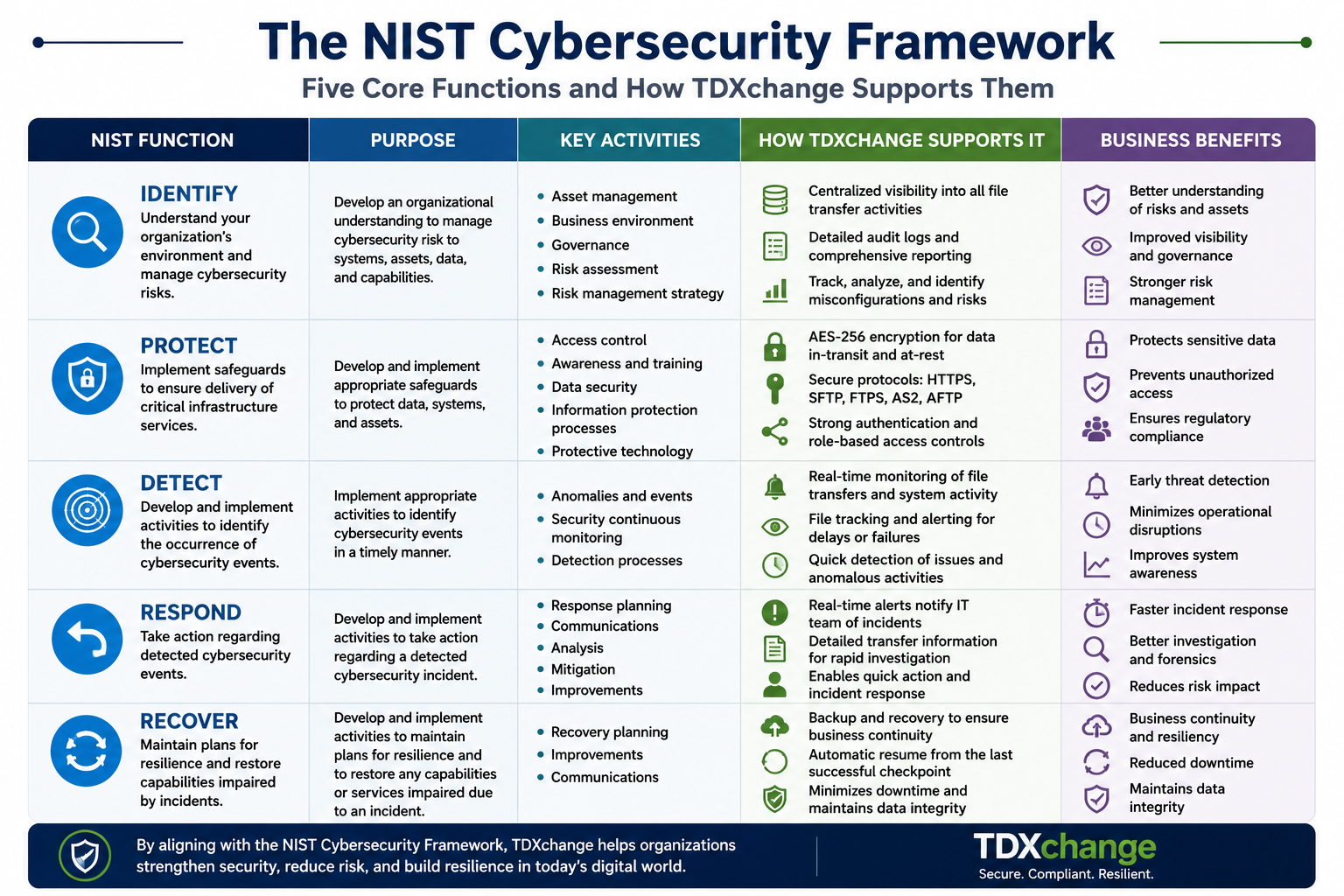
TDXchange can support cybersecurity outcomes across all six Core Functions of the NIST Cybersecurity Framework 2.0: Govern, Identify, Protect, Detect, Respond, and Recover.
1. Govern: Establishing Accountability and Control
The Govern function focuses on establishing and monitoring an organization’s cybersecurity strategy, policies, roles, responsibilities, and risk-management expectations.
For MFT environments, this includes determining:
- Who is responsible for file-transfer security
- Who can access sensitive information
- Which policies apply to users and trading partners
- How administrative responsibilities are separated
- How risks and compliance obligations are documented
- Whether security controls are applied consistently
- How changes and exceptions are reviewed
How TDXchange Supports Govern
TDXchange provides centralized governance capabilities, including:
- Role-Based Access Control
- Delegated administration
- Segregation of duties
- Native MFA for administrators and end users
- Enterprise identity-provider integration
- Partner-specific access controls
- Centralized policy enforcement
- Configuration-change tracking
- Administrative audit trails
- Data-retention and lifecycle controls
- Compliance reporting and SIEM integration
These capabilities help organizations establish accountability, consistently enforce security policies, and produce evidence demonstrating how file-transfer operations are governed.
2. Identify: Improving Visibility Into Data Movement
The Identify function focuses on understanding:
- Assets
- Data
- File-transfer workflows
- Cybersecurity risks
- Business relationships
- Operational dependencies
Organizations cannot effectively protect information or workflows they cannot see.
How TDXchange Supports Identify
TDXchange provides centralized visibility into enterprise file-transfer operations through:
- Detailed audit logs
- End-to-end file tracking
- Transfer monitoring
- Workflow-level reporting
- Operational dashboards
- Partner and endpoint visibility
- Historical transaction records
For example, a financial institution can use TDXchange to:
- Identify failed or delayed transfers
- Monitor trading-partner activity
- Detect workflow anomalies
- Review historical transfer activity
- Understand system dependencies
- Analyze operational risks
This visibility helps organizations understand their data-exchange environment and identify potential vulnerabilities, dependencies, and operational risks before they become larger problems.
3. Protect: Securing Sensitive Data and Workflows
The Protect function focuses on implementing safeguards that reduce cybersecurity risk.
These safeguards include:
- Encryption
- Authentication
- Access control
- Secure communications
- Data protection
- Policy enforcement
How TDXchange Supports Protect
TDXchange provides security capabilities aligned with modern cybersecurity practices, including:
- AES-256 encryption
- Encryption in transit and at rest
- Native MFA for administrators and end users
- MFA through external identity providers
- Role-Based Access Control
- Contextual access controls
- Enterprise authentication integration
- IP filtering
- Zero Trust-aligned security controls
- Secure trading-partner connectivity
- Quantum-safe encryption capabilities
Supported secure transfer protocols include:
- HTTPS
- SFTP
- FTPS
- AS2
- AFTP
These safeguards help organizations protect sensitive data, enforce least-privilege access, and reduce the risk of unauthorized access or disclosure.
4. Detect: Identifying Threats and Operational Issues Quickly
The Detect function focuses on discovering and analyzing cybersecurity events before they become major security incidents or operational disruptions.
Modern threats and failures may involve:
- Suspicious user behavior
- Compromised credentials
- Delayed or missing workflows
- Abnormal transfer patterns
- Unexpected file sizes
- Unusual destinations
- Runaway processes
- Operational anomalies
How TDXchange Supports Detect
TDXchange provides:
- Real-time monitoring
- Intelligent alerting
- Operational dashboards
- End-to-end workflow visibility
- Transfer tracking
- Behavioral monitoring
- Anomaly-detection capabilities
The platform can alert administrators and operational teams when:
- A file transfer is delayed or missing
- A transfer fails
- Suspicious activity is detected
- Transfer behavior differs from established patterns
- An endpoint becomes unavailable
- A critical workflow is at risk of missing its SLA
These capabilities help organizations improve awareness, identify risks faster, and reduce the likelihood that small issues will become major disruptions.
5. Respond: Accelerating Incident Response
The Respond function focuses on taking appropriate action during cybersecurity incidents and operational disruptions.
Organizations need:
- Real-time alerts
- End-to-end visibility
- Rapid diagnostics
- Workflow context
- Defensible audit evidence
- Consistent response procedures
How TDXchange Supports Respond
TDXchange supports incident response through:
- Real-time security and operational alerts
- Detailed transfer context
- Centralized reporting
- Operational diagnostics
- Searchable audit trails
- Workflow and endpoint visibility
- Automated notifications and policy enforcement
When suspicious activity is detected, authorized administrators can:
- Investigate affected workflows
- Review the complete transfer history
- Identify impacted users, partners, and endpoints
- Analyze administrative and user activity
- Determine which policies were applied
- Take corrective action quickly
This context-rich visibility can reduce investigation time and help security and operations teams respond more effectively.
6. Recover: Maintaining Operational Resilience
The Recover function focuses on restoring affected operations and maintaining business continuity after a cybersecurity incident, system failure, or service disruption.
Mission-critical file-transfer environments require:
- Resilient architecture
- High availability
- Failover capabilities
- Transfer recovery
- Operational continuity
- Tested backup and recovery processes
How TDXchange Supports Recover
TDXchange helps organizations strengthen resilience through:
- Backup and recovery capabilities
- High-availability clustering
- Automated transfer recovery
- Checkpoint and restart
- Failover support
- Resilient deployment options
- Centralized monitoring during recovery
For example, if a large transfer is interrupted by a network outage or infrastructure failure, TDXchange can resume it from the last successful checkpoint instead of restarting the entire transfer.
These capabilities help organizations:
- Minimize downtime
- Reduce operational delays
- Improve transfer reliability
- Maintain data integrity
- Restore critical workflows faster
- Support business continuity objectives
Together, these capabilities allow TDXchange to support security and resilience outcomes across all six NIST CSF 2.0 Core Functions while helping organizations govern and protect the complete lifecycle of enterprise data exchanges.
AI Governance and the NIST Cybersecurity Framework
As organizations deploy AI-powered capabilities, cybersecurity governance must extend to AI systems as well.
Security teams increasingly ask:
- What information can AI access?
- Are AI interactions audited?
- Does AI operate under least-privilege principles?
- Is sensitive transfer data protected?
- Can AI actions be monitored and governed?
Organizations implementing AI within MFT environments should ensure:
- AI accesses only authorized information
- AI operates under Zero Trust principles
- AI interactions are logged and auditable
- Sensitive transfer payloads remain protected
AI should be treated as another identity that must continuously authenticate, authorize, and justify access.
Why Risk-Based Cybersecurity Matters
The NIST Cybersecurity Framework emphasizes a risk-based approach to cybersecurity.
Organizations must prioritize security investments based on:
- operational impact
- threat exposure
- compliance requirements
- business risk
Modern cybersecurity strategies increasingly focus on:
- proactive threat reduction
- operational resilience
- continuous monitoring
- automation
- governance visibility
rather than relying solely on static security controls.
How TDXchange Supports Risk Management
TDXchange helps organizations strengthen cybersecurity risk management through:
- customizable security policies
- workflow governance
- audit reporting
- operational visibility
- secure partner access
- transfer monitoring
- encryption enforcement
Organizations can configure security controls based on:
- compliance requirements
- industry regulations
- operational policies
- risk tolerance
This flexibility helps enterprises align their security posture with the NIST framework’s risk-based approach.
Why Operational Visibility Is Essential for Cybersecurity
One of the most important cybersecurity concepts today is visibility.
Without visibility, organizations struggle to:
- identify risks
- detect failures
- respond to incidents
- maintain compliance
- manage operational complexity
Modern Managed File Transfer platforms increasingly function as:
- operational control layers
- cybersecurity visibility systems
- compliance governance platforms
rather than simply file movement tools.
The Future of Cybersecurity and Managed File Transfer
Cybersecurity requirements continue evolving rapidly.
Organizations increasingly require:
- Zero Trust architecture
- behavioral analytics
- threat intelligence integration
- automation
- quantum-safe encryption
- real-time anomaly detection
- hybrid cloud security
Modern MFT platforms must evolve alongside these changing security expectations.
TDXchange is designed to help organizations modernize secure data exchange while improving:
- resilience
- visibility
- governance
- scalability
- operational control
Executive Takeway
The NIST Cybersecurity Framework provides organizations with a structured approach to improving cybersecurity, operational resilience, and risk management.
Managed File Transfer platforms play a critical role in supporting these objectives by helping organizations:
- secure sensitive data movement
- improve operational visibility
- strengthen governance
- automate workflows
- maintain compliance
- recover from disruptions
By aligning secure file transfer workflows with the NIST Cybersecurity Framework, organizations can improve both cybersecurity posture and operational resilience in an increasingly complex threat environment.
To learn more about secure Managed File Transfer and cybersecurity best practices, contact bTrade.
About the Author
Don Miller is President and General Counsel of bTrade, where he leads day-to-day operations and oversees legal, regulatory, and compliance activities for the company’s secure managed file transfer (MFT) platform. In this dual role, he helps ensure bTrade’s products and services meet the operational, data-protection, and governance expectations of enterprise and regulated customers. Don brings more than 20 years of legal experience advising businesses on risk management, contracts, intellectual property, and dispute resolution, applying that background to the practical realities of software operations and compliance. He holds a Juris Doctor from the University of Southern California Gould School of Law and is admitted to practice before California state and federal courts.
Frequently Asked Questions
What is the NIST Cybersecurity Framework?
The NIST Cybersecurity Framework is a cybersecurity risk management framework developed by the National Institute of Standards and Technology to help organizations improve security, resilience, and operational governance.
What are the five functions of the NIST Cybersecurity Framework?
The five core functions are:
- Identify
- Protect
- Detect
- Respond
- Recover
These functions help organizations structure and improve cybersecurity operations.
Why is the NIST Cybersecurity Framework important?
The framework helps organizations manage cybersecurity risk, improve operational resilience, strengthen governance, and respond more effectively to evolving cyber threats.
How does Managed File Transfer support cybersecurity?
Managed File Transfer platforms help organizations securely move sensitive data while providing encryption, access controls, audit visibility, monitoring, governance, and workflow automation.
What is risk-based cybersecurity?
Risk-based cybersecurity prioritizes security investments and operational controls based on business impact, threat exposure, and organizational risk levels.
Why is operational visibility important in cybersecurity?
Operational visibility helps organizations detect threats, monitor workflows, identify anomalies, investigate incidents, and maintain compliance more effectively.
What industries use the NIST Cybersecurity Framework?
Industries including financial services, healthcare, government, manufacturing, retail, logistics, and critical infrastructure commonly use the NIST Cybersecurity Framework.
What is the NIST Cybersecurity Framework 2.0?
NIST CSF 2.0 is the latest version of the Cybersecurity Framework and includes six functions: Govern, Identify, Protect, Detect, Respond, and Recover.
How does TDXchange support NIST CSF 2.0?
TDXchange supports Govern, Identify, Protect, Detect, Respond, and Recover through security controls, observability, governance, automation, recovery capabilities, and compliance reporting.
Why is quantum-safe encryption important?
Quantum-safe encryption helps protect sensitive data against future quantum computing threats and supports long-term confidentiality requirements.
How does AI governance relate to cybersecurity?
AI governance helps ensure AI systems operate securely, access only authorized information, and remain auditable within enterprise environments.