
Executive Summary
Financial services organizations have some of the most demanding file transfer requirements of any industry. Every day, banks, investment firms, payment processors, insurers, and hedge funds exchange millions of sensitive files containing payments, trade confirmations, customer information, invoices, regulatory reports, and post-trade reconciliations.
A general-purpose file transfer solution may work for many industries, but financial institutions require platforms specifically designed for security, compliance, operational resilience, auditability, and extremely high transaction volumes.
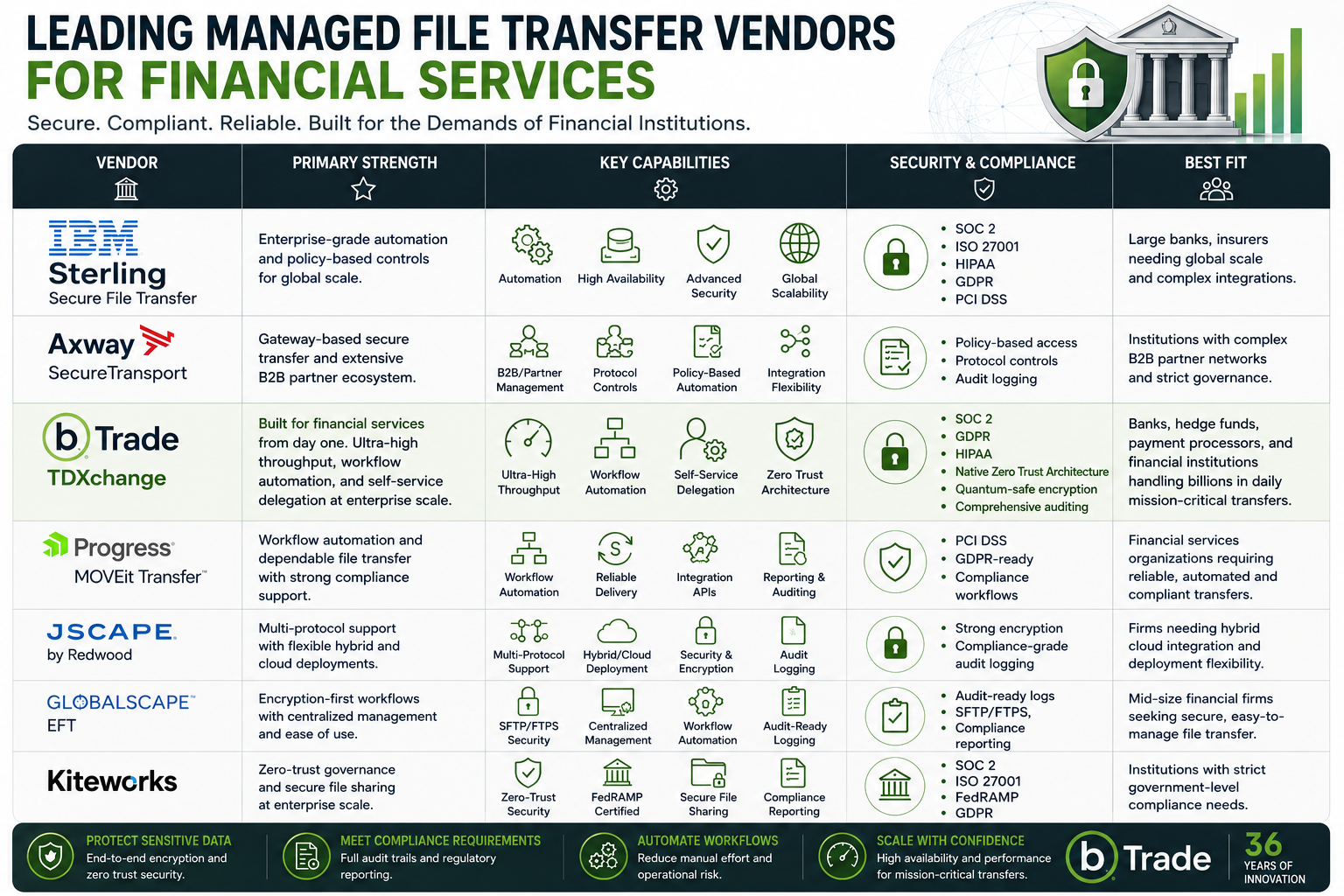
While vendors such as IBM Sterling, Axway SecureTransport, Progress MOVEit, JSCAPE, and Globalscape have established a presence in financial services, organizations should also consider platforms purpose-built by companies with deep roots in the industry.
Since 1990, bTrade has focused on solving secure data exchange challenges for financial institutions. That heritage continues today with TDXchange, which processes billions of dollars in post-trade reconciliation files, payment transactions, invoices, and other mission-critical financial data every day across major banks, financial institutions, and hedge funds worldwide.
Key Takeaways
- Financial institutions require more than secure file transfer, they need operational resilience, compliance, and auditability.
- Leading MFT vendors include IBM Sterling, Axway SecureTransport, Progress MOVEit, JSCAPE, Globalscape, Kiteworks, and bTrade TDXchange.
- Enterprise MFT platforms should provide Zero Trust security, workflow automation, audit trails, high availability, and operational visibility.
- TDXchange was originally designed around the demanding requirements of financial services and continues to support some of the world's largest financial organizations.
- Financial services MFT must connect mainframes, payment platforms, trading systems, asset management applications, core banking systems, clearing networks, custodians, regulators, and modern cloud services.
- A missing or delayed critical file can interrupt payments, trading, settlement, reconciliation, reporting, or customer activity. Uptime, reliability, immediate alerting, and rapid recovery are therefore business requirements.
- Financial institutions need platforms capable of processing millions of small and large files every day while delivering each transaction as quickly as possible.
- Alerting must identify missing files, workflow failures, SLA risks, and unusual activity immediately without overwhelming teams with duplicate or expected alerts.
- Self-service delegation, ultra-high throughput, compliance, and enterprise automation have been core design principles since day one.
Why Financial Services Need Specialized Managed File Transfer
Financial institutions operate under some of the world’s strictest regulatory requirements and compliance obligations. They cannot tolerate failed transfers, delayed settlements, missing critical files, incomplete audit trails, or extended service interruptions.
Every file may contain:
- Payment instructions
- Trade confirmations
- Settlement and reconciliation records
- SWIFT messages
- Customer information
- Regulatory submissions
- Financial statements
- Treasury transactions
- Invoices
- Market and reference data
These exchanges connect mainframes, core banking applications, payment platforms, trading systems, asset management systems, treasury applications, clearing and settlement networks, custodians, risk and compliance systems, general ledgers, cloud services, regulators, and external partners.
A missing or delayed file can interrupt payments, trading, settlement, reconciliation, regulatory reporting, or customer activity. The consequences can include lost revenue, compliance exposure, audit findings, damaged customer confidence, and increased operational risk.
Financial institutions may also process millions of small and large files every day, often within strict payment, settlement, trading, and reporting windows. Files must be processed and delivered as quickly as possible while maintaining security, reliability, complete traceability, and predictable performance at scale.
An MFT platform designed for financial services should provide capabilities across the following areas:
Enterprise Security
Financial data requires multiple layers of protection, including:
- AES 256 encryption
- TLS 1.2 and TLS 1.3
- SSH and SFTP
- Multifactor authentication
- Role based access control
- Native Zero Trust Architecture
- Payload encryption
- Quantum safe cryptography readiness
Security controls should protect data throughout the complete exchange, whether it moves between internal systems, cloud environments, financial networks, customers, regulators, or external partners.
Regulatory Compliance and Auditability
Financial institutions must demonstrate who exchanged information, what was transferred, where it was sent, when it moved, which controls were applied, and whether the complete process succeeded.
An enterprise MFT platform should provide:
- Immutable audit trails
- Complete transfer histories
- Detailed operational and compliance reporting
- User activity logging
- Administrative change auditing
- Authentication and authorization records
- Configurable retention policies
- Evidence of delivery, processing, retries, and exceptions
These capabilities can help financial institutions support applicable requirements such as PCI DSS, SOX, GDPR, GLBA, SEC regulations, FINRA requirements, and other regional or industry specific obligations.
Enterprise Integration and Automation
Financial file exchanges rarely operate in isolation. The MFT platform must integrate legacy infrastructure with modern applications, services, and external networks while coordinating complete business workflows.
Required capabilities include:
- Mainframe integration
- Core banking integration
- Payment and settlement system integration
- Trading and asset management system integration
- Treasury and general ledger integration
- Clearing network and custodian connectivity
- API and cloud service integration
- Event driven workflows
- Flexible scheduling
- Workflow orchestration
- Policy based automation
- Automated retries
- Exception handling
- Business process automation
Automation reduces manual intervention, improves consistency, and lowers the risk of human error across high volume and time sensitive financial processes.
Operational Resilience and Performance
Financial systems operate continuously, and every minute of downtime can affect critical business activity.
Organizations require:
- High availability
- Disaster recovery
- Clustering
- Horizontal scalability
- Automatic service recovery
- Checkpoint and transfer restart
- Detection of missing or late files
- Immediate and actionable alerting
- Alert prioritization that prevents alert fatigue
- End to end operational visibility
- Support for millions of daily file exchanges
- Efficient processing of both small and large files
- Rapid delivery with predictable performance at scale
For financial services, MFT is not simply a mechanism for moving files. It is a critical security, compliance, integration, and operational layer connecting the systems, organizations, and business processes on which the institution depends.
Why bTrade Is Different
Many technology vendors expanded into financial services over time.
Financial services is where bTrade started.
Financial services has played a foundational role in shaping bTrade’s technology. The security, compliance, performance, and operational requirements of banks, investment firms, payment providers, hedge funds, and other regulated organizations have directly influenced our product architecture.
In these demanding environments, missed payment deadlines, delayed settlements, incomplete audit records, security incidents, or unpredictable performance can create immediate business and regulatory consequences.
Rather than adapting a general purpose platform to meet these requirements, we built TDXchange around the operational realities of financial services.
That foundation includes:
- Architecture designed for mission critical financial workflows
- Ultra high throughput with predictable performance at scale
- Continuous operational availability and resilient processing
- Native Zero Trust controls across users, applications, services, workflows, APIs, and AI
- Tamper resistant transaction and configuration histories
- Enterprise workflow orchestration and policy based automation
- Delegated self service without surrendering centralized governance
- Granular role based access controls
- End to end visibility from file reception through business completion
- Enterprise SLA monitoring and automated escalation
- Crypto agility and quantum safe encryption
As cybersecurity threats continue to evolve, so has our platform.
Recognizing the long term risks posed by quantum computing before they became mainstream, bTrade became the first Managed File Transfer vendor to introduce quantum safe encryption into its products.
This proactive approach helps financial institutions protect sensitive information from emerging “harvest now, decrypt later” attacks while preparing for the next generation of cryptographic standards.
The same security first philosophy guides our AI strategy.
Rather than allowing AI unrestricted access to enterprise information, our AI capabilities are built on Native Zero Trust Architecture principles. Every AI interaction follows the same identity verification, authorization, least privilege, role based access, and auditing controls as the rest of the platform.
This ensures that AI models can access only the information explicitly permitted by organizational security policies. Financial institutions can benefit from AI assisted operational intelligence without unnecessarily exposing sensitive financial, transactional, or customer information.
Today, TDXchange supports financial exchanges representing billions of dollars in daily activity, including post trade reconciliation, payment processing, settlement records, invoices, and other mission critical transactions across major financial institutions, global banks, payment providers, and hedge funds.
That experience, combined with our commitment to anticipating future challenges rather than simply reacting to them, continues to shape every release of the platform.
Self Service Reduces Operational Risk
Financial operations teams should not depend on a centralized support group to answer every transfer question or investigate every exception.
TDXchange uses delegated administration and secure self service to give authorized users access to the transactions, workflows, partners, and reports relevant to their responsibilities.
Granular role based access allows:
- Business and operational teams to monitor authorized transfers and investigate exceptions
- Trading partners to verify file delivery without contacting support
- Central administrators to maintain consistent security, compliance, and governance
This reduces support dependency, accelerates issue resolution, and prevents the MFT administration team from becoming an operational bottleneck.
Operational Visibility and SLA Governance
Financial institutions must know more than whether the MFT platform is running. They need to know whether an expected file arrived, completed every required workflow step, reached the correct destination, and met its business deadline.
End to end operational observability gives authorized teams the context needed to investigate missing files, delayed transactions, workflow failures, partner issues, configuration changes, and downstream processing problems.
Enterprise SLA monitoring and automated escalation apply business commitments to that operational evidence. This helps organizations identify files and workflows at risk, notify the correct owners, and escalate meaningful exceptions without creating unnecessary alert fatigue.
Together, these capabilities help financial institutions move from reactive troubleshooting toward proactive operational governance.
Built for Predictable Performance at Scale
Financial institutions often process millions of transfers every day.
Performance is not simply about achieving maximum speed during an isolated test. It is about maintaining predictable execution under sustained enterprise workloads while processing millions of small files, large data sets, concurrent workflows, and time sensitive financial exchanges.
TDXchange was engineered to support:
- Millions of files per day and high volume batch processing
- Large file transfers across high latency and bandwidth constrained networks
- Low latency and time sensitive workflows
- Distributed deployments
- Enterprise clustering, workload distribution, and high availability
- Kubernetes based deployments and horizontal scaling
- On premises, cloud, and hybrid architectures
- Rapid processing without sacrificing security, auditing, or reliability
This architecture allows financial institutions to increase transaction volumes, onboard new business units and partners, and expand across distributed environments without redesigning established workflows or sacrificing security, reliability, visibility, or predictable performance.
Questions Every Financial Institution Should Ask
When evaluating an MFT platform, consider:
- Does it support our compliance requirements?
- Can it integrate with our banking, ERP, cloud, and trading systems?
- Does it provide immutable audit trails?
- Can business users securely self-service routine tasks?
- Can it process our expected transaction volumes?
- Does it support event-driven automation?
- Does it implement Native Zero Trust Architecture?
- Is the vendor experienced in highly regulated financial environments?
- Can the platform integrate with our mainframes, payment systems, trading platforms, asset management applications, core banking systems, clearing networks, custodians, and cloud services?
- Can it detect when an expected critical file never arrived?
- Can it immediately alert the appropriate teams without generating unnecessary noise?
- Can it distinguish planned downtime and temporary retries from genuine business failures?
- Can it process millions of small and large files every day?
- Can it maintain predictable performance during payment cycles, market events, settlement windows, and reporting deadlines?
- Can it deliver urgent and large exchanges as quickly as possible while maintaining encryption, validation, auditing, and workflow controls?
- Can capacity, performance, and infrastructure conditions be connected to the financial transactions and business processes they affect?
Executive Takeaways
Selecting a Managed File Transfer platform for financial services is about far more than securely moving files. Financial institutions require a platform built for regulatory compliance, operational resilience, ultra-high throughput, and a proactive approach to emerging security threats.
For more than three decades, bTrade has partnered with banks, investment firms, payment providers, insurers, and hedge funds to solve some of the industry's most demanding data exchange challenges. Today, TDXchange processes billions of dollars in post-trade reconciliations, payment transactions, invoices, and other mission-critical financial exchanges every day while providing Native Zero Trust Architecture, quantum-safe encryption, workflow automation, delegated self-service, and enterprise-scale performance.
Our experience extends beyond our customer base. Many of our executives, architects, and engineering team members have previously worked in financial services, bringing first-hand knowledge of trading systems, payment processing, regulatory compliance, and the operational realities of highly regulated financial environments. That industry expertise allows us to understand our customers' challenges from day one and build solutions that address real business needs rather than theoretical use cases.
Just as importantly, our roadmap continues to be shaped by many of the world's leading financial institutions. Their evolving requirements have influenced key capabilities such as delegated self-service, ultra-high throughput processing, Native Zero Trust Architecture, quantum-safe encryption, workflow orchestration, and AI built on Zero Trust principles. Rather than simply reacting to industry trends, we work alongside our customers to anticipate what's next.
When evaluating an MFT platform, don't just compare features. Consider the vendor's experience in financial services, the expertise of the people behind the platform, their ability to anticipate emerging threats, and their commitment to long-term partnership. In one of the world's most demanding industries, those qualities often become the difference between a product that simply transfers files and a platform that becomes a trusted part of your business.
About the Author
Andrei Olin is Chief Technology Officer at bTrade, where he leads product strategy, delivery, architecture, and security across the company’s B2B, Managed File Transfer, and secure data exchange platforms.
Andrei has more than 30 years of experience spanning enterprise architecture, software development, infrastructure, cybersecurity, middleware, trading systems, SaaS, and Managed File Transfer. His career includes building mission-critical systems and infrastructure at Bear Stearns and Morgan Stanley, designing and operating enterprise MFT and messaging platforms for Merrill Lynch and Deutsche Bank, and building and scaling SaaS and security products at startups. He holds master’s and bachelor’s degrees in Information Technology with a focus on Information Security.
Frequently Asked Questions
Which MFT vendors specialize in financial services?
Well-known vendors include IBM Sterling, Axway SecureTransport, bTrade TDXchange, Progress MOVEit, JSCAPE by Redwood, Globalscape EFT, Kiteworks. Each offers different strengths depending on organizational size, compliance requirements, and deployment preferences.
Why do financial institutions use Managed File Transfer?
Managed File Transfer provides secure, automated, and auditable movement of sensitive financial data while helping organizations meet regulatory requirements, reduce operational risk, and improve business efficiency.
Which financial systems should an MFT platform integrate with?
A financial services MFT platform should connect mainframes, core banking systems, payment platforms, SWIFT environments, trading and order management systems, asset and portfolio management applications, treasury systems, clearing and settlement platforms, custodians, market data services, risk and compliance systems, general ledgers, data platforms, cloud services, APIs, and external partners.
The exact integration method may use secure protocols, APIs, file systems, middleware, or application specific workflows.
Why is missing file detection critical in financial services?
A transfer cannot fail if it never started. Payment, trade, settlement, reconciliation, and regulatory files may be expected within precise processing windows. If a source system does not generate the file, basic failure monitoring may report nothing.
A financial services MFT platform should track expected arrivals, identify missing or late files, evaluate their SLA and business impact, and immediately notify the correct owners.
How can financial institutions receive immediate alerts without alert fatigue?
Alerts should be prioritized according to transaction criticality, SLA risk, business impact, and the scope of the failure. The platform should correlate duplicate errors, recognize planned maintenance, suppress expected connection failures, and escalate only conditions requiring attention.
Each alert should contain enough transaction, workflow, system, and partner context for the recipient to act immediately.
Can an MFT platform process millions of small and large financial files daily?
An enterprise MFT platform should be architected to process millions of daily transactions while supporting both large numbers of small files and high volume transfers of large files.
Organizations should validate this capability using representative workloads that include concurrency, encryption, workflow processing, logging, partner activity, and peak business volumes rather than relying only on vendor throughput claims.
What security features should a financial services MFT platform include?
Enterprise platforms should provide encryption in transit and at rest, Native Zero Trust Architecture, multi-factor authentication, role-based access controls, comprehensive auditing, workflow automation, and operational monitoring.
Why is self-service important in financial services?
Self-service allows business users and trading partners to securely track file transfers, view delivery status, and resolve routine operational questions without creating support tickets, reducing operational overhead while maintaining security.
Can TDXchange handle high-volume financial workloads?
Yes. TDXchange processes billions of dollars in payment files, post-trade reconciliations, invoices, and other financial transactions every day for major financial institutions, banks, and hedge funds worldwide.
Why do many financial organizations choose vendors with industry experience?
Financial institutions benefit from vendors that understand regulatory requirements, operational resiliency, transaction processing, audit expectations, and enterprise-scale performance. Experience in financial services often translates into platforms designed around those unique operational challenges rather than adapting general-purpose software.