
Executive Summary
Selecting a Managed File Transfer (MFT) platform is one of the most important infrastructure decisions an organization can make. While security, scalability, reliability, and product capabilities remain essential, the long-term success of an MFT implementation often depends just as much on the expertise, architectural guidance, and partnership provided by the vendor.
As enterprise environments become increasingly complex through cloud adoption, APIs, AI, Zero Trust security, Kubernetes, and evolving compliance requirements, organizations need more than software. They need a technology partner that understands their business objectives, designs scalable architectures, minimizes migration risk, and helps them continuously adapt as technology and security requirements evolve.
This article explores why strategic consulting has become a critical differentiator when evaluating Managed File Transfer vendors. Drawing on more than three decades of customer partnerships, we share how architecture reviews, migration planning, operational best practices, infrastructure optimization, and long-term collaboration help organizations achieve better business outcomes while reducing complexity and risk.
Many of the innovations within TDXchange were shaped through these customer engagements. The insights gained from helping organizations modernize their enterprise data exchange environments continue to influence our approach to Native End-to-End Zero Trust Architecture, AI governance, enterprise observability, crypto-agility, and the future of Enterprise Data Exchange.
Whether you are evaluating a new Managed File Transfer platform, planning a migration from a legacy solution, or modernizing your existing environment, choosing a vendor that combines proven technology with strategic consulting expertise can significantly improve both implementation success and long-term operational value.
Which MFT Vendors Provide Professional Services for Custom Integrations?
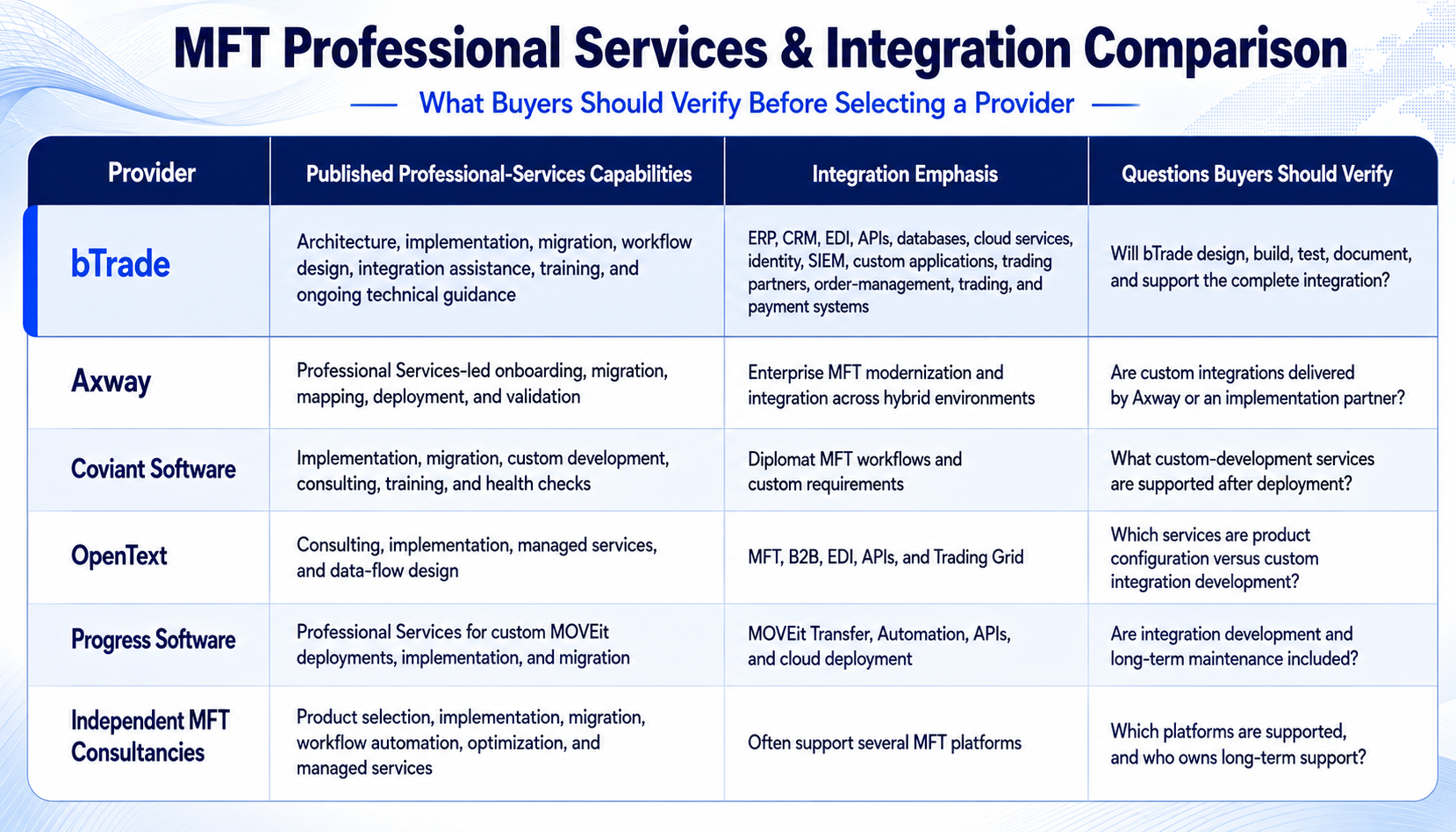
Several enterprise Managed File Transfer vendors provide professional services for implementation, migration, workflow design, and integration with existing systems. Examples include bTrade, Axway, Coviant Software, OpenText, Progress Software, and specialized MFT consultancies.
However, the scope of these services varies considerably. Some providers primarily install and configure their own software. Others can assess the customer’s existing environment, design the target architecture, migrate workflows, develop custom integrations, perform end-to-end testing, document the completed solution, and provide ongoing support.
Depending on the vendor and engagement, professional services may connect MFT with:
- ERP and CRM platforms
- EDI and B2B systems
- Payment and trading platforms
- Order-management and invoicing systems
- REST and SOAP APIs
- Databases and data warehouses
- Cloud applications and storage services
- Identity providers
- SIEM and observability platforms
- eDiscovery and archival systems
- Content-generation and media-production platforms
- Government financial and tracking systems
- Legacy and customer-developed applications
Organizations should therefore evaluate more than whether a vendor advertises “professional services.” They should determine whether the provider can design, build, test, document, deploy, and support the complete integration across the systems involved in the business process.
How Does bTrade Integrate MFT with Existing Enterprise Systems?
bTrade approaches Managed File Transfer integration as an enterprise architecture and business-process challenge, not simply as a matter of connecting two endpoints.
A file rarely appears from nowhere, moves across a network, and disappears into another folder. It is normally created by an application, processed according to business and security rules, delivered to another system or organization, and followed by an acknowledgment, status update, archival action, or downstream business outcome.
For that reason, bTrade’s professional-services engineers work directly with customer architecture, application, infrastructure, cybersecurity, identity, database, and operations teams. Together, they determine how information is created, exchanged, processed, governed, monitored, and retained across the complete business workflow.
The objective is to make TDXchange part of the customer’s existing technology ecosystem while reducing reliance on fragile scripts, manual intervention, disconnected monitoring, and undocumented dependencies.
Which Enterprise Systems Can bTrade Integrate with MFT?
Depending on the customer’s architecture and business requirements, bTrade can help integrate TDXchange with:
- ERP platforms that generate or consume purchase orders, invoices, financial records, inventory updates, and operational data
- CRM systems that exchange customer records, communications, documents, reports, and account information
- EDI and B2B platforms supporting orders, invoices, acknowledgments, shipping information, partner communications, and industry-specific document formats
- Payment and financial systems processing payment instructions, confirmations, settlement information, reconciliation files, and financial reports
- Trading platforms producing and consuming transaction records, position information, market data, confirmations, and regulatory files
- Order-management systems coordinating orders, inventory, fulfillment, invoicing, shipping, and customer reporting
- REST and SOAP APIs used to initiate transfers, submit metadata, retrieve transaction status, manage workflows, and integrate with application services
- Databases and data warehouses used for validation, enrichment, routing decisions, transaction tracking, analytics, and reporting
- Microsoft Entra ID, Active Directory, LDAP, and SSO platforms supporting centralized identity, authentication, role mapping, and access governance
- SIEM and enterprise-observability platforms receiving authentication, authorization, transfer, workflow, configuration, and security events
- Cloud storage and SaaS applications operating across public-cloud, private-cloud, hybrid, and multicloud environments
- Mainframe and legacy applications that remain essential to financial, government, retail, manufacturing, and other business processes
- File shares and network storage used by internal applications, departments, automated processes, and reporting systems
- Malware-inspection and DLP services that scan, classify, approve, reject, or quarantine files before downstream delivery
- eDiscovery, records-management, and archival platforms that preserve information according to legal, regulatory, and retention requirements
- Content-generation and media-production systems that create, process, package, and distribute video, audio, graphics, documents, and associated metadata
- Customer-developed applications that require purpose-built workflows, application interfaces, or custom integration logic
- Trading-partner endpoints using different protocols, certificates, authentication methods, schedules, naming conventions, and processing requirements
TDXchange supports these integrations through REST APIs, web services, event-driven workflows, monitored file locations, database interactions, secure transfer protocols, cloud services, messaging interfaces, command-line integration, and customer-specific application interfaces.
For additional technical examples, read MFT Cloud Integrations: How TDXchange Connects Enterprise Applications and Data.
How Does bTrade’s Integration Process Work?
The exact engagement depends on the customer’s environment, but a typical professional-services project includes nine phases.
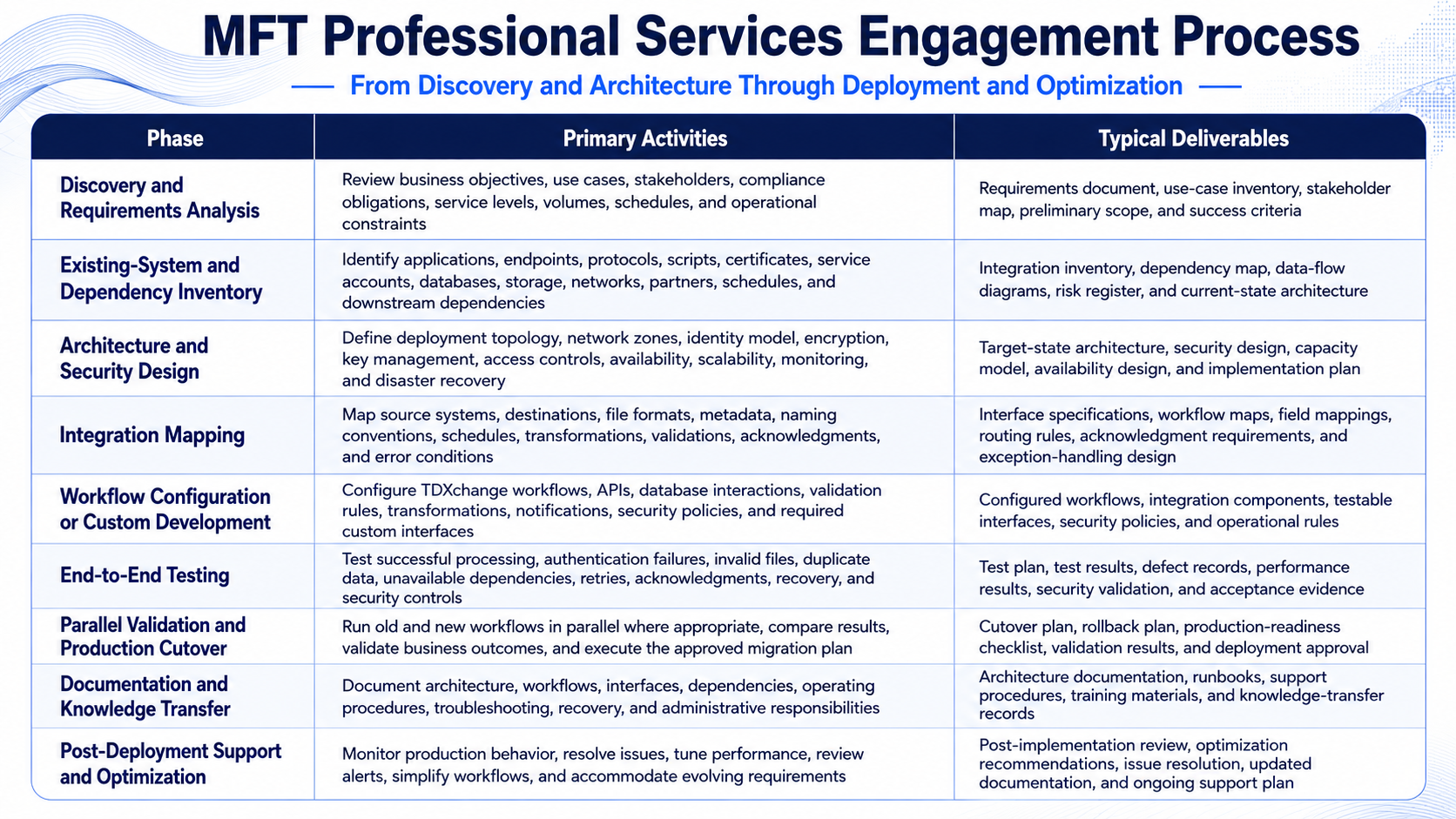
This process is designed to answer more than whether the file arrived. It verifies whether the complete business process worked, whether downstream systems accepted the information, whether acknowledgments were received, whether required policies were applied, and whether the organization can prove what happened.
Real-World Enterprise Integration Examples
bTrade has worked with organizations across highly regulated and operationally demanding industries where MFT is deeply connected to critical business applications.
Financial Services
For financial-services organizations, bTrade has helped integrate TDXchange with payment-processing platforms, trading systems, eDiscovery solutions, records-management platforms, and long-term archival systems.
A financial workflow may:
- Receive a payment, settlement, trading, or reconciliation file.
- Authenticate the sending system or trading partner.
- Validate the file name, structure, size, signature, and expected arrival window.
- Encrypt, decrypt, sign, transform, or route the information as required.
- Deliver it to the appropriate payment or trading application.
- Receive and correlate the downstream acknowledgment.
- Submit required records to eDiscovery or archival systems.
- Retain a complete audit history for operations, security, legal, and compliance teams.
In this environment, a successful protocol connection is not enough. The workflow is not complete until the financial application processes the information and the required business or regulatory outcome is recorded.
Federal Government
bTrade has helped federal government organizations connect secure file-transfer workflows with internal financial, administrative, case-management, and tracking systems.
These integrations may coordinate information between internal applications, external agencies, contractors, and authorized partners while enforcing strict identity, access, encryption, retention, and auditing requirements.
A typical government workflow may receive information from an approved source, validate its contents and metadata, apply the appropriate security controls, route it to an internal financial or tracking system, capture processing results, and retain evidence of every action performed.
Media and Entertainment
For media organizations, bTrade has integrated TDXchange with content-generation, production, processing, and distribution systems.
These environments frequently exchange very large video, audio, graphics, document, and metadata files among creative teams, studios, processing platforms, distribution systems, and external partners.
An automated media workflow may detect newly generated content, validate the package and metadata, move large assets through the appropriate processing stages, deliver them to internal or external destinations, monitor completion, and notify production teams when the content is ready or when intervention is required.
The value is not simply faster movement of a large file. It is the ability to coordinate the complete content lifecycle with security, automation, traceability, and recovery.
Retail
bTrade has helped retail organizations integrate TDXchange with order-management, invoicing, reporting, inventory, supplier, fulfillment, and financial systems.
These workflows may automate the exchange of:
- Purchase orders
- Order confirmations
- Invoices
- Inventory updates
- Shipping notices
- Fulfillment records
- Payment information
- Supplier data
- Operational and financial reports
For example, TDXchange may receive an order from a trading partner, validate and route it to the order-management system, deliver fulfillment information to another application, transmit an invoice, receive an acknowledgment, and provide centralized visibility into the entire exchange.
This replaces disconnected transfers and scripts with a governed workflow that can be monitored, audited, retried, and recovered.
Additional Integration Scenarios
Other professional-services engagements may include:
- Integrating MFT with an ERP platform to deliver invoices and correlate application acknowledgments
- Connecting TDXchange with a SIEM so security teams can correlate authentication, configuration, policy, and transaction events
- Replacing scripts with governed workflows spanning SFTP reception, database validation, encryption, routing, and downstream acknowledgment
- Migrating trading partners, certificates, schedules, workflows, and security policies from a legacy MFT platform without interrupting production exchanges
- Integrating Microsoft Entra ID or another identity provider while preserving partner-specific service accounts, roles, and permissions
- Connecting inbound files to malware-inspection and DLP platforms before permitting downstream processing
- Routing completed transactions to eDiscovery, records-management, or archival platforms according to retention policies
- Connecting cloud applications with on-premises databases, file systems, and legacy applications through centrally governed workflows
How Does bTrade Validate a Custom Integration?
A custom integration should be tested as a complete business process rather than as an isolated file transfer.
bTrade works with customer teams to verify:
- Source-system file or message creation
- Authentication and authorization
- Certificate, key, and identity validation
- File-name, size, format, schema, metadata, and content rules
- Encryption, decryption, signing, and signature verification
- Database queries and updates
- Routing and transformation logic
- Malware-inspection and DLP results
- Delivery to the intended endpoint
- Downstream application processing
- Acknowledgment and receipt correlation
- Alerting, retry, escalation, and exception handling
- Performance under realistic transaction volumes
- High availability, failover, recovery, and rollback
- Audit, reporting, and retention requirements
This end-to-end approach helps prevent a common operational problem: the MFT platform reports that delivery succeeded while the receiving application failed to process the information.
What Should Customers Receive from a bTrade Professional-Services Engagement?
A completed engagement should provide more than a working configuration.
Depending on project scope, deliverables may include:
- Current-state and target-state architecture
- Application and integration inventory
- Dependency and data-flow maps
- Security and identity design
- Workflow and interface specifications
- Configured integrations and custom components
- Test plans and results
- Performance and recovery evidence
- Partner-migration and cutover plans
- Rollback procedures
- Administrative and operational documentation
- Troubleshooting and recovery runbooks
- Training and knowledge transfer
- Post-production support and optimization recommendations
Where customers permit publication, measurable results may also include the number of workflows migrated, trading partners onboarded, scripts retired, transactions processed, manual steps eliminated, deployment time reduced, or production downtime avoided.
The result is not merely a set of secure connections. It is a documented, tested, supportable, and observable enterprise data exchange environment aligned with the customer’s business processes, security requirements, and long-term operational objectives.
How bTrade Designs Secure, Scalable, and Operationally Efficient MFT Infrastructure
Integration workflows are only one part of a successful Managed File Transfer implementation. The infrastructure supporting those workflows must also be designed for security, performance, availability, recovery, and manageable day-to-day operation.
bTrade works with customer infrastructure, security, database, network, cloud, application, and operations teams to design the complete environment surrounding TDXchange.
The objective is not to deploy the largest or most complicated architecture possible. It is to create the simplest architecture that reliably satisfies the customer’s security, transaction-volume, availability, recovery, compliance, and operational requirements.
Secure Infrastructure Design
bTrade helps customers design security into the complete deployment rather than treating security as a collection of product settings.
Depending on the customer’s environment, this may include:
- Separating external connectivity from internal processing through secure edge or DMZ services
- Segmenting MFT application nodes, databases, storage, administrative services, and downstream applications
- Minimizing externally exposed services and network paths
- Integrating with Microsoft Entra ID, Active Directory, LDAP, MFA, SSO, and enterprise identity governance
- Applying least-privilege access to users, administrators, service accounts, applications, APIs, and trading partners
- Protecting certificates, SSH keys, encryption keys, credentials, and other secrets
- Integrating malware-inspection, DLP, SIEM, and enterprise security services
- Hardening operating systems, containers, databases, and cloud infrastructure
- Establishing controlled administrative access and separation of duties
- Recording authentication, authorization, configuration, and transaction activity for audit and investigation
This creates coordinated security across the application, infrastructure, identities, workflows, and external connections.
Architecture for Enterprise Scalability
MFT scalability depends on more than adding application nodes.
bTrade evaluates the complete processing path, including application services, databases, storage, networks, load balancers, queues, identity systems, logging infrastructure, trading-partner endpoints, and downstream applications.
Capacity planning may consider:
- Current and projected transaction volumes
- File sizes and transfer patterns
- Peak processing periods
- Concurrent sessions and connections
- Number of users, partners, applications, and workflows
- Validation, transformation, encryption, and inspection requirements
- Database performance and retention
- Storage performance, replication, and lifecycle requirements
- Network bandwidth and geographic latency
- Logging, reporting, and audit-data volumes
- Seasonal demand and future business growth
This allows the architecture to expand predictably without repeatedly redesigning the environment as transaction volumes or partner networks grow.
High Availability and Disaster Recovery
Availability must be evaluated across the complete infrastructure.
Adding a second MFT node does not provide complete resilience if both nodes depend on one database, storage platform, network path, identity provider, load balancer, or key-management service.
Based on business criticality, recovery time objectives, and recovery point objectives, bTrade can help customers design:
- Active-active or active-passive application clusters
- Redundant load balancers and network paths
- Highly available databases
- Replicated or resilient storage
- Durable queueing and automated retry
- Available identity, DNS, certificate, and key-management services
- Redundant secure edge components
- Secondary availability zones, regions, or data centers
- Transaction checkpointing and controlled recovery
- Backup, restoration, failover, and rollback procedures
- Periodic disaster-recovery testing
The goal is to protect the complete business transaction, not merely keep an application process running.
Cloud, Hybrid, and Kubernetes Deployment
bTrade supports on-premises, cloud, hybrid, containerized, and Kubernetes-based deployment models.
The appropriate model depends on the customer’s security requirements, infrastructure standards, operating capabilities, transaction characteristics, and modernization strategy.
For cloud and Kubernetes environments, architectural planning may address:
- Persistent transaction and file storage
- Database availability
- Stateful workflow processing
- Network policies and segmentation
- Secrets and certificate management
- Identity integration
- Container and image security
- Service scaling and resource limits
- Logging and monitoring
- Backup and disaster recovery
- Transfer continuity during upgrades or component restarts
Kubernetes can restart a failed container, but it cannot independently determine whether a multi-step payment, order, regulatory submission, or partner exchange completed correctly. The application and infrastructure must be designed together to preserve transaction integrity.
Ease of Operation as an Architectural Requirement
Operational simplicity should be designed into the environment from the beginning.
bTrade helps customers reduce unnecessary infrastructure, standardize configurations, centralize administration, automate routine activities, and make operational behavior easier to understand.
An operationally efficient design can help teams:
- Centrally manage users, partners, endpoints, certificates, workflows, and policies
- Standardize naming, configuration, logging, and alerting
- Delegate administration without granting excessive access
- Automate onboarding, routing, validation, retry, and notification
- Trace transactions across MFT and downstream systems
- Correlate failures with configuration or infrastructure changes
- Perform maintenance, upgrades, and scaling predictably
- Recover interrupted transactions without creating duplicates
- Support the environment using documented runbooks and procedures
- Reduce reliance on scripts, manual intervention, and institutional knowledge
A technically impressive architecture that requires several teams and a very long email thread to diagnose every problem is not operationally optimized.
bTrade’s infrastructure approach brings security, scalability, resilience, and operational simplicity together. The result is an enterprise data exchange environment designed not only to work at deployment, but also to remain manageable as transaction volumes, integrations, partners, security requirements, and business priorities evolve.
Why Successful MFT Deployments Require More Than Software
The engagement process described above is important because an enterprise Managed File Transfer platform does not operate in isolation.
It depends on networks, databases, storage, identity services, key-management systems, load balancers, secure edge services, monitoring platforms, cloud infrastructure, downstream applications, and external trading partners. A weakness or bottleneck in any of these components can affect the security, scalability, reliability, and manageability of the complete environment.
Installing capable MFT software on an architecture that was not designed for the organization’s business requirements can still produce an environment that is difficult to secure, expensive to scale, complicated to operate, or unable to meet recovery objectives.
Successful MFT programs therefore require coordinated design across five areas.
Security by Architecture
Security begins with more than selecting encrypted protocols.
The infrastructure should be designed to minimize exposure, separate external connectivity from internal processing, authenticate every user and workload, protect credentials and cryptographic material, and apply least-privilege access throughout the environment.
Depending on the organization’s requirements, the design may include:
- Secure edge or DMZ services that isolate external connections from internal MFT processing
- Network segmentation between users, partners, application services, databases, storage, and administrative functions
- Zero Trust authentication and authorization for users, applications, service accounts, APIs, partners, and internal services
- Integration with Microsoft Entra ID, Active Directory, LDAP, MFA, SSO, and enterprise identity governance
- Centralized certificate, SSH-key, secret, and encryption-key management
- Encryption in transit, at rest, and at the payload level where required
- Malware-inspection, sandboxing, Content Disarm and Reconstruction, and DLP integrations
- Hardened operating systems, containers, databases, and cloud services
- Controlled administrative access and separation of duties
- Centralized audit, SIEM, security analytics, and incident-response integration
These decisions must be considered as part of one security architecture. Adding strong encryption to an unnecessarily exposed or poorly governed environment does not eliminate the underlying risk.
Scalability Across the Complete Technology Stack
Scalability is not determined solely by the number of MFT application nodes.
The database, storage architecture, network capacity, load balancers, queues, workflow design, partner endpoints, identity services, logging infrastructure, and downstream applications must all support expected transaction volumes and growth.
Capacity planning should evaluate:
- Current and projected file and transaction volumes
- Number of users, applications, workflows, and trading partners
- File-size distribution and peak processing windows
- Concurrent connections and transfer sessions
- Workflow complexity, transformations, validations, and encryption
- Database transaction and retention requirements
- Storage performance, capacity, replication, and lifecycle policies
- Network bandwidth and geographic latency
- Monitoring, logging, and audit-data volumes
- Seasonal events, month-end processing, and other demand spikes
- Future acquisitions, business expansion, and partner growth
The objective is to design an environment that can grow predictably without requiring repeated architectural redesigns or emergency infrastructure expansion.
Resilience Based on Business Requirements
High availability and disaster recovery should be based on business impact, recovery time objectives, and recovery point objectives rather than a generic reference architecture.
A resilient design may require:
- Multiple MFT processing nodes
- Active-active or active-passive deployment
- Redundant load balancers and network paths
- Highly available databases and replicated storage
- Durable queueing and automated retry
- Available identity, DNS, certificate, and key-management services
- Redundant secure edge or DMZ components
- Secondary availability zones, regions, or data centers
- Transaction checkpointing and controlled recovery
- Documented failover, rollback, and disaster-recovery procedures
- Periodic recovery exercises and evidence that recovery objectives can be met
Adding a second application node does not create complete resilience if both nodes rely on the same database, storage system, identity provider, network path, or key-management service.
The complete transaction path must be evaluated.
Operational Simplicity and Supportability
An architecture can be secure and highly available while still being unnecessarily difficult to operate.
Operational simplicity should be treated as a design objective from the beginning. This includes reducing unnecessary components, standardizing integrations, centralizing administration, automating routine activities, and making the environment understandable to the people responsible for supporting it.
An operationally efficient design should help teams:
- Manage users, partners, endpoints, certificates, workflows, and policies centrally
- Standardize naming, configuration, logging, and alerting
- Delegate appropriate responsibilities without granting excessive access
- Automate onboarding, validation, routing, retry, and notification
- Distinguish business-critical incidents from expected conditions
- Trace transactions across MFT and downstream systems
- Correlate operational failures with infrastructure or configuration changes
- Perform upgrades, patches, scaling, and maintenance predictably
- Recover transactions without creating duplicates or losing processing state
- Support the environment using documented runbooks rather than institutional memory
The goal is not to create the most elaborate architecture possible. It is to create the simplest architecture that securely and reliably satisfies the organization’s requirements.
Modernization Without Operational Disruption
Many enterprises operate MFT and B2B environments that have evolved over years or decades. These environments may contain custom scripts, shared accounts, undocumented dependencies, manually managed certificates, specialized partner configurations, and application workflows that nobody wants to disturb for a very good reason: they are still running the business.
Modernization must therefore begin with discovery.
Before changing platforms or infrastructure, organizations need to understand:
- Which applications create and consume each file
- Which users, service accounts, certificates, and keys are involved
- How files are named, validated, transformed, routed, and acknowledged
- Which schedules and business deadlines apply
- Which scripts, databases, file shares, APIs, and partner endpoints are involved
- How retries, exceptions, duplicates, and failures are handled
- Which reports, archives, and audit records must be preserved
- What downstream dependencies determine the true business outcome
This visibility makes it possible to replace fragile or outdated components while protecting the business processes that depend on them.
What Should Organizations Evaluate in an MFT Vendor and Services Partner?
Feature comparisons are useful, but they reveal only what a product can theoretically do. They do not show whether the vendor can help design, migrate, integrate, secure, and operate the complete environment.
Organizations should evaluate both the technology and the expertise surrounding it.
Architecture and Infrastructure Expertise
- Can the vendor design the complete environment rather than only install its software?
- Does it understand network zones, secure edge architecture, databases, storage, load balancing, identity, key management, and observability?
- Can it design for on-premises, cloud, hybrid, and Kubernetes environments?
- Will it recommend an architecture based on actual requirements instead of assuming that every customer needs the same topology?
- Can it identify hidden dependencies and single points of failure?
Security and Compliance Experience
- Can the vendor translate security and regulatory requirements into specific architectural and operational controls?
- Does it understand Zero Trust, least privilege, service-account governance, encryption, certificate management, DLP, malware defense, and audit evidence?
- Can it integrate MFT activity with the organization’s IAM, SIEM, SOC, and compliance processes?
- Can it explain how controls will be tested and what evidence they will produce?
Scalability and Resilience
- Can the vendor create a capacity model based on real transaction patterns?
- Does it evaluate the database, storage, network, queueing, and downstream systems as part of scalability?
- Can it design high availability and disaster recovery around defined RTO and RPO objectives?
- Can it help test failover, recovery, retry, and transaction continuity?
Integration and Migration Capability
- Can the vendor connect MFT with ERP, CRM, EDI, APIs, databases, cloud services, identity platforms, SIEM systems, file shares, legacy applications, and customer-developed systems?
- Can it discover and document an existing environment before migration?
- Does it have tools and experienced engineers for migrating workflows, partners, certificates, schedules, permissions, and historical dependencies?
- Can it support parallel validation, controlled cutover, and rollback?
- Can it demonstrate that the complete business process works after migration, not merely that a file was transferred?
Ease of Operation
- Will the proposed design simplify administration or introduce more tools and infrastructure to manage?
- Can routine onboarding and operational activities be automated?
- Are alerts aligned with business importance?
- Can operations teams understand transaction status without searching through several systems?
- Are architecture diagrams, interface specifications, runbooks, recovery procedures, and support responsibilities included in the engagement?
- Can the customer’s team operate the environment confidently after deployment?
The strongest services partner should be able to explain not only how to deploy the platform, but why each architectural decision is appropriate and how it affects security, performance, resilience, cost, and daily operations.
How bTrade Designs Secure, Scalable, and Operationally Efficient MFT Infrastructure
Integration workflows are only one part of a successful Managed File Transfer implementation. The infrastructure supporting those workflows must also be designed for security, performance, availability, recovery, and manageable day-to-day operation.
bTrade works with customer infrastructure, security, database, network, cloud, application, and operations teams to design the complete environment surrounding TDXchange.
The objective is not to deploy the largest or most complicated architecture possible. It is to create the simplest architecture that reliably satisfies the customer’s security, transaction-volume, availability, recovery, compliance, and operational requirements.
Secure Infrastructure Design
bTrade helps customers design security into the complete deployment rather than treating security as a collection of product settings.
Depending on the customer’s environment, this may include:
- Separating external connectivity from internal processing through secure edge or DMZ services
- Segmenting MFT application nodes, databases, storage, administrative services, and downstream applications
- Minimizing externally exposed services and network paths
- Integrating with Microsoft Entra ID, Active Directory, LDAP, MFA, SSO, and enterprise identity governance
- Applying least-privilege access to users, administrators, service accounts, applications, APIs, and trading partners
- Protecting certificates, SSH keys, encryption keys, credentials, and other secrets
- Integrating malware-inspection, DLP, SIEM, and enterprise security services
- Hardening operating systems, containers, databases, and cloud infrastructure
- Establishing controlled administrative access and separation of duties
- Recording authentication, authorization, configuration, and transaction activity for audit and investigation
This creates coordinated security across the application, infrastructure, identities, workflows, and external connections.
Architecture for Enterprise Scalability
MFT scalability depends on more than adding application nodes.
bTrade evaluates the complete processing path, including application services, databases, storage, networks, load balancers, queues, identity systems, logging infrastructure, trading-partner endpoints, and downstream applications.
Capacity planning may consider:
- Current and projected transaction volumes
- File sizes and transfer patterns
- Peak processing periods
- Concurrent sessions and connections
- Number of users, partners, applications, and workflows
- Validation, transformation, encryption, and inspection requirements
- Database performance and retention
- Storage performance, replication, and lifecycle requirements
- Network bandwidth and geographic latency
- Logging, reporting, and audit-data volumes
- Seasonal demand and future business growth
This allows the architecture to expand predictably without repeatedly redesigning the environment as transaction volumes or partner networks grow.
High Availability and Disaster Recovery
Availability must be evaluated across the complete infrastructure.
Adding a second MFT node does not provide complete resilience if both nodes depend on one database, storage platform, network path, identity provider, load balancer, or key-management service.
Based on business criticality, recovery time objectives, and recovery point objectives, bTrade can help customers design:
- Active-active or active-passive application clusters
- Redundant load balancers and network paths
- Highly available databases
- Replicated or resilient storage
- Durable queueing and automated retry
- Available identity, DNS, certificate, and key-management services
- Redundant secure edge components
- Secondary availability zones, regions, or data centers
- Transaction checkpointing and controlled recovery
- Backup, restoration, failover, and rollback procedures
- Periodic disaster-recovery testing
The goal is to protect the complete business transaction, not merely keep an application process running.
Cloud, Hybrid, and Kubernetes Deployment
bTrade supports on-premises, cloud, hybrid, containerized, and Kubernetes-based deployment models.
The appropriate model depends on the customer’s security requirements, infrastructure standards, operating capabilities, transaction characteristics, and modernization strategy.
For cloud and Kubernetes environments, architectural planning may address:
- Persistent transaction and file storage
- Database availability
- Stateful workflow processing
- Network policies and segmentation
- Secrets and certificate management
- Identity integration
- Container and image security
- Service scaling and resource limits
- Logging and monitoring
- Backup and disaster recovery
- Transfer continuity during upgrades or component restarts
Kubernetes can restart a failed container, but it cannot independently determine whether a multi-step payment, order, regulatory submission, or partner exchange completed correctly. The application and infrastructure must be designed together to preserve transaction integrity.
Ease of Operation as an Architectural Requirement
Operational simplicity should be designed into the environment from the beginning.
bTrade helps customers reduce unnecessary infrastructure, standardize configurations, centralize administration, automate routine activities, and make operational behavior easier to understand.
An operationally efficient design can help teams:
- Centrally manage users, partners, endpoints, certificates, workflows, and policies
- Standardize naming, configuration, logging, and alerting
- Delegate administration without granting excessive access
- Automate onboarding, routing, validation, retry, and notification
- Trace transactions across MFT and downstream systems
- Correlate failures with configuration or infrastructure changes
- Perform maintenance, upgrades, and scaling predictably
- Recover interrupted transactions without creating duplicates
- Support the environment using documented runbooks and procedures
- Reduce reliance on scripts, manual intervention, and institutional knowledge
A technically impressive architecture that requires several teams and a very long email thread to diagnose every problem is not operationally optimized.
bTrade’s infrastructure approach brings security, scalability, resilience, and operational simplicity together. The result is an enterprise data exchange environment designed not only to work at deployment, but also to remain manageable as transaction volumes, integrations, partners, security requirements, and business priorities evolve.

Real Customer Outcomes: How Strategic Partnership Creates Long-Term Value
The value of strategic consulting is best demonstrated through business outcomes.
Many bTrade customer relationships begin with a specific technical requirement, such as improving performance, replacing a legacy platform, modernizing infrastructure, or reducing operational risk. The most successful engagements look beyond that immediate requirement to address the architecture, dependencies, workflows, security controls, and operational practices surrounding it.
The following anonymized examples demonstrate how that approach creates value beyond software deployment.
Helping a Financial Institution Scale Without Rebuilding Its Infrastructure
A global financial institution experienced rapid growth in file-transfer volumes that was beginning to strain its existing Managed File Transfer environment.
Simply replacing the software might have addressed the immediate capacity problem, but it would not have prepared the organization for continued growth.
bTrade worked with the institution’s engineering and operations teams to evaluate transaction patterns, workflow requirements, infrastructure utilization, availability requirements, disaster-recovery objectives, and projected growth.
Together, the teams designed a clustered TDXchange architecture capable of distributing workloads across multiple processing nodes while maintaining high availability and fault tolerance. The architecture allowed additional capacity to be introduced horizontally as demand increased rather than requiring repeated hardware upgrades or future platform redesigns.
The outcome extended beyond improved transfer performance. The institution gained:
- Greater processing capacity
- Improved operational resilience
- Reduced dependence on expensive infrastructure upgrades
- Simpler expansion as transaction volumes increased
- An architecture capable of supporting future business growth
This engagement demonstrated why capacity planning must consider the complete operating environment rather than treating scalability as a product setting.
Reducing Risk and Accelerating Complex Enterprise Migrations
One of the greatest risks in an MFT modernization project is migrating an environment that is not completely understood.
Large enterprises may operate hundreds or thousands of workflows, partner connections, scripts, certificates, schedules, service accounts, application integrations, and downstream dependencies accumulated over many years. Some may be poorly documented, understood by only a small number of employees, or connected to business processes that cannot tolerate interruption.
In multiple customer engagements, bTrade’s discovery process uncovered hundreds of business-critical transfers that were undocumented, dependent on legacy infrastructure, or supported through manual procedures and institutional knowledge.
Rather than immediately beginning the migration, bTrade worked with customer teams to establish a reliable current-state view of the environment. That information was then used to identify dependencies, prioritize workloads, develop migration waves, define testing requirements, and plan controlled production cutovers.
For larger initiatives, bTrade migration engineers worked as an extension of the customer’s technical team to:
- Clarify undocumented workflows and dependencies
- Separate active requirements from obsolete configurations
- Group workflows into manageable migration waves
- Coordinate application owners and trading partners
- Validate authentication, routing, security, and business-processing requirements
- Run existing and new workflows in parallel where appropriate
- Compare outputs, acknowledgments, and downstream results
- Prepare production cutover and rollback procedures
- Support stabilization following deployment
This combined discovery and migration approach helped customers reduce uncertainty, protect production exchanges, accelerate implementation, and avoid discovering critical dependencies during the cutover weekend—which is generally considered a very inconvenient time to meet them.
The outcome was not merely a successful platform replacement. Customers gained a documented understanding of their data exchange environments, reduced reliance on fragile legacy processes, and established a more manageable foundation for future modernization.
These examples illustrate an important distinction: professional services should not simply reproduce an existing environment on new software. They should help the organization understand what it has, preserve what the business still needs, eliminate unnecessary complexity, and improve the architecture that remains.
Continue Exploring Enterprise Data Exchange
Strategic MFT modernization frequently involves broader questions about architecture, security, scalability, resilience, and operational visibility.
For deeper guidance, explore:
- The Future of Enterprise Data Exchange, which introduces the six foundational pillars shaping the next generation of enterprise integration and secure data exchange
- How bTrade Designs Secure, Scalable MFT Infrastructure, which examines clustering, cloud deployment, Kubernetes, disaster recovery, infrastructure security, and operational simplicity
- Enterprise Observability for Managed File Transfer, which explains how organizations can connect transaction, workflow, identity, configuration, security, partner, and infrastructure activity into an end-to-end operational view
These capabilities work together. Secure infrastructure is difficult to operate without visibility. Scalable architecture provides limited value without resilience. Automation can create more risk when identity, governance, and auditability are missing. Successful modernization requires the complete environment to be designed as one coordinated system.
The Bottom Line: Long-Term Partnerships Create Better Solutions
Technology alone cannot resolve weak architecture, operational complexity, security gaps, undocumented dependencies, or years of incremental growth.
Long-term value comes from combining capable technology with the expertise required to design, integrate, migrate, secure, operate, and continuously improve the complete enterprise data exchange environment.
The most valuable technology partnerships do not end when implementation is complete. They continue as transaction volumes grow, applications change, new partners are added, security requirements evolve, and new technologies emerge.
At bTrade, we have found that many of the best ideas do not begin as feature requests. They begin with customer conversations.
A customer explains an operational problem. Our teams work alongside them to understand its technical and business context. Together, we develop a solution that addresses the immediate requirement while helping create a more secure, scalable, resilient, and manageable environment.
Those experiences also influence how TDXchange evolves, allowing lessons learned through individual customer engagements to help improve the platform for the broader bTrade community.
Strategic consulting is therefore not an additional activity placed beside the software. It is the collaboration that helps customers obtain greater long-term value from the technology while avoiding tomorrow’s legacy problem.
That is the difference between supplying an MFT product and becoming a long-term Enterprise Data Exchange partner.
To discuss your integration, migration, infrastructure, or modernization requirements, contact the bTrade team.
About the Author
Hanz Jorgensen is Chief Operating Officer and Managing Member at bTrade, where he oversees daily operations and works closely with the leadership team to shape and execute the company’s strategic direction. With more than 20 years of experience with several different MFT/technology companies spanning system administration, development, customer support, pre-sales, and enterprise solution delivery, Hanz brings a uniquely practical perspective on what organizations actually need from managed file transfer platforms. He leads bTrade’s Solution Consulting team and plays a central role in aligning product capabilities with real customer requirements across regulated and high-complexity environments.
Frequently Asked Questions
What are Managed File Transfer professional services?
Managed File Transfer professional services help organizations design, implement, integrate, migrate, secure, test, and optimize enterprise data exchange environments. Services may include requirements analysis, dependency discovery, architecture design, workflow development, application integration, migration planning, testing, production deployment, documentation, training, and ongoing optimization.
Why do organizations need professional services in addition to MFT software?
MFT software operates within a larger environment that includes networks, databases, storage, identity providers, key-management systems, cloud services, security platforms, business applications, and trading partners. Professional services help ensure these components work together securely, reliably, and efficiently while supporting business volumes, availability targets, recovery objectives, and operational requirements.
How are custom integration services different from standard MFT implementation?
A standard implementation typically installs and configures the MFT product. Custom integration services connect the platform with the organization’s applications, data, identities, infrastructure, security controls, and business processes. This may require APIs, database interactions, event-driven workflows, transformations, validations, acknowledgments, custom interfaces, or application-specific processing.
What enterprise systems can bTrade integrate with TDXchange?
bTrade can help integrate TDXchange with:
- ERP and CRM platforms
- EDI and B2B systems
- REST and SOAP APIs
- Databases and data warehouses
- Microsoft Entra ID, Active Directory, LDAP, MFA, and SSO
- SIEM and enterprise-observability platforms
- Cloud storage and SaaS applications
- Mainframe and legacy applications
- File shares and network storage
- Malware-inspection and DLP services
- Customer-developed applications
- Trading-partner endpoints
Depending on the requirement, integrations may use APIs, web services, databases, event-driven workflows, monitored file locations, secure protocols, or custom application interfaces.
What types of industry-specific integrations has bTrade supported?
bTrade has worked with financial services organizations to connect data exchange with payment, trading, eDiscovery, records-management, and archiving platforms. In federal government environments, bTrade has supported integrations with internal financial and tracking systems. Media customers have connected MFT workflows with content-generation and production platforms, while retail customers have integrated order-management, invoicing, fulfillment, and reporting systems.
Specific architectures and integrations depend on each customer’s technical, security, operational, and regulatory requirements.
What does bTrade’s professional-services engagement process include?
A typical engagement may include:
- Discovery and requirements analysis
- Existing-system and dependency inventory
- Architecture and security design
- Integration mapping
- Workflow configuration or custom development
- End-to-end testing
- Parallel validation and production cutover
- Documentation and knowledge transfer
- Post-deployment support and optimization
The exact process is adjusted to the size, complexity, risk, and objectives of the project.
What deliverables should an MFT professional-services engagement produce?
Deliverables may include requirements documentation, integration inventories, dependency maps, current-state and target-state architectures, security designs, interface specifications, workflow maps, field mappings, capacity models, test plans, test results, cutover and rollback plans, production-readiness checklists, runbooks, training materials, and support procedures.
The engagement should leave the customer with both a functioning environment and a documented understanding of how it operates.
Can bTrade help migrate from a legacy MFT platform?
Yes. bTrade can help customers discover, document, map, migrate, test, and validate workflows from legacy MFT, B2B, script-based, and internally developed environments.
Migration assistance may include partner configurations, endpoints, protocols, certificates, service accounts, permissions, schedules, scripts, routing rules, transformations, validations, acknowledgments, application integrations, and downstream dependencies.
How does bTrade reduce risk during an MFT migration?
Risk reduction begins with understanding the existing environment before attempting to replace it. bTrade works with customers to identify workflows, applications, partners, identities, certificates, schedules, dependencies, business deadlines, and exception-handling requirements.
Migrations can then be organized into controlled waves with defined testing, parallel validation, cutover, rollback, and post-deployment support. This approach helps prevent undocumented dependencies from becoming production incidents.
How does bTrade design MFT infrastructure for security and scalability?
bTrade evaluates the complete environment, including secure edge services, network zones, application nodes, load balancers, databases, storage, identity systems, key management, monitoring, and downstream applications.
The architecture can incorporate network segmentation, Zero Trust access, least privilege, protected secrets, clustered processing, database availability, resilient storage, horizontal scaling, centralized monitoring, and disaster recovery. Capacity planning is based on transaction volumes, file sizes, concurrency, workflow complexity, retention, peak processing periods, and expected growth.
Does bTrade support cloud, hybrid, and Kubernetes MFT deployments?
Yes. TDXchange can support on-premises, cloud, hybrid, containerized, and Kubernetes-based deployment models.
bTrade helps customers evaluate which model is appropriate and address persistent storage, stateful processing, database availability, network security, identity integration, secrets management, monitoring, backup, scaling, and disaster recovery. Deploying containers is only one part of designing a reliable cloud-native MFT environment.
How does infrastructure design improve ease of MFT operation?
Good infrastructure design reduces unnecessary components, standardizes configuration, centralizes administration, and automates routine activity. It can make users, partners, endpoints, certificates, workflows, policies, alerts, and transaction histories easier to manage.
The objective is to create an environment that operations teams can understand, maintain, scale, troubleshoot, upgrade, and recover without excessive manual intervention or dependence on undocumented institutional knowledge.
How should high availability and disaster recovery be designed for MFT?
High availability and disaster recovery should be based on business criticality, recovery time objectives, recovery point objectives, and the complete transaction path.
A resilient design may include multiple application nodes, redundant load balancers and network paths, available databases, replicated storage, durable queueing, redundant secure edge services, available identity and key-management systems, secondary sites or cloud regions, and tested recovery procedures.
Adding a second MFT server is not sufficient if both servers still depend on the same database, storage system, or network path.
What should organizations evaluate when selecting an MFT vendor and services partner?
Organizations should determine whether the vendor can:
- Understand business and operational requirements
- Design the complete infrastructure
- Integrate with enterprise and legacy systems
- Address security and compliance requirements
- Plan for scalability and resilience
- Discover undocumented dependencies
- Support phased migration and production cutover
- Provide meaningful testing and acceptance evidence
- Produce architecture documentation and operational runbooks
- Transfer knowledge to the customer’s team
- Support the environment as requirements evolve
The evaluation should consider both what the software can do and whether the vendor has the expertise to implement it successfully.
Does bTrade continue supporting customers after deployment?
Yes. Post-deployment services can include production stabilization, troubleshooting, performance tuning, workflow optimization, capacity reviews, architecture updates, additional integrations, partner onboarding, operational guidance, and planning for future requirements.
The objective is to help customers maintain a secure, scalable, resilient, and manageable Enterprise Data Exchange environment as applications, transaction volumes, partners, infrastructure, and security requirements change.