
At bTrade, our philosophy is simple:
𝗢𝘂𝗿 𝗰𝘂𝘀𝘁𝗼𝗺𝗲𝗿𝘀’ 𝘀𝘂𝗰𝗰𝗲𝘀𝘀 𝗶𝘀 𝘁𝗵𝗲 𝗼𝗻𝗹𝘆 𝗺𝗲𝘁𝗿𝗶𝗰 𝘁𝗵𝗮𝘁 𝗺𝗮𝘁𝘁𝗲𝗿𝘀.
For more than 36 years, we have helped enterprises design, secure, and scale mission-critical file transfer infrastructure. And for the third year in a row, bTrade has been recognized as the #1 Managed File Transfer (MFT) vendor by Info-Tech Research Group, a recognition driven directly by customer feedback and satisfaction.
Executive Summary
Organizations depend on Managed File Transfer (MFT) platforms to move business-critical and sensitive data securely between employees, systems, customers, suppliers, and partners. However, successful MFT deployments require much more than support for file transfer protocols. They require security, resiliency, scalability, governance, observability, and the flexibility to adapt to evolving cybersecurity threats.
At bTrade, we design TDXchange with these principles at the core. Our approach combines high availability, centralized administration, automation, auditing, compliance controls, hybrid-cloud flexibility, and quantum-safe security capabilities to help organizations build secure and resilient data exchange ecosystems. The result is an MFT platform designed to support both today's operational requirements and tomorrow's cybersecurity challenges.
Key Takeaways:
- Customer-Driven Innovation: bTrade's product roadmap is fully driven by client feedback through direct executive engagement, operational workshops, and long-term partnerships, ensuring practical innovation aligned with real-world business needs rather than theoretical features.
- Zero Trust Architecture: bTrade implements operational Zero Trust in MFT through strict role-based access control, certificate lifecycle governance, micro-segmentation, continuous authentication, end-to-end encryption, and full audit logging to protect against insider threats and unauthorized access.
- Scalable Infrastructure Design: Infrastructure is architected for horizontal scalability, load balancing, high availability, and peak performance across hybrid and multi-cloud environments, ensuring current deployments never limit future growth or global trading partner expansion.
- Annual Strategic Reviews: As part of maintenance commitment, bTrade conducts yearly reviews with customers to assess infrastructure performance, evaluate capacity planning, review security posture, validate SLA performance, and align business initiatives with platform capabilities.
- Four-Year #1 Recognition: Info-Tech Research Group ranked bTrade as the #1 MFT vendor for three consecutive years based on verified client feedback evaluating real-world deployment experience, service quality, partnership strength, and responsiveness, not just technology capability.
This recognition reflects what matters most to us: long-term partnership.
What Makes a Managed File Transfer Infrastructure Secure and Scalable?
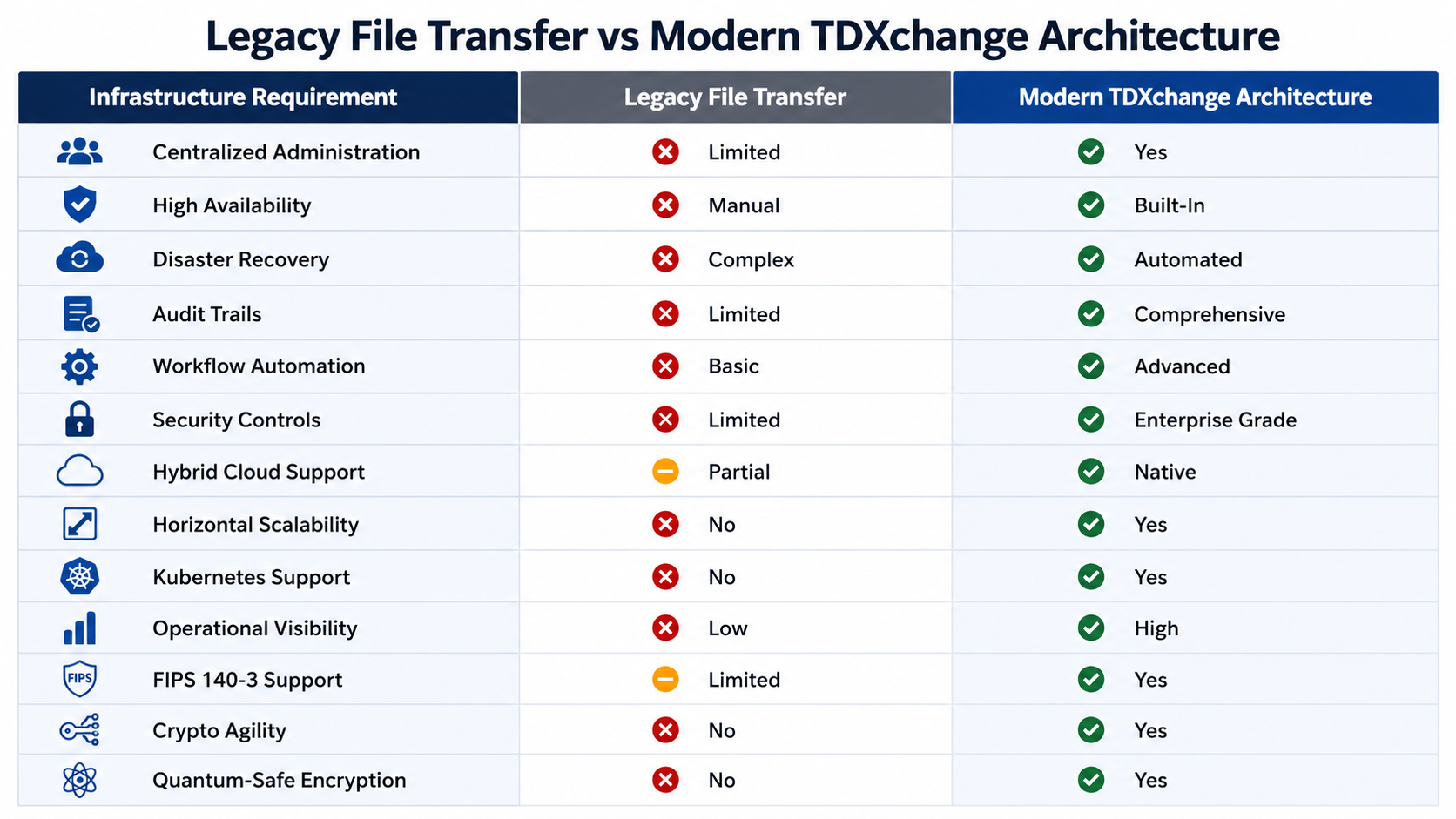
Organizations often focus on file transfer functionality when evaluating MFT solutions. In reality, the underlying architecture is what determines whether a platform can securely and reliably support long-term business growth.
A modern Managed File Transfer infrastructure should deliver four key capabilities:
Security
- Encryption in transit and at rest
- Multi-factor authentication (MFA)
- Role-based access controls (RBAC)
- Audit logging and compliance reporting
- Policy enforcement and governance controls
- Secure certificate and key management
- FIPS 140-3 validated cryptography
- Crypto agility
- Quantum-safe encryption capabilities
Scalability
- Horizontal scaling
- Clustering
- Load balancing
- Kubernetes support
- Hybrid cloud deployment options
Resiliency
- High availability
- Disaster recovery
- Automated failover
- Checkpoint restart capabilities
- Geographic redundancy
Operational Visibility
- Centralized monitoring
- Alerting
- Reporting
- Transfer tracking
- Performance analytics
When these capabilities are designed into the platform from the beginning, organizations can scale operations without sacrificing security or reliability.
Security Is More Than Encryption
Security is often the first topic discussed during MFT evaluations, and rightly so. Sensitive information is constantly moving between systems, users, and external organizations.
At bTrade, security is built into every layer of the TDXchange architecture.
Organizations rely on TDXchange to help secure:
- Financial transactions
- Healthcare records
- Government documents
- Supply chain data
- Intellectual property
- Customer information
- Operational data exchanges
Beyond encryption, security requires governance, visibility, authentication controls, auditing, and policy enforcement. These controls help organizations maintain compliance requirements while reducing operational risk.
How Quantum-Safe Encryption Strengthens MFT Security
Traditional cybersecurity strategies focus on protecting data from today's threats.
Increasingly, organizations are also evaluating future risks associated with quantum computing.
One concern is the growing awareness of "harvest now, decrypt later" attacks. In these scenarios, encrypted data may be stolen today and stored until future quantum computing capabilities potentially make decryption possible.
For organizations handling long-lived sensitive information, this creates a new security consideration.
Examples include:
- Financial records
- Healthcare data
- Government information
- Legal documents
- Intellectual property
- Personally identifiable information (PII)
To address these emerging risks, TDXchange incorporates quantum-safe encryption capabilities and crypto-agile architecture principles.
This approach helps organizations:
- Prepare for future cryptographic standards
- Reduce long-term data exposure
- Strengthen confidentiality protections
- Improve cybersecurity resilience
- Adapt to evolving regulatory requirements
Future-proof security is becoming just as important as current compliance.
High Availability by Design
Downtime can disrupt business operations, delay transactions, and create compliance challenges.
That is why TDXchange is designed around high availability principles.
Key capabilities include:
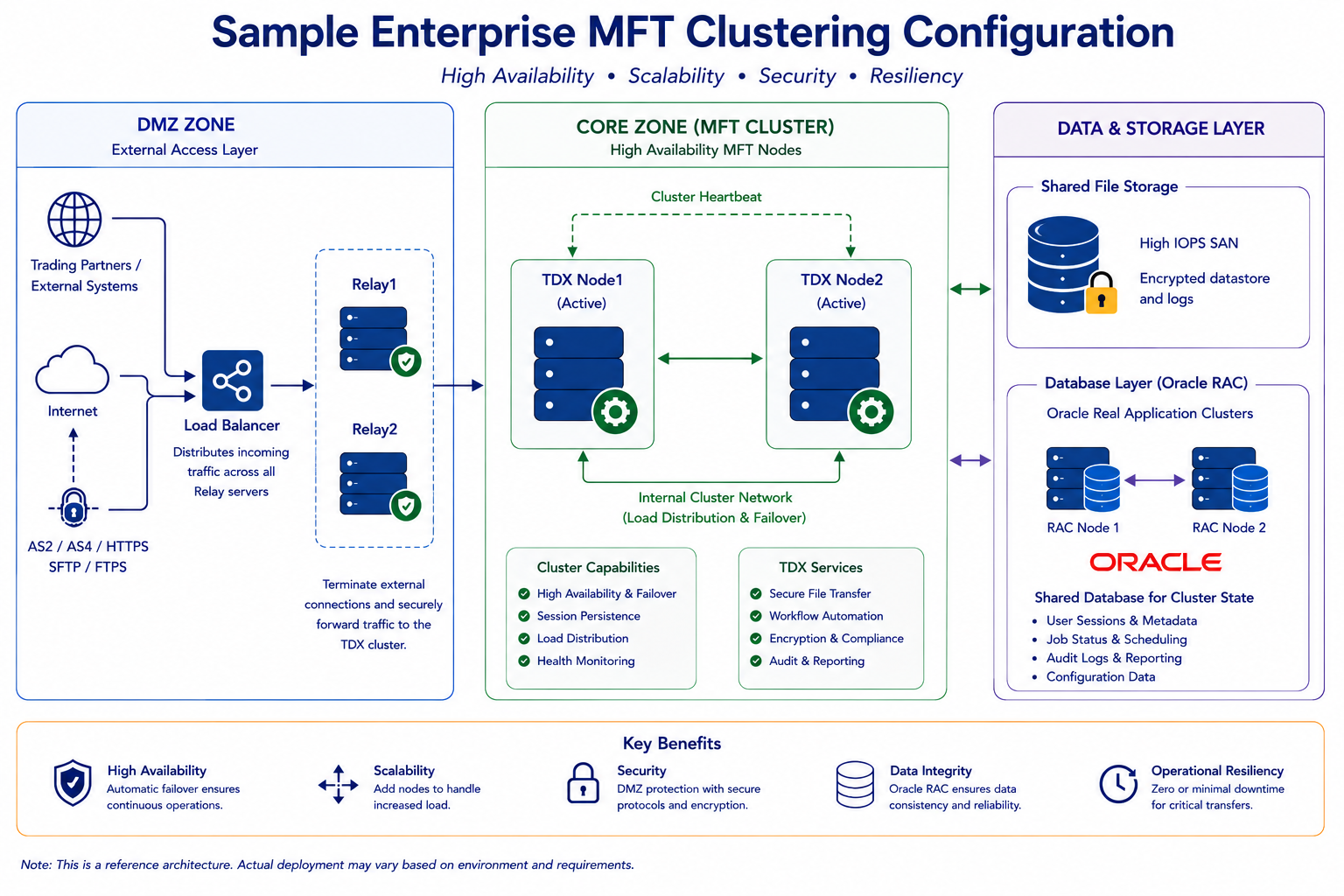
- Multi-node clustering
- Redundant services
- Automated failover
- Fault tolerance
- Continuous availability
By eliminating single points of failure, organizations can maintain uninterrupted data exchange even during infrastructure maintenance or unexpected outages.
For many customers, this capability is essential because MFT is no longer a supporting system, it is part of their critical business infrastructure.
Centralized Administration and Governance
Managing hundreds or thousands of trading partners can quickly become complex.
TDXchange provides centralized administration that allows organizations to manage:
- Users
- Trading partners
- Certificates
- Policies
- Workflows
- Security controls
- Reporting
A single administrative interface improves visibility while reducing operational overhead.
This centralized approach helps organizations maintain consistent governance across distributed environments.
Automation and Integration Architecture
Manual file transfer processes are difficult to scale and often introduce unnecessary operational risk.
Organizations may experience:
- Human error
- Delayed processing
- Missing files
- Inconsistent workflows
- Unnecessary retries
- Disconnected integrations
- Compliance gaps
- Growing dependence on custom scripts
Modern MFT infrastructure should do more than automate individual transfers. It should coordinate complete business processes across files, APIs, cloud services, enterprise applications, message queues, internal systems, and external trading partners.
The architecture behind those integrations is important.
New connectors should be added through standardized, modular interfaces without requiring changes to the core platform or disrupting existing workflows. This allows organizations to integrate new applications and services while reducing custom development, upgrade risk, and long term maintenance.
A modern automation and integration architecture should support:
- REST and SOAP APIs
- API initiated and event driven workflows
- Cloud storage and content platforms
- Enterprise applications and databases
- File systems and shared storage
- Message queues and event streams
- Custom business applications
- Internal systems and external trading partners
- Scheduled and condition based processing
- Automated retries, notifications, and exception handling
Integration should also extend beyond file delivery.
After a file reaches its destination, the MFT platform may need to:
- Trigger a remote job or application process
- Call an API
- Publish an event to a message queue
- Initiate validation or reconciliation
- Start a database import
- Request or process an acknowledgment
- Notify business and operational teams
- Continue the next step in a dependent workflow
These post delivery actions should remain part of the same governed transaction. The platform should preserve the file name, transaction identifier, partner information, workflow status, timing, and other relevant context.
This allows operations teams to determine whether the complete business process succeeded rather than simply confirming that a file reached its destination.
Automation must also account for planned maintenance and temporary outages.
The architecture should preserve transaction state when a partner endpoint, API, gateway, or downstream application is unavailable. Affected files should remain protected and governed until processing can continue safely when the dependency becomes available again.
This reduces:
- Unnecessary connection attempts
- Predictable failure alerts
- Duplicate processing
- Manual resubmissions
- Operational noise
- The risk of files being overlooked during recovery
TDXchange brings these capabilities together through centralized workflow orchestration, APIs, application and cloud integrations, secure transaction management, policy driven processing, and automated exception handling.
The objective is not simply to connect more systems. It is to create an automation architecture that can evolve as applications, cloud platforms, business requirements, and partner ecosystems change without accumulating another generation of fragile custom code.
Observability Improves Operational Success
One of the most overlooked aspects of MFT architecture is observability.
Organizations need visibility into:
- Transfer activity
- Performance metrics
- Failed transactions
- Security events
- User activity
- Compliance reporting
TDXchange provides centralized monitoring, auditing, and reporting capabilities that allow teams to quickly identify issues and maintain operational awareness.
Visibility is often the difference between simply transferring files and successfully managing enterprise data exchange.
Hybrid Cloud Flexibility
Every organization has different infrastructure requirements.
Some maintain on-premises environments. Others operate entirely in the cloud. Many adopt hybrid architectures.
TDXchange supports:
- On-premises deployments
- Private cloud deployments
- Public cloud deployments
- Hybrid cloud architectures
This flexibility allows organizations to align deployment strategies with business, security, and regulatory requirements.
Kubernetes and Dynamic Scalability
As transaction volumes grow, infrastructure must scale efficiently.
TDXchange supports containerized deployments and Kubernetes-based architectures that provide:
- Dynamic scaling
- Resource optimization
- Automated recovery
- Improved resiliency
- Faster deployment cycles
This enables organizations to grow file transfer capacity without major architectural redesigns.
How Does bTrade Help Customers Succeed?
When organizations evaluate Managed File Transfer platforms, they typically ask:
• How do we design infrastructure that scales?
• How do we implement Zero Trust in file transfers?
• How do we ensure long-term compliance and governance?
• How do we future-proof our investment?
At bTrade, we address all of these and not as add-ons, but as foundational design principles.
1. Designing Optimal MFT Infrastructure With Room to Grow
We don’t deploy “minimum viable” environments.
We work alongside our customers to architect secure file transfer ecosystems that account for:
• Current transaction volumes
• Projected growth
• Hybrid and multi-cloud environments
• Global trading partner expansion
• Disaster recovery and high availability requirements
Whether deploying TDXchange, TDCloud, or hybrid models, we ensure infrastructure is:
• Horizontally scalable
• Load-balanced
• High availability ready
• Built for performance under peak conditions
Infrastructure decisions made today should never limit tomorrow’s growth.
2. Implementing Zero Trust in Managed File Transfer
What is Zero Trust in MFT?
Zero Trust means that every transfer, user, application, and connection is continuously verified, regardless of network location.
At bTrade, Zero Trust is not marketing language. It is operational architecture.
We help customers implement:
• Strict role-based access control (RBAC)
• Certificate validation and lifecycle governance
• Micro-segmentation of file zones
• Continuous authentication and authorization checks
• End-to-end encryption (in transit and at rest)
• Full audit logging for compliance visibility
This approach protects organizations against:
• Insider threats
• Lateral movement after breach
• Certificate misuse
• Unauthorized partner access
Security is designed in and not bolted on.
3. Annual Strategic Reviews as Part of Maintenance
Technology evolves. Threats evolve. Business priorities evolve.
That’s why our customer relationships do not end at deployment.
As part of our maintenance commitment, we conduct annual strategic reviews with customers to:
• Assess infrastructure performance
• Evaluate capacity planning
• Review security posture
• Validate SLA performance
• Align upcoming business initiatives with roadmap capabilities
These reviews ensure our platform continues to support the business, not constrain it.
4. A Product Roadmap Driven by Customers
One of the most powerful differentiators at bTrade is this:
Our product roadmap is fully driven by our clients.
Many of the capabilities within TDXchange and TDCloud exist because customers requested them.
We continuously gather feedback through:
• Direct executive engagement
• Operational workshops
• Real-world use case discussions
• Long-term customer partnerships
This client-driven model leads to practical innovation, not theoretical feature development.
It also builds transparency.
Our customers know we build with their long-term best interests in mind.
Why Info-Tech Ranked bTrade #1 for the Fourth Year in a Row
Being recognized as the #1 MFT vendor by Info-Tech Research Group three consecutive years is meaningful because:
• Rankings are based on verified client feedback
• Customers evaluate real-world deployment experience
• Service quality, partnership, and responsiveness matter as much as technology
The recognition reflects not just platform capability, but relationship strength.
What Makes bTrade Different?
Many vendors sell software.
We build partnerships.
Our customers trust us because:
• We design infrastructure for long-term scalability
• We embed Zero Trust principles from day one
• We conduct annual strategic reviews
• We evolve our roadmap based on client needs
• We prioritize transparency and open dialogue
This creates relationships built on alignment, not transactions.
Executive Takeaways
- Modern Managed File Transfer architecture is no longer simply infrastructure for moving files, it has become a strategic component of Enterprise Data Exchange, supporting business-critical workflows, regulatory compliance, cloud transformation, and operational resilience.
- Long-term success is determined more by architectural decisions than by feature checklists. Choices around clustering, network segmentation, storage, scalability, governance, and disaster recovery have a lasting impact on security, performance, and operational efficiency.
- Organizations should design MFT environments around business outcomes rather than technical components, ensuring the architecture can support growth in transaction volumes, partner ecosystems, hybrid cloud adoption, and evolving cybersecurity requirements.
- Security should be embedded throughout the architecture through Zero Trust principles, least-privilege access, identity integration, immutable audit trails, and cryptographic agility, rather than relying solely on encrypted file transfers.
- High availability, disaster recovery, and operational observability should be foundational design principles. Real-time visibility into business workflows, SLA monitoring, automated alerting, and centralized governance help reduce operational risk while improving service reliability.
- Modern MFT platforms should support flexible deployment models including on-premises, cloud-native, hybrid, and containerized environments allowing organizations to modernize without introducing vendor lock-in or architectural constraints.
- AI-driven operational intelligence is becoming an important architectural capability, helping organizations simplify administration, accelerate troubleshooting, detect anomalies, and reduce operational overhead while maintaining strong governance and security controls.
- The most successful implementations begin with collaborative infrastructure design. Aligning architecture with business objectives, compliance requirements, recovery objectives, scalability goals, and long-term growth strategies enables organizations to build secure, resilient, and future-ready Enterprise Data Exchange environments that continue delivering value for years to come.
About the Author
Hanz Jorgensen is Chief Operating Officer and Managing Member at bTrade, where he oversees daily operations and works closely with the leadership team to shape and execute the company’s strategic direction. With more than 20 years of experience with several different MFT/technology companies spanning system administration, development, customer support, pre-sales, and enterprise solution delivery, Hanz brings a uniquely practical perspective on what organizations actually need from managed file transfer platforms. He leads bTrade’s Solution Consulting team and plays a central role in aligning product capabilities with real customer requirements across regulated and high-complexity environments.
Frequently Asked Questions:
What makes bTrade different from other MFT vendors?
bTrade differentiates itself through client-driven innovation, Zero Trust architecture implementation, annual strategic reviews, and scalable infrastructure design tailored for long-term growth.
What is MFT infrastructure?
MFT infrastructure consists of the servers, applications, security controls, workflows, monitoring tools, and networking components used to securely exchange files between users, systems, and business partners.
Why is scalability important for Managed File Transfer?
As organizations grow, file volumes, users, and partner connections increase. Scalable MFT infrastructure ensures performance and reliability can grow without major architectural changes.
How does bTrade implement Zero Trust in file transfer?
bTrade applies continuous verification, role-based access control, certificate lifecycle governance, encrypted zones, and complete audit logging across every transfer workflow.
Does bTrade support hybrid cloud MFT environments?
Yes. TDXchange and TDCloud support hybrid deployments with centralized governance, secure routing, and scalable architecture.
Why is Info-Tech recognition important?
Info-Tech rankings are based on verified client satisfaction and real-world implementation feedback, making the recognition a strong validation of customer trust.
Our Commitment.
After 36 years in secure file transfer, one truth remains constant:
• Technology can be replicated.
• Partnership cannot.
At bTrade, we work with our customers not just to deploy MFT platforms, but to build secure, scalable ecosystems that evolve with their business.
When our customers succeed, we succeed.
How does clustering improve MFT availability?
Clustering distributes workloads across multiple nodes, eliminating single points of failure and improving resiliency during maintenance or unexpected outages.
Can Managed File Transfer run in hybrid cloud environments?
Yes. Modern MFT platforms support on-premises, cloud, and hybrid deployments, allowing organizations to align infrastructure with security, compliance, and operational requirements.
What security controls should an enterprise MFT platform include?
Organizations should look for encryption, MFA, role-based access controls, auditing, policy enforcement, secure authentication, governance controls, and quantum-safe security capabilities.
What is crypto agility?
Crypto agility is the ability to quickly adopt new cryptographic standards and technologies as threats evolve, reducing future migration complexity.
Why is quantum-safe encryption important?
Quantum-safe encryption helps organizations prepare for future cryptographic threats associated with quantum computing while protecting sensitive long-term data from "harvest now, decrypt later" attacks.
Why is observability important for MFT operations?
Observability provides visibility into transfer activity, performance, failures, security events, and compliance reporting, helping organizations proactively manage operations and reduce risk.