

Organizations today exchange more sensitive information than ever before. Financial transactions, healthcare records, legal documents, intellectual property, supply chain data, and government communications all move between internal systems, business partners, cloud platforms, and remote employees.
As data volumes continue to grow and regulatory requirements become more complex, choosing the right file transfer deployment model has become a strategic decision.
The question is no longer simply whether cloud or on-premises is better.
The real question is:
Which deployment model best aligns with your security, compliance, operational, and business requirements?
Quick Answer: Cloud vs On-Premise File Transfer
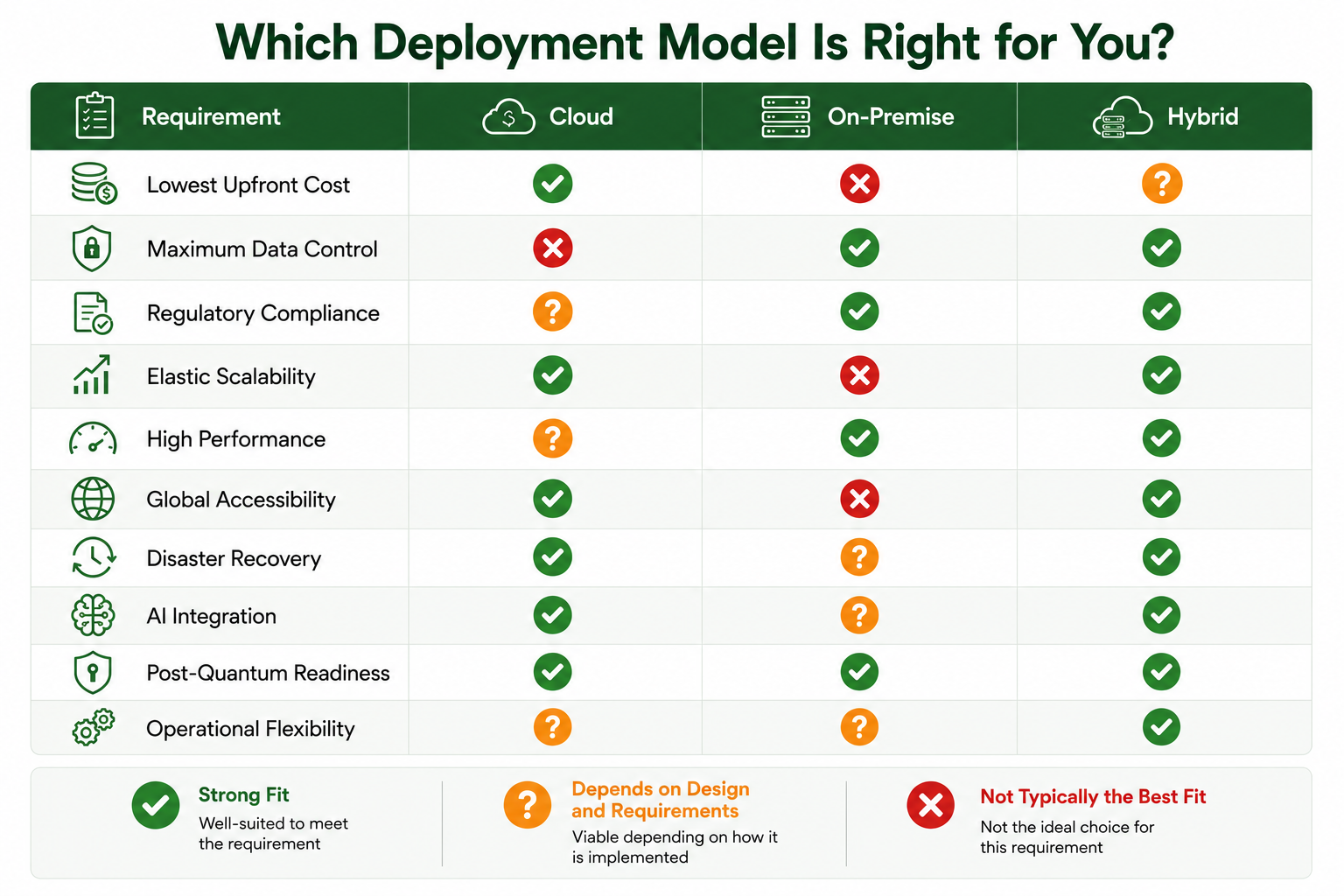
Cloud-based file transfer is typically the best choice for organizations seeking rapid scalability, lower upfront costs, simplified infrastructure management, and support for distributed workforces.
On-premise file transfer is often preferred by organizations requiring maximum control, strict data sovereignty, highly customized environments, or specialized compliance requirements.
For many enterprises in 2026, a hybrid deployment model provides the best balance of security, compliance, performance, and operational flexibility.
Key Takeaways
- Cloud deployment reduces infrastructure management and accelerates scalability.
- On-premise deployment provides greater control over security, compliance, and data residency.
- Hybrid architectures combine the advantages of both approaches.
- Compliance and data sovereignty often influence deployment decisions more than technology.
- Zero Trust security principles should be implemented regardless of deployment model.
- AI governance is becoming an important consideration when evaluating file transfer platforms.
- Post-quantum cryptography (PQC) readiness is emerging as a key requirement for protecting long-term sensitive data.
- Most enterprise organizations now operate hybrid environments rather than purely cloud or purely on-premises infrastructures.
What Is Cloud-Based vs On-Premise File Transfer?
Cloud-Based File Transfer
Cloud-based file transfer uses infrastructure hosted and managed by a third-party provider. Organizations access file transfer services through cloud platforms while the provider manages hardware, software updates, maintenance, scalability, and infrastructure availability.
Common cloud deployment environments include:
- AWS
- Microsoft Azure
- Google Cloud Platform
Benefits include simplified operations, elastic scaling, and predictable subscription-based pricing.
On-Premise File Transfer
On-premise file transfer runs entirely within an organization's own infrastructure.
The organization maintains control over:
- Servers
- Storage
- Networking
- Security policies
- Software updates
- Compliance controls
This model provides maximum visibility and customization but requires greater operational responsibility.
Hybrid File Transfer
Hybrid file transfer combines on-premise and cloud environments.
Organizations often use hybrid architectures to:
- Keep regulated data on-premises
- Support cloud-based partner connectivity
- Improve disaster recovery
- Enable cloud bursting
- Support global operations
Hybrid deployments have become increasingly common among large enterprises.
Why Most Enterprises Choose Hybrid
The cloud-versus-on-premise debate often presents a false choice.
Most organizations do not operate entirely in one environment.
Instead, they combine multiple deployment models to meet different business requirements.
Examples include:
- Healthcare organizations keeping patient records on-premises while using cloud-based partner exchanges
- Financial institutions maintaining internal processing systems locally while leveraging cloud-based disaster recovery
- Global enterprises using cloud infrastructure for external collaboration while retaining sensitive intellectual property internally
For many organizations, hybrid has become the default deployment model rather than an exception.
Cloud-Based File Transfer: Advantages and Challenges
Advantages
Lower Upfront Costs
Cloud deployments eliminate significant hardware investments and convert capital expenditures into predictable operational expenses.
Rapid Scalability
Organizations can quickly increase or decrease resources based on demand without purchasing additional infrastructure.
Simplified Operations
Cloud providers handle:
- Infrastructure maintenance
- Patching
- Upgrades
- Backup management
- Hardware replacement
Global Accessibility
Cloud platforms support distributed teams, remote workers, and global trading partners.
Built-In Disaster Recovery
Many cloud providers automatically replicate data across multiple regions and availability zones.
Challenges
Reduced Infrastructure Control
Organizations must trust cloud providers with aspects of infrastructure management.
Data Sovereignty Concerns
Certain regulations require data to remain within specific geographic boundaries.
Potential Latency
Network distance and internet dependency can impact performance for large file transfers.
Vendor Dependency
Organizations become partially dependent on cloud providers for availability and infrastructure services.
On-Premise File Transfer: Advantages and Challenges
Advantages
Maximum Control
Organizations retain complete control over:
- Infrastructure
- Security policies
- Data storage
- Access controls
- Compliance requirements
Strong Data Sovereignty
Data remains within organizational boundaries, helping support strict regulatory requirements.
High Performance
For certain workloads, local infrastructure can reduce latency and improve transfer performance.
Extensive Customization
Organizations can tailor environments to specific operational and security requirements.
Challenges
Higher Capital Investment
Infrastructure, licensing, and operational staffing requirements are typically higher.
Manual Scaling
Growth often requires additional hardware procurement and deployment.
Maintenance Responsibility
Internal teams must manage:
- Patching
- Upgrades
- Hardware lifecycle
- Backup systems
- Disaster recovery planning
Zero Trust Matters More Than Deployment Location
One of the biggest misconceptions in cybersecurity is that deployment location automatically determines security.
In reality, security depends far more on architecture than infrastructure location.
Whether deployed in the cloud, on-premises, or in a hybrid environment, organizations should implement:
- Multi-factor authentication (MFA)
- Role-based access controls
- Least-privilege access
- Continuous authentication
- Network segmentation
- Comprehensive auditing
- Encryption at rest and in transit
Zero Trust principles should apply consistently across all deployment models.
How bTrade Helps Organizations Design the Right File Transfer Architecture
Choosing between cloud, on-premise, and hybrid file transfer isn't simply a technology decision. It requires balancing security, compliance, operational requirements, performance expectations, data sovereignty concerns, and long-term scalability goals.
At bTrade, we work closely with organizations to design and deploy Managed File Transfer environments that align with their specific business and regulatory requirements.
There is no one-size-fits-all approach.
Some organizations require fully on-premise deployments to meet strict compliance or data residency requirements. Others prefer cloud-native architectures that provide operational agility and rapid scalability. Many enterprises adopt hybrid models that combine the strengths of both approaches.
TDXchange: Flexible Enterprise MFT
TDXchange supports multiple deployment models, allowing organizations to choose the architecture that best fits their needs.
Organizations can deploy TDXchange:
- On-premises
- In private cloud environments
- In public cloud environments
- In hybrid architectures
- Containerized or non-containerized
- As clustered high-availability deployments
Whether running in a traditional data center or across modern cloud infrastructure, TDXchange provides consistent security, governance, automation, auditing, and operational visibility.
TDCloud: Managed Cloud MFT
For organizations looking to reduce infrastructure management and accelerate deployment, TDCloud provides a fully managed cloud-based MFT platform.
TDCloud delivers:
- Enterprise-grade security
- High availability
- Operational monitoring
- Automated maintenance
- Simplified upgrades
- Faster onboarding
This allows organizations to focus on business operations rather than managing infrastructure.
Deployment on Your Cloud Provider of Choice
Many organizations have already standardized on a cloud platform.
bTrade supports deployments across major cloud providers, including:
- AWS
- Microsoft Azure
- Google Cloud Platform
Depending on operational requirements, deployments can be delivered using:
- Kubernetes
- Containers
- Virtual machines
- Traditional server-based architectures
Architecture Designed Around Your Requirements
Rather than forcing customers into a predetermined deployment model, we help organizations evaluate factors such as:
- Compliance requirements
- Data sovereignty
- Performance objectives
- Availability requirements
- Disaster recovery strategies
- Security architecture
- Zero Trust initiatives
- Future post-quantum cryptography readiness
The result is an infrastructure design tailored to the organization's operational goals rather than a vendor's preferred architecture.
Whether an organization needs cloud, on-premise, hybrid, Kubernetes, clustering, or a combination of these approaches, the objective remains the same:
Deliver secure, resilient, and scalable file transfer infrastructure that supports both current and future business requirements.
Executive Takeaway
The cloud versus on-premise debate is no longer purely about infrastructure.
Organizations must evaluate:
- Security requirements
- Compliance obligations
- Data sovereignty
- Performance expectations
- Disaster recovery objectives
- AI governance
- Post-quantum readiness
- Operational complexity
For many enterprises, the answer is increasingly hybrid.
The goal is not choosing one environment over another.
The goal is deploying file transfer capabilities where they provide the greatest security, resilience, scalability, compliance, and business value.
About the Author
Andrei Olin is Chief Technology Officer at bTrade, where he leads product strategy, delivery, architecture, and security across the company’s B2B, Managed File Transfer, and secure data exchange platforms.
Andrei has more than 30 years of experience spanning enterprise architecture, software development, infrastructure, cybersecurity, middleware, trading systems, SaaS, and Managed File Transfer. His career includes building mission-critical systems and infrastructure at Bear Stearns and Morgan Stanley, designing and operating enterprise MFT and messaging platforms for Merrill Lynch and Deutsche Bank, and building and scaling SaaS and security products at startups. He holds master’s and bachelor’s degrees in Information Technology with a focus on Information Security.
Frequently Asked Questions
Is cloud file transfer more secure than on-premise?
Neither deployment model is inherently more secure. Security depends on architecture, access controls, encryption, monitoring, governance, and operational practices.
Is hybrid file transfer becoming the standard?
Yes. Most enterprise organizations now operate hybrid environments that combine cloud and on-premise infrastructure to balance compliance, flexibility, and scalability.
What industries prefer on-premise file transfer?
Government, defense, healthcare, financial services, legal, and organizations with strict data sovereignty requirements often prefer on-premise or hybrid deployments.
How does Zero Trust apply to file transfer?
Zero Trust requires continuous verification, least-privilege access, strong authentication, auditing, and encryption regardless of deployment location.
Should organizations consider post-quantum encryption?
Organizations handling sensitive information with long retention requirements should begin evaluating post-quantum cryptography to prepare for future quantum computing threats.
What is the biggest advantage of cloud-based file transfer?
Cloud-based file transfer offers rapid scalability, lower upfront costs, simplified operations, and support for distributed workforces.
What is the biggest advantage of on-premise file transfer?
On-premise deployments provide maximum control over infrastructure, security, compliance, and data residency.
Why are many enterprises choosing hybrid deployments?
Hybrid architectures allow organizations to maintain sensitive operations internally while leveraging cloud scalability, accessibility, and disaster recovery capabilities where appropriate.