

When organizations first deploy a Managed File Transfer (MFT) solution, performance often feels predictable and interchangeable across platforms.
Transfers complete. Dashboards stay green. Architectural decisions such as clustering, storage, databases, and workflow design seem secondary.
That changes rapidly once an environment begins processing hundreds of thousands or millions of files per day.
At scale, MFT is no longer a background utility. It becomes core enterprise infrastructure, where performance, reliability, security, and compliance are inseparable, and where early architectural decisions determine long-term success.
With over three decades of experience designing and operating large-scale MFT environments, bTrade has consistently observed the same reality: high-volume file transfer systems rarely fail due to a single issue. They degrade when multiple “acceptable” design choices compound under real-world load.
This article explains what breaks first in high-volume MFT environments and how architecture determines whether systems scale or stall.
Executive Summary
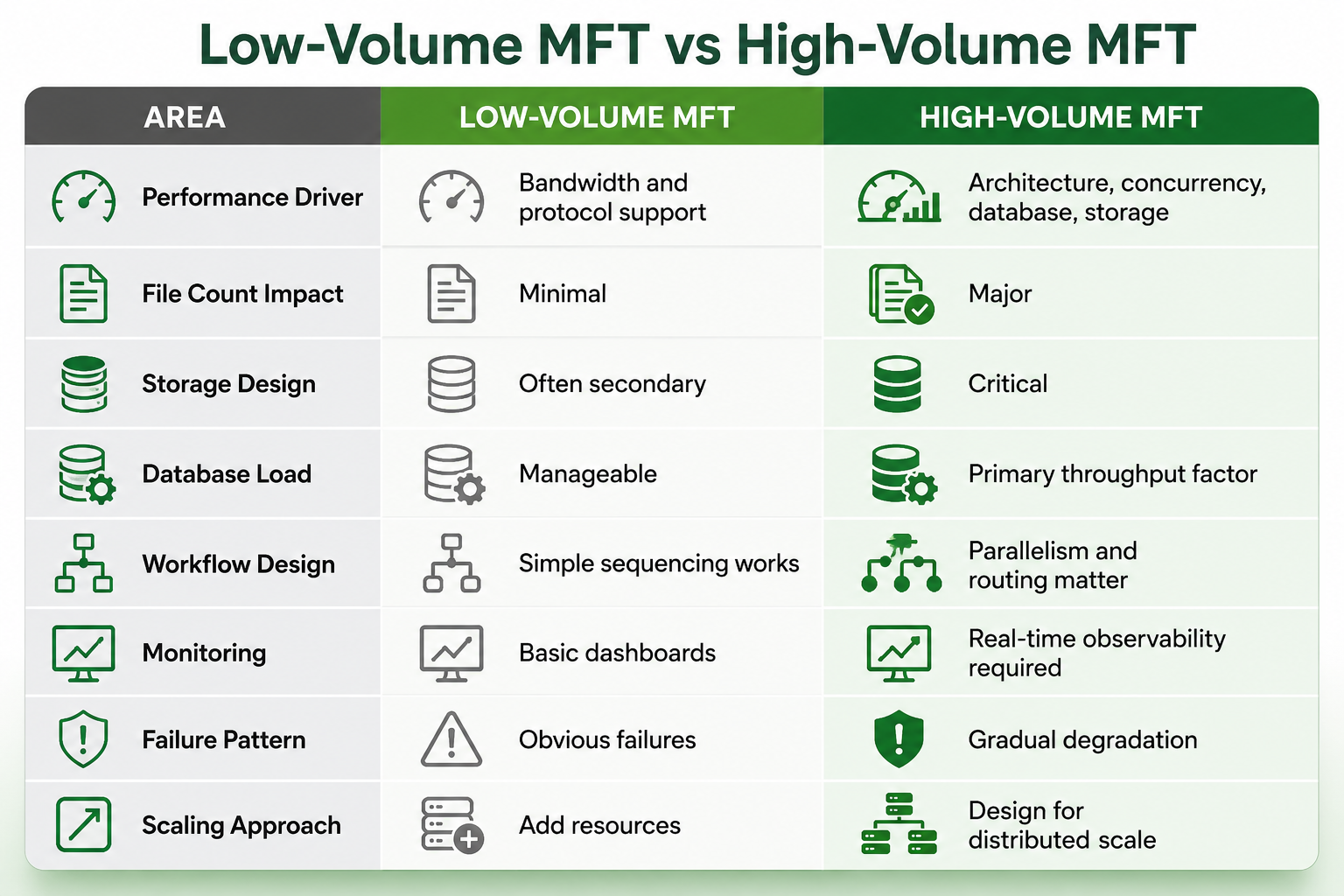
High-volume Managed File Transfer environments process hundreds of thousands or millions of files per day. At that scale, performance is no longer determined only by bandwidth or protocol support. Storage design, database throughput, workflow concurrency, clustering, data locality, network latency, and audit volume all become critical architectural factors.
MFT platforms often fail gradually under load, with growing queues, missed processing windows, delayed workflows, and database or storage contention. Organizations that treat MFT as enterprise infrastructure from the beginning can improve scalability, resiliency, compliance readiness, and long-term operational stability. TDXchange helps enterprises design MFT environments for predictable performance at scale through architecture-first planning, clustering, workflow optimization, and operational visibility.
Key Takeaways:
- File Count Drives Complexity: High-volume MFT environments processing hundreds of thousands of small files experience more operational stress than those moving fewer large files. Each file introduces overhead through metadata operations, database transactions, audit records, and workflow orchestration.
- Storage Becomes the First Bottleneck: Shared storage platforms (NAS, certain NFS configurations) create performance constraints through metadata latency and I/O contention as concurrent access increases. Growing transfer queues and missed processing windows emerge before outright failures occur.
- Database Throughput Limits Scale: At high volumes, databases managing transfer state, workflow execution, and audit records become the primary throughput determinant. High-frequency transactions stress schemas and indexing strategies, making the database the throttle regardless of CPU or network capacity.
- Network Optimization Beyond Bandwidth: Latency, packet loss, TCP window sizing, and routing efficiency matter more than raw bandwidth in cross-region workflows, hybrid cloud deployments, and global partner integrations. Unoptimized network stacks introduce compounding latency visible only at scale.
- Workflow Design and Data Locality: Centralized processing for distributed partners, sequential workflows limiting concurrency, and ignoring proximity between endpoints reduce scalability. Optimized architectures account for data locality, parallel execution, and intelligent routing.
- Early Architecture Decisions Create Long-Term Constraints: Single-region deployments, minimal clustering, and centralized storage become structural limitations at enterprise scale. Retrofitting requires coordinating partner downtime, migrating data, and redesigning workflows under operational pressure.
- MFT as Business Infrastructure: At scale, MFT directly affects SLAs, partner trust, regulatory compliance, and audit readiness. Successful environments are defined by intentional architectural design aligned with long-term operational requirements, not feature counts.
Why File Count Matters More Than File Size in MFT
One of the most common misconceptions in Managed File Transfer design is equating scale with large file sizes.
In practice, environments transferring hundreds of thousands of small to medium files experience significantly more operational stress than environments moving fewer large files.
Each file introduces overhead, including:
- File system metadata operations
- Database transactions for state management and checkpoints
- Audit and compliance record creation
- Encryption, integrity checks, and workflow orchestration
At high file counts, throughput is governed less by network bandwidth and more by transaction efficiency, concurrency handling, and persistence design.
MFT platforms optimized primarily for large-file acceleration often struggle under sustained high file volumes because they were not architected for extreme transactional density.
Storage Performance: The First Bottleneck in High-Volume MFT
When MFT performance issues arise, networks are frequently blamed. In reality, storage is often the first constraint to surface.
Shared storage platforms, especially centralized NAS or certain NFS configurations can become bottlenecks as:
- Concurrent access increases
- Metadata operations spike
- Multiple MFT nodes compete for the same volumes
Even when raw throughput appears sufficient, metadata latency and I/O contention can slow the entire transfer pipeline.
These issues rarely cause outright failure. Instead, organizations experience:
- Growing transfer queues
- Missed processing windows
- Downstream system delays
Because nothing appears “down,” these problems are difficult to diagnose once environments reach scale.
Database Throughput Limits MFT Scalability
Every enterprise-grade MFT platform relies on a database to manage:
- Transfer state and recovery
- Workflow execution
- Partner configurations
- Audit, reporting, and compliance records
At small scale, database impact is minimal. At high volume, it becomes a primary determinant of system throughput.
High-frequency, short-lived transactions place significant stress on database schemas, indexing strategies, and write patterns. If these components are not designed for scale from the beginning, the database becomes the throttle, regardless of available CPU, storage, or network capacity.
By the time this limitation becomes visible, remediation often requires disruptive changes.
Network Performance Goes Beyond Bandwidth
While sufficient bandwidth is important, it is rarely the limiting factor in mature MFT environments.
Latency, packet loss, TCP window sizing, and routing efficiency play a far greater role particularly in:
- Cross-region and cross-Atlantic workflows
- Hybrid on-premises and cloud deployments
- Partner integrations across geographies
Unoptimized network stacks and inefficient routing paths introduce compounding latency that becomes visible only at scale.
Workflow Design and Data Locality Impact Performance
At high volumes, where data is processed matters as much as how it is transferred.
Architectural patterns that frequently limit scalability include:
- Centralized processing for globally distributed partners
- Sequential workflows that limit concurrency
- Ignoring proximity between transfer endpoints and processing systems
Optimized MFT architectures account for data locality, parallel execution, and intelligent routing to reduce latency and failure exposure.
Why High-Volume MFT Requires Architecture-First Design
High-volume MFT systems rarely fail because of one obvious issue. They degrade when multiple acceptable design choices combine under sustained load. A storage platform that works at 10,000 files per day may struggle at 1 million. A database schema that works for moderate transfers may become the bottleneck when every file creates multiple state updates, audit records, and workflow events. That is why high-volume MFT must be designed around expected file counts, concurrency patterns, storage behavior, database throughput, partner distribution, and recovery requirements from the beginning.
What to Evaluate Before Scaling MFT
Organizations planning for high-volume MFT should evaluate:
- Daily and peak file counts
- Average and maximum file size
- Workflow concurrency requirements
- Storage platform and metadata performance
- Database write patterns and indexing
- Audit and reporting volume
- Partner geography and network latency
- Clustering and failover design
- Recovery and checkpoint requirements
- Compliance and retention obligations
Why Early MFT Architecture Decisions Become Long-Term Constraints
Many MFT environments begin with reasonable assumptions:
- Single-region deployments
- Minimal clustering
- Centralized storage
- “We’ll scale later” planning
At enterprise scale, these choices become structural constraints.
Changing them later often involves:
- Coordinating downtime with external partners
- Migrating large volumes of data
- Redesigning workflows under operational pressure
- Introducing risk to availability and compliance
This is why performance issues often persist longer than expected and not due to lack of awareness, but because safe architectural change is difficult once MFT becomes mission-critical.
Why Retrofitting Performance Rarely Works
Once embedded into business operations, MFT systems support:
- Revenue-generating processes
- Regulatory and audit requirements
- Time-sensitive partner workflows
Every architectural change carries risk. As a result, many organizations tolerate known limitations far longer than planned.
The reality is clear: MFT architecture must be designed for scale upfront, not corrected after problems surface.
Managed File Transfer as Business Infrastructure
At scale, MFT is no longer just a technical tool.
It directly affects:
- Service-level agreements (SLAs)
- Partner trust and reliability
- Regulatory compliance and audit readiness
The most successful MFT environments are not defined by the number of features. They are defined by intentional architectural design aligned with long-term operational requirements.
How bTrade Designs MFT for Scale
At bTrade, we recognize that technology alone does not solve scale challenges.
We work closely with customers to:
- Understand current and projected file volumes
- Analyze file size distributions and concurrency patterns
- Assess network topology, storage platforms, and database capacity
- Identify availability, security, and compliance requirements
- Design clustering, storage, and workflow architectures that scale predictably
This collaborative, architecture-first approach ensures that MFT environments are resilient not only at launch, but throughout sustained business growth.
Executive Takeaways
High-volume Managed File Transfer is not simply a larger version of a conventional MFT deployment. Once an environment processes hundreds of thousands or millions of files per day, architecture becomes the primary factor determining performance, resilience, security, and operational stability.
File count often creates more stress than total data volume because every file generates metadata operations, database transactions, audit records, encryption activity, and workflow events. As concurrency increases, limitations in storage, database throughput, workflow design, and network latency begin to compound. The result is rarely a complete outage. More often, organizations experience growing queues, missed processing windows, delayed downstream systems, SLA violations, and increasingly difficult troubleshooting.
The most important conclusions for organizations planning or operating high-volume MFT environments are:
- Architecture determines sustainable capacity. CPU, memory, and bandwidth alone cannot compensate for inefficient storage, database, workflow, or clustering design.
- File count must be treated as a primary sizing metric. Hundreds of thousands of small files can create significantly more transactional overhead than a smaller number of very large files.
- Storage frequently becomes the first bottleneck. Metadata latency and I/O contention can restrict performance even when a storage platform appears to provide sufficient raw throughput.
- Database design can become the system-wide throttle. Transfer state, workflow execution, checkpoints, partner configuration, reporting, and audit records generate high-frequency transactions that must be designed and indexed for scale.
- Network performance is more than bandwidth. Latency, packet loss, routing, protocol behavior, and TCP configuration become especially important across regions, cloud environments, and globally distributed partners.
- Workflow concurrency and data locality matter. Sequential processing, centralized routing, and unnecessary movement of data increase latency and reduce scalability.
- Clustering must address performance and resilience. Adding nodes does not automatically improve scale if every node still competes for the same constrained database, storage, or network resources.
- Observability must extend across the complete transaction lifecycle. Organizations need visibility into queues, workflow stages, infrastructure dependencies, processing times, partner activity, and SLA risk, not simply whether an individual transfer succeeded.
- Security and compliance overhead must be included in capacity planning. Encryption, integrity checks, audit logging, retention, access controls, and reporting consume resources and cannot be treated as secondary functions.
- Retrofitting architecture is significantly harder than designing it correctly. Once MFT supports revenue-generating processes, regulated information, and external partners, structural changes may require downtime, data migration, workflow redesign, and considerable operational risk.
- MFT must be treated as business infrastructure. At enterprise scale, its performance directly affects customer commitments, partner trust, regulatory compliance, audit readiness, and business continuity.
The practical takeaway is straightforward: organizations should design MFT around projected file counts, peak concurrency, data distribution, storage behavior, database throughput, availability objectives, recovery requirements, and compliance obligations from the beginning.
At lower volumes, architectural compromises may remain hidden. At enterprise scale, they become operational realities. That is when architecture stops being academic and starts determining whether the business continues moving or everyone begins staring at growing queues while insisting that all the servers are technically still up.
About the Author
Andrei Olin is Chief Technology Officer at bTrade, where he leads product strategy, delivery, architecture, and security across the company’s B2B, Managed File Transfer, and secure data exchange platforms.
Andrei has more than 30 years of experience spanning enterprise architecture, software development, infrastructure, cybersecurity, middleware, trading systems, SaaS, and Managed File Transfer. His career includes building mission-critical systems and infrastructure at Bear Stearns and Morgan Stanley, designing and operating enterprise MFT and messaging platforms for Merrill Lynch and Deutsche Bank, and building and scaling SaaS and security products at startups. He holds master’s and bachelor’s degrees in Information Technology with a focus on Information Security.
Ready to Evaluate Your MFT Architecture?
If you’d like to learn more or take a closer look at how your current Managed File Transfer infrastructure will perform as your business scales, bTrade offers a complimentary MFT Evaluation.
Our team works with you to review your existing architecture, understand your requirements, and identify opportunities to improve performance, resilience, security, and scalability before issues surface in production.
To schedule an evaluation or start a conversation, reach out to us at info@bTrade.com
Frequently Asked Questions
What file volume qualifies as high-volume MFT?
High-volume MFT typically involves processing hundreds of thousands to millions of files daily. At this scale, architectural decisions around storage, databases, and workflow design become critical performance determinants rather than secondary considerations.
Why do small files stress MFT systems more than large files?
Each file generates metadata operations, database transactions, audit records, and workflow orchestration overhead. Processing 100,000 small files creates significantly more transactional stress than transferring 100 large files of equivalent total size, making file count the primary complexity driver.
What causes storage bottlenecks in MFT environments?
Shared storage platforms like NAS or certain NFS configurations experience metadata latency and I/O contention as concurrent access increases. These issues manifest as growing transfer queues and missed processing windows rather than outright failures, making diagnosis difficult.
How does database design affect MFT scalability?
Databases managing transfer state, workflow execution, and audit records become the primary throughput throttle at high volumes. High-frequency transactions stress schemas and indexing strategies, limiting system capacity regardless of available CPU, storage, or network resources.
Why is network latency more important than bandwidth for MFT?
Latency, packet loss, TCP window sizing, and routing efficiency impact performance more than raw bandwidth, especially in cross-region workflows and hybrid cloud deployments. Unoptimized network stacks introduce compounding delays visible only at enterprise scale.
Can MFT architecture be fixed after deployment?
Retrofitting MFT architecture at scale requires coordinating partner downtime, migrating data, and redesigning workflows under operational pressure. Most organizations tolerate known limitations longer than planned because architectural changes carry significant risk once MFT becomes mission-critical infrastructure.