

A Practical Decision Guide for Secure, Scalable, and Resilient File Transfer
Architecture decisions are easy to underestimate when systems, workloads, and operational requirements are still relatively small.
A single server may adequately support a limited number of trading partners, predictable workflows, and moderate transfer volumes. Then the business grows. Transfer volumes increase. More applications and partners are added. Infrastructure moves into the cloud. Availability requirements become stricter. Suddenly, an early architectural shortcut becomes a very expensive long-term commitment.
This is why organizations evaluating enterprise Managed File Transfer frequently ask:
Should we use traditional MFT clustering, Kubernetes, or both?
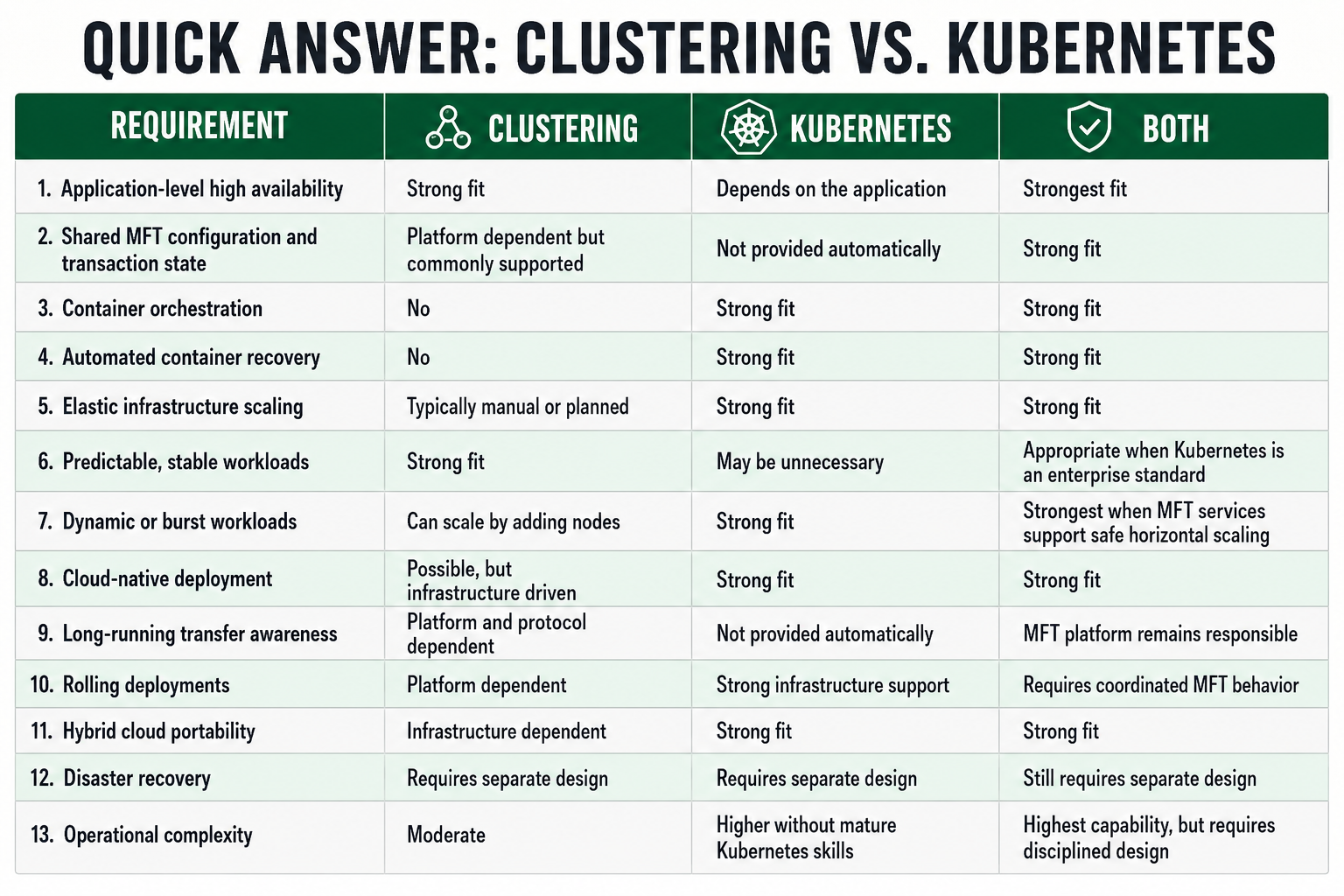
The short answer is that clustering and Kubernetes solve different problems.
Clustering primarily provides application-level availability, workload coordination, and processing resilience. Kubernetes manages containerized infrastructure, deployment, resource allocation, scaling, and recovery.
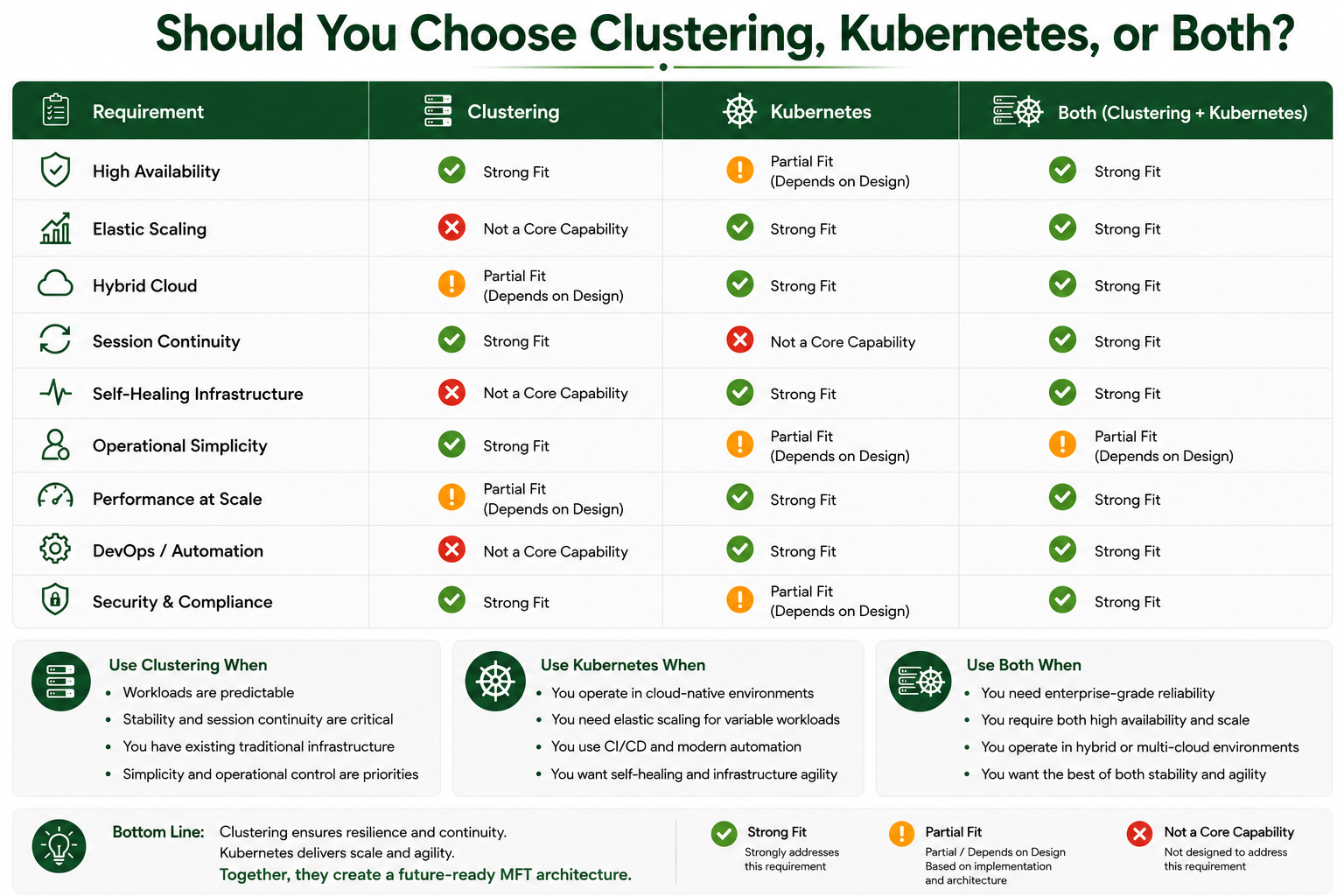
For many large enterprise environments, the right answer is not clustering versus Kubernetes. It is clustering and Kubernetes, each performing the job it was designed to do.
Executive Summary
Use traditional MFT clustering when application availability, transfer processing continuity, predictable performance, and controlled infrastructure are the primary requirements.
Use Kubernetes when the organization needs container orchestration, automated deployment, infrastructure portability, elastic resource management, and alignment with cloud-native operating practices.
Use both when mission-critical MFT services must combine application-aware resiliency with cloud-native infrastructure automation.
Neither approach automatically solves database performance, storage bottlenecks, disaster recovery, workflow design, transfer integrity, or operational governance. Those requirements must be addressed as part of the complete MFT architecture.
Key Takeaways
- Clustering and Kubernetes are complementary architectural approaches, not direct replacements.
- MFT clustering operates primarily at the application layer.
- Kubernetes operates primarily at the container and infrastructure orchestration layer.
- Restarting a container does not automatically recover an interrupted file transfer or workflow.
- High availability depends on databases, storage, networking, load balancers, identity services, and other dependencies—not only application nodes.
- Kubernetes is valuable when an organization already has mature container, DevOps, and cloud-native operating practices.
- Traditional clustering may be more practical for stable, predictable, on-premises environments.
- Combining clustering and Kubernetes can provide application resilience and infrastructure automation.
- The best architecture is the simplest one that satisfies the organization’s availability, scalability, security, and operational requirements.
What Is the Difference Between MFT Clustering and Kubernetes?
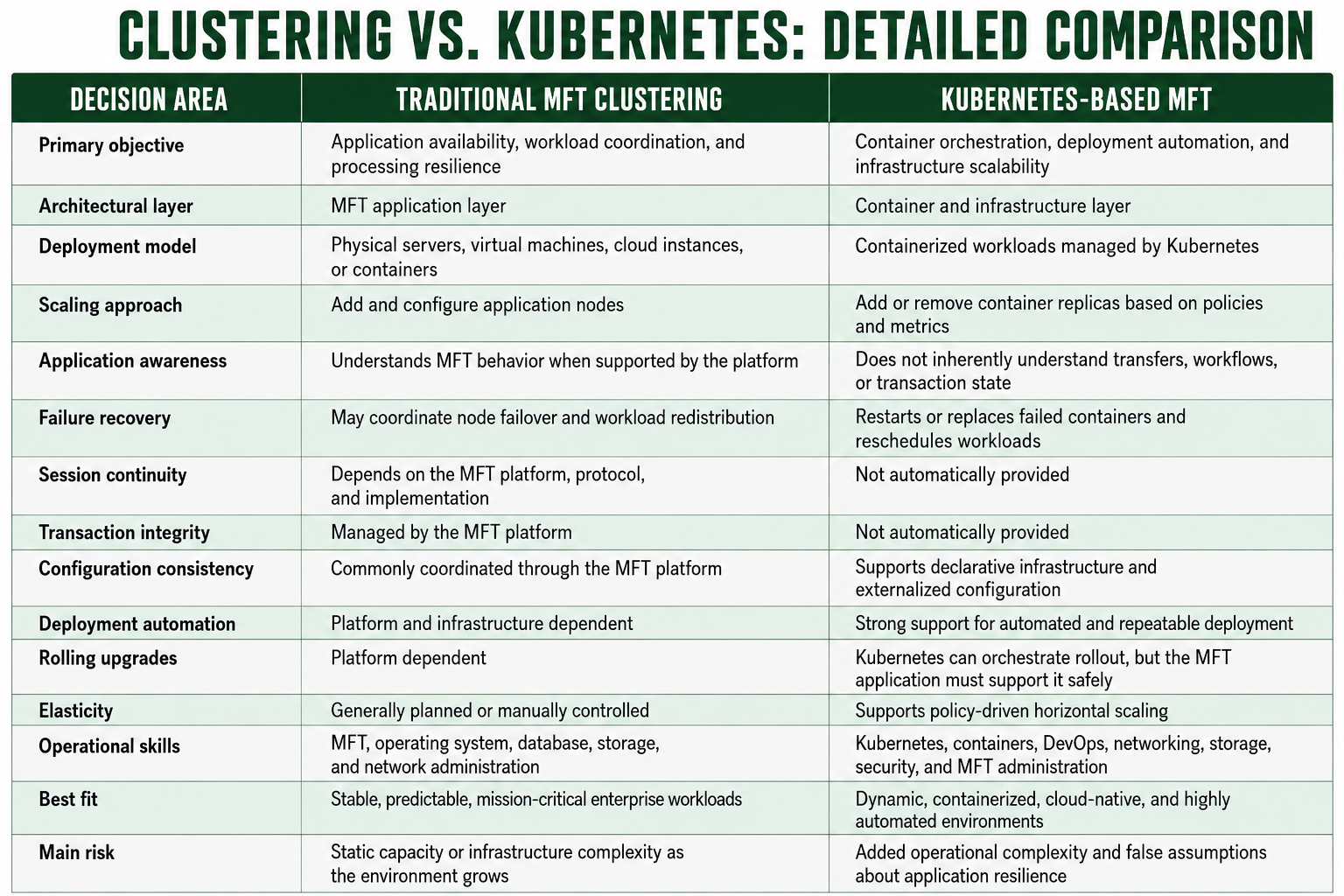
The difference is primarily the layer each technology manages.
MFT Clustering
MFT clustering coordinates multiple MFT application instances so they can operate as a unified platform.
Depending on the MFT product and architecture, clustered nodes may share or coordinate:
- Configuration
- Transaction state
- Work queues
- Scheduled workflows
- Partner definitions
- Processing responsibilities
- Administrative services
- Audit information
The exact behavior varies by platform. Organizations should never assume that the word “clustered” automatically guarantees active session preservation, checkpoint restart, or uninterrupted workflow execution.
Those capabilities must be verified.
For a detailed explanation, read Clustering in Managed File Transfer.
Kubernetes
Kubernetes orchestrates containerized workloads across a cluster of infrastructure nodes.
It can manage:
- Container placement
- Service discovery
- Resource allocation
- Health monitoring
- Failed-container replacement
- Rolling deployments
- Configuration distribution
- Horizontal scaling
- Infrastructure abstraction
The Kubernetes Horizontal Pod Autoscaler can increase or decrease application replicas based on supported metrics.
However, Kubernetes does not inherently understand MFT transactions.
It may know that a container stopped responding. It does not automatically know whether that container was halfway through delivering a settlement file, processing a healthcare transaction, or executing a multistep workflow.
Kubernetes can restart the container. The MFT platform must determine what happens to the business transaction.
The Most Important Architectural Distinction
A healthy container is not the same thing as a healthy business process.
Likewise, restarting a service is not the same thing as successfully recovering a transfer.
Consider an MFT node processing a large file when the underlying container or infrastructure node fails.
Kubernetes may:
- Detect the failed workload.
- Schedule a replacement container.
- Restart the MFT service.
- Restore network access to the application.
That is valuable infrastructure recovery.
But several business questions remain:
- Was the transfer completed?
- Can it safely resume?
- Must it restart?
- Was a partial file left at the destination?
- Could retrying create duplicate processing?
- Was workflow state preserved?
- Will the transaction remain fully auditable?
- Does the remote protocol support checkpoint restart?
- Does the MFT application understand what happened?
These are MFT application and workflow responsibilities.
Kubernetes is a powerful orchestration platform. It is not magic dust that automatically turns every application into a transactionally resilient one.
When Should You Choose Traditional MFT Clustering?
Traditional clustering is often the best fit when the environment has stable workloads and strict availability requirements but does not need dynamic container orchestration.
Choose clustering when:
- Transfer workloads are predictable.
- Infrastructure is primarily on-premises or based on virtual machines.
- Application availability is more important than rapid elasticity.
- The organization prefers controlled, long-lived infrastructure.
- Kubernetes is not already an enterprise operating standard.
- The operations team has strong traditional infrastructure expertise.
- Regulatory or internal policies limit container adoption.
- The environment relies heavily on established enterprise applications and file systems.
- Additional capacity can be planned in advance.
- Simplicity is more valuable than infrastructure abstraction.
A financial institution processing predictable settlement files, for example, may gain more value from a carefully designed active-active MFT cluster than from introducing Kubernetes solely because it is the current architectural fashion.
Newer is not automatically better. It is simply newer.
When Should You Choose Kubernetes for MFT?
Kubernetes becomes valuable when the organization already operates cloud-native infrastructure and needs consistency, automation, and flexible resource management.
Choose Kubernetes when:
- Containerization is an established enterprise standard.
- The organization already has experienced Kubernetes and DevOps teams.
- MFT services must operate across public cloud, private cloud, or hybrid environments.
- Infrastructure deployment must be repeatable and automated.
- Workloads fluctuate significantly.
- Rapid deployment and rollback are operational priorities.
- Infrastructure-as-code and CI/CD are mature practices.
- Resource utilization must be centrally managed.
- Application components can scale horizontally.
- The MFT platform has been designed and tested for Kubernetes operation.
Kubernetes is particularly useful when organizations need to standardize application delivery across AWS, Microsoft Azure, Google Cloud, private cloud, and on-premises container platforms.
However, the decision should consider the complete operational cost.
Kubernetes may reduce certain forms of manual infrastructure work while introducing requirements around:
- Cluster administration
- Container security
- Persistent storage
- Ingress and network policy
- Secrets management
- Monitoring
- Capacity management
- Version compatibility
- Platform upgrades
- Troubleshooting across multiple abstraction layers
If an organization deploys one modest MFT instance and has no broader Kubernetes strategy, adding Kubernetes may provide considerably more architecture than the problem requires.
When Should You Use Both?
Use clustering and Kubernetes together when the organization needs both application-aware resilience and cloud-native infrastructure orchestration.
In this architecture:
The MFT Platform Provides
- Transaction processing
- Workflow coordination
- Shared or synchronized configuration
- Application-level load distribution
- Transfer and workflow recovery
- Auditability
- Application-aware failover
- Partner and protocol management
Kubernetes Provides
- Container scheduling
- Infrastructure health monitoring
- Failed-container replacement
- Resource allocation
- Horizontal replica management
- Deployment automation
- Rolling updates
- Infrastructure portability
- Integration with DevOps tooling
This layered model is appropriate when:
- MFT is mission-critical.
- Kubernetes is already a strategic platform.
- Workloads require application-level continuity.
- Infrastructure must scale dynamically.
- The organization operates across hybrid or multi-cloud environments.
- Deployment automation is important.
- The MFT application has been engineered for distributed operation.
The key is making sure the two layers coordinate properly.
Kubernetes should not scale MFT processing nodes based solely on CPU usage if database throughput, storage latency, workflow queues, partner throttling, or active sessions are the real constraints.
Scaling the application layer without understanding downstream dependencies may simply help the system reach its next bottleneck faster.
Common Deployment Scenarios
Scenario 1: Stable, Regulated On-Premises Environment
An organization operates from two controlled data centers with predictable transfer schedules, strict change-management procedures, and limited container adoption.
Recommended approach: Traditional MFT clustering.
Why:
- Workloads are predictable.
- Infrastructure is tightly governed.
- Capacity can be planned.
- Operational teams already understand the environment.
- Kubernetes may add complexity without providing proportional value.
The architecture should still include redundant databases, storage, networking, load balancers, and disaster recovery.
Scenario 2: Cloud-Native Enterprise with Variable Demand
An organization runs most enterprise applications on Kubernetes and experiences significant changes in transfer demand.
Recommended approach: Kubernetes with application-aware MFT clustering.
Why:
- Kubernetes provides standardized deployment and resource orchestration.
- MFT clustering provides transaction and workflow resilience.
- The combined model supports dynamic infrastructure without treating containers as transaction-aware services.
Scenario 3: Hybrid Cloud Modernization
An organization is gradually moving applications into the cloud while maintaining core systems on-premises.
Recommended approach: A hybrid model using clustered MFT services with Kubernetes where it provides operational value.
For example:
- Traditional clustered services may support established on-premises workloads.
- Containerized MFT services may support cloud-based applications.
- Secure relays may be distributed across network zones and regions.
- Centralized governance and observability should span both environments.
The goal should be consistent operation—not two disconnected MFT platforms wearing the same company logo.
Scenario 4: Small but Business-Critical Environment
An organization has moderate transfer volume but strict availability requirements.
Recommended approach: A simple two-node cluster may be sufficient.
Kubernetes is not required merely because the workload is important. A well-designed clustered deployment may deliver the necessary resilience with less operational overhead.
Scenario 5: High-Volume, High-Frequency Processing
An organization processes millions of files, especially large numbers of small files, across complex workflows.
Recommended approach: Depends on workload behavior, but clustering is usually foundational; Kubernetes may support infrastructure elasticity.
The architecture must also evaluate:
- Database throughput
- Storage IOPS
- Directory operations
- Queue performance
- Audit-event volume
- Workflow design
- Network latency
- Data locality
For these environments, read High-Volume Managed File Transfer: Why Architecture Determines Performance at Scale.
Scenario 6: Multi-Region Disaster Recovery
An organization requires recovery from a complete data-center or regional outage.
Recommended approach: Clustering or Kubernetes may participate, but neither replaces disaster recovery architecture.
The organization must separately address:
- Database replication
- File and queue replication
- Configuration recovery
- Keys and certificates
- DNS and traffic management
- Identity services
- Regional dependencies
- Recovery Time Objective
- Recovery Point Objective
- Partner connectivity
- Recovery testing
A Kubernetes cluster spread across nodes is not automatically a multi-region disaster recovery plan.
A Practical Decision Framework
Before choosing an architecture, answer these questions in order.
1. What Business Workflows Depend on MFT?
Identify:
- Critical files
- Transfer deadlines
- Business owners
- Partner dependencies
- Compliance requirements
- Financial or operational impact of failure
Architecture should begin with business impact, not infrastructure preference.
2. What Availability Is Actually Required?
Define:
- Acceptable downtime
- Recovery Time Objective
- Recovery Point Objective
- Maintenance requirements
- Peak operating periods
- Regional recovery needs
“Always available” sounds impressive but is not an architecture requirement until it is translated into measurable objectives.
3. How Predictable Are the Workloads?
Evaluate:
- Normal transfer volume
- Peak transfer volume
- File-count distribution
- File-size distribution
- Concurrent connections
- Workflow complexity
- Seasonal or event-driven spikes
- Partner availability patterns
Stable workloads may not benefit significantly from elastic infrastructure.
4. Where Does Transaction State Live?
Determine how the platform manages:
- Active transfers
- Workflow state
- Scheduling
- Transfer queues
- Retry information
- Partner configuration
- Audit history
- Duplicate prevention
This is one of the most important questions in a Kubernetes deployment.
If a container disappears, the transaction state must not disappear with it.
5. Is the MFT Platform Designed for Horizontal Scaling?
Verify that additional application instances can safely share workloads without creating:
- Duplicate processing
- Conflicting schedules
- Session loss
- Inconsistent configuration
- Queue contention
- Database overload
- Audit gaps
More replicas do not automatically mean more useful capacity.
6. Does the Organization Have the Skills to Operate Kubernetes?
Kubernetes can be an excellent architecture when it is supported by mature teams, processes, and tooling.
Without those capabilities, it may make troubleshooting harder by adding:
- Containers
- Pods
- Services
- Ingress
- Persistent volumes
- Secrets
- Operators
- Network policies
- Multiple layers of logging
Complexity is not free simply because it is described in YAML.
7. How Will the Architecture Be Monitored?
The organization should be able to observe both:
Infrastructure health
- Nodes
- Pods
- CPU
- Memory
- Network
- Storage
- Kubernetes events
Business transaction health
- File arrival
- Transfer status
- Workflow progress
- Delivery confirmation
- SLA status
- Partner availability
- Retry activity
- Duplicate processing
- Transaction history
Infrastructure monitoring and MFT observability must work together.
Questions to Ask an MFT Vendor
Before approving either architecture, ask the vendor:
- Does the platform support active-active clustering?
- What state is shared between application nodes?
- What happens to an active transfer when a node or pod fails?
- Does recovery depend on the protocol or remote partner?
- How are duplicate transfers and duplicate workflow execution prevented?
- Can nodes be added or removed without interrupting processing?
- Is the platform certified or explicitly supported on Kubernetes?
- How are rolling upgrades coordinated with active transfers?
- Which components require persistent storage?
- How are secrets, certificates, and encryption keys managed?
- What metrics should control scaling?
- Does scaling the application tier create database or storage bottlenecks?
- How is the platform monitored across nodes and environments?
- How are configuration changes synchronized and audited?
- What testing has been performed at comparable transaction volumes?
- How are backup and disaster recovery handled?
- Can the vendor help design the surrounding infrastructure?
- How difficult is the environment to patch, upgrade, and operate daily?
Vague answers such as “Kubernetes handles that” should lead to considerably more questions.
Common Architectural Mistakes
Assuming Kubernetes Replaces Application Resilience
Kubernetes can restart workloads. The MFT platform must still protect transfers, workflows, queues, transaction state, and auditability.
Scaling Only the Application Tier
Adding application replicas will not resolve bottlenecks in databases, storage, networking, partner endpoints, or workflow design.
Introducing Kubernetes Without Operational Readiness
If the organization lacks Kubernetes experience, the platform may become harder to operate and troubleshoot.
Treating Clustering as Disaster Recovery
A cluster can protect against component failures within an environment. It does not necessarily protect against the loss of an entire region, cloud account, or data center.
Ignoring Long-Running Connections
Rolling updates, scaling events, and pod termination can interrupt active transfer sessions unless the platform and infrastructure manage them appropriately.
Designing Around Average Volume
Architectures must account for peaks, backlogs, partner outages, and recovery processing, not merely average daily volume.
Choosing Technology Before Defining Requirements
Starting with “We want Kubernetes” is not the same thing as starting with an architecture requirement.
Technology should support the business objective. It should not become the objective.
How TDXchange Supports Both Architectural Models
TDXchange supports traditional clustered deployments and Kubernetes-based architectures, allowing organizations to select an operating model aligned with their infrastructure, workload, resiliency, and governance requirements.
TDXchange provides capabilities including:
- Multi-node clustering
- Centralized administration
- Distributed workload processing
- High availability
- Secure relay and proxy services
- Kubernetes deployment support
- Workflow automation
- Centralized operational visibility
- Transaction auditing
- Role-based access control
- Multi-tenancy and delegated administration
- Hybrid cloud support
- SLA monitoring
- Scalable partner management
The appropriate design depends on the customer.
Some organizations need a predictable clustered deployment on virtual machines. Others need Kubernetes-based orchestration across cloud environments. Large enterprises may combine both models.
At bTrade, we work with customers to evaluate:
- Current and anticipated workloads
- File counts and file sizes
- Partner and protocol requirements
- Availability objectives
- Infrastructure standards
- Cloud strategy
- Security and compliance requirements
- Operational skills
- Database and storage architecture
- Disaster recovery objectives
The goal is not to deploy the most complicated architecture possible.
The goal is to build the simplest architecture that can securely and reliably meet the organization’s requirements today while providing a practical path for future growth.
For the broader architectural framework, read Modern MFT Architecture: How to Build Secure, Scalable, and Resilient Enterprise File Transfer.
Executive Takeaway
The decision between clustering and Kubernetes should not be reduced to old technology versus new technology.
They solve different problems.
Clustering helps keep MFT applications and business processes available.
Kubernetes helps deploy, operate, recover, and scale containerized infrastructure.
Organizations with stable and predictable environments may achieve everything they need through well-designed MFT clustering.
Organizations with mature cloud-native operations may benefit from Kubernetes.
Organizations that require application-level resilience and cloud-native infrastructure automation may use both.
The most important decision is not whether the architecture contains Kubernetes, containers, virtual machines, or an impressive number of boxes on a diagram.
It is whether the architecture can preserve transaction integrity, meet business SLAs, recover safely, scale predictably, and remain manageable for the people responsible for operating it.
That is what makes an MFT architecture successful.
About the Author
Andrei Olin is Chief Technology Officer at bTrade, where he leads product strategy, delivery, architecture, and security across the company’s B2B, Managed File Transfer, and secure data exchange platforms.
Andrei has more than 30 years of experience spanning enterprise architecture, software development, infrastructure, cybersecurity, middleware, trading systems, SaaS, and Managed File Transfer. His career includes building mission-critical systems and infrastructure at Bear Stearns and Morgan Stanley, designing and operating enterprise MFT and messaging platforms for Merrill Lynch and Deutsche Bank, and building and scaling SaaS and security products at startups. He holds master’s and bachelor’s degrees in Information Technology with a focus on Information Security.
FAQ: Clustering vs Kubernetes in MFT
Is Kubernetes better than MFT clustering?
Not inherently. Kubernetes and MFT clustering solve different problems. Kubernetes manages containerized infrastructure, while MFT clustering coordinates application services, workloads, and transaction processing. The better approach depends on the organization’s requirements.
Does Kubernetes replace MFT clustering?
No. Kubernetes can restart containers, redistribute workloads, and manage replicas, but it does not automatically provide transfer-state management, workflow recovery, duplicate prevention, or application-aware failover.
When should an organization use traditional MFT clustering?
Traditional clustering is appropriate for stable, predictable, mission-critical environments that require application availability and workload distribution but do not need Kubernetes-based orchestration or elastic infrastructure.
When should an organization run MFT on Kubernetes?
Kubernetes is appropriate when the organization already has mature container operations, needs repeatable deployments, operates across cloud or hybrid environments, or requires dynamic infrastructure scaling.
Can clustering and Kubernetes be used together?
Yes. Kubernetes can orchestrate the infrastructure hosting MFT services, while MFT clustering provides application-level resiliency, workload coordination, and transaction management.
Does Kubernetes provide file-transfer session continuity?
Not automatically. Session continuity depends on the MFT platform, the transfer protocol, application state management, remote endpoint capabilities, and the surrounding architecture.
Can Kubernetes automatically scale MFT workloads?
Kubernetes can increase or decrease container replicas based on supported metrics. However, the MFT platform must support safe horizontal scaling, and the organization must consider databases, storage, queues, partner limits, and active transfers.
Is MFT clustering the same as disaster recovery?
No. Clustering primarily protects service availability within an operating environment. Disaster recovery addresses the loss of an entire environment and requires separate planning for data, files, configurations, networking, identity, keys, certificates, and partner connectivity.
What is the best MFT architecture for hybrid cloud?
Many hybrid environments use a combination of centralized MFT governance, distributed secure edge services, clustered application processing, and Kubernetes where cloud-native orchestration provides operational value.
What should organizations evaluate before choosing an architecture?
Organizations should evaluate business criticality, transfer volumes, workload variability, availability objectives, recovery requirements, transaction-state management, infrastructure standards, operational expertise, database and storage performance, security, compliance, and long-term maintenance.
Does TDXchange support clustering and Kubernetes?
Yes. TDXchange supports multi-node clustered deployments and Kubernetes-based architectures, allowing organizations to select or combine deployment models based on scalability, resiliency, operational, and infrastructure requirements.
Final Thought
If you're evaluating your MFT architecture, ask yourself:
"Will this design support where our business is going, not just where it is today?"
That's the difference between a system that works, and one that truly scales.
Additional Technical Resources
- Kubernetes Documentation
- Kubernetes StatefulSets
- NIST Cybersecurity Framework
- Google Site Reliability Engineering (SRE)