
Managed File Transfer has traditionally been evaluated using a familiar checklist:
- Supported protocols
- Encryption
- Workflow automation
- High availability
- Audit reporting
- Partner management
- Cloud deployment
Those capabilities remain important. However, they no longer tell organizations whether an MFT platform is prepared for the next decade of enterprise data exchange.
Files now move among applications, APIs, cloud platforms, AI services, trading partners, users, edge systems, and distributed infrastructure. At the same time, organizations must respond to Zero Trust requirements, increasing transaction volumes, quantum-related cryptographic risk, complex supply chains, and growing demands for operational intelligence.
The better question is no longer simply:
Which MFT product can securely move a file?
It is:
Which MFT vendors have the architecture, security model, operational intelligence, and demonstrated ability to support the future of enterprise data exchange?
This article compares several established vendors using public information available as of August 23, 2026.
The comparison includes:
- bTrade TDXchange
- Axway Managed File Transfer
- IBM Sterling Secure File Transfer
- Cleo Integration Cloud
- Progress MOVEit
- Fortra GoAnywhere MFT
- Kiteworks
This is not a laboratory benchmark, procurement recommendation, or declaration that one platform is best for every organization. Vendor websites are naturally enthusiastic narrators of their own stories. The objective is to compare what each vendor publicly documents, identify meaningful strengths, and distinguish delivered capabilities from strategic direction.
In Summary
The strongest future-facing MFT vendors are evolving beyond isolated file transfer.
Their platforms increasingly combine:
- AI-assisted operations
- Zero Trust security
- Cryptographic agility
- Post-quantum readiness
- End-to-end observability
- Predictive operational intelligence
- File, API, and workflow orchestration
- Cloud-native deployment
- Kubernetes support
- Enterprise scalability
- Customer-driven product development
The research indicates that no vendor leads every category.
Axway demonstrates a broad and mature enterprise MFT portfolio with operational intelligence, containerization, hybrid deployment, and documented post-quantum support in Transfer CFT.
Cleo has established a particularly strong position in AI-native supply chain orchestration, intelligent exception management, API integration, and business-process visibility.
IBM provides extensive enterprise scale, high availability, AI-assisted monitoring, API support, containerized deployment, and a mature ecosystem around Sterling Secure File Transfer.
Progress MOVEit remains a widely adopted MFT platform with strong workflow automation, security, auditability, REST APIs, cloud delivery, high availability, and an increasingly crypto-agile foundation.
Fortra GoAnywhere offers mature workflow automation, extensive integrations, accelerated transfer through FileCatalyst, flexible deployment, and a broader Zero Trust File Transfer bundle.
Kiteworks differentiates itself through content-centric Zero Trust, secure AI integration, compliance, controlled private-data exchange, and a broad connector and workflow ecosystem.
bTrade TDXchange presents one of the most integrated future-facing visions by bringing Native End-to-End Zero Trust Architecture across all platform components, post-quantum cryptography, AI-assisted operational intelligence, end-to-end observability, Kubernetes deployment, accelerated transfer, APIs, workflow orchestration, multi-tenancy, and delegated administration into one enterprise data exchange platform.
The important distinction is not the length of the feature list. It is whether those capabilities operate together as one governed architecture.
Key Takeaways
- No vendor can be declared the universal leader without evaluating the organization’s architecture, workflows, security requirements, transaction profile, and operating model.
- Axway presents one of the broadest traditional enterprise MFT portfolios and has publicly documented operational intelligence, containerization, and post-quantum support.
- Cleo is especially strong in AI-native orchestration, EDI and API integration, business-process visibility, and intelligent exception management.
- IBM demonstrates proven enterprise scale, AI-assisted monitoring, high availability, APIs, and Kubernetes-based container deployment.
- Progress MOVEit remains strong in secure file exchange, workflow automation, REST APIs, auditability, cloud delivery, and conventional enterprise resilience.
- Fortra GoAnywhere combines approachable workflow automation, broad connectivity, Zero Trust-related controls, and high-speed FileCatalyst integration.
- Kiteworks has a strong security-first vision around Zero Trust, private-data governance, secure AI connectivity, compliance, and content protection.
- TDXchange differentiates itself by combining native internal Zero Trust, deployed post-quantum protection, Kubernetes scalability, enterprise observability, AI-assisted operations, and customer-driven innovation within one MFT and enterprise data exchange platform.
- Publicly unavailable evidence should not automatically be interpreted as an absent capability. Buyers should confirm important requirements through technical demonstrations, documentation, architecture reviews, and controlled testing.
- A product roadmap is valuable, but evidence of production delivery matters more than an impressive collection of future-tense verbs.
How Were the MFT Vendors Evaluated?
The comparison uses nine forward-looking categories.
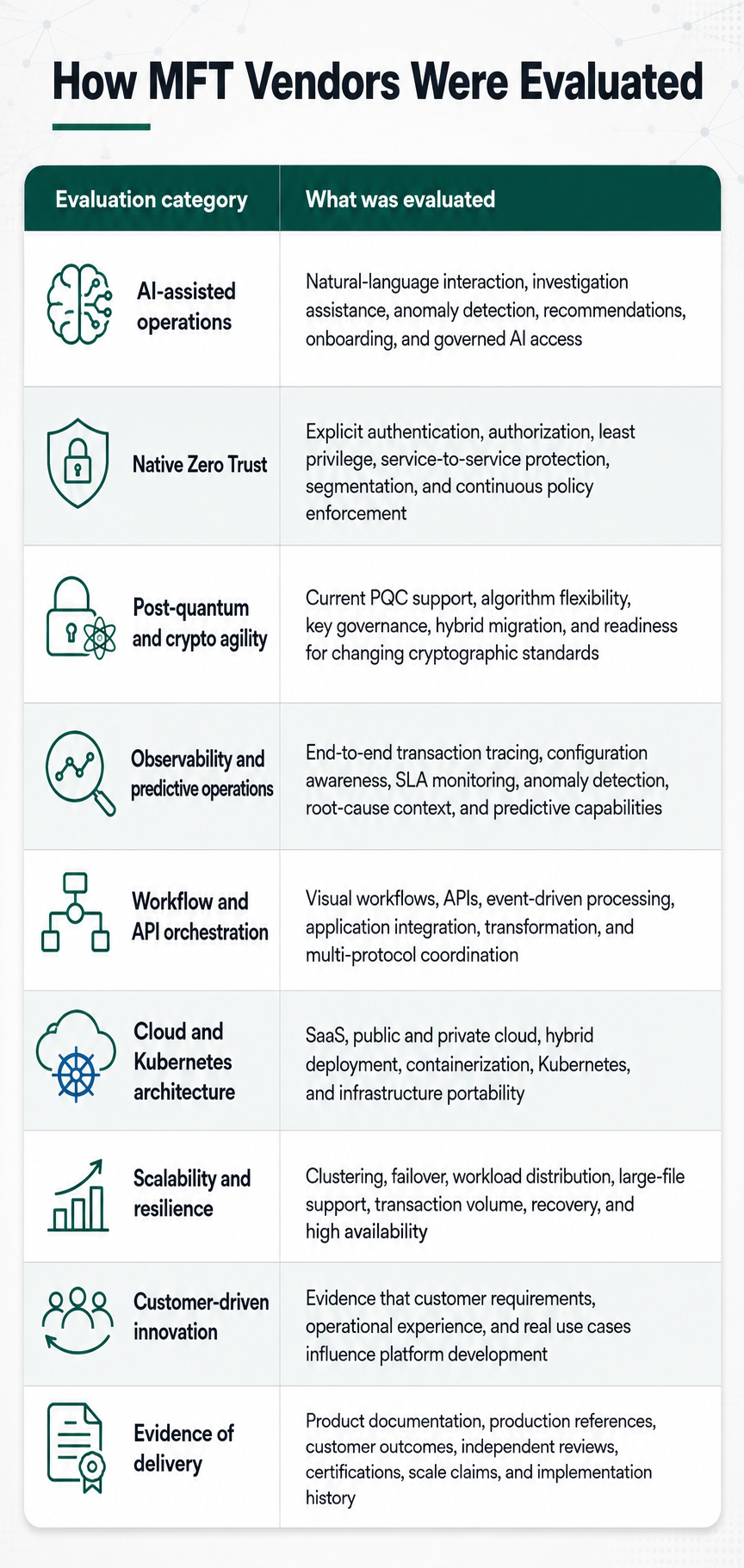
Public evidence was classified as:
- Strong: The vendor clearly documents a generally available product capability or provides substantial evidence of production use.
- Developing: The vendor describes an emerging capability, roadmap direction, limited implementation, or capability delivered through an adjacent product.
- Limited public evidence: The reviewed official materials did not provide enough detail to verify the capability.
Limited public evidence does not necessarily mean the capability is absent. It means buyers should ask the vendor to demonstrate it.
MFT Vendor Comparison at a Glance
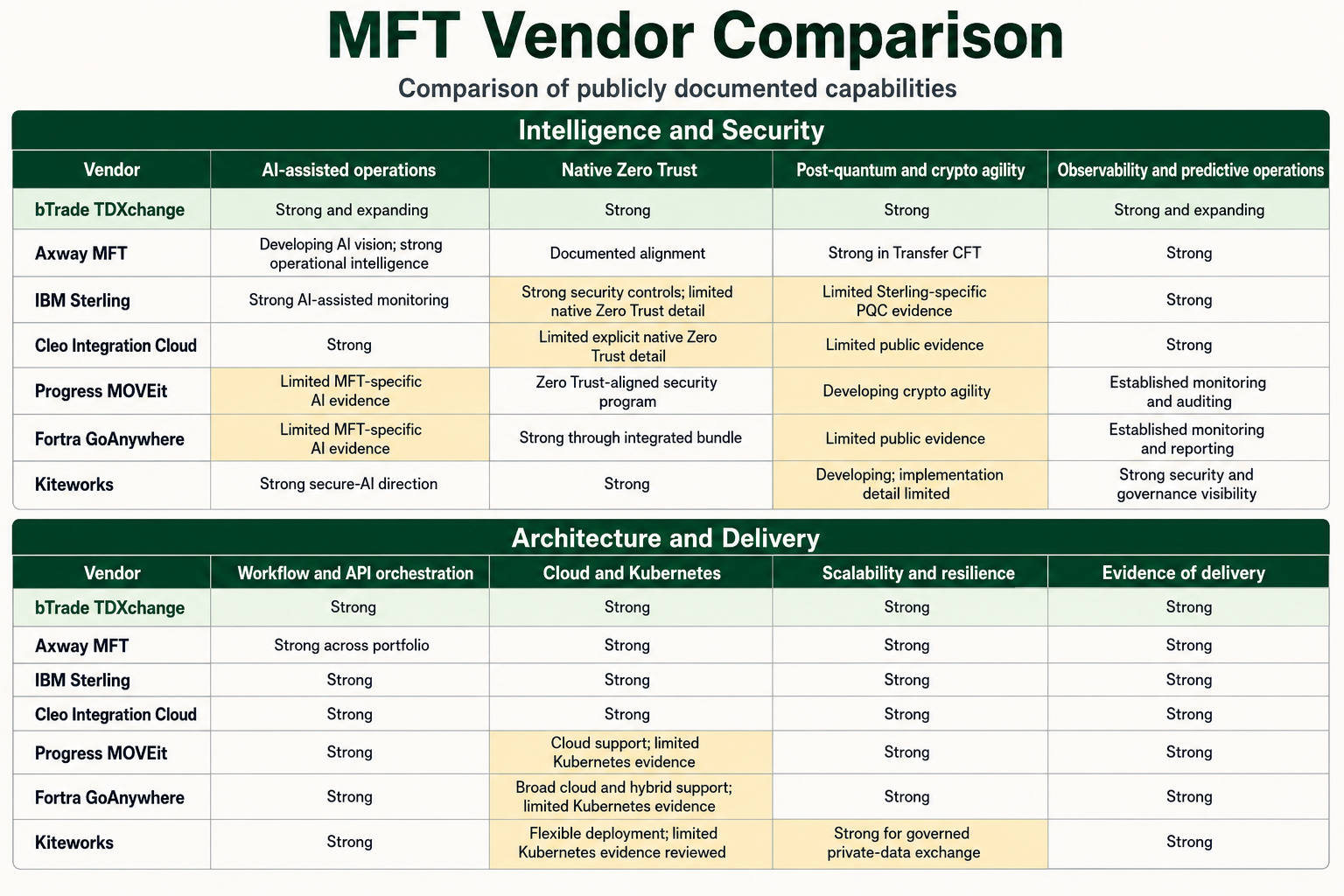
The table is intentionally compact. Important architectural distinctions appear in the detailed analysis below.
Which Vendor Has the Strongest AI-Assisted Operations Vision?
bTrade TDXchange
TDXchange is being developed around AI-assisted operational intelligence rather than a generic chatbot attached to an administration screen.
Publicly documented capabilities and direction include:
- Natural-language interaction
- Intelligent investigation of failures
- Anomaly detection across files, partners, users, and workflows
- Potential SLA-breach prediction
- Operational-event correlation
- Root-cause assistance
- Workflow optimization
- Operational recommendations
- Role-aware responses
- Customer-hosted and SaaS-based AI deployment options
The security model is an important differentiator. TDXchange’s AI architecture is designed to follow the platform’s existing RBAC and Zero Trust policies, limiting access to authorized operational information rather than granting an AI service unrestricted visibility into customer data.
Some of these capabilities represent an expanding roadmap rather than a claim that every AI function is currently autonomous. bTrade’s stated objective is governed assistance with human oversight, not turning production MFT administration over to an unsupervised robot having a particularly confident Tuesday.
Sources: TDXchange v5, AI Security and Governance in MFT, and AI-Driven Managed File Transfer.
Cleo Integration Cloud
Cleo demonstrates one of the market’s strongest currently documented AI positions.
Cleo states that AI is embedded across monitoring, mapping, onboarding, analytics, and exception management. Publicly described capabilities include:
- Natural-language questions about transactions, partners, errors, and SLAs
- Intelligent error classification
- Recommended resolutions
- Predictive anomaly detection
- Prescriptive action plans
- AI-assisted onboarding and mapping
- Business-process and supply-chain context
This is broader than traditional MFT administration because Cleo approaches the problem through supply chain orchestration spanning EDI, APIs, applications, files, and partner activity.
Sources: Cleo AI, Intelligent Exception Management, and Cleo Integration Cloud.
IBM Sterling
IBM Sterling Secure File Transfer documents AI-assisted monitoring of file activity, end-to-end visibility, governance, risk monitoring, and SLA improvement.
IBM’s broader AI portfolio is extensive, but buyers should distinguish capabilities embedded directly in Sterling Secure File Transfer from capabilities available through other IBM products and services.
Source: IBM Sterling Secure File Transfer.
Axway
Axway has articulated a substantial vision involving AI agents, intelligent routing, conversational analytics, content classification, predictive monitoring, and increasingly autonomous MFT operations.
Its current MFT portfolio already includes Operational Intelligence, predictive analytics, monitoring, and self-service. The public evidence is strongest for operational intelligence and strategic AI direction; buyers should confirm which generative and agentic capabilities are generally available in their specific Axway components.
Sources: Axway Managed File Transfer and The Evolution of MFT AI.
Kiteworks
Kiteworks is pursuing AI from a secure-data-access perspective. Its Secure MCP Server connects approved AI agents and clients with governed file and content operations while retaining policy enforcement and auditing.
This is a significant future-facing capability, although it differs from AI specifically designed to administer and troubleshoot an MFT environment.
Sources: Kiteworks Secure MCP Server and Securing AI Integrations.
Progress and Fortra
Progress has a broader portfolio of AI-driven products, but the reviewed public MOVEit materials provide limited evidence of AI-assisted MOVEit administration, anomaly analysis, or natural-language operations.
Fortra describes itself as an AI-amplified cybersecurity provider, but current GoAnywhere materials emphasize automation, security, workflows, integrations, and accelerated transfer rather than embedded MFT operational intelligence.
Both platforms remain highly capable in traditional automation. Buyers specifically seeking AI-assisted MFT operations should request demonstrations and product-specific roadmaps.
Which MFT Vendors Provide the Strongest Zero Trust Architecture?
Zero Trust is frequently used as a broad security description. A more useful evaluation asks where trust is actually removed.
bTrade TDXchange
TDXchange applies Zero Trust principles to:
- Administrators
- End users
- Applications
- Service accounts
- Trading partners
- APIs
- Workflows
- Internal platform services
- AI-assisted operations
The internal-service dimension is particularly important. TDXchange v5 requires authentication and authorization among internal components rather than assuming that communications inside the platform or network are inherently trusted.
The platform also combines:
- MFA
- SSO
- RBAC
- Least privilege
- Partner-specific policies
- Organizational isolation
- IP restrictions
- Secure edge architecture
- Auditing of identity and policy decisions
Source: TDXchange v5.
Kiteworks
Kiteworks demonstrates a strong content-centric Zero Trust position. Its approach emphasizes continuous control over private data, granular access, policy enforcement, monitoring, encryption, secure AI connections, and governance that follows information beyond the initial transfer.
This is especially relevant for organizations prioritizing controlled collaboration and private-content exchange.
Source: Kiteworks Zero Trust AI guidance.
Fortra GoAnywhere
Fortra offers a Zero Trust File Transfer bundle combining GoAnywhere MFT with access controls, malware scanning, encryption, monitoring, and persistent protection that can continue after a file is shared.
This is meaningful, but buyers should understand that the complete implementation involves an integrated bundle rather than only the core GoAnywhere MFT product.
Source: GoAnywhere Zero Trust File Transfer.
Axway, IBM, and Progress
Axway provides extensive Zero Trust guidance and strong controls involving federation, auditability, least privilege, secure clients, proxy architecture, and hybrid security.
IBM Sterling provides DMZ-based proxy protection, encryption, authentication, risk monitoring, governance, and extensive enterprise security capabilities. Public materials reviewed for this comparison provide less detail about whether every internal Sterling service relationship follows a native Zero Trust model.
Progress describes a cybersecurity program based on Zero Trust and provides MFA, SSO, roles, authorization, WAF, gateway separation, encryption, auditability, DLP integration, and SIEM integration. Its public documentation focuses more on layered security and cyber resilience than internal service-to-service Zero Trust.
Sources: Axway Zero Trust and MFT, IBM Sterling Secure File Transfer, and MOVEit Cyber Resiliency Principles.
Which MFT Vendors Are Most Prepared for Post-Quantum Cryptography?
bTrade TDXchange
TDXchange v5 publicly documents NIST-approved quantum-safe protection for data at rest and in transit, supported by a crypto-agile architecture intended to accommodate changing algorithms and standards.
bTrade’s approach also recognizes that post-quantum migration involves more than encrypting a file. It affects:
- Key establishment
- Digital signatures
- Certificates
- Protocols
- APIs
- Internal services
- Datastores
- Partner interoperability
- Key and certificate governance
Source: TDXchange v5.
Axway Transfer CFT
Axway documents post-quantum cryptography support in Transfer CFT, along with cloud-native deployment, routing, monitoring, and Kafka integration.
That gives Axway one of the clearest public PQC positions among established MFT vendors. Buyers should still verify which protocols, connection types, algorithms, versions, and deployment models receive post-quantum protection.
Source: Transfer CFT as a Hybrid MFT File Hub.
Progress MOVEit
MOVEit uses AES-256, automatic key rotation, and an OpenSSL 3.0 foundation that Progress says is designed to adapt as cryptographic standards evolve, including future post-quantum requirements.
That demonstrates crypto-agility direction, but it should not be interpreted as current deployment of NIST post-quantum mechanisms within MOVEit transfer sessions.
Source: MOVEit Transfer.
Kiteworks
Kiteworks discusses quantum-resistant encryption and the importance of post-quantum migration. The reviewed public product materials provide less implementation detail about standardized algorithms, protected protocol layers, hybrid negotiation, or general availability.
Organizations considering Kiteworks for PQC should request an exact cryptographic architecture and supported-algorithm matrix.
IBM, Cleo, and Fortra
IBM has a broad enterprise quantum-safe portfolio, but the reviewed Sterling Secure File Transfer materials did not establish native PQC support in the MFT product.
Public Cleo and GoAnywhere materials reviewed for this article did not provide sufficient product-specific evidence of deployed standardized PQC capabilities.
This may change as standards, cryptographic libraries, and customer requirements evolve.
Which Vendors Offer the Strongest Observability and Predictive Operations?
Axway
Axway has one of the market’s most mature public observability stories.
Its MFT portfolio includes:
- End-to-end file tracking
- Workbench
- Operational Intelligence for MFT
- Predictive analytics
- Automated notifications
- Self-service operations
- SLA-oriented monitoring
- Centralized administration
Axway’s strength is the breadth of its operational tooling across a large, distributed MFT estate.
Source: Axway Managed File Transfer.
Cleo
Cleo provides strong business-process visibility across transactions, partner activity, SLAs, exceptions, EDI, APIs, MFT, and applications.
Its intelligent exception-management capabilities add anomaly detection, likely-cause analysis, consolidation of related errors, and guided resolution. That moves the platform beyond infrastructure monitoring toward operational and business context.
Source: Cleo Visibility and Business Insights.
bTrade TDXchange
TDXchange provides:
- End-to-end transaction histories
- Workflow-step visibility
- Configuration and administrative change tracking
- Identity and authorization context
- Partner-level visibility
- SLA monitoring
- Proactive alerts and escalation
- Content-level search where authorized
- SIEM and enterprise-observability integration
- AI-assisted anomaly detection and investigation
Its direction is to correlate transaction, workflow, security, configuration, partner, and infrastructure context so administrators can understand why a business process failed, not merely discover that a protocol session ended badly.
Sources: MFT Observability and TDXchange SLA Governance.
IBM
IBM Sterling provides AI-assisted monitoring, end-to-end visibility, governance, risk monitoring, and SLA-focused operational insight. Its enterprise scale and event-based architecture strengthen that position.
Progress, Fortra, and Kiteworks
MOVEit provides tamper-evident records, customizable reports, transfer alerts, recipient activity, auditing, and centralized visibility. Public evidence of predictive MFT operations is more limited.
GoAnywhere provides centralized monitoring, reporting, alerts, audit information, job history, and trend visibility. Its public positioning remains more focused on automation and security than predictive operations.
Kiteworks provides extensive auditing and governance across private-content exchange. Its visibility is especially strong for security, compliance, access, and data movement, while its public MFT-specific predictive-operations evidence is more limited than Cleo, Axway, or bTrade.
Which Vendors Best Combine Files, APIs, and Workflow Orchestration?
Cleo
Cleo is particularly strong in this category because Cleo Integration Cloud connects:
- EDI
- APIs
- MFT
- Applications
- Partner ecosystems
- Data transformation
- Supply chain workflows
- Business-process visibility
Its platform can operate as both an API provider and API consumer while presenting integrated visibility across batch and real-time transactions.
Sources: Cleo API Integration and Cleo API Provider and Consumer Capabilities.
Axway
Axway combines MFT with a broader enterprise integration portfolio that includes API management, application integration, B2B integration, event streaming, and operational intelligence.
This breadth is valuable for large organizations already invested in Axway’s platform, although capabilities may span several products rather than one administration layer.
bTrade TDXchange
TDXchange combines:
- MFT
- REST and SOAP APIs
- Multi-protocol communication
- Event-driven workflows
- File and data validation
- Transformation
- Partner onboarding
- Cloud storage integration
- Scheduling
- Routing
- Approvals
- Notifications
- Retry and recovery
- Centralized governance
The platform’s direction is to coordinate files, APIs, applications, AI services, and partner interactions as governed enterprise data exchange workflows.
Source: TDXchange.
Fortra GoAnywhere
GoAnywhere provides mature visual workflow automation, commands, REST APIs, reusable projects, cloud connectors, key administration, job control, and a connector marketplace. It is a strong option for organizations prioritizing low-code file-transfer automation and broad application connectivity.
Sources: GoAnywhere Commands and APIs and GoAnywhere Cloud Connectors.
IBM and Progress
IBM Sterling provides REST APIs, B2B integration, secure gateways, event-based processing, partner management, and extensive enterprise connectivity.
MOVEit offers REST APIs and low-code workflow automation with branching logic, scheduling, cloud endpoints, and connection to third-party FTP and SFTP systems.
Kiteworks provides visual workflows and a library of approximately 2,000 connectors and workflow functions, with an emphasis on governed private-data exchange.
Source: Kiteworks MFT.
Which MFT Vendors Have the Strongest Cloud and Kubernetes Architecture?
Deployment flexibility involves more than confirming that a vendor supports the cloud.
Organizations should determine whether the same MFT platform can operate across on-premises, private cloud, public cloud, hybrid, multi-cloud, and containerized environments while maintaining consistent security, administration, governance, automation, and operational visibility.
Buyers should also evaluate how easily the platform can expand as migrations and business requirements evolve:
- Can the same platform operate on-premises, in the cloud, and across hybrid environments?
- Are cloud and on-premises capabilities delivered through the same product and operating model?
- Can features, protocols, integrations, trading partners, and capacity be added as migration phases are completed?
- Does expansion require a new product edition, platform migration, or reimplementation?
- Can established workflows, configurations, security policies, and audit histories be preserved as the environment grows?
- Who is responsible for managing the infrastructure under each deployment model?
These questions help distinguish genuine deployment and growth flexibility from a product that can simply be installed on a virtual machine hosted in the cloud.
bTrade TDXchange
TDXchange supports:
- On-premises deployment
- Public and private cloud
- Hybrid deployment
- Containerized environments
- Kubernetes
- Multi-node clustering
- Multi-tenancy
- Delegated administration
- Customer-managed or bTrade-managed deployment models
- License-driven growth that allows organizations to begin with the capabilities, protocols, integrations, trading partners, and capacity required for the initial deployment, then expand the same platform as migrations progress and business requirements grow
This model allows organizations to migrate applications and trading partners in phases while preserving established workflows, configurations, security policies, governance, and operational visibility. Additional capabilities and capacity can be enabled without replacing the underlying platform or redesigning the existing implementation.
Kubernetes is combined with MFT-level clustering and transaction-state coordination. This distinction matters because restarting a container is not the same thing as recovering an interrupted business transaction.
Sources: Modern MFT Architecture and Scaling MFT with Kubernetes.
Axway
Axway supports on-premises, private cloud, public cloud, hybrid environments, managed cloud services, containers, and Kubernetes deployment for relevant MFT components.
Its managed cloud service provides tiered availability commitments up to 99.99%, while its containerization strategy is intended to simplify deployment, updates, automation, and scaling.
Sources: Axway MFT Cloud Services and Axway MFT Containerization.
IBM
IBM provides certified containers for Sterling B2B Integrator and Sterling File Gateway, including Kubernetes-based deployment. IBM also offers extensive hybrid-cloud infrastructure and related integration services.
Sources: IBM Sterling container installation and IBM Sterling Secure File Transfer.
Cleo
Cleo supports public and private cloud deployment, and Cleo Harmony supports containerized Kubernetes deployment. Cleo’s primary differentiation remains its cloud integration and orchestration model.
Source: Cleo Harmony Containerization.
Progress, Fortra, and Kiteworks
MOVEit can run on Windows Server on-premises, in a customer cloud, or as MOVEit Cloud hosted in Microsoft Azure. It provides strong cloud choice but limited public evidence of a Kubernetes-native MOVEit architecture.
GoAnywhere supports cloud, on-premises, hybrid, and managed-service deployment. The reviewed public platform documentation did not establish a Kubernetes-native deployment model.
Kiteworks supports cloud and on-premises deployment models. Buyers requiring Kubernetes should confirm product-specific container orchestration support and operational responsibility.
Which Vendors Demonstrate the Strongest Scalability and Resilience?
IBM
IBM publicly positions Sterling Secure File Transfer to move more than one million files per day. It supports event-based architecture, high availability, large files, growing trading-partner environments, and file movement without product-defined size or volume limits.
This represents strong evidence of large-enterprise delivery.
Source: IBM Sterling Secure File Transfer.
Axway
Axway states that more than 2,500 organizations use its MFT technology to transfer trillions of files. Its portfolio includes distributed peer-to-peer transfer, large-scale deployment, managed cloud availability up to 99.99%, centralized control, and predictive operational capabilities.
Source: Axway Managed File Transfer.
bTrade TDXchange
TDXchange supports:
- Active-active and active-passive clustering
- Multi-node workload distribution
- Automated failover
- Queue persistence
- Recovery of interrupted transactions
- High-volume processing
- Millions of files per day
- Large-file acceleration through AFTP
- Multi-data-center architecture
- Hybrid and Kubernetes deployment
- Maintenance without complete service interruption
bTrade also documents a financial-services deployment processing more than 2,000,000 transfers per day across a four-node active-active architecture.
Sources: High-Volume MFT Architecture and bTrade MFT Glossary.
Progress
MOVEit supports active-active web-farm deployment, active-passive disaster recovery, multi-tenancy, high-volume transfer, on-premises deployment, private cloud, and managed cloud.
Fortra
GoAnywhere supports clustering, load balancing, automated recovery, large files, multiple platforms, and accelerated transfers through FileCatalyst. Fortra states that FileCatalyst can support transfer rates of up to 10 Gbps, subject to infrastructure and network conditions.
Source: GoAnywhere MFT.
Cleo and Kiteworks
Cleo demonstrates scalable orchestration across partner ecosystems, EDI, APIs, applications, and MFT, with customer outcomes documented across large supply-chain environments.
Kiteworks emphasizes scalable private-data exchange, centralized governance, resilient workflows, connectors, compliance, and controlled external collaboration.
How Does Customer-Driven Innovation Affect an MFT Vendor’s Future?
Product vision should not be evaluated only by counting emerging technologies.
A vendor can mention AI, Zero Trust, quantum computing, and Kubernetes in one paragraph and still fail to solve the customer’s actual problem.
Customer-driven innovation considers:
- How customer requirements enter the roadmap
- Whether product leaders work directly with customers
- Whether the vendor supports complex architecture design
- Whether features address operational rather than theoretical problems
- Whether migration and implementation expertise are available
- Whether customers influence security, usability, governance, and automation
- Whether the vendor can provide long-term continuity
Cleo demonstrates customer outcomes and a strong orientation toward supply-chain processes and partner ecosystems.
Axway and IBM bring extensive global-enterprise experience and large installed bases that influence their product portfolios.
Progress and Fortra have mature user communities, partner networks, customer references, and established MFT ecosystems.
Kiteworks has built its strategy around the security, governance, and compliance challenges surrounding private-content exchange.
At bTrade, customer-driven innovation has shaped capabilities including:
- Multi-tenancy
- Delegated administration
- High-volume transaction processing
- Accelerated File Transfer Protocol
- Maintenance windows
- Enterprise SLA monitoring
- Configuration-change visibility
- Secure content-level search
- Zero Trust architecture
- Post-quantum protection
- AI-assisted operations
Many of those capabilities originated through direct work with organizations operating complex, highly regulated, and mission-critical data exchange environments.
This approach forms Pillar 6 of bTrade’s Enterprise Data Exchange strategy: Customer-Driven Innovation, Delegated Self-Service, and Human-Centered Enterprise Data Exchange.
Which MFT Vendor Has the Strongest Overall Vision?
There is no honest universal answer.
The best choice depends on what an organization means by “the future.”
Consider Axway when:
- A broad, mature enterprise MFT portfolio is required
- The environment includes extensive distributed infrastructure
- Operational intelligence and centralized management are priorities
- The organization wants containerized and managed-cloud options
- Transfer CFT’s documented post-quantum capabilities align with the use case
Consider IBM Sterling when:
- Proven enterprise scale is the primary requirement
- The organization already operates within the IBM ecosystem
- B2B integration, gateways, partner management, and MFT must work together
- AI-assisted monitoring and certified container deployment are important
- Complex global infrastructure requires mature high availability
Consider Cleo when:
- MFT is part of a broader EDI, API, application, and supply-chain orchestration strategy
- AI-assisted exception management is a major priority
- Business-process visibility is more important than protocol-level monitoring
- Trading-partner integration and onboarding drive the project
Consider Progress MOVEit when:
- Secure, auditable MFT and straightforward workflow automation are the primary requirements
- Windows and Azure align with the organization’s infrastructure strategy
- REST APIs, cloud endpoints, auditing, and conventional high availability are sufficient
- The organization prioritizes an established and widely adopted MFT platform
Consider Fortra GoAnywhere when:
- Low-code file-transfer automation is important
- Broad connectors and reusable workflows are required
- FileCatalyst acceleration is needed for large-file movement
- The organization wants to combine GoAnywhere with other Fortra security products
- Flexible cloud, hybrid, managed-service, and on-premises deployment is needed
Consider Kiteworks when:
- Security and compliance around private-data exchange are the primary drivers
- Content-centric Zero Trust is required
- Secure AI access and governed AI file operations are strategic priorities
- MFT, secure collaboration, email protection, and content governance must be coordinated
Consider bTrade TDXchange when:
- MFT is being modernized into a broader enterprise data exchange platform
- Native End-to-End Zero Trust Architecture across all platform components
- Post-quantum protection and cryptographic agility are immediate architectural priorities
- AI-assisted operations must follow existing RBAC and data-access policies
- End-to-end observability must include transactions, workflows, identities, partners, changes, and SLAs
- On-premises, cloud, hybrid, clustering, and Kubernetes must share one operating model
- Large files, millions of daily transactions, APIs, and complex workflows must coexist
- Multi-tenancy, delegated administration, and customer-driven development are important
- The organization wants direct access to experienced MFT architects rather than becoming the proud owner of another support ticket number
Questions Organizations Should Ask Every MFT Vendor
Marketing language is useful for discovering possibilities. Architecture reviews and demonstrations determine whether those possibilities exist in the required version and deployment model.
Ask every vendor:
- Which AI capabilities are generally available today?
- Which capabilities remain on the roadmap?
- Can the AI access file contents, metadata, credentials, or configuration?
- Does AI access follow the user’s existing RBAC permissions?
- Are AI prompts, responses, recommendations, and actions audited?
- Is customer information sent to an external model?
- Does Zero Trust apply only to users and endpoints, or also to internal platform services?
- Which post-quantum algorithms are implemented?
- Which protocols, datastores, APIs, and internal services receive post-quantum protection?
- Can the platform operate in classical, hybrid, and post-quantum modes?
- Can it trace a transaction through downstream processing and acknowledgment?
- Can it correlate failures with recent configuration changes?
- Can it detect abnormal behavior and predict SLA risk?
- Are APIs used only for administration, or can they participate in governed business workflows?
- Is Kubernetes officially supported in production?
- How does the product preserve transaction state when a container or node fails?
- What transaction volumes have been demonstrated under conditions similar to ours?
- Can the vendor provide production references for comparable workloads?
- Which customer requests materially changed the product during the last two years?
- What evidence proves that the roadmap is being delivered?
The answers should be specific. “We use AI,” “we support Zero Trust,” and “we are quantum ready” are conversation starters, not architecture documents.
The Bottom Line
The MFT market is dividing into two broad groups.
The first group continues to improve secure file transfer through better automation, cloud delivery, reporting, and integration.
The second is transforming MFT into an intelligent enterprise data exchange layer that governs files, APIs, applications, AI services, workflows, infrastructure, users, and partners as one connected environment.
Several vendors are moving in that direction, but from different starting points.
Axway brings portfolio breadth and operational maturity.
IBM brings scale and enterprise depth.
Cleo brings AI-native integration and supply-chain orchestration.
Progress brings mature, secure, and accessible MFT.
Fortra brings strong automation, connectivity, and accelerated transfer.
Kiteworks brings a security-first private-data exchange model.
bTrade brings an architecture designed to unify Zero Trust, post-quantum cryptography, AI-assisted operations, observability, Kubernetes, high-volume processing, accelerated transfer, APIs, and customer-driven innovation.
The future will not be defined by the vendor with the longest feature list.
It will be defined by platforms that can adapt as threats, cryptography, infrastructure, integration patterns, and operational requirements change—without forcing customers to rebuild their data exchange environment every few years.
That is the real measure of a future-ready MFT platform.
To explore bTrade’s complete strategy, read The Future of Enterprise Data Exchange: AI, Zero Trust, Quantum-Safe Security, and the Evolution of Managed File Transfer.
About the Author
Hanz Jorgensen is Chief Operating Officer and Managing Member at bTrade, where he oversees daily operations and works closely with the leadership team to shape and execute the company’s strategic direction. With more than 20 years of experience with several different MFT/technology companies spanning system administration, development, customer support, pre-sales, and enterprise solution delivery, Hanz brings a uniquely practical perspective on what organizations actually need from managed file transfer platforms. He leads bTrade’s Solution Consulting team and plays a central role in aligning product capabilities with real customer requirements across regulated and high-complexity environments.
Frequently Asked Questions
Which MFT vendor has the strongest vision for the future?
No single vendor leads every category. Axway, IBM, Cleo, Progress, Fortra, Kiteworks, and bTrade each demonstrate different strengths. Organizations should evaluate AI operations, Zero Trust, post-quantum support, observability, orchestration, cloud architecture, scalability, ease of operation, and evidence of delivery against their specific requirements.
Which MFT vendors currently provide AI-assisted operations?
Cleo publicly documents embedded AI for monitoring, onboarding, mapping, analytics, anomaly detection, and exception management. IBM Sterling documents AI-assisted file-activity monitoring. bTrade is expanding TDXchange around governed natural-language operations, anomaly detection, investigation assistance, SLA prediction, and operational recommendations. Axway has documented operational intelligence and a broader agentic AI direction.
Which MFT vendors support post-quantum cryptography?
bTrade documents NIST-approved quantum-safe protection in TDXchange v5 for data at rest and in transit. Axway documents post-quantum support in Transfer CFT. Progress documents a crypto-agile OpenSSL foundation intended to support future post-quantum requirements. Buyers should verify exact algorithms, protocols, versions, and deployment requirements directly with each vendor.
What does native Zero Trust mean in MFT?
Native Zero Trust means the platform does not grant implicit trust based on network location or internal status. It explicitly authenticates and authorizes users, administrators, applications, services, APIs, partners, workflows, and internal platform components while enforcing least privilege and retaining evidence of access decisions.
Which MFT platforms support Kubernetes?
Public materials document Kubernetes or certified-container support for bTrade TDXchange, relevant Axway MFT components, IBM Sterling B2B Integrator and File Gateway, and Cleo Harmony. Organizations should confirm the supported version, topology, storage model, upgrade process, transaction-state handling, and production support terms.
How is MFT observability different from monitoring?
Monitoring detects known conditions such as transfer failures, missed schedules, or unavailable services. Observability correlates transactions, workflows, identities, configurations, partners, infrastructure, security events, and business outcomes to explain what happened, why it happened, and what was affected.
Should MFT buyers trust vendor roadmap claims?
Roadmaps are useful indicators of direction, but they are not substitutes for delivered functionality. Buyers should separate generally available capabilities, preview functionality, roadmap items, adjacent portfolio integrations, and conceptual thought leadership.
What evidence should an MFT vendor provide?
A vendor should provide product documentation, architecture diagrams, supported-version matrices, security certifications, performance results, high-availability designs, customer references, implementation examples, release histories, roadmap evidence, and demonstrations using workflows comparable to the buyer’s environment.
Why is customer-driven innovation important in MFT?
MFT supports business-critical workflows that vary considerably among industries and organizations. Customer-driven development helps ensure that new capabilities solve real operational, security, integration, governance, and usability problems rather than simply adding fashionable technology labels.
How does TDXchange differ from traditional MFT platforms?
TDXchange combines multi-protocol MFT, APIs, workflows, accelerated transfer, native internal Zero Trust, post-quantum protection, end-to-end observability, AI-assisted operations, multi-tenancy, delegated administration, clustering, and Kubernetes deployment within one enterprise data exchange architecture.
<script type="application/ld+json">
{
  "@context": "https://schema.org",
  "@graph": [
    {
      "@type": "Organization",
      "@id": "https://www.btrade.com/#organization",
      "name": "bTrade",
      "url": "https://www.btrade.com/",
      "logo": {
        "@type": "ImageObject",
        "@id": "https://www.btrade.com/#logo",
        "url": "https://cdn.prod.website-files.com/66a7f3a6c2fca5ac33297031/66a7f3a6c2fca5ac3329719f_btrade-logo.svg",
        "contentUrl": "https://cdn.prod.website-files.com/66a7f3a6c2fca5ac33297031/66a7f3a6c2fca5ac3329719f_btrade-logo.svg",
        "caption": "bTrade"
      },
      "sameAs": [
        "https://www.linkedin.com/company/btrade/"
      ]
    },
    {
      "@type": "WebSite",
      "@id": "https://www.btrade.com/#website",
      "url": "https://www.btrade.com/",
      "name": "bTrade",
      "publisher": {
        "@id": "https://www.btrade.com/#organization"
      },
      "inLanguage": "en-US"
    },
    {
      "@type": "Person",
      "@id": "https://www.btrade.com/#hanz-jorgensen",
      "name": "Hanz Jorgensen",
      "url": "https://www.linkedin.com/in/hanzjorgensen/",
      "sameAs": [
        "https://www.linkedin.com/in/hanzjorgensen/"
      ],
      "jobTitle": "Chief Operating Officer and Managing Member",
      "worksFor": {
        "@id": "https://www.btrade.com/#organization"
      },
      "description": "Hanz Jorgensen is Chief Operating Officer and Managing Member at bTrade. He has more than 20 years of experience across Managed File Transfer and enterprise technology, including system administration, development, customer support, pre-sales, and enterprise solution delivery."
    },
    {
      "@type": "ImageObject",
      "@id": "https://www.btrade.com/blogs/mft-vendor-comparison-future-vision-2026-2027#primaryimage",
      "url": "https://cdn.prod.website-files.com/66a7f3a6c2fca5ac33297043/6a8b68ae5c88ac6c3b34b16f_Future%20of%20MFT%20Resized.png",
      "contentUrl": "https://cdn.prod.website-files.com/66a7f3a6c2fca5ac33297043/6a8b68ae5c88ac6c3b34b16f_Future%20of%20MFT%20Resized.png",
      "caption": "MFT Vendor Comparison 2026–2027: Future-Ready Platforms"
    },
    {
      "@type": "BreadcrumbList",
      "@id": "https://www.btrade.com/blogs/mft-vendor-comparison-future-vision-2026-2027#breadcrumb",
      "itemListElement": [
        {
          "@type": "ListItem",
          "position": 1,
          "name": "Home",
          "item": "https://www.btrade.com/"
        },
        {
          "@type": "ListItem",
          "position": 2,
          "name": "Blogs",
          "item": "https://www.btrade.com/blogs"
        },
        {
          "@type": "ListItem",
          "position": 3,
          "name": "MFT Vendor Comparison 2026–2027",
          "item": "https://www.btrade.com/blogs/mft-vendor-comparison-future-vision-2026-2027"
        }
      ]
    },
    {
      "@type": "WebPage",
      "@id": "https://www.btrade.com/blogs/mft-vendor-comparison-future-vision-2026-2027#webpage",
      "url": "https://www.btrade.com/blogs/mft-vendor-comparison-future-vision-2026-2027",
      "name": "Which MFT Vendors Have the Strongest Vision for the Future? 2026–2027 Comparison",
      "description": "Compare leading MFT vendors across AI, Zero Trust, post-quantum security, observability, orchestration, cloud architecture, scalability, and delivery.",
      "datePublished": "2026-08-24T00:00:00-04:00",
      "dateModified": "2026-08-24T00:00:00-04:00",
      "isPartOf": {
        "@id": "https://www.btrade.com/#website"
      },
      "primaryImageOfPage": {
        "@id": "https://www.btrade.com/blogs/mft-vendor-comparison-future-vision-2026-2027#primaryimage"
      },
      "breadcrumb": {
        "@id": "https://www.btrade.com/blogs/mft-vendor-comparison-future-vision-2026-2027#breadcrumb"
      },
      "mainEntity": [
        {
          "@id": "https://www.btrade.com/blogs/mft-vendor-comparison-future-vision-2026-2027#article"
        },
        {
          "@id": "https://www.btrade.com/blogs/mft-vendor-comparison-future-vision-2026-2027#faq"
        }
      ],
      "inLanguage": "en-US"
    },
    {
      "@type": "BlogPosting",
      "@id": "https://www.btrade.com/blogs/mft-vendor-comparison-future-vision-2026-2027#article",
      "url": "https://www.btrade.com/blogs/mft-vendor-comparison-future-vision-2026-2027",
      "mainEntityOfPage": {
        "@id": "https://www.btrade.com/blogs/mft-vendor-comparison-future-vision-2026-2027#webpage"
      },
      "headline": "Which MFT Vendors Have the Strongest Vision for the Future? 2026–2027 Comparison",
      "alternativeHeadline": "MFT Vendor Comparison 2026–2027: Future-Ready Platforms",
      "description": "Compare leading MFT vendors across AI, Zero Trust, post-quantum security, observability, orchestration, cloud architecture, scalability, and delivery.",
      "image": {
        "@id": "https://www.btrade.com/blogs/mft-vendor-comparison-future-vision-2026-2027#primaryimage"
      },
      "dateCreated": "2026-08-24T00:00:00-04:00",
      "datePublished": "2026-08-24T00:00:00-04:00",
      "dateModified": "2026-08-24T00:00:00-04:00",
      "author": {
        "@id": "https://www.btrade.com/#hanz-jorgensen"
      },
      "publisher": {
        "@id": "https://www.btrade.com/#organization"
      },
      "isPartOf": {
        "@id": "https://www.btrade.com/#website"
      },
      "articleSection": [
        "Managed File Transfer",
        "MFT Vendor Comparison",
        "Enterprise Data Exchange",
        "Artificial Intelligence",
        "Zero Trust Security",
        "Post-Quantum Cryptography",
        "Enterprise Observability",
        "Cloud Architecture"
      ],
      "keywords": [
        "MFT vendor comparison",
        "Managed File Transfer vendors",
        "best MFT platform 2026",
        "future-ready MFT",
        "enterprise Managed File Transfer",
        "AI-assisted MFT operations",
        "Zero Trust MFT",
        "post-quantum MFT security",
        "MFT observability",
        "Kubernetes MFT",
        "cloud MFT architecture",
        "MFT scalability",
        "enterprise data exchange",
        "TDXchange",
        "Axway",
        "IBM Sterling",
        "Cleo",
        "Progress MOVEit",
        "Fortra GoAnywhere",
        "Kiteworks"
      ],
      "about": [
        {
          "@type": "Thing",
          "name": "Managed File Transfer"
        },
        {
          "@type": "Thing",
          "name": "Enterprise Data Exchange"
        },
        {
          "@type": "Thing",
          "name": "Zero Trust Architecture"
        },
        {
          "@type": "Thing",
          "name": "Post-Quantum Cryptography"
        },
        {
          "@type": "Thing",
          "name": "Enterprise Observability"
        },
        {
          "@type": "Thing",
          "name": "Artificial Intelligence"
        }
      ],
      "mentions": [
        {
          "@type": "SoftwareApplication",
          "name": "TDXchange",
          "applicationCategory": "Managed File Transfer"
        },
        {
          "@type": "Organization",
          "name": "Axway"
        },
        {
          "@type": "Organization",
          "name": "IBM"
        },
        {
          "@type": "Organization",
          "name": "Cleo"
        },
        {
          "@type": "Organization",
          "name": "Progress"
        },
        {
          "@type": "Organization",
          "name": "Fortra"
        },
        {
          "@type": "Organization",
          "name": "Kiteworks"
        }
      ],
      "inLanguage": "en-US"
    },
    {
      "@type": "FAQPage",
      "@id": "https://www.btrade.com/blogs/mft-vendor-comparison-future-vision-2026-2027#faq",
      "url": "https://www.btrade.com/blogs/mft-vendor-comparison-future-vision-2026-2027#frequently-asked-questions",
      "isPartOf": {
        "@id": "https://www.btrade.com/blogs/mft-vendor-comparison-future-vision-2026-2027#webpage"
      },
      "mainEntity": [
        {
          "@type": "Question",
          "name": "Which MFT vendor has the strongest vision for the future?",
          "acceptedAnswer": {
            "@type": "Answer",
            "text": "No single vendor leads every category. Axway, IBM, Cleo, Progress, Fortra, Kiteworks, and bTrade each demonstrate different strengths. Organizations should evaluate AI operations, Zero Trust, post-quantum support, observability, orchestration, cloud architecture, scalability, ease of operation, and evidence of delivery against their specific requirements."
          }
        },
        {
          "@type": "Question",
          "name": "Which MFT vendors currently provide AI-assisted operations?",
          "acceptedAnswer": {
            "@type": "Answer",
            "text": "Cleo publicly documents embedded AI for monitoring, onboarding, mapping, analytics, anomaly detection, and exception management. IBM Sterling documents AI-assisted file-activity monitoring. bTrade is expanding TDXchange around governed natural-language operations, anomaly detection, investigation assistance, SLA prediction, and operational recommendations. Axway has documented operational intelligence and a broader agentic AI direction."
          }
        },
        {
          "@type": "Question",
          "name": "Which MFT vendors support post-quantum cryptography?",
          "acceptedAnswer": {
            "@type": "Answer",
            "text": "bTrade documents NIST-approved quantum-safe protection in TDXchange v5 for data at rest and in transit. Axway documents post-quantum support in Transfer CFT. Progress documents a crypto-agile OpenSSL foundation intended to support future post-quantum requirements. Buyers should verify exact algorithms, protocols, versions, and deployment requirements directly with each vendor."
          }
        },
        {
          "@type": "Question",
          "name": "What does native Zero Trust mean in MFT?",
          "acceptedAnswer": {
            "@type": "Answer",
            "text": "Native Zero Trust means the platform does not grant implicit trust based on network location or internal status. It explicitly authenticates and authorizes users, administrators, applications, services, APIs, partners, workflows, and internal platform components while enforcing least privilege and retaining evidence of access decisions."
          }
        },
        {
          "@type": "Question",
          "name": "Which MFT platforms support Kubernetes?",
          "acceptedAnswer": {
            "@type": "Answer",
            "text": "Public materials document Kubernetes or certified-container support for bTrade TDXchange, relevant Axway MFT components, IBM Sterling B2B Integrator and File Gateway, and Cleo Harmony. Organizations should confirm the supported version, topology, storage model, upgrade process, transaction-state handling, and production support terms."
          }
        },
        {
          "@type": "Question",
          "name": "How is MFT observability different from monitoring?",
          "acceptedAnswer": {
            "@type": "Answer",
            "text": "Monitoring detects known conditions such as transfer failures, missed schedules, or unavailable services. Observability correlates transactions, workflows, identities, configurations, partners, infrastructure, security events, and business outcomes to explain what happened, why it happened, and what was affected."
          }
        },
        {
          "@type": "Question",
          "name": "Should MFT buyers trust vendor roadmap claims?",
          "acceptedAnswer": {
            "@type": "Answer",
            "text": "Roadmaps are useful indicators of direction, but they are not substitutes for delivered functionality. Buyers should separate generally available capabilities, preview functionality, roadmap items, adjacent portfolio integrations, and conceptual thought leadership."
          }
        },
        {
          "@type": "Question",
          "name": "What evidence should an MFT vendor provide?",
          "acceptedAnswer": {
            "@type": "Answer",
            "text": "A vendor should provide product documentation, architecture diagrams, supported-version matrices, security certifications, performance results, high-availability designs, customer references, implementation examples, release histories, roadmap evidence, and demonstrations using workflows comparable to the buyer's environment."
          }
        },
        {
          "@type": "Question",
          "name": "Why is customer-driven innovation important in MFT?",
          "acceptedAnswer": {
            "@type": "Answer",
            "text": "MFT supports business-critical workflows that vary considerably among industries and organizations. Customer-driven development helps ensure that new capabilities solve real operational, security, integration, governance, and usability problems rather than simply adding fashionable technology labels."
          }
        },
        {
          "@type": "Question",
          "name": "How does TDXchange differ from traditional MFT platforms?",
          "acceptedAnswer": {
            "@type": "Answer",
            "text": "TDXchange combines multi-protocol MFT, APIs, workflows, accelerated transfer, native internal Zero Trust, post-quantum protection, end-to-end observability, AI-assisted operations, multi-tenancy, delegated administration, clustering, and Kubernetes deployment within one enterprise data exchange architecture."
          }
        }
      ]
    }
  ]
}
</script>