
How AI, Operational Intelligence & Secure Automation Are Transforming Enterprise MFT and B2B Integration
What Is AI-Powered Managed File Transfer?
AI-powered Managed File Transfer (MFT) uses artificial intelligence to automate partner onboarding, optimize workflows, identify operational anomalies, improve troubleshooting, and provide predictive insights across enterprise data exchange environments.
Organizations use AI-powered MFT to:
- Reduce manual administration
- Accelerate partner onboarding
- Detect operational anomalies
- Improve visibility
- Automate workflows
- Strengthen security monitoring
Enterprise integration is entering one of the biggest transformations in decades.
For years, organizations relied on static workflows, manual onboarding, disconnected monitoring systems, ticket-driven operations, and fragmented automation to manage enterprise data exchange. While these approaches worked historically, they are becoming increasingly difficult to scale across modern environments involving:
- hybrid cloud
- Kubernetes
- APIs
- SaaS applications
- distributed ecosystems
- real-time operations
- growing cybersecurity risks
- increasing compliance requirements
At the same time, enterprises are under constant pressure to:
- onboard partners faster
- automate operations
- improve operational visibility
- reduce manual overhead
- strengthen security
- modernize legacy infrastructure
- support AI-driven operations
This is where intelligent Managed File Transfer (MFT), AI-driven automation, and modern B2B integration platforms are beginning to fundamentally transform enterprise operations.
At bTrade, we view AI not simply as another feature, but as a major operational evolution in how organizations manage:
- enterprise data exchange
- onboarding
- workflow automation
- operational intelligence
- anomaly detection
- cybersecurity
- compliance automation
TDXchange is evolving to help organizations build more intelligent, scalable, automated, and operationally aware enterprise integration environments.
In Summary
Modern enterprise integration platforms must do far more than move files or process EDI transactions.
Today’s organizations increasingly require:
- AI-driven operational intelligence
- intelligent automation
- centralized visibility
- anomaly detection
- onboarding automation
- hybrid cloud scalability
- delegated administration
- operational resiliency
- Zero Trust security
- future-ready cybersecurity
AI combined with modern Managed File Transfer and B2B integration platforms enables organizations to significantly reduce operational overhead while improving scalability, visibility, resiliency, compliance, and business agility.
At the same time, AI security and governance are becoming critically important. Organizations must ensure AI-driven enterprise integration does not expose sensitive customer data or create new operational risks.
Key Takeaways
- AI is transforming enterprise Managed File Transfer, B2B integration, and operational automation.
- Modern MFT platforms increasingly function as intelligent enterprise data exchange hubs.
- AI can significantly reduce manual onboarding, troubleshooting, and operational overhead.
- Hybrid cloud, APIs, EDI, and distributed ecosystems require more intelligent operational automation.
- Security and governance remain critical as AI-driven enterprise automation expands.
- TDXchange was designed with a security-first AI architecture to minimize customer risk.
- TDXchange supports both SaaS-based AI and customer-hosted AI deployment models.
- TDXchange’s AI architecture avoids transferring customer data to external AI systems.
- Zero Trust security and quantum-safe encryption remain foundational components of modern enterprise integration.
The Problem with Traditional B2B Integration
Many traditional enterprise integration environments still rely heavily on:
- manual onboarding
- ticket-driven operations
- custom scripts
- fragmented monitoring
- static EDI mappings
- siloed operational ownership
- disconnected automation tools
As organizations scale, these environments become increasingly difficult to manage.
Common enterprise challenges include:
- onboarding delays
- failed transfers
- troubleshooting complexity
- operational bottlenecks
- inconsistent governance
- compliance reporting gaps
- lack of visibility
- increasing operational overhead
Traditional integration models were never designed for today’s highly distributed and rapidly evolving enterprise ecosystems.
Modern organizations need more intelligent and operationally aware integration platforms.
What Is Intelligent Managed File Transfer & B2B Integration?
Intelligent enterprise integration combines:
- Managed File Transfer (MFT)
- EDI
- APIs
- workflow automation
- operational intelligence
- AI-driven analytics
- centralized governance
into a more scalable, secure, and automated enterprise platform.
Rather than simply moving files between systems, intelligent integration platforms help organizations:
- automate decision-making
- reduce manual intervention
- optimize workflows
- accelerate onboarding
- proactively identify issues
- improve operational visibility
- strengthen compliance and security
This transforms enterprise integration from a reactive operational process into a more intelligent and proactive operational platform.
How AI Is Transforming Enterprise MFT & B2B Integration
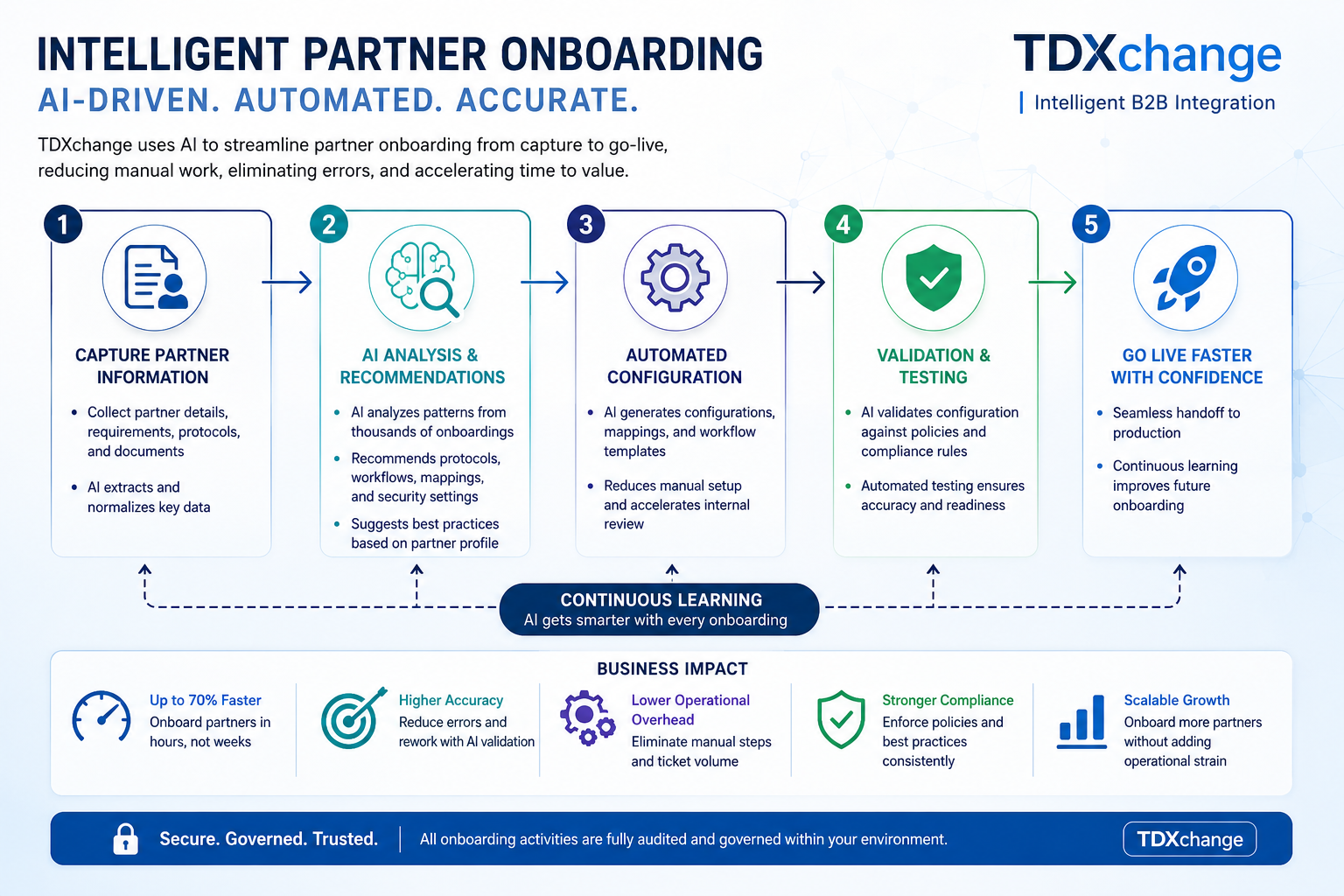
1. Intelligent Partner Onboarding
One of the biggest operational bottlenecks in enterprise integration environments is onboarding new trading partners.
Traditional onboarding often involves:
- manual configuration
- protocol setup
- certificate exchanges
- workflow mapping
- ticketing processes
- operational validation
- testing coordination
AI-driven onboarding capabilities can help automate many of these repetitive operational tasks by:
- identifying onboarding patterns
- recommending configuration templates
- simplifying mapping workflows
- validating configurations
- reducing repetitive setup tasks
At bTrade, we are actively introducing AI-driven functionality to help simplify:
- partner onboarding
- workflow creation
- migration activities
- operational configuration management
This helps organizations onboard partners faster while reducing operational overhead.
2. AI-Driven Operational Intelligence & Anomaly Detection
Traditional MFT operations are often highly reactive.
Operational teams frequently discover issues only after:
- transfers fail
- SLAs are missed
- workflows break
- partners report problems
AI-driven operational intelligence helps organizations proactively identify:
- unusual transfer behavior
- failed workflows
- abnormal operational activity
- security anomalies
- performance degradation
- capacity issues
before they become business-critical incidents.
This significantly improves:
- operational resiliency
- troubleshooting speed
- SLA management
- business continuity
- operational visibility
TDXchange is evolving to help enterprises move from reactive operational management toward more predictive and intelligent operations.

3. Workflow Optimization & Intelligent Automation
Modern enterprise integration environments increasingly involve:
- APIs
- EDI workflows
- SaaS applications
- cloud platforms
- external trading partners
- distributed automation pipelines
Managing these workflows manually becomes increasingly difficult as environments scale.
AI-driven workflow optimization can help organizations:
- automate repetitive operational tasks
- optimize routing decisions
- simplify orchestration
- improve scheduling efficiency
- identify workflow bottlenecks
- reduce manual intervention
TDXchange combines enterprise automation with centralized visibility and operational intelligence across distributed enterprise ecosystems.
Security-First AI Architecture
As AI adoption accelerates across enterprise software, security becomes one of the most important considerations.
At bTrade, we strongly believe AI should improve operational intelligence without introducing unnecessary risk to customer environments.
That’s why we designed our AI implementation with a security-first architecture focused on minimizing customer exposure and protecting sensitive enterprise data.
We are not only heavily testing each AI component for security, but we also designed the overall AI architecture to operate with the least possible risk to client environments.
Unlike many AI implementations that require transferring operational or business data into external AI systems, TDXchange’s AI model is designed so that the AI layer generates HQL-based operational queries which are then executed directly within the customer’s own environment.
This means:
- customer operational data remains within the customer environment
- sensitive enterprise data does not need to be transferred into external AI systems
- organizations maintain stronger governance and operational control
- AI-driven operational intelligence can be implemented with significantly reduced risk exposure
This architecture helps organizations balance:
- AI-driven operational efficiency
- enterprise governance
- cybersecurity requirements
- compliance obligations
- operational control
within highly regulated enterprise environments.
Flexible AI Deployment Models
Organizations have different operational, compliance, and security requirements.
To support varying enterprise deployment models, TDXchange supports two types of AI implementations:
- SaaS-based AI services
- customer-hosted AI deployments within the client’s own environment
This flexibility allows organizations to align AI deployment models with:
- regulatory requirements
- internal governance policies
- operational preferences
- cybersecurity strategies
- data residency requirements
For highly regulated industries, customer-hosted AI models can provide additional operational control and security assurance.
Intelligent Operational Visibility
One of the biggest enterprise integration challenges is lack of visibility across complex workflows.
Organizations frequently struggle to answer:
- Did the file arrive?
- Why did the workflow fail?
- Which partner is impacted?
- Where is the operational delay?
- Was the file modified?
- Which SLA is at risk?
Modern enterprise platforms increasingly require:
- centralized dashboards
- operational analytics
- transfer intelligence
- workflow monitoring
- predictive alerting
- AI-driven operational insights
TDXchange provides centralized visibility across:
- MFT workflows
- EDI operations
- API integrations
- partner ecosystems
- hybrid cloud environments
allowing organizations to manage enterprise operations more proactively.
Hybrid Cloud & Distributed Enterprise Integration
Modern enterprises rarely operate entirely within a single infrastructure.
Organizations increasingly manage enterprise integration across:
- on-prem systems
- public cloud
- private cloud
- Kubernetes
- SaaS applications
- APIs
- external partner ecosystems
Modern integration platforms must support:
- hybrid cloud architectures
- distributed operations
- centralized governance
- scalable automation
- operational visibility
- secure orchestration
TDXchange supports both traditional enterprise deployments and Kubernetes-based architectures depending on customer operational requirements.
Self-Service Operations & Delegated Administration
As enterprise ecosystems scale, centralized operations teams often become overloaded.
Modern enterprises increasingly require:
- delegated administration
- self-service onboarding
- distributed operational ownership
- role-based operational control
TDXchange supports true multi-tenant administration allowing enterprises to securely delegate operational access to:
- departments
- subsidiaries
- operational teams
- business units
- external partners
Authorized users can:
- onboard partners
- monitor workflows
- generate reports
- manage transfers
- review audit logs
- re-send failed transfers
without requiring direct involvement from centralized MFT administration teams.
This significantly improves operational scalability and business responsiveness.
Zero Trust Security & Quantum-Safe Readiness
As enterprise integration environments become more distributed and AI-driven, cybersecurity becomes even more critical.
Modern enterprise integration platforms must continue enforcing:
- Zero Trust security
- role-based access controls
- MFA
- encryption at rest
- encryption in transit
- malware scanning
- audit logging
- policy enforcement
- centralized governance
At bTrade, security remains foundational across all automation and AI-driven operational capabilities.
In addition, one of the most important emerging cybersecurity requirements is post-quantum security readiness.
Sensitive enterprise data exchanged today may still require protection years or decades into the future.
TDXchange supports:
- quantum-safe encryption
- cryptographic agility
- long-term confidentiality protection
- future cybersecurity readiness
helping organizations prepare for future “harvest now, decrypt later” cybersecurity threats associated with quantum computing advancements.
Why Experience Matters in Enterprise Integration
Many organizations underestimate the operational complexity of enterprise integration environments.
Real-world enterprise ecosystems involve:
- legacy systems
- regulatory requirements
- distributed ownership
- operational dependencies
- scaling challenges
- evolving cybersecurity risks
At bTrade, we’ve spent decades helping organizations design, modernize, secure, and scale mission-critical enterprise integration environments across highly regulated industries.
Hands-on operational experience matters when building platforms intended to support long-term enterprise operations.
Why Organizations Choose TDXchange
Organizations choose TDXchange because it combines:
- enterprise-grade Managed File Transfer
- AI-driven operational intelligence
- workflow automation
- centralized governance
- hybrid cloud readiness
- delegated administration
- operational visibility
- Zero Trust security
- quantum-safe encryption
- secure AI architecture
within a scalable enterprise integration platform.
Unlike many legacy integration environments that evolved through disconnected tools and scripts, TDXchange was designed to support modern enterprise operational requirements from the ground up.
bTrade has been building enterprise data exchange platforms since the early 1990s and continues evolving TDXchange to support the future of intelligent enterprise integration.
Final Thoughts
The future of enterprise integration is becoming increasingly:
- intelligent
- automated
- operationally aware
- AI-assisted
- distributed
- security-driven
Modern organizations need platforms capable of combining:
- Managed File Transfer
- EDI
- APIs
- AI-driven operations
- automation
- centralized governance
- cybersecurity
- hybrid cloud scalability
within a unified operational framework.
AI will not replace enterprise integration expertise, architecture design, operational governance, or cybersecurity discipline — but it will significantly improve how organizations automate and manage increasingly complex enterprise ecosystems.
Organizations that modernize enterprise integration early will be far better positioned to scale securely, efficiently, and resiliently in the years ahead.
About the Author
Andrei Olin is Chief Technology Officer at bTrade, where he leads product strategy, delivery, architecture, and security across the company’s B2B, Managed File Transfer, and secure data exchange platforms.
Andrei has more than 30 years of experience spanning enterprise architecture, software development, infrastructure, cybersecurity, middleware, trading systems, SaaS, and Managed File Transfer. His career includes building mission-critical systems and infrastructure at Bear Stearns and Morgan Stanley, designing and operating enterprise MFT and messaging platforms for Merrill Lynch and Deutsche Bank, and building and scaling SaaS and security products at startups. He holds master’s and bachelor’s degrees in Information Technology with a focus on Information Security.
Frequently Asked Questions (FAQ)
What is intelligent Managed File Transfer?
Intelligent Managed File Transfer combines secure file transfer, automation, AI-driven operational intelligence, centralized governance, and workflow automation into a more scalable enterprise integration platform.
How does AI improve enterprise MFT operations?
AI helps automate onboarding, anomaly detection, operational monitoring, workflow optimization, troubleshooting, and predictive operational analysis.
How does TDXchange secure its AI implementation?
TDXchange was designed with a security-first AI architecture that minimizes customer risk by generating HQL queries executed directly within the customer environment without transferring sensitive enterprise data into external AI systems.
Does TDXchange support customer-hosted AI?
Yes. TDXchange supports both SaaS-based AI services and customer-hosted AI deployment models depending on organizational security, governance, and compliance requirements.
Why is operational visibility important in enterprise integration?
Operational visibility helps organizations proactively monitor workflows, identify failures, improve SLA management, strengthen compliance, and reduce troubleshooting complexity.
What security capabilities should modern integration platforms support?
Modern integration platforms should support:
- Zero Trust security
- MFA
- encryption at rest
- encryption in transit
- malware scanning
- audit logging
- policy enforcement
- centralized governance
- quantum-safe encryption
What is quantum-safe encryption?
Quantum-safe encryption uses post-quantum cryptographic algorithms designed to resist future quantum computing attacks and protect long-term sensitive enterprise data.
Why do organizations choose TDXchange?
Organizations choose TDXchange because it combines enterprise-grade MFT, intelligent automation, centralized governance, operational visibility, hybrid cloud readiness, AI-driven operations, secure AI architecture, Zero Trust security, and quantum-safe encryption within a modern enterprise integration platform.