

Executive Summary
Partner onboarding is often one of the most expensive and time-consuming aspects of Managed File Transfer programs. Many organizations still rely on email exchanges, spreadsheets, ticketing systems, and manual configuration processes to onboard new customers, suppliers, vendors, and trading partners.
These manual processes create delays, increase operational costs, introduce security risks, and make it difficult to scale.
Modern MFT platforms are transforming onboarding through automation, workflow-driven approvals, delegated administration, self-service capabilities, and AI-assisted data collection. Organizations that modernize partner onboarding can significantly reduce onboarding times while improving governance, security, and operational efficiency.
Understanding why partner onboarding is complex, and how modern platforms like TDXchange address it, is essential for organizations looking to scale their file transfer infrastructure.
Key Takeaways:
- Partner Onboarding Complexity: Connecting external organizations to MFT platforms takes weeks or months due to coordination across security teams, network engineers, and compliance groups. The technical transfer itself takes seconds, but onboarding requires protocol configuration, certificate exchange, and multi-team validation.
- Biggest Bottleneck: Collecting partner requirements (certificates, endpoints, authentication methods, network details) through emails and spreadsheets causes the longest delays. Miscommunication about configurations, expired certificates, or missing security requirements triggers multiple clarification rounds extending timelines by days or weeks.
- Certificate Management Risks: AS2, HTTPS, and FTPS protocols require certificate generation, secure exchange, validation, and expiration monitoring. Manual certificate handling increases configuration errors and service interruption risks across partner ecosystems.
- Modern Platform Solutions: TDXchange transforms onboarding into structured workflows where partners enter protocol details, certificates, and security requirements directly into a centralized interface. AI-assisted analysis identifies certificate validity issues, protocol mismatches, and configuration conflicts before testing begins.
- Human Oversight Required: AI accelerates configuration analysis and flags potential risks, but MFT administrators must review partner requests, validate security parameters, and approve onboarding to ensure both efficiency and compliance in production environment.
What Is Partner Onboarding in Managed File Transfer?
Partner onboarding is the process of connecting external organizations to a secure file transfer environment. This includes configuring protocols, authentication methods, network access, security requirements, and operational workflows.
While transferring a file can take seconds, onboarding a new partner can take weeks or even months in many enterprises.
Why?
Because partner integrations involve coordination between multiple teams across multiple organizations.
The Typical MFT Partner Onboarding Process
In most organizations, onboarding follows a multi-step process involving both technical and operational teams.
A typical onboarding sequence may include:
- Business agreement and requirements definition
- Collecting partner requirements, certificates, and technical details
- protocol selection (SFTP, AS2, HTTPS, FTPS)
- endpoint addresses
- authentication methods
- IP allowlists and network details
- encryption requirements
- file formats and processing rules
- Security review and compliance checks
- Network and firewall configuration
- Transfer configuration and workflow setup
- Testing and validation
- Operational approval and production go-live
Each step typically involves several stakeholders:
- security teams
- network engineers
- integration engineers
- compliance teams
- application owners
Even small delays at any stage can significantly extend onboarding timelines.
Why Step #2 Is the Biggest Onboarding Bottleneck
In real-world environments, the largest delays usually occur during step #2: collecting partner requirements and technical details.
This phase sounds straightforward but is often the most complicated.
Information is frequently exchanged through:
- emails
- spreadsheets
- documentation files
- manual certificate exchanges
During this process organizations must gather and validate information such as:
- certificates and encryption keys
- endpoint configurations
- network access details
- authentication credentials
- file format specifications
- protocol compatibility
Because this information must come from two different organizations, miscommunication is common.
Examples include:
- incorrect endpoint configurations
- mismatched authentication methods
- expired or incompatible certificates
- missing security requirements
- incomplete operational parameters
Each issue can trigger multiple rounds of clarification, delaying onboarding by days or weeks.
As partner ecosystems grow, this manual coordination becomes increasingly difficult to manage.
The Certificate Management Challenge
One of the most common operational risks in partner onboarding is certificate handling.
Secure protocols such as AS2, HTTPS, and FTPS rely on certificates for authentication and encryption.
This introduces additional operational steps:
- certificate generation
- secure certificate exchange between partners
- validation of certificate chains
- monitoring expiration dates
- managing renewal cycles
In many environments, these processes remain manual, increasing the risk of configuration errors and service interruptions.
Why Testing Extends Onboarding Timelines
Once configurations are complete, onboarding moves into the testing phase.
Testing often includes:
- connectivity validation
- encryption verification
- file format validation
- workflow testing
- error handling validation
Because these tests require coordination between multiple organizations, scheduling and troubleshooting can significantly extend onboarding timelines.
In many cases, partner onboarding spends more time in testing and coordination than in the technical configuration itself.
The Need for Modern MFT Partner Onboarding Platforms
As organizations grow their partner ecosystems, manual onboarding processes quickly become unsustainable.
Without centralized tools and structured workflows, operations teams spend significant time on repetitive tasks such as:
- collecting partner configuration details
- validating certificates and authentication methods
- coordinating testing cycles
- tracking onboarding progress across teams
This is where modern Managed File Transfer platforms must evolve beyond basic file transfer capabilities.
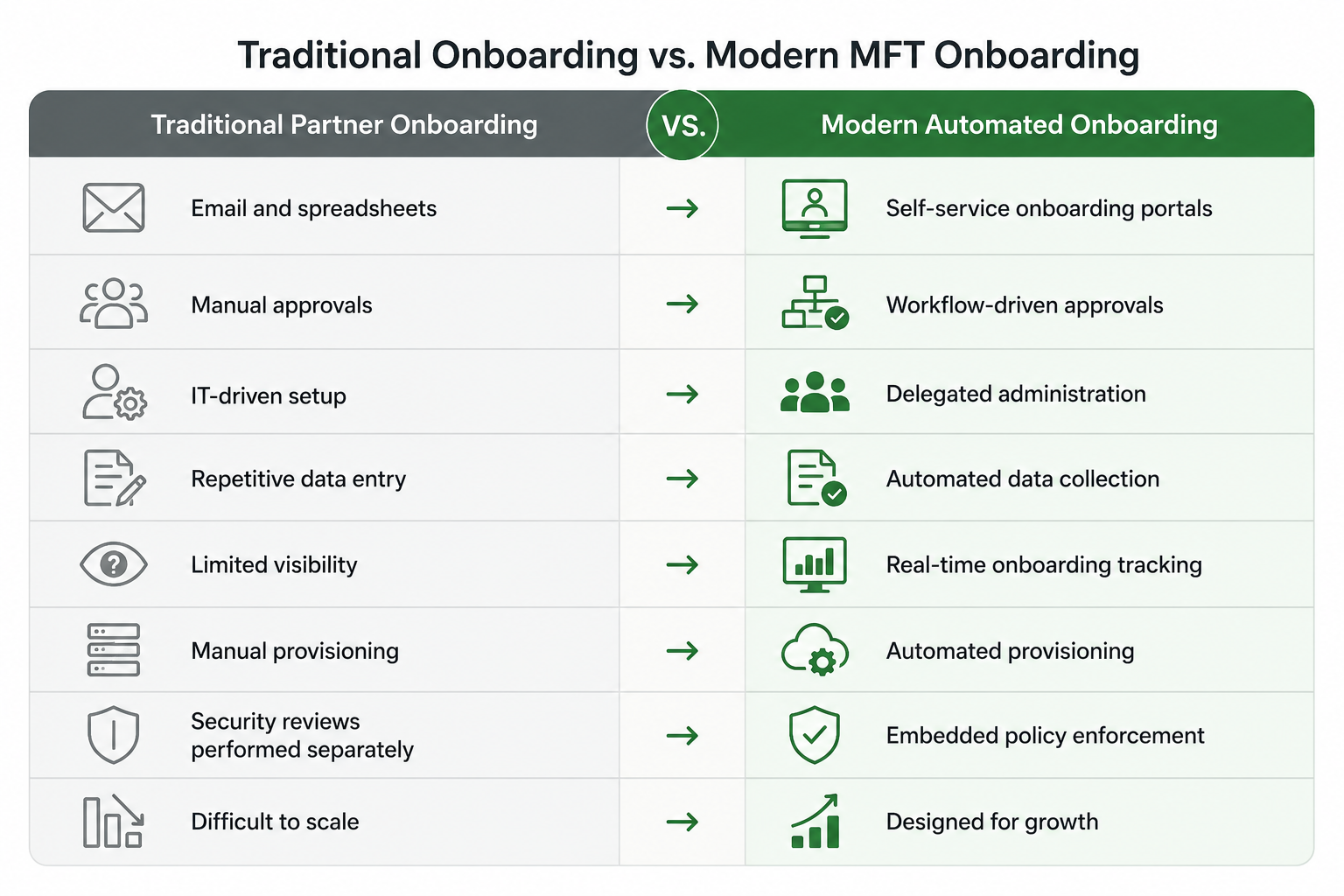
How TDXchange Is Evolving Partner Onboarding with Self-Service, Workflow Automation, and AI
To further simplify partner onboarding, bTrade is currently developing an Intelligent Partner Onboarding framework for TDXchange, targeted for release in Q4.
The goal is to reduce the manual effort traditionally associated with onboarding new customers, suppliers, vendors, and trading partners while maintaining governance, security, and compliance requirements.
Planned capabilities include:
- Self-Service Partner Onboarding: Allow partners and business users to initiate onboarding requests through a guided portal rather than relying on emails and spreadsheets.
- Workflow-Driven Approvals: Route onboarding requests through predefined approval workflows to streamline governance and reduce delays.
- Delegated Administration: Enable business units to manage portions of the onboarding process without requiring central IT involvement for every task.
- Policy-Based Provisioning: Automatically apply security controls, protocols, permissions, and onboarding standards based on organizational policies.
- Real-Time Onboarding Visibility: Provide administrators with insight into onboarding progress, bottlenecks, and pending actions.
- AI-Assisted Onboarding: Use natural language interactions to collect onboarding requirements, validate information, identify unusual security requests, and recommend configurations based on established onboarding patterns.
By combining automation, governance, and AI-assisted workflows, this planned enhancement aims to help organizations onboard partners faster while reducing operational overhead and maintaining security and compliance standards.
Using AI to Identify Onboarding Risks Early
One of the emerging capabilities in modern MFT platforms is AI-assisted onboarding analysis.
Once partner information is submitted, the system can analyze the configuration to identify potential issues before the transfer setup begins.
AI-assisted analysis can help detect:
- missing or inconsistent security requirements
- certificate validity or expiration risks
- protocol mismatches between partners
- incorrect authentication configurations
- network configuration conflicts
- operational risks that could impact reliability
This allows potential problems to be flagged early in the onboarding process instead of appearing later during testing or production operations.
Human Oversight Still Matters
While AI can accelerate analysis and highlight potential risks, human oversight remains critical.
After the system analyzes the partner configuration, the information and identified risks can be presented to an MFT administrator.
The administrator reviews the request, validates the security and operational parameters, and approves the onboarding process before configuration moves forward.
This approach combines automation, AI insights, and human expertise to ensure both efficiency and security.
Why Partner Onboarding Is Becoming a Strategic Priority
As organizations expand their partner ecosystems, onboarding speed increasingly impacts business agility.
Delays in onboarding can mean:
- Delayed revenue
- Delayed partner integration
- Increased operational costs
- Poor customer experiences
- Greater compliance risk
Organizations that automate onboarding gain a competitive advantage by enabling secure collaboration while maintaining governance and operational efficiency.
Platforms like TDXchange demonstrate how enterprise data exchange infrastructure is evolving beyond simple file transfer toward secure, scalable data movement platforms.
Final Thoughts
In enterprise data exchange, the hardest part is rarely transferring the file.
The real challenge is connecting organizations, aligning security requirements, and ensuring operational reliability before the first transfer ever occurs.
Organizations that modernize partner onboarding processes will gain faster integrations, improved security posture, and more scalable partner ecosystems.
Because in the world of enterprise file transfer, successful data movement begins long before the first file moves.
About the Author
Hanz Jorgensen is Chief Operating Officer and Managing Member at bTrade, where he oversees daily operations and works closely with the leadership team to shape and execute the company’s strategic direction. With more than 20 years of experience with several different MFT/technology companies spanning system administration, development, customer support, pre-sales, and enterprise solution delivery, Hanz brings a uniquely practical perspective on what organizations actually need from managed file transfer platforms. He leads bTrade’s Solution Consulting team and plays a central role in aligning product capabilities with real customer requirements across regulated and high-complexity environments.
Frequently Asked Questions:
What is partner onboarding in Managed File Transfer (MFT)?
Partner onboarding in Managed File Transfer (MFT) is the process of securely connecting an external organization to a file transfer platform. It includes configuring protocols such as SFTP or AS2, exchanging certificates, defining authentication methods, setting network access rules, and validating workflows to ensure secure and reliable data exchange between partners.
Why is partner onboarding in MFT often complex?
Partner onboarding is complex because it requires coordination between multiple teams across multiple organizations. Security teams, network engineers, and operations teams must validate authentication methods, certificates, firewall rules, and data handling policies before a transfer can begin. Even small configuration issues can delay onboarding by days or weeks.
What information is required to onboard a partner to an MFT platform?
Typical partner onboarding requires several technical and security details, including:
- Supported protocols (SFTP, AS2, HTTPS, FTPS)
- Endpoint addresses and network configuration
- Authentication methods and credentials
- Encryption and certificate information
- File format and processing requirements
- Operational parameters such as scheduling and retry rules
Collecting and validating this information is one of the most time-consuming parts of the onboarding process.
What are the most common challenges in MFT partner onboarding?
The most common challenges include:
- Incomplete or inconsistent technical requirements
- Certificate exchange and expiration management
- Firewall and network configuration delays
- Protocol compatibility issues between organizations
- Manual communication across multiple teams
- Extended testing and validation cycles
These challenges often make onboarding significantly slower than the actual file transfer process.
How can organizations automate MFT partner onboarding?
Organizations can automate partner onboarding by using modern MFT platforms that provide structured onboarding workflows. These platforms allow partners or internal teams to enter configuration details directly into the system, automate validation checks, and manage certificate lifecycle processes while providing centralized visibility into onboarding status.
How can AI improve partner onboarding in file transfer platforms?
AI can assist partner onboarding by analyzing submitted configuration details and identifying potential risks early in the process. For example, AI can highlight certificate issues, detect mismatched protocols, identify missing security requirements, or flag network configuration conflicts. This helps organizations resolve issues before testing or production deployment.
Does AI replace administrators in MFT onboarding?
No. AI is best used as a support tool that analyzes configuration data and highlights potential risks. Human administrators still review partner configurations, validate security requirements, and approve onboarding decisions to ensure operational reliability and compliance.
How does TDXchange simplify partner onboarding?
TDXchange simplifies partner onboarding by providing a centralized interface where users can submit all partner requirements directly into the system. The platform can analyze the submitted information, identify potential security or operational risks, and present the results to MFT administrators for review. This structured workflow reduces manual coordination and speeds up partner integrations.
Why is partner onboarding critical for enterprise data exchange?
Efficient partner onboarding allows organizations to scale their digital ecosystems. As companies exchange data with hundreds or thousands of partners, structured onboarding processes ensure secure connectivity, reduce operational delays, and improve the reliability of B2B data movement.