
Why Architecture Matters More Than a Feature Checklist
Throughout my career in enterprise technology, I have seen the same pattern repeatedly.
A platform may work perfectly well when it supports 20 trading partners, a few thousand daily transfers, and several straightforward workflows. Then the organization grows. File volumes increase. More business units need access. Applications move to the cloud. Partners require different protocols. Compliance requirements expand. Suddenly, the architecture that looked perfectly reasonable during implementation becomes the source of every operational headache.
That is when architecture stops being academic.
Modern Managed File Transfer architecture must do more than move files securely. It must support distributed infrastructure, hybrid cloud, high availability, workflow automation, centralized governance, operational visibility, delegated administration, and long-term scalability without becoming increasingly difficult to operate.
The protocols matter. The features matter. But the architecture determines whether those capabilities will continue working together when the environment becomes larger, more distributed, and considerably less forgiving.
Executive Summary
Modern Managed File Transfer architecture is the technical and operational foundation used to securely exchange, process, govern, monitor, and scale business-critical files across internal systems, cloud platforms, applications, users, and external trading partners.
A modern MFT architecture typically combines:
- Secure edge gateways and DMZ relay services
- Multiple secure transfer protocols
- Centralized workflow orchestration
- High availability and clustering
- Hybrid cloud and Kubernetes support
- Scalable databases and storage
- Identity integration and Zero Trust controls
- Encryption in transit and at rest
- Centralized auditing and observability
- SLA monitoring and automated recovery
- APIs and cloud application integrations
- Delegated administration and multi-tenancy
- Cryptographic agility and quantum-safe security
- AI-assisted operational intelligence
The objective is not merely to make file transfer work. The objective is to make enterprise data exchange secure, resilient, observable, scalable, and manageable over its entire operational lifecycle.
Key Takeaways
- Architecture determines how well an MFT platform scales, recovers, integrates, and remains manageable.
- Secure protocols alone do not provide centralized governance, automation, resiliency, or operational visibility.
- External-facing transfer services should be separated from internal processing systems through secure relay or proxy layers.
- High availability must address application services, databases, storage, networking, load balancing, and supporting infrastructure.
- Clustering and Kubernetes solve different architectural problems and can often be used together.
- File count, workflow complexity, database activity, storage performance, and partner behavior can be more important than total file size.
- Zero Trust must extend beyond user authentication to services, workflows, APIs, AI systems, and administrative operations.
- Observability should follow a file from ingestion through processing and final delivery.
- Ease of installation, configuration, patching, upgrading, and daily administration are architectural qualities—not cosmetic product features.
- The right architecture should reduce operational complexity as the environment grows, not increase it.
What Is Modern Managed File Transfer Architecture?
Modern MFT architecture is a centralized but potentially distributed framework for securely exchanging files and data across enterprise systems, cloud platforms, users, and external organizations.
It brings transfer protocols, automation, security, governance, monitoring, and administration together within one managed operational environment.
Traditional file transfer environments were frequently assembled from:
- Standalone FTP or SFTP servers
- Operating-system scripts
- Scheduled jobs
- Shared service accounts
- Locally managed encryption keys
- Separate monitoring tools
- Custom retry logic
- Manual partner onboarding
- Inconsistent logging
- Department-specific transfer products
Each component may work individually. The problem appears when hundreds or thousands of independent components must be secured, monitored, upgraded, audited, and supported together.
Modern MFT architecture replaces that fragmentation with centrally governed services and reusable workflows while still supporting distributed deployment where required.
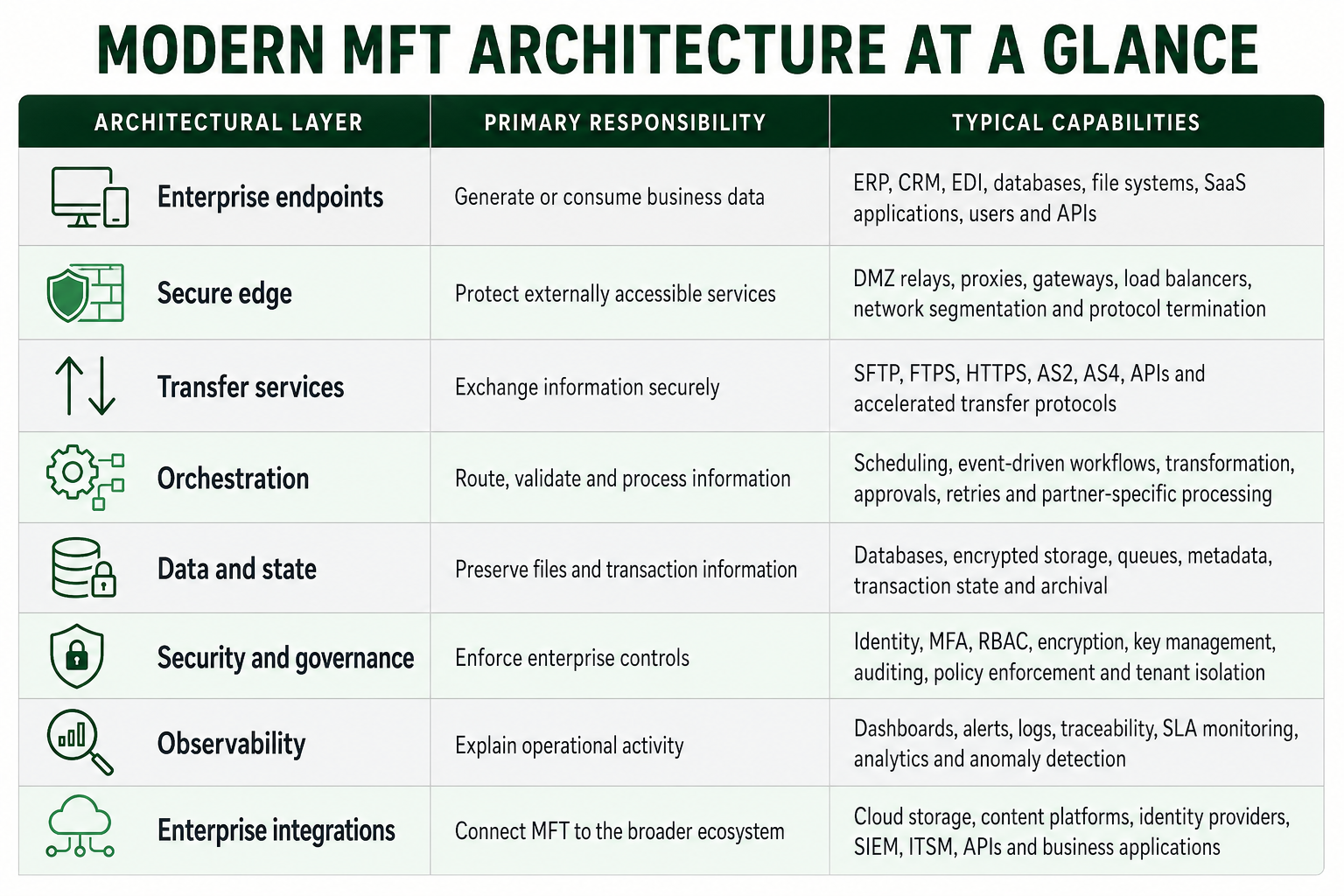
These layers should operate as one platform, but they should not be treated as one inseparable component. Clear architectural separation improves security, scalability, maintainability, and failure isolation.
Why Legacy File Transfer Architectures Eventually Fail
Legacy file transfer environments rarely collapse overnight. They usually become progressively harder to operate.
A new script is added for one partner. Another server is installed for a business unit. A monitoring job is created to watch the first script. Someone adds a second script to restart the first one. Before long, the organization owns an ecosystem that technically works, provided that the three people who understand it never take vacation at the same time.
Common warning signs include:
- Transfers spread across numerous servers and scripts
- Different security policies for different departments
- Shared credentials and unmanaged SSH keys
- Limited end-to-end transaction visibility
- Manual partner onboarding
- No centralized configuration history
- Operational teams investigating expected failures
- Different patching and upgrade processes for every server
- Inconsistent retry and recovery behavior
- Infrastructure scaling without corresponding application scaling
- Limited disaster recovery testing
- Business users depending on administrators for routine tasks
The problem is not necessarily that the original design was wrong. It may simply have been designed for a much smaller environment.
Modernization begins by designing for the environment the organization is becoming, not just the environment it has today.
The Core Principles of Modern MFT Architecture
1. Separate External Connectivity from Internal Processing
Core MFT application and data services should not be directly exposed to the internet.
A secure architecture commonly places relay, proxy, or gateway services in a segmented network zone such as a DMZ. These services accept or initiate external communications without storing sensitive business data or exposing internal application services.
A secure edge layer can provide:
- Network segmentation
- Controlled ingress and egress
- Protocol proxying
- Source restrictions
- Connection filtering
- DoS protection
- Load balancing
- Certificate-based authentication
- Isolation of internet-facing services
This supports the principles described in NIST SP 800-41 Rev. 1, which addresses controlling traffic between networks with different security postures.
The design should also avoid quietly turning the DMZ into another unmanaged file repository. Files should move through controlled services into protected processing and storage environments according to defined policies.
2. Centralize Governance Without Creating a Central Bottleneck
Centralized governance does not mean every workflow must run on one oversized server.
It means that security policies, identities, workflows, audit records, partner configurations, and operational controls are managed consistently—even when processing is distributed across nodes, locations, or cloud environments.
A modern control plane should provide:
- Centralized configuration
- Reusable workflow templates
- Partner-specific policies
- Role-based administration
- Configuration version history
- Centralized certificate and key management
- Consistent auditing
- Unified operational dashboards
- Policy enforcement across environments
This allows organizations to distribute processing while maintaining a single governance model.
3. Design for High Availability Across the Entire Dependency Chain
Adding a second MFT application node does not automatically create high availability.
A resilient architecture must evaluate every supporting dependency:
- Load balancers
- Relay and proxy services
- Application nodes
- Databases
- Storage
- Message queues
- DNS
- Identity providers
- Network routes
- Cloud services
- Monitoring systems
- Encryption and key-management services
If every application component is redundant but all nodes depend on one storage device, the architecture still contains a single point of failure. It is simply wearing a more impressive diagram.
High availability architecture should address:
- Active-active or active-passive application services
- Automated workload distribution
- Connection and transaction continuity
- Database resilience
- Redundant storage
- Health checks
- Automated failover
- Recovery of in-process transactions
- Queue persistence
- Maintenance without full platform interruption
The required design should be driven by business recovery objectives, including Recovery Time Objective and Recovery Point Objective, rather than by a generic statement that the platform is “highly available.”
4. Treat Scalability as More Than CPU and Memory
MFT scalability is often discussed in terms of file size or network bandwidth. Those are only part of the equation.
The architecture must account for:
- Number of files
- File-size distribution
- Concurrent connections
- Number of trading partners
- Protocol mix
- Workflow complexity
- Database transactions
- Storage IOPS
- Directory operations
- Encryption overhead
- Validation and transformation
- Retention policies
- Audit-event volume
- API activity
- Peak processing windows
One 100-gigabyte file and one million 100-kilobyte files may contain a similar amount of data, but they create very different demands on storage, databases, operating systems, and workflow engines.
Organizations evaluating demanding workloads should also review High-Volume Managed File Transfer: Why Architecture Determines Performance at Scale.
5. Make Every Transaction Observable from Beginning to End
Infrastructure monitoring can tell you that a server is running. It cannot necessarily tell you whether Friday’s payment file reached the correct bank, passed validation, completed processing, and met its SLA.
Modern MFT observability must connect technical events to business transactions.
Operations teams should be able to answer:
- Did the expected file arrive?
- Where did it originate?
- Which workflow processed it?
- Was it validated or transformed?
- Where was it routed?
- Was it delivered successfully?
- Which partner or application is affected?
- Is the transaction approaching an SLA deadline?
- What changed before the failure occurred?
- Who changed the configuration?
- Are similar failures occurring elsewhere?
This requires correlation across:
- File events
- Protocol sessions
- Workflow steps
- Configuration changes
- Security activity
- Infrastructure health
- Partner behavior
- SLA status
- Delivery confirmation
NIST SP 800-92 describes the importance of enterprise log-management infrastructure and processes. For MFT, those logs become substantially more useful when they are connected to complete transaction history and operational context.
Learn more in What Is MFT Observability?.
Clustering, Kubernetes, and Distributed MFT Architecture
Clustering and Kubernetes are frequently presented as competing approaches. In reality, they operate at different architectural layers.
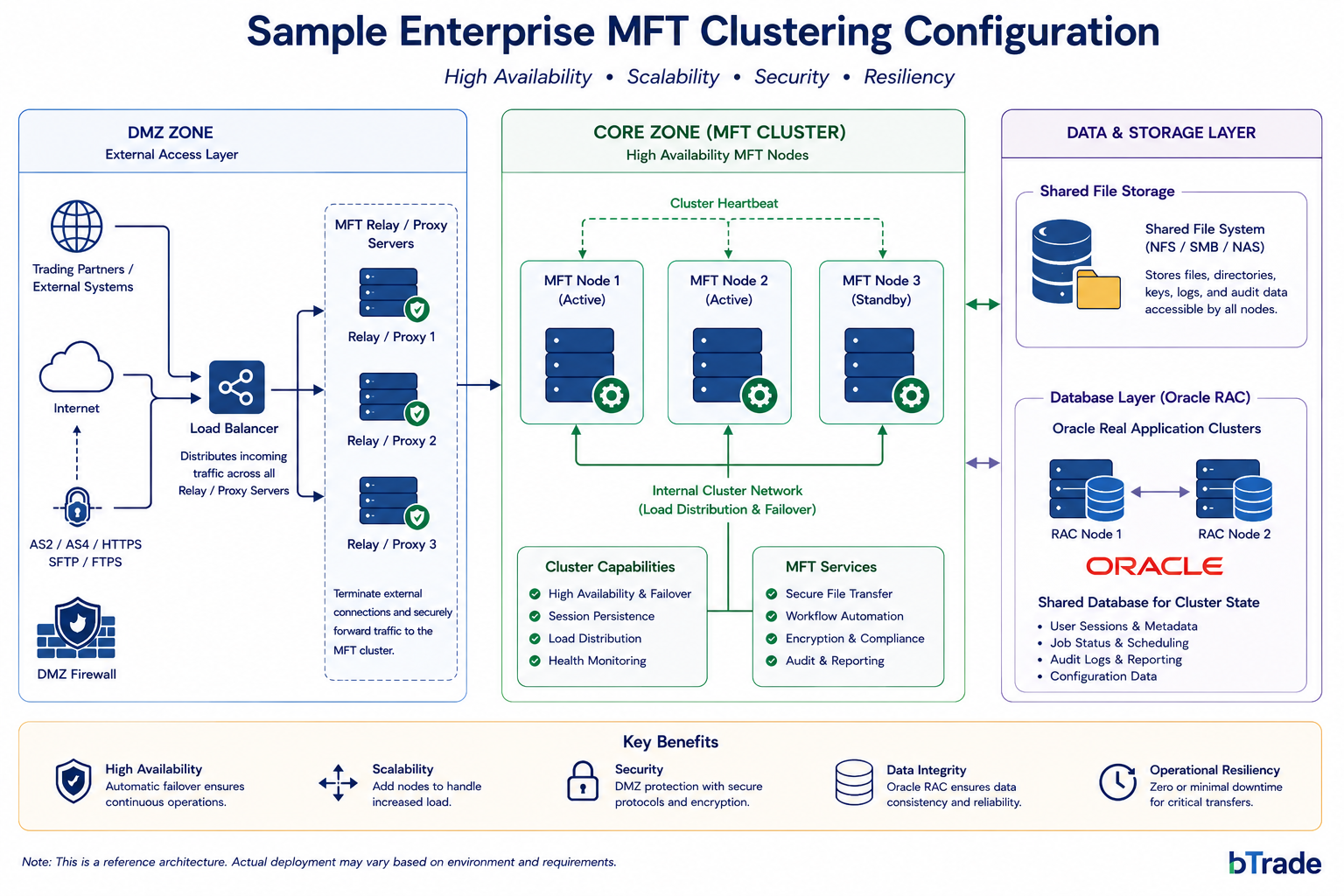
What Clustering Provides
MFT clustering provides application-level coordination across multiple nodes. Depending on the platform, this may include:
- Shared transaction state
- Workload distribution
- Application failover
- Session handling
- Coordinated scheduling
- Centralized configuration
- Processing continuity
- Node-level resilience
Clustering understands MFT transactions and application state.
What Kubernetes Provides
Kubernetes manages containerized infrastructure and workloads. It can provide:
- Container scheduling
- Pod health monitoring
- Automated restart
- Horizontal scaling
- Rolling deployment
- Infrastructure portability
- Resource management
- Hybrid and multi-cloud consistency
Kubernetes can restart an unhealthy container, but it does not automatically understand whether a transfer was partially processed, whether a workflow may safely restart, or whether duplicate delivery must be prevented.
That intelligence must come from the MFT platform.
The best architecture may therefore combine MFT clustering with Kubernetes orchestration.
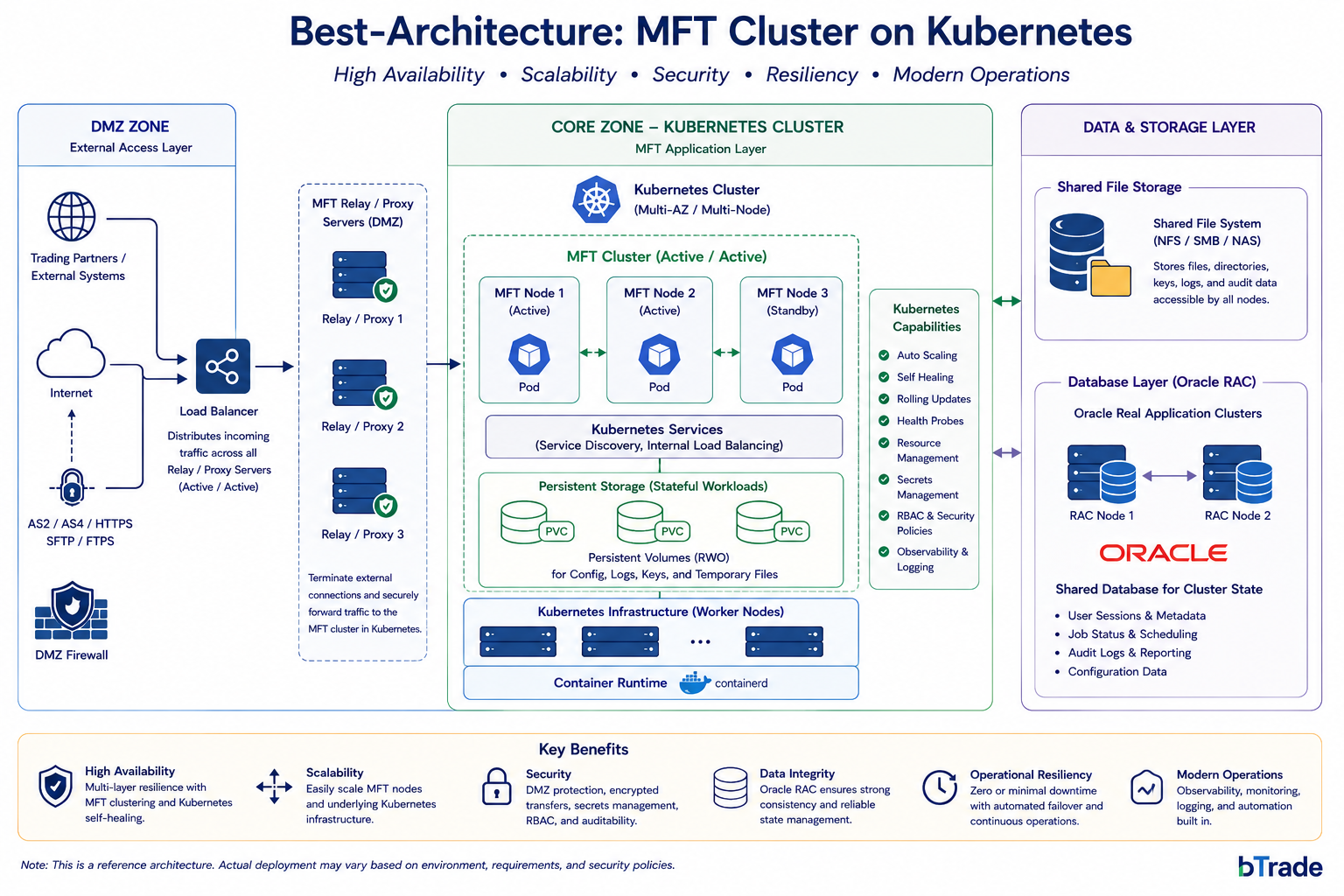
Organizations considering these deployment models can explore:
- Clustering vs. Kubernetes in Enterprise MFT
- How to Scale Managed File Transfer with Kubernetes
- Clustering in Managed File Transfer
Hybrid Cloud and Distributed Enterprise Architecture
Most large organizations do not operate in a single environment.
Their file-transfer workflows may connect:
- On-premises applications
- Private cloud infrastructure
- AWS
- Microsoft Azure
- Google Cloud
- SaaS platforms
- Partner-operated gateways
- Remote facilities
- Regional data centers
- Kubernetes environments
- End-user content platforms
Modern MFT architecture should provide consistent governance across these environments without requiring separate operational silos.
A hybrid architecture may place:
- External connectivity near partners or regional endpoints
- Processing services near the applications they support
- Central governance in a protected control environment
- Storage in approved locations
- Observability across the entire topology
- Disaster recovery services in another region or platform
The design must also consider data residency, network latency, cloud egress costs, storage performance, regulatory requirements, and the availability of external dependencies.
“Cloud-ready” should mean more than installing the same large virtual machine in somebody else’s data center.
Cloud Storage and Application Integration
Modern enterprise data exchange extends beyond traditional transfer protocols.
MFT platforms increasingly need to interact with cloud object storage, content platforms, file systems, APIs, identity services, and business applications.
TDXchange can connect to platforms such as:
- Amazon S3
- Azure Blob Storage
- Google Cloud Storage
- Google Drive
- Microsoft SharePoint
- Box
- Dropbox
- Windows SMB file shares
- REST APIs and web services
For supported repositories, workflows can monitor predefined locations and retrieve:
- All available files
- Files that have not previously been processed
- Files matching predefined names, patterns, dates, or other connector criteria
TDXchange can similarly deliver files into predefined repository locations as part of governed workflows.
This allows cloud and content platforms to participate in the same automation, security, auditing, and operational visibility applied to traditional trading-partner transfers.
Learn more in Managed File Transfer with Cloud Application Integrations.
Security Architecture for Modern MFT
Security must be built into every architectural layer.
A secure protocol protects a connection. It does not automatically protect credentials, administrative actions, stored files, workflow execution, internal services, APIs, or downstream systems.
Native End-to-End Zero Trust Across All Platform Components
NIST SP 800-207 explains that trust should not be granted implicitly based only on network location or asset ownership.
Applied to MFT, Zero Trust should cover:
- Administrators
- End users
- Trading partners
- Applications
- APIs
- Automated workflows
- Internal services
- Cloud integrations
- AI services
- Machine identities
TDXchange applies these controls across all platform components rather than limiting Zero Trust to user authentication or network access.
Each interaction should be authenticated, authorized, constrained by least privilege, and auditable.
This is broader than simply adding MFA to the login page.
Learn more in Native End-to-End Zero Trust Architecture.
Identity and Access Control
Modern MFT architecture should support:
- Native MFA
- External identity-provider MFA
- Single sign-on
- Role-based access control
- Least-privilege permissions
- Service identities
- Partner-specific accounts
- Credential rotation
- Certificate-based authentication
- OAuth 2.0 and OpenID Connect
- Active Directory, LDAP, and Microsoft Entra ID integration
TDXchange supports native MFA for administrators and end users, as well as authentication and MFA through enterprise identity providers.
Encryption and Cryptographic Agility
Sensitive information should be protected:
- In transit
- At rest
- In temporary processing locations
- In queues
- In backups
- During archival
- During administrative access
Modern architecture must also prepare for cryptographic change.
In 2024, NIST finalized its first principal post-quantum standards:
- FIPS 203: ML-KEM for key establishment
- FIPS 204: ML-DSA for digital signatures
- FIPS 205: SLH-DSA as an additional hash-based signature option
Post-quantum mechanisms do not replace AES-256 payload encryption, identity security, key management, or vulnerability protection. They address specific cryptographic risks associated with future quantum computing.
Modern MFT architecture should therefore support crypto-agility: the ability to update algorithms, certificates, keys, protocols, and policies without redesigning the entire platform.
For a complete treatment, see Post-Quantum Managed File Transfer Security.
File and Content Protection
Inbound files should not automatically be trusted because they arrived through an encrypted connection.
The architecture should support or integrate with:
- File-type validation
- Filename and size policies
- Antivirus scanning
- Sandboxing
- Content disarm and reconstruction
- Data loss prevention
- File-integrity verification
- Quarantine and approval workflows
- Data classification
- Controlled release policies
The OWASP File Upload Cheat Sheet recommends layered controls such as file-type validation, filename restrictions, authorization, controlled storage, and malware analysis.
Workflow Orchestration and Automation
Modern MFT workflows should be event-driven, reusable, and governed.
A workflow may begin when:
- A file arrives
- An API request is received
- A schedule is reached
- An application generates an event
- A message enters a queue
- A partner becomes available
- A business approval is completed
- A prior workflow finishes
The platform may then:
- Authenticate the source.
- Validate the file.
- Apply security and business policies.
- Rename, package, encrypt, compress, or transform the data.
- Route it to one or more destinations.
- Confirm delivery.
- Update downstream applications.
- Record the complete transaction.
- Notify relevant users or systems.
- Retry or escalate when processing fails.
Reusable workflow templates reduce configuration inconsistency and accelerate trading-partner onboarding.
The architecture should also distinguish between deterministic workflow execution and AI assistance. AI may help explain anomalies, recommend actions, or accelerate configuration, but business-critical security and routing policies should remain governed and predictable.
Resilience, Disaster Recovery, and Business Continuity
High availability and disaster recovery are related, but they are not interchangeable.
High availability addresses failures within the active operating environment. Disaster recovery addresses the loss or extended unavailability of that environment.
An MFT disaster recovery design should define:
- Recovery Time Objective
- Recovery Point Objective
- Secondary infrastructure
- Database replication or restoration
- File and queue replication
- Configuration synchronization
- Key and certificate availability
- DNS and network failover
- Identity-provider dependencies
- Partner communication procedures
- Recovery testing
- Transaction reconciliation after failover
A backup is important. A backup that has never been restored during a realistic test is mostly an optimistic theory.
Organizations should regularly test:
- Platform recovery
- Database recovery
- File reconciliation
- Partner connectivity
- Workflow execution
- Security controls
- Operational communications
- Return to the primary environment
Architecture should make these tests repeatable without placing production data or workflows at unnecessary risk.
Delegated Administration and Multi-Tenancy
Centralized administration becomes a bottleneck when every business unit, partner, and operational team depends on one small group for routine changes.
Modern MFT architecture should allow responsibilities to be delegated within clearly defined boundaries.
TDXchange can separate administration across hierarchical organizational structures and provide controlled access to:
- Domains
- Organizations
- Departments
- Divisions
- Trading partners
- Workflows
- Reports
- Transfer history
- Operational actions
Authorized users may be permitted to monitor transfers, onboard partners, review activity, rerun approved transactions, or manage specific configurations without receiving unrestricted platform access.
This supports scale while preserving governance.
Delegation should reduce administrative friction—not create dozens of miniature, independently governed MFT environments.
Ease of Use Is an Architectural Requirement
Enterprise software is sometimes treated as if complexity proves sophistication.
It does not.
A platform that supports impressive capabilities but requires specialized expertise for every installation, patch, upgrade, and routine configuration creates long-term operational risk.
A modern MFT architecture should be:
Straightforward to Install
Deployment should use clearly documented prerequisites, predictable dependencies, repeatable installation processes, and architecture patterns that match the intended scale.
Easy to Learn
Administrators should be able to understand how partners, workflows, services, security policies, and transfers relate to one another without memorizing disconnected configuration files and scripts.
Efficient to Configure
Reusable templates, centralized administration, consistent navigation, validation, and sensible defaults reduce errors and accelerate onboarding.
Predictable to Patch
Security patches should not require rebuilding the environment or manually updating numerous disconnected components through unrelated procedures.
Manageable to Upgrade
Upgrades should preserve configurations, provide clear compatibility guidance, support testing in non-production environments, and minimize operational disruption.
Simple to Operate Daily
Administrators should be able to see what is happening, identify what requires attention, and take authorized action from a centralized interface.
Low Maintenance
The platform should minimize unnecessary infrastructure, redundant services, manual cleanup, and constant administrative babysitting.
Simplicity is not the absence of enterprise capability. It is the disciplined organization of that capability.
Trading Partner Architecture
Trading partners should be treated as distinct governed entities rather than collections of credentials and scripts.
Each partner may require different:
- Protocols
- Certificates
- Keys
- Network restrictions
- File formats
- Schedules
- SLAs
- Retention policies
- Workflows
- Alerting rules
- Maintenance windows
- Administrative ownership
Partner-specific isolation makes it easier to understand activity, enforce policy, delegate administration, and contain risk.
Modern architecture should also understand planned partner availability.
If a partner performs scheduled maintenance, the MFT platform should be able to pause connection attempts, securely queue files, suppress expected failures, and automatically resume processing when the maintenance window ends.
Otherwise, operations teams may spend Monday morning manually reprocessing thousands of files that failed for a reason everyone already knew about.
Learn more in How Trading Partner Maintenance Windows Reduce Alert Fatigue.
How to Evaluate an MFT Architecture
Executive evaluation should move beyond protocol and feature checklists.
Ask the following questions.
Security and Governance
- Are internet-facing services isolated from internal application and data services?
- Does Zero Trust extend to users, services, workflows, APIs, and AI?
- Can access be limited by role, organization, partner, and responsibility?
- Are configuration changes fully audited?
- How are certificates, keys, and credentials governed?
- Does the platform support cryptographic agility?
Scalability and Performance
- Has the platform been tested at comparable file counts and workflow volumes?
- How does it handle many small files?
- Can processing scale horizontally?
- How are database and storage bottlenecks addressed?
- Can workloads be distributed without losing centralized governance?
- What happens during extreme traffic spikes?
Resilience
- Which components remain single points of failure?
- How are in-process transactions recovered?
- Does clustering preserve application and transaction state?
- How are databases, storage, networking, and identity services protected?
- Has the proposed disaster recovery process been tested?
Operations and Observability
- Can administrators follow a transaction from ingestion to delivery?
- Can the platform warn teams before an SLA is breached?
- Can configuration changes be correlated with operational failures?
- Does it distinguish expected partner downtime from genuine incidents?
- Can operational information be securely exposed to customers or business teams?
Deployment and Maintenance
- How difficult is installation?
- How many components must be separately maintained?
- What skills are required for daily administration?
- How are patches applied?
- How disruptive are upgrades?
- Does the architecture become more complicated as usage grows?
Integration and Modernization
- Does the platform connect to cloud storage and enterprise content platforms?
- Can it support files, APIs, applications, events, and messages within governed workflows?
- Does it operate consistently across on-premises and cloud environments?
- Can new services be introduced without redesigning existing workflows?
These questions reveal operational burden and long-term viability considerably better than checking whether two platforms both support SFTP.
How TDXchange Supports Modern MFT Architecture
TDXchange is designed to provide secure, scalable, and centrally governed enterprise data exchange across on-premises, hybrid cloud, cloud, and Kubernetes environments.
Its architectural capabilities include:
- Secure relay and proxy services
- Centralized multi-protocol administration
- SFTP, FTPS, HTTPS, AS2, AS4, APIs, and AFTP
- High availability and clustering
- Horizontal scalability
- Kubernetes support
- Workflow automation and orchestration
- Centralized operational visibility
- End-to-end transaction auditing
- SLA monitoring and alerting
- Native and identity-provider MFA
- Role-based access control
- Multi-tenancy and delegated administration
- Encryption in transit and at rest
- Quantum-safe cryptography and crypto-agility
- Cloud storage and content-platform integrations
- AI-assisted operational intelligence
- Partner-specific maintenance windows
- An interface designed to be easy to learn, configure, operate, patch, and maintain
That flexibility extends beyond where TDXchange can be deployed. Its license-driven model allows organizations to begin with the protocols, integrations, trading partners, capacity, and capabilities required for their initial implementation. As migrations progress and business requirements grow, additional functionality can be enabled within the same platform without replacing the underlying architecture or redesigning established workflows.
Unlike file transfer environments assembled from disconnected servers, scripts, monitoring products, and years of accumulated exceptions, TDXchange provides these capabilities within a unified Enterprise Data Exchange platform.
bTrade has been building secure enterprise file transfer platforms since 1990. Our architecture approach is shaped not only by product development, but by decades of helping customers design, migrate, operate, scale, and recover mission-critical MFT environments.
That experience matters because the best architecture is not the one that looks most impressive on a slide.
It is the one that still works reliably years later, after transaction volumes increase, infrastructure changes, applications move, regulations evolve, and the people who originally built it are no longer the only ones capable of operating it.
Executive Takeaway
Modern MFT architecture is no longer just a technical implementation decision.
It directly affects:
- Cybersecurity
- Compliance
- Business continuity
- Partner onboarding
- Operational productivity
- Cloud modernization
- Customer experience
- Infrastructure cost
- Long-term scalability
Organizations should design MFT environments around business workflows, security boundaries, transaction volumes, operational responsibilities, recovery objectives, and future growth.
The goal is not simply to deploy a file transfer product.
The goal is to establish a secure Enterprise Data Exchange foundation that can connect people, applications, cloud platforms, APIs, and trading partners while remaining resilient, observable, and manageable over time.
Architecture does not become less important after implementation.
That is usually when organizations begin discovering how important it was all along.
About the Author
Andrei Olin is Chief Technology Officer at bTrade, where he leads product strategy, delivery, architecture, and security across the company’s B2B, Managed File Transfer, and secure data exchange platforms.
Andrei has more than 30 years of experience spanning enterprise architecture, software development, infrastructure, cybersecurity, middleware, trading systems, SaaS, and Managed File Transfer. His career includes building mission-critical systems and infrastructure at Bear Stearns and Morgan Stanley, designing and operating enterprise MFT and messaging platforms for Merrill Lynch and Deutsche Bank, and building and scaling SaaS and security products at startups. He holds master’s and bachelor’s degrees in Information Technology with a focus on Information Security.
Frequently Asked Questions (FAQ)
What is modern MFT architecture?
Modern MFT architecture is a secure and scalable enterprise framework that combines file-transfer protocols, workflow automation, identity controls, encryption, high availability, centralized governance, operational observability, cloud integration, and auditing.
What are the principal layers of MFT architecture?
The principal layers include enterprise endpoints, secure edge and DMZ services, transfer services, workflow orchestration, data and transaction-state management, security and governance, observability, and enterprise integrations.
Why is MFT architecture important?
Architecture determines whether an MFT platform can scale, recover from failures, protect sensitive information, support hybrid infrastructure, simplify operations, and remain manageable as transaction volumes and business requirements grow.
What is the difference between MFT and an SFTP server?
SFTP is a secure transfer protocol. MFT combines SFTP and other protocols with centralized automation, security policy, monitoring, auditing, workflow orchestration, partner management, high availability, and enterprise governance.
Should an MFT server be placed in the DMZ?
Internet-facing transfer services may operate through DMZ gateways, relays, or proxies, but core processing, administrative, database, and storage services should generally remain within protected network zones. The exact design depends on the organization’s security architecture.
What is MFT clustering?
MFT clustering coordinates multiple application nodes to improve high availability, processing distribution, scalability, and transaction continuity. Application-aware clustering addresses different concerns than infrastructure-level container orchestration.
Is Kubernetes a replacement for MFT clustering?
Not necessarily. Kubernetes manages container infrastructure, while MFT clustering manages application and transaction behavior. Many enterprise architectures can benefit from using both together.
What makes an MFT architecture highly available?
A highly available MFT architecture eliminates avoidable single points of failure across application nodes, relays, databases, storage, networking, load balancers, identity services, and supporting infrastructure. It must also preserve or safely recover transaction state.
How does MFT architecture support hybrid cloud?
Hybrid MFT architecture connects on-premises applications, public and private clouds, SaaS platforms, content repositories, APIs, and trading partners under consistent security, automation, governance, and observability.
Why does file count matter in MFT performance?
Every file can create directory operations, database records, workflow events, security checks, audit activity, and protocol sessions. Millions of small files may therefore place greater strain on an MFT environment than a smaller number of very large files.
What is MFT observability?
MFT observability provides end-to-end insight into file activity, protocol sessions, workflows, configuration changes, partner behavior, SLA status, security events, and delivery outcomes. It helps teams understand not only what failed, but why.
How does Zero Trust apply to MFT?
Zero Trust requires users, services, APIs, workflows, machines, AI systems, and internal components to authenticate and receive explicitly authorized access. Trust should not be granted simply because a connection originates inside the network.
What is quantum-safe MFT architecture?
Quantum-safe MFT architecture combines strong symmetric encryption, post-quantum key establishment and signatures, crypto-agility, key management, and modern security controls to prepare sensitive enterprise data exchange for future cryptographic threats.
What should organizations evaluate before selecting an MFT platform?
Organizations should evaluate security architecture, scalability, transaction-state management, high availability, disaster recovery, observability, cloud support, integration capabilities, administrative delegation, ease of use, patching, upgrades, maintenance requirements, and vendor expertise—not just supported protocols.
How does TDXchange simplify MFT operations?
TDXchange combines centralized administration, reusable workflows, partner management, operational dashboards, delegated administration, auditing, automation, clustering, cloud integrations, and security controls in one platform designed to be straightforward to learn, configure, operate, and maintain.
Can TDXchange support on-premises, cloud, hybrid, and Kubernetes deployments?
Yes. TDXchange supports traditional on-premises deployments, cloud infrastructure, hybrid environments, clustered architectures, and Kubernetes-based deployments based on an organization’s infrastructure, scalability, resiliency, and governance requirements.