
GDPR: Your Data, Your Rights! How Enterprise Data Exchange Supports GDPR Compliance in 2026
In Summary
Since its introduction in 2018, the General Data Protection Regulation (GDPR) has fundamentally changed how organizations collect, process, store, and transfer personal data. While GDPR originated in the European Union, its impact extends globally to any organization handling the personal data of EU residents.
Today, GDPR is about more than regulatory compliance. It has become a framework for building customer trust, strengthening data governance, and demonstrating accountability.
As organizations exchange sensitive information across employees, customers, partners, cloud services, and business applications, protecting personal data throughout its lifecycle has become a critical responsibility. This is where Enterprise Data Exchange and Managed File Transfer play an important role, providing the security, governance, and visibility needed to protect sensitive information as it moves across the enterprise.
This article explores how GDPR impacts Enterprise Data Exchange and how organizations can strengthen compliance through Native End-to-End Zero Trust Archicecture, Role-Based Access Control (RBAC), encryption, auditability, and modern security practices. It also complements our articles on Native End-to-End Zero Trust Architecture, Access Control, AI Security & Governance, and The Future of Enterprise Data Exchange, where we explore the technologies shaping the future of secure enterprise data exchange.
Key Takeaways
- GDPR gives individuals greater control over their personal information.
- Organizations must have a lawful basis for processing personal data.
- GDPR applies to many organizations outside the European Union.
- Individuals have rights related to access, correction, deletion, portability, and objection.
- Organizations must implement appropriate technical and organizational safeguards.
- Non-compliance can result in significant regulatory penalties and reputational damage.
- Secure Managed File Transfer (MFT) solutions can help organizations support GDPR compliance requirements.
- TDXchange provides encryption, auditing, access controls, workflow automation, and governance capabilities designed to help organizations protect sensitive data.
What Is GDPR?
The General Data Protection Regulation (GDPR) is one of the world's most influential privacy regulations.
Introduced by the European Union in May 2018, GDPR establishes rules governing how organizations collect, process, store, transfer, and protect personal data.
The regulation was designed to provide individuals with greater transparency and control over how their information is used while holding organizations accountable for protecting that information.
Today, GDPR serves as a model for privacy legislation around the world and has influenced numerous data protection laws globally.
Who Does GDPR Apply To?
One of the most common misconceptions is that GDPR only applies to organizations located within the European Union.
In reality, GDPR may apply to organizations anywhere in the world if they:
- Offer goods or services to EU residents
- Process personal information belonging to EU residents
- Monitor the behavior of individuals located within the EU
This means organizations in healthcare, financial services, manufacturing, retail, technology, government contracting, and other industries often find themselves subject to GDPR requirements even if they have no physical presence in Europe.
Understanding GDPR Data Subject Rights
A core principle of GDPR is empowering individuals to maintain control over their personal information.
Right to Access
Individuals can request information about what personal data an organization maintains and how that information is being used.
Example:
A customer asks a healthcare provider to disclose all personal information stored about them.
Right to Rectification
Individuals can request corrections to inaccurate or incomplete personal information.
Example:
An employee discovers an incorrect address or phone number in an HR system and requests an update.
Right to Erasure (Right to Be Forgotten)
Under certain circumstances, individuals may request deletion of their personal information.
Example:
A former customer requests removal of marketing data no longer required for legitimate business purposes.
Right to Data Portability
Individuals can request their information in a structured format that allows transfer to another provider.
Example:
A customer switching financial institutions requests their account information be transferred securely.
Right to Object
Individuals may object to certain forms of processing, particularly direct marketing activities.
Example:
A consumer opts out of personalized marketing campaigns and requests their preferences be honored.
What Is a Lawful Basis for Processing Data?
GDPR requires organizations to establish a lawful basis before processing personal data.
Common lawful bases include:
Consent
The individual has explicitly agreed to the processing activity.
Contractual Necessity
Processing is required to fulfill a contract.
Legal Obligation
Processing is required by law.
Legitimate Interests
Processing supports legitimate business interests while balancing privacy rights.
Public Interest or Official Authority
Processing supports public functions or government responsibilities.
Organizations should clearly document and justify the legal basis supporting each processing activity.
Why GDPR Matters for Secure Data Exchange
Many organizations focus on privacy notices and consent management when discussing GDPR.
However, GDPR also places significant emphasis on protecting personal information during transmission and storage.
Sensitive information often moves between:
- Customers and organizations
- Business partners
- Suppliers
- Financial institutions
- Healthcare providers
- Government agencies
- Cloud platforms
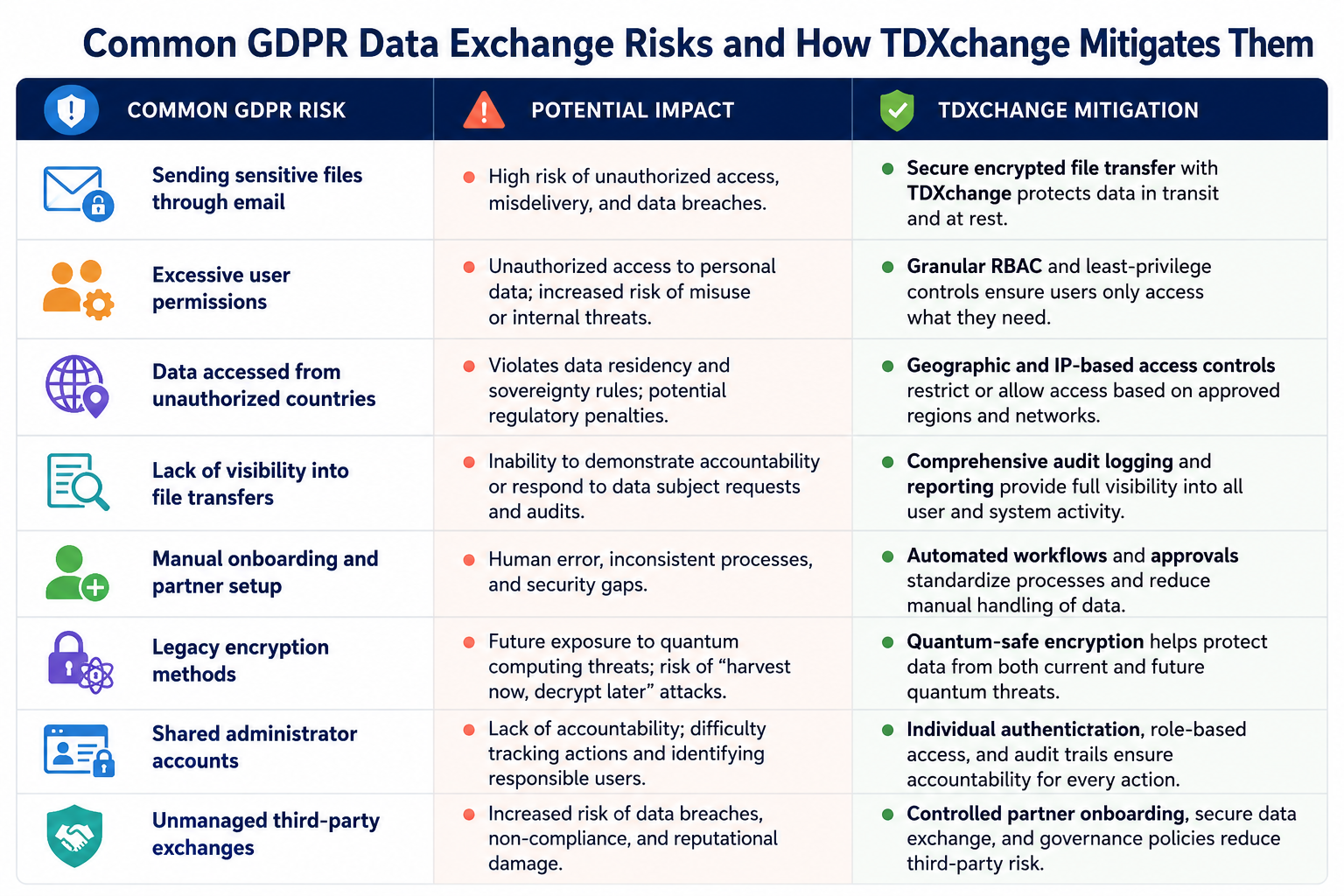
Every transfer creates potential exposure.
This is why secure data exchange and Managed File Transfer (MFT) solutions play an important role in supporting GDPR compliance initiatives.
Common GDPR Data Transfer Use Cases
Healthcare Data Exchange
Healthcare organizations routinely exchange patient records, claims data, laboratory results, and provider information.
GDPR requires appropriate safeguards to protect this sensitive information during transfer and storage.
Financial Services
Banks, insurance providers, and financial institutions exchange account information, customer records, and regulatory reporting data.
Strong encryption, auditing, and access controls help support compliance requirements.
Human Resources
Organizations often transfer employee records between payroll providers, benefits administrators, and HR systems.
These transfers frequently involve personally identifiable information (PII) protected under GDPR.
Third-Party Partner Communications
Manufacturers, retailers, and logistics providers regularly exchange customer, supplier, and operational data with business partners around the world.
Organizations must ensure those transfers are secure and appropriately governed.
How TDXchange Helps Organizations Strengthen GDPR Compliance
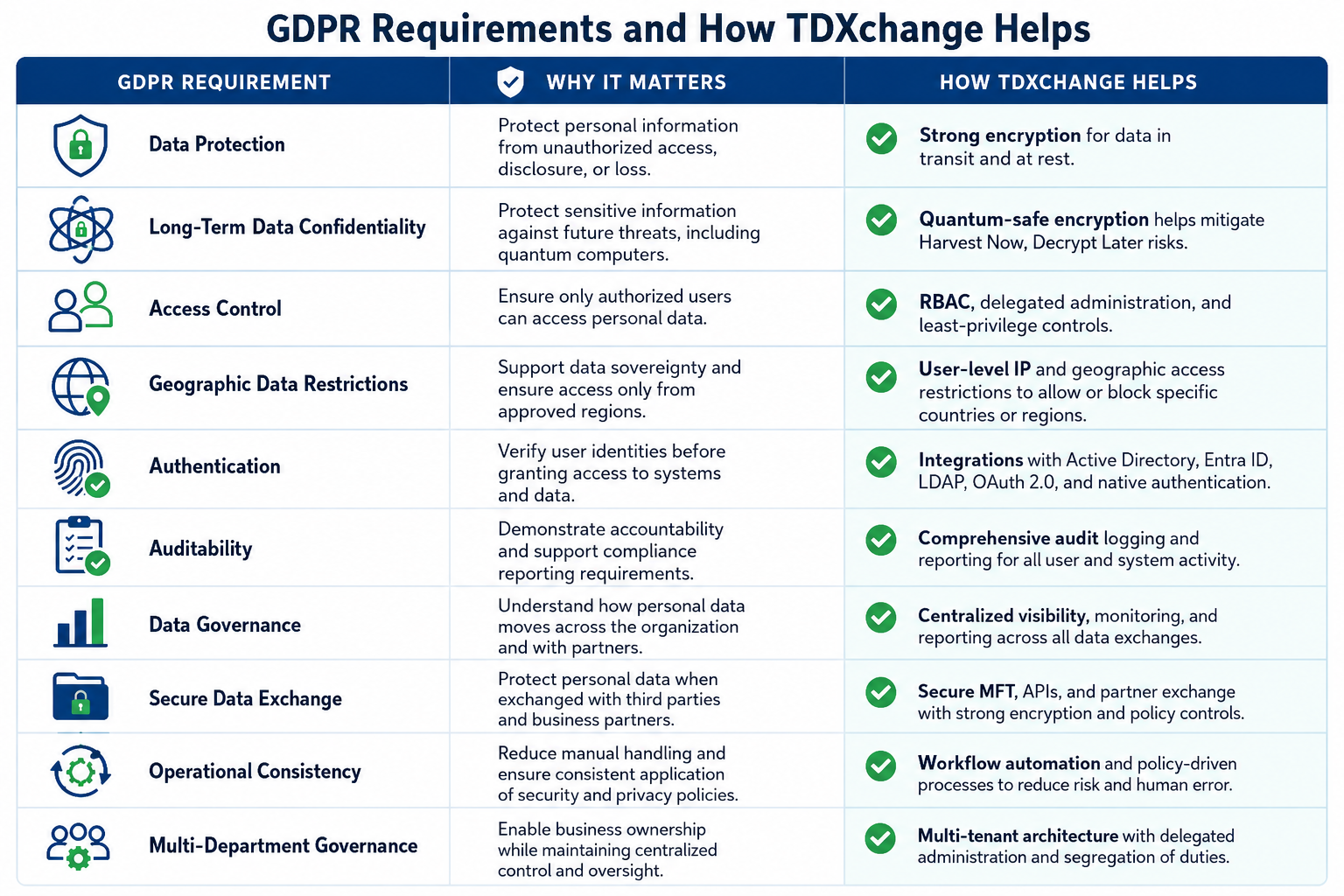
While no software solution alone can guarantee GDPR compliance, technology plays a critical role in helping organizations protect personal data, enforce security controls, demonstrate accountability, and reduce operational risk.
TDXchange was designed to help organizations build secure, governed, and resilient Enterprise Data Exchange environments by combining modern security architecture with comprehensive operational visibility and automation.
Native End-to-End Zero Trust Architecture and Role-Based Access Control
Protecting personal data begins with controlling who can access it.
TDXchange applies Native End-to-End Zero Trust Architecture, continuously verifying users, APIs, workflows, cloud services, and internal platform components rather than relying on implicit trust. Combined with highly configurable Role-Based Access Control (RBAC), organizations can precisely define who can view data, administer workflows, onboard trading partners, manage certificates, or perform administrative functions.
Granular delegated administration allows business users to manage approved activities without requiring full administrative privileges, supporting least-privilege access, segregation of duties, and stronger governance while reducing operational bottlenecks.
These capabilities directly support GDPR principles of data protection, accountability, and controlled access.
Strong Encryption and Crypto-Agility
Protecting personal data requires more than encrypting information today. Organizations must also prepare for future cryptographic threats.
TDXchange protects sensitive information both in transit and at rest using strong encryption while incorporating quantum-safe encryption and a crypto-agile architecture designed to evolve as cryptographic standards change.
This is particularly important when considering Harvest Now, Decrypt Later (HNDL) attacks, where encrypted information captured today could be decrypted in the future as quantum computing matures. By combining modern encryption with crypto-agility, organizations can better protect long-lived personal data while preparing for future regulatory and security requirements.
Enterprise Identity and Secure Authentication
Strong identity management is fundamental to GDPR compliance.
TDXchange integrates with enterprise identity providers including:
- Microsoft Entra ID
- Active Directory
- LDAP
- OAuth 2.0
- Native TDXchange authentication
This enables organizations to align Enterprise Data Exchange with existing identity governance policies while supporting centralized authentication, simplified user administration, and consistent security controls across the enterprise.
Enterprise Observability and Auditability
Demonstrating GDPR compliance requires more than protecting data. Organizations must also demonstrate how that data is accessed, transferred, and managed.
TDXchange provides comprehensive Enterprise Observability, delivering centralized visibility into:
- File transfers
- Workflow execution
- User activity
- Administrative actions
- Authentication events
- Partner communications
- Configuration changes
- Audit history
This operational visibility helps organizations identify compliance gaps, investigate incidents more efficiently, simplify regulatory reporting, and demonstrate accountability during audits.
Automated Workflows and Reduced Operational Risk
Manual processes frequently introduce unnecessary compliance and security risks.
TDXchange automates partner onboarding, approvals, workflow routing, notifications, policy enforcement, and business processes, reducing manual intervention while improving consistency, governance, and operational efficiency.
Automated workflows also help organizations standardize how sensitive information is handled, reducing the likelihood of human error while supporting repeatable compliance processes.
Geographic Access Controls and Data Sovereignty
Many organizations must demonstrate that personal data is only accessed from approved locations.
TDXchange provides highly configurable IP-based and geographic access controls that allow organizations to:
- Restrict access from specific countries or regions
- Limit administrative access to approved corporate networks
- Enforce geographic security policies
- Support data sovereignty initiatives
- Reduce unauthorized access risks
These controls help organizations strengthen cross-border governance while supporting GDPR requirements related to protecting personal data.
AI Governance for Enterprise Data
As organizations increasingly adopt Artificial Intelligence, GDPR extends beyond human access to include how AI interacts with enterprise information.
Within TDXchange, AI operates under the same Native End-to-End Zero Trust Architecture and Role-Based Access Control as every other platform component. Rather than requiring unrestricted access to sensitive business information, AI focuses on operational metadata whenever possible, helping administrators troubleshoot issues, summarize operational activity, and improve efficiency while maintaining clearly defined trust boundaries and full auditability.
This approach allows organizations to embrace AI-powered Operational Intelligence without compromising privacy, governance, or regulatory compliance.
Built for Modern Enterprise Data Exchange
GDPR compliance depends on more than individual security features. It requires a platform designed to protect personal data throughout its entire lifecycle while adapting to evolving business, regulatory, and cybersecurity requirements.
By combining Native End-to-End Zero Trust Architecture, Role-Based Access Control, strong encryption, crypto-agility, Enterprise Observability, AI governance, workflow automation, and centralized management, TDXchange helps organizations build Enterprise Data Exchange environments that are secure, resilient, and better prepared to support both today's GDPR requirements and tomorrow's privacy challenges.
GDPR Compliance Is an Ongoing Process
Privacy regulations continue evolving.
Organizations must regularly evaluate:
- Data collection practices
- Data retention policies
- Security controls
- Vendor relationships
- Data transfer mechanisms
- Incident response procedures
Compliance is not a one-time project.
It is an ongoing commitment to protecting personal information and maintaining customer trust.
Final Thoughts
GDPR is ultimately about more than regulatory compliance.
It is about giving individuals greater control over their personal information while encouraging organizations to adopt stronger data protection practices.
As organizations exchange increasing volumes of sensitive information across cloud environments, applications, partners, and global ecosystems, secure data exchange becomes a critical component of privacy and compliance strategies.
By combining strong governance, security controls, and modern data exchange technologies, organizations can better protect personal information while supporting both regulatory requirements and business objectives.
Executive Takeways
GDPR is more than a regulatory requirement. It is a framework for protecting personal data, strengthening governance, and building customer trust throughout the information lifecycle.
Modern Enterprise Data Exchange platforms play a critical role by combining Native End-to-End Zero Trust Architecture, Role-Based Access Control (RBAC), strong encryption, crypto-agility, comprehensive auditability, Enterprise Observability, workflow automation, and governed AI to help organizations safeguard sensitive information while supporting compliance initiatives.
At bTrade, we believe privacy, security, and operational efficiency go hand in hand. By building Enterprise Data Exchange solutions that protect data, simplify governance, and adapt to evolving business and regulatory requirements, organizations can strengthen GDPR compliance while creating a more secure and resilient foundation for the future.
About the Author
Don Miller is President and General Counsel of bTrade, where he leads day-to-day operations and oversees legal, regulatory, and compliance activities for the company’s secure managed file transfer (MFT) platform. In this dual role, he helps ensure bTrade’s products and services meet the operational, data-protection, and governance expectations of enterprise and regulated customers. Don brings more than 20 years of legal experience advising businesses on risk management, contracts, intellectual property, and dispute resolution, applying that background to the practical realities of software operations and compliance. He holds a Juris Doctor from the University of Southern California Gould School of Law and is admitted to practice before California state and federal courts.
Frequently Asked Questions
What is GDPR?
The General Data Protection Regulation (GDPR) is the European Union's privacy regulation governing how organizations collect, process, store, transfer, and protect personal data. It establishes individuals' rights over their personal information while requiring organizations to implement appropriate security, governance, and accountability measures.
Does GDPR apply to companies outside the European Union?
Yes. GDPR applies to any organization, regardless of location, that processes the personal data of individuals residing in the European Union. Organizations offering goods or services to EU residents or monitoring their behavior may also be subject to GDPR requirements.
What are the key rights provided by GDPR?
GDPR grants individuals several important rights, including the right to access their personal data, request corrections, request erasure ("the right to be forgotten"), restrict or object to certain processing activities, and receive their data in a portable format. Organizations must implement processes that support these rights while maintaining security and accountability.
What qualifies as personal data under GDPR?
Personal data includes any information that can directly or indirectly identify an individual. Examples include names, email addresses, phone numbers, identification numbers, IP addresses, online identifiers, location data, and any information that can reasonably be linked to a specific person.
How does Enterprise Data Exchange support GDPR compliance?
Enterprise Data Exchange platforms help organizations protect personal data as it moves between employees, customers, business partners, cloud services, and enterprise applications. Features such as encryption, Native End-to-End Zero Trust Architecture, Role-Based Access Control (RBAC), audit logging, workflow automation, and operational visibility help organizations strengthen governance while supporting GDPR compliance initiatives.
Why are Zero Trust and Role-Based Access Control important for GDPR?
GDPR requires organizations to protect personal data from unauthorized access. Native End-to-End Zero Trust Architecture continuously verifies every user, application, workflow, and API, while Role-Based Access Control (RBAC) ensures individuals only have access to the information required for their responsibilities. Together, these principles support least-privilege access, stronger governance, and improved regulatory compliance.
How does TDXchange help organizations support GDPR initiatives?
TDXchange helps organizations strengthen GDPR compliance by combining Native End-to-End Zero Trust Architecture, strong encryption, crypto-agility, Role-Based Access Control, delegated administration, enterprise identity integration, workflow automation, comprehensive audit logging, Enterprise Observability, and centralized governance. These capabilities help organizations protect personal data while improving operational efficiency and regulatory accountability.
How does AI impact GDPR compliance?
As organizations adopt Artificial Intelligence, protecting personal data becomes even more important. Within TDXchange, AI operates under the same Role-Based Access Control and Native End-to-End Zero Trust Architecture as every other platform component. Whenever possible, AI analyzes operational metadata rather than sensitive business data, helping organizations improve operational efficiency while maintaining privacy, governance, and compliance.
Does GDPR require encryption?
While GDPR does not mandate specific encryption technologies, it strongly encourages organizations to implement appropriate technical safeguards to protect personal data. Strong encryption, secure key management, and crypto-agile architectures are widely recognized as best practices for reducing risk and protecting sensitive information throughout its lifecycle.
Why is audit logging important for GDPR?
Comprehensive audit logging helps organizations demonstrate accountability by providing visibility into who accessed personal data, what actions were performed, when they occurred, and how information moved throughout the enterprise. Detailed audit trails also simplify investigations, regulatory reporting, and ongoing compliance efforts.