
Executive Summary
Sending large files sounds simple until file sizes reach hundreds of gigabytes or terabytes. At that point, traditional methods such as email, FTP, SFTP, HTTPS uploads, and consumer file-sharing tools often break down. Transfers fail, performance becomes inconsistent, auditability is limited, and operations teams are left manually troubleshooting under pressure.
For enterprises, large file transfer is not just a convenience issue. It is an operational, security, compliance, and governance challenge.
TDXchange, combined with bTrade’s Accelerated File Transfer Protocol (AFTP), helps organizations send large files securely, predictably, and repeatedly at scale. TDXchange provides the enterprise control layer for orchestration, security, auditing, monitoring, and policy enforcement, while AFTP is purpose-built to move large datasets efficiently across long-distance and high-latency networks.
Together, they transform large file transfer from a fragile manual process into a resilient, governed, and repeatable enterprise workflow.
Key Takeaways
- Traditional file transfer methods often fail when moving very large files.
- Large file transfer requires speed, security, reliability, visibility, and governance.
- AFTP is designed for sustained bulk data movement across long-distance networks.
- TDXchange provides orchestration, auditability, access controls, and policy enforcement.
- Automatic restart and recovery reduce manual intervention.
- Enterprise-grade security must include encryption, authentication, access controls, and audit trails.
- Large file transfer is critical across banking, media, healthcare, retail, and government.
- Successful large file transfer depends on repeatability and control, not just bandwidth.
Why Sending Large Files Is an Enterprise Challenge
As file sizes grow, many organizations quickly discover that traditional transfer methods were not designed for sustained bulk data movement.
Large file transfer supports critical business workflows, including:
- eDiscovery and regulatory data production
- Media and content distribution
- Data replication and analytics pipelines
- Healthcare data exchange
- Retail data synchronization
- Partner and inter-agency data exchange
When large transfers fail or slow down, the impact can be immediate:
- Missed deadlines and service-level agreements
- Partner escalations
- Compliance and audit exposure
- Manual rework
- Operational firefighting
- Delayed business processes
The real question is not:
“Can we send large files?”
The better question is:
“Can we send large files securely, predictably, and repeatedly at scale?”
Why Traditional File Transfer Methods Fall Short
Many organizations still rely on tools that work for occasional file movement but struggle at enterprise scale.
Common limitations include:
- Email attachments hit size limits quickly.
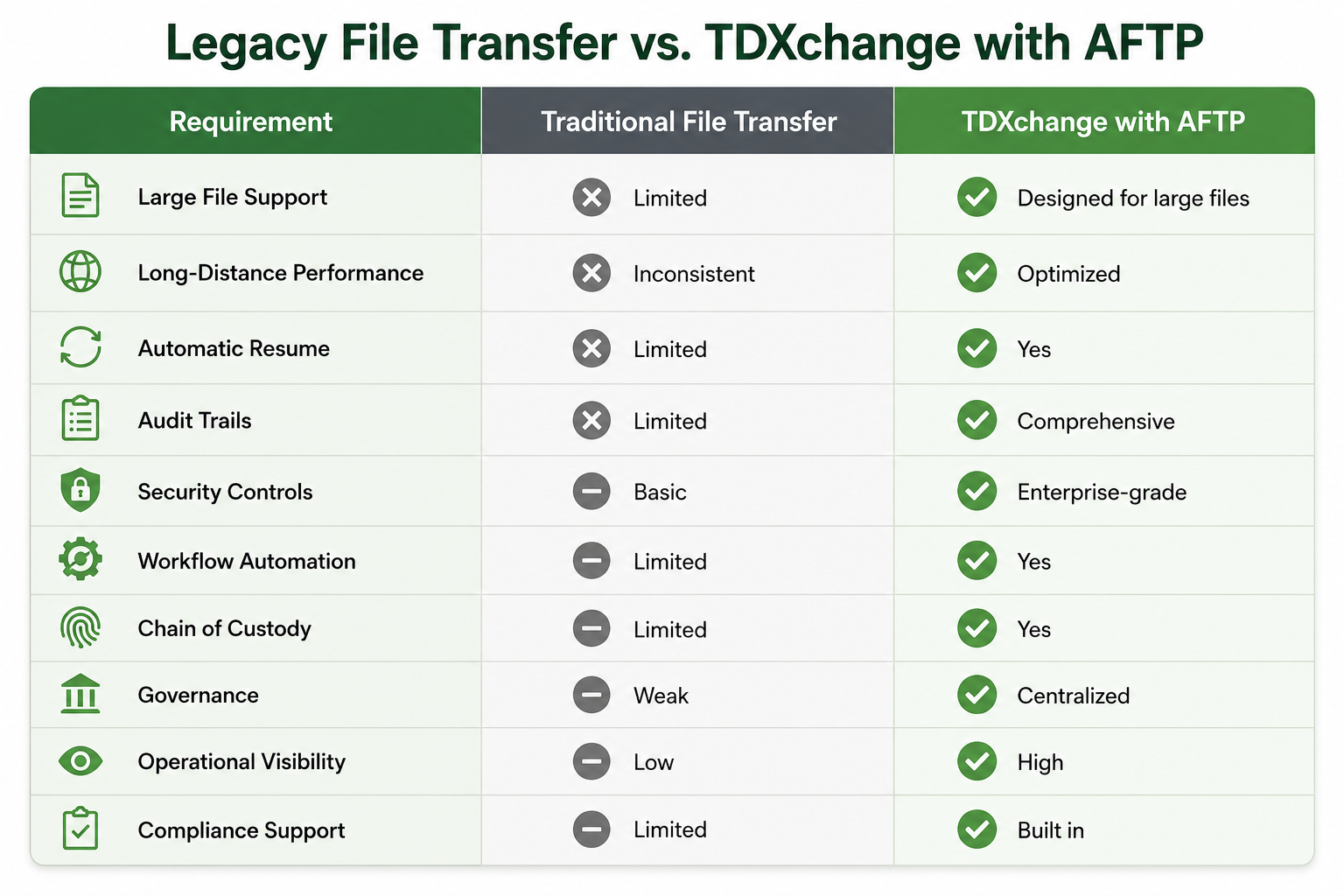
- FTP and SFTP can struggle with latency and long-distance performance.
- HTTPS uploads may fail during long-running transfers.
- Consumer file-sharing tools often lack enterprise governance.
- Manual retries increase operational risk.
- Limited audit trails create compliance challenges.
These approaches may work for smaller or less frequent transfers, but they often fail when organizations need to move very large files securely and repeatedly across regions, partners, and business units.
What Is AFTP?
AFTP, or Accelerated File Transfer Protocol, is bTrade’s proprietary protocol designed for large, sustained bulk data transfers.
Unlike traditional transfer protocols, AFTP is optimized to:
- Maximize available bandwidth
- Improve performance over long-distance networks
- Handle latency and packet loss more efficiently
- Resume interrupted transfers without starting over
- Support predictable movement of large datasets
For organizations moving multi-gigabyte or terabyte-scale files, this reliability is critical.
How TDXchange and AFTP Work Together
At bTrade, large file transfer is treated as a governed enterprise workflow, not a one-off transaction.
TDXchange Provides the Control Layer
TDXchange manages the enterprise requirements around large file movement, including:
- Transfer orchestration
- Security enforcement
- User and partner access controls
- Monitoring and alerting
- Audit trails
- Policy enforcement
- Workflow automation
This gives organizations visibility and control over how files move across environments.
AFTP Provides the Performance Layer
AFTP handles the efficient movement of large files across challenging networks.
It is especially useful when organizations need to move data across:
- Long-distance networks
- High-latency environments
- Intercontinental connections
- Unreliable networks
- High-volume data exchange workflows
Together, TDXchange and AFTP help organizations move large files faster and more reliably without sacrificing security, auditability, or governance.
Large File Transfer Use Cases
Organizations across banking, media, healthcare, retail, and government rely on secure large file transfer for production workflows.
Common use cases include:
- High-volume eDiscovery delivery
- Media content distribution
- Regulatory data submissions
- Healthcare data exchange
- Retail data synchronization
- Secure inter-agency data sharing
- Data replication and analytics dataset movement
- Partner and supplier data exchange
In each case, success depends on more than speed. It depends on repeatability, resilience, and control.
Security and Compliance Requirements for Large File Transfer
Sending large files securely requires more than encryption in transit.
Enterprise-grade large file transfer should include:
- Strong encryption
- Secure authentication
- Role-based access controls
- Policy enforcement
- Immutable audit logs
- Non-repudiation
- Chain-of-custody tracking
- End-to-end visibility
- Automated alerts
- Compliance reporting
TDXchange embeds these controls directly into the transfer workflow, helping organizations make security and compliance part of the process rather than an afterthought.
Why Large File Transfer Is a Business Control
Large file transfer is no longer just a technical utility.
For many organizations, it directly affects:
- Customer delivery
- Regulatory timelines
- Partner relationships
- Revenue operations
- Security posture
- Compliance readiness
A failed transfer can delay a legal production, disrupt a media workflow, interrupt a data pipeline, or create unnecessary operational risk.
That is why large file transfer must be treated as a governed business process.
Executive Takeaway
Sending large files at enterprise scale is not about finding a bigger pipe.
It is about building the right foundation.
TDXchange and AFTP transform large file transfer from a fragile, manual process into a secure, resilient, governed, and repeatable enterprise workflow.
For organizations facing growing data volumes, distributed partners, global operations, and increasing regulatory pressure, this architectural approach provides both speed and confidence.
About the Author
Don Miller is President and General Counsel of bTrade, where he leads day-to-day operations and oversees legal, regulatory, and compliance activities for the company’s secure managed file transfer (MFT) platform. In this dual role, he helps ensure bTrade’s products and services meet the operational, data-protection, and governance expectations of enterprise and regulated customers. Don brings more than 20 years of legal experience advising businesses on risk management, contracts, intellectual property, and dispute resolution, applying that background to the practical realities of software operations and compliance. He holds a Juris Doctor from the University of Southern California Gould School of Law and is admitted to practice before California state and federal courts.
FAQ:
What is the best way to send large files securely?
The best way to send large files securely is to use an enterprise Managed File Transfer platform that provides encryption, authentication, access controls, audit trails, automation, and reliable transfer recovery.
What is AFTP?
AFTP stands for Accelerated File Transfer Protocol. It is bTrade’s proprietary protocol designed to move large files and bulk datasets efficiently across long-distance and high-latency networks.
How is AFTP different from FTP or SFTP?
FTP and SFTP were designed for traditional file movement. AFTP is optimized for large, sustained bulk transfers, especially where latency, packet loss, and long-distance network performance create challenges.
Can AFTP resume interrupted transfers?
Yes. AFTP is designed to resume interrupted transfers without restarting from the beginning, which is critical for multi-gigabyte and terabyte-scale files.
Is AFTP suitable for global file transfers?
Yes. AFTP is designed to support global data movement, including intercontinental transfers, by reducing the impact of latency and network variability.
How does TDXchange manage large file transfers?
TDXchange orchestrates large file transfers as governed workflows. It applies security policies, monitors progress, enforces access controls, captures audit trails, and provides operational visibility.
Is AFTP secure?
Yes. AFTP operates within the TDXchange security framework, which includes encryption, authentication, role-based access controls, auditing, and policy enforcement.
Can AFTP be used for regulated data transfers?
Yes. Organizations in regulated industries can use AFTP within TDXchange to move sensitive data while maintaining encryption, access control, auditability, and compliance visibility.
Why do traditional file transfer tools struggle with large files?
Traditional tools often struggle because they were not designed for sustained high-volume transfers, long-running sessions, network interruptions, high latency, or enterprise governance requirements.
What industries need secure large file transfer?
Banking, healthcare, government, media, retail, legal, manufacturing, and data-intensive enterprises often require secure large file transfer for regulated, sensitive, or time-critical workflows.