

Is TDXchange a good alternative to IBM Sterling for managed file transfer?
Yes. TDXchange is an enterprise Managed File Transfer alternative worth evaluating when an organization wants a lighter architecture, lower infrastructure overhead, and a platform that is easier to learn, install, and maintain. It combines secure file exchange, workflow automation, integration, and operational governance, with deployment options that support customer-operated environments or SaaS through TDCloud.
The right fit depends on the IBM products you use, the business processes they support, and the dependencies that must survive a migration.
I am bTrade’s CTO, so my perspective is straightforward: I believe strongly in what we have built. This article explains our design priorities and how I would evaluate them against an existing Sterling environment. It is a practitioner’s comparison, not an independent performance benchmark.
Start with the business process, not the product name
A file transfer platform can sit behind a payment, a reconciliation, a shipment, or a regulatory submission. When it fails, the consequence may be a missed payment deadline or an interruption that reaches well beyond the infrastructure team.
That is why I would start a replacement discussion with three questions:
- What business outcome must this exchange deliver?
- What makes the current environment difficult or expensive to operate?
- What evidence would convince us that the replacement is ready for production?
IBM Sterling is an established enterprise platform. IBM documents substantial capabilities in security, automation, availability, and operational visibility. An organization already getting good results from its deployment should have a concrete reason to change.
For another organization, the deciding factors may be infrastructure footprint, specialist administration, maintenance effort, or the time needed to implement routine changes. Those are legitimate architectural and operational requirements.
A lighter architecture should mean less overhead
One of our priorities with TDXchange is delivering enterprise MFT through a lightweight architecture.
We position TDXchange as a lighter alternative to complex IBM Sterling deployments, designed to support comparable MFT requirements with less compute overhead and a simpler operating model.
The practical objective is to avoid requiring an extensive infrastructure footprint simply to get useful file transfer operations running. Customers should be able to start with an appropriately sized deployment and expand as their workload and resilience requirements grow.
This matters beyond the initial server bill. Every required component brings responsibilities: installation, configuration, monitoring, patching, backup, recovery, and change control. Those responsibilities follow the platform into development, testing, production, and disaster recovery.
However, “lighter” needs context. A single production node cannot be meaningfully compared with a geographically redundant environment. A basic transfer workflow cannot be compared with a deployment performing extensive transformation and other business processing.
IBM’s own sizing guidance accounts for processing, memory, CPU, storage, and implementation-specific requirements. The same discipline should apply when evaluating TDXchange.
My recommendation is to run representative workflows and compare the complete deployments:
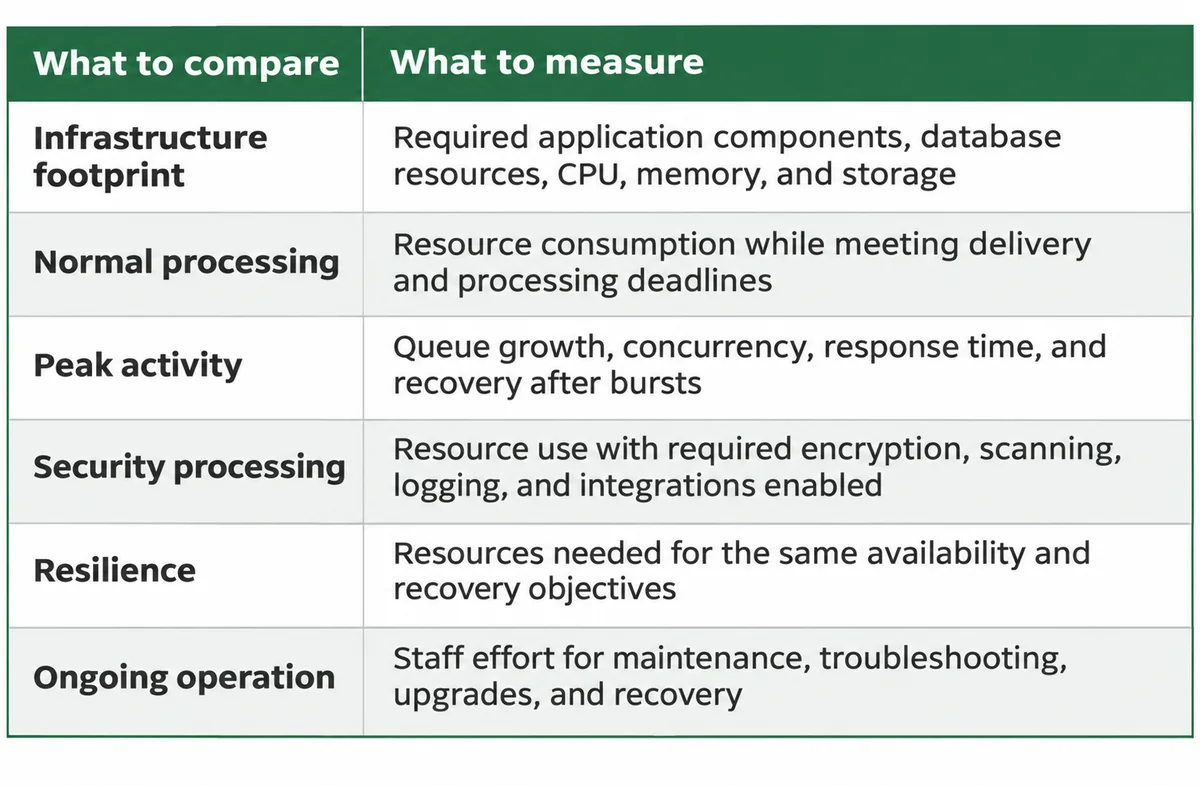
That gives the customer something more useful than a generic claim about being faster or cheaper: evidence tied to the environment they actually need.
Easier to learn, install, and maintain
We also designed TDXchange to make enterprise MFT functionality easier to learn and operate.
Our objective is a substantially simpler learning, installation, and maintenance experience than customers may encounter in complex Sterling environments. The comparison should be demonstrated through everyday work.
Can an administrator onboard a partner, configure a schedule, investigate a failure, update a certificate, and produce useful audit evidence without working through a complicated chain of procedures?
For me, that is a better usability test than watching someone who knows the product deliver a polished demonstration.
Installation deserves the same attention. Ask both teams to document prerequisites, configuration steps, validation, and recovery procedures for the proposed architecture. Compare the effort needed to reach a supported production configuration.
Maintenance is equally important. A platform remains your responsibility long after the implementation team leaves. Evaluate how your staff will apply updates, check compatibility, validate workflows, restore service, and obtain help when something goes wrong.
Enterprise software still requires training and sound engineering. The aim is to make those responsibilities understandable and manageable.
Accelerated large-file transfer is part of TDXchange
Large-file acceleration has been part of bTrade’s engineering work for years. We began developing our Accelerated File Transfer Protocol, AFTP, in 2007 and introduced a limited enterprise release in 2008, during the same era in which technologies such as Aspera were establishing accelerated data transfer as an enterprise capability.
The distinction is how we deliver it: AFTP is a native capability within the TDXchange offering. IBM Aspera is a separate product family from IBM Sterling.
For customers, that means accelerated movement of large files can operate within the same TDXchange environment used for workflow automation, security policies, partner management, monitoring, and audit reporting. They can address routine exchanges and demanding large-data workloads through one MFT platform.
That matters when moving production video, engineering files, eDiscovery collections, or other large datasets across long-distance networks. The business still needs to know who sent the data, where it went, whether it arrived, and what should happen next.
TDXchange can also generate a lightweight AFTP client for remote locations and partner endpoints, avoiding the need for a full MFT installation at every location.
For me, acceleration is most useful when it remains part of the governed business workflow.
Keep security and integration central to the decision
A smaller footprint only helps if the platform still supports the controls and connections your business requires.
TDXchange brings together Native End-to-End Zero Trust, encryption at rest and in transit, crypto agility, and post-quantum cryptographic capabilities. Its integration options include APIs, enterprise storage and cloud services, and protocols such as SFTP, FTPS, HTTPS, AS2, and AS4.
For a replacement project, I would turn those capabilities into an architecture review:
- Where will sensitive files and processing data be stored?
- Which identities can access them, and with what permissions?
- How will the platform connect to identity, monitoring, SIEM, malware scanning, and DLP systems?
- What happens when a certificate expires, a partner is unavailable, or a downstream application rejects a file?
- What evidence will establish who accessed the data and whether the business process completed?
Quantum-safe protection belongs in that review too. Examine the algorithms, product versions, protected data paths, key management, and partner compatibility. IBM also documents post-quantum capabilities in Connect:Direct, so buyers should compare implementation coverage rather than assume the presence of a keyword settles the decision.
First establish which IBM functions you are replacing
“IBM Sterling” does not describe one identical environment.
Your deployment may involve Sterling File Gateway, B2B Integrator, Connect:Direct, or a combination of products and integrations. The migration scope must identify the functions actually in use.
For example, moving file routing and scheduled exchanges is a different project from replacing specialized EDI processing, mainframe connections, or application logic built around a particular product.
A sound assessment separates three decisions:
- Replace: Functions that will move into TDXchange.
- Integrate: Systems or services that will remain and connect to TDXchange.
- Redesign: Workflows or dependencies that require a different implementation.
Do not assume that a configuration export becomes a working replacement, or that support for common transfer protocols proves compatibility with every existing connection.
This is where experienced migration engineers earn their place in the project.
Mainframe connectivity: TDAccess as an alternative to Connect:Direct
The comparison also needs to account for mainframes. Many organizations depend on file exchanges between mainframe applications, distributed systems, and external partners.
bTrade offers TDAccess, our proprietary secure transport software with encryption and compression capabilities, which directly competes with IBM Sterling Connect:Direct for mainframe and cross-platform file exchange.
TDAccess supports environments including MVS/zSeries, AS400/iSeries, and distributed platforms. That gives organizations evaluating their IBM estate a bTrade option for mainframe connectivity alongside TDXchange’s broader MFT and workflow capabilities.
The product mapping matters: evaluate TDXchange for centralized managed file transfer and orchestration, TDXchange with AFTP for accelerated large-data movement, and TDAccess for mainframe and cross-platform transport requirements.
A replacement assessment should identify operating-system versions, data formats, job dependencies, security requirements, and partner endpoints. Direct competition does not imply automatic protocol compatibility or unchanged execution of existing Connect:Direct processes. Those details belong in discovery and migration testing.
Our professional services team can assess these requirements as part of a coordinated migration plan, preserving the business outcomes while selecting the appropriate bTrade components.
Our professional services team has migrated customers from IBM environments
bTrade’s experienced professional services team has successfully completed migrations from IBM file transfer environments.
That experience is important because a migration involves much more than moving files or recreating a list of trading partners. Required behavior can be distributed across schedules, scripts, permissions, certificates, application interfaces, and operational procedures.
Our MFT Migration Service begins with understanding those dependencies and the business processes they support.
The work includes discovery, target architecture planning, workflow reconstruction, partner connectivity, testing, and controlled cutover. Where appropriate, existing and replacement workflows can operate in parallel while teams validate results.
Acceptance should cover more than successful transmission. It should establish that the correct destination received the file, required acknowledgments were captured, downstream processing worked, exceptions were handled, and the expected evidence was retained.
Migration waves, ownership, escalation, and rollback procedures should be agreed before production cutover. The exact IBM products and functions being replaced are assessed for each engagement.
Choose how you want to operate the replacement
Replacing an MFT platform does not require moving everything to the cloud.
TDXchange supports customer-operated deployments across on-premises, cloud, hybrid, and Kubernetes environments.
TDCloud provides the SaaS option, with bTrade operating and maintaining the underlying platform. Customers retain responsibility for their workflows, users, trading partners, integrations, and business policies unless additional operational services are agreed.
The choice should follow your operating model:
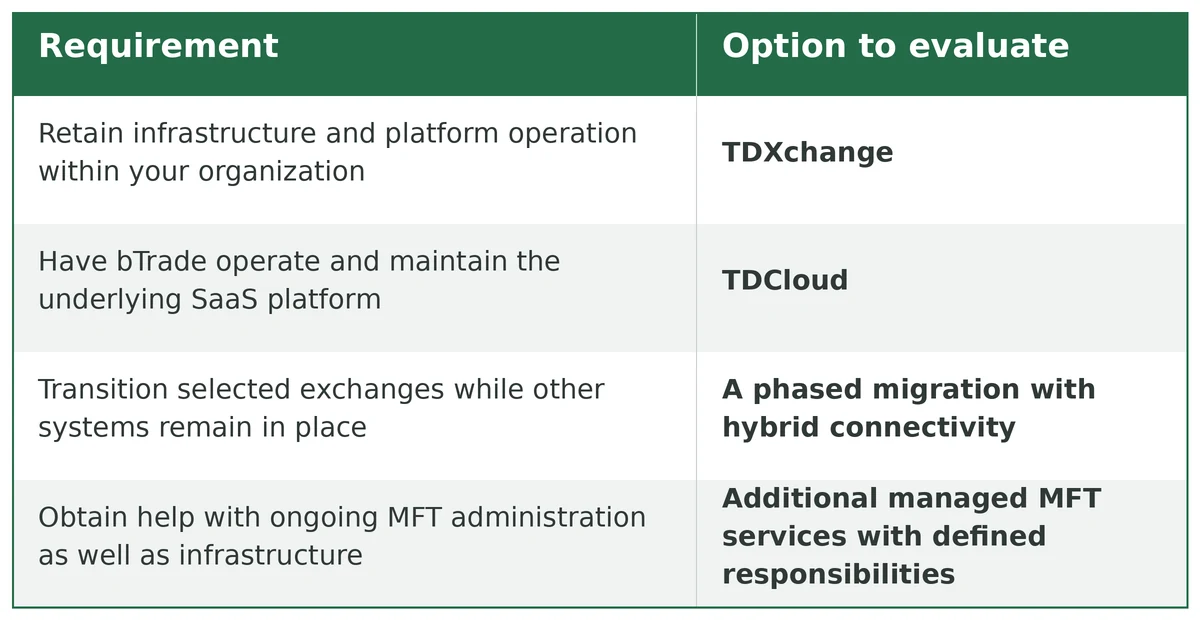
Support also belongs in this decision. Ask who will assist with an architectural issue, a failed business workflow, or a difficult production incident. Our professional services offering includes access to experienced MFT architects, engineers, and product specialists. Define the support coverage and escalation arrangements that your operation requires.
Prove the fit with your own workflows
If you are evaluating alternatives to IBM Sterling, I would include TDXchange in a practical evaluation centered on three outcomes:
Less infrastructure overhead. Easier day-to-day operation. A controlled migration that preserves business continuity.
Give your team representative work to perform. Include a normal exchange, a peak workload, a partner outage, an access-control check, and a recovery scenario. Measure both system behavior and the effort required from your people.
That is how you establish whether a platform is easier to learn, less demanding to operate, and appropriate for your business.
If your current IBM environment is becoming difficult to maintain, talk with bTrade about a migration assessment. Bring your architecture, critical workflows, and operational concerns. We can help define what should move, what should remain, and what must be demonstrated before you commit to a transition.
About the Author
Andrei Olin is Chief Technology Officer at bTrade, where he leads product strategy, delivery, architecture, and security across the company’s B2B, Managed File Transfer, and secure data exchange platforms.
Andrei has more than 30 years of experience spanning enterprise architecture, software development, infrastructure, cybersecurity, middleware, trading systems, SaaS, and Managed File Transfer. His career includes building mission-critical systems and infrastructure at Bear Stearns and Morgan Stanley, designing and operating enterprise MFT and messaging platforms for Merrill Lynch and Deutsche Bank, and building and scaling SaaS and security products at startups. He holds master’s and bachelor’s degrees in Information Technology with a focus on Information Security.
Frequently Asked Questions
Is TDXchange a good alternative to IBM MFT solutions?
Yes. TDXchange offers comparable functionality across core enterprise MFT requirements, including secure file transfer, workflow automation, trading-partner management, integration, monitoring, auditability, and high availability. Its lightweight architecture is designed to deliver these capabilities with less infrastructure overhead and simpler installation, administration, and maintenance. A feature-by-feature assessment maps your existing IBM environment to TDXchange and identifies any specialized requirements that need additional components or integration.
Does bTrade offer an alternative to IBM Sterling Connect:Direct for mainframe transfers?
Yes. TDAccess is bTrade’s secure transport software with encryption and compression capabilities for mainframe and cross-platform file exchange. It competes with Connect:Direct, with migration planning addressing platform support, endpoints, job dependencies, and required business behavior.
Does TDXchange include accelerated large-file transfer?
Yes. bTrade’s Accelerated File Transfer Protocol, AFTP, is a native capability within the TDXchange offering. It enables accelerated large-file movement within the same environment used for workflow automation, security, monitoring, and auditing. Confirm licensing and endpoint requirements for the proposed deployment.
Can TDXchange integrate with AI-assisted EDI and non-EDI mapping and translation systems?
Yes. TDXchange can integrate with external mapping and translation systems through APIs and automated workflows. Examples include TDXchange with Datuum for EDI and non-EDI mapping and transformation, and TDXchange with FlightPath Data for structured-data validation, preparation, and governance. TDXchange manages secure transfer and workflow orchestration, while the connected system performs the required data processing. This allows organizations to combine specialized tools within a governed enterprise data exchange process.
Can bTrade help migrate from IBM Sterling to bTrade solutions?
Yes. bTrade’s experienced professional services team has successfully completed migrations from IBM file transfer environments. The team assesses existing workflows, trading partners, integrations, and platform dependencies, then plans and executes the transition to the appropriate bTrade solution. Migration services include architecture planning, workflow configuration, testing, phased cutover, and rollback procedures, with support for on-premises, cloud, hybrid, and SaaS deployments.
Sources and comparison scope
This article reflects bTrade’s product positioning and engineering priorities, supported by the documentation below. Comparative statements about resource efficiency and ease of use should be validated against the specific IBM products, configurations, workloads, and operating requirements under consideration. No independently measured savings percentage or universal performance advantage is asserted.