
How bTrade and Atesta Analytics Combine Secure Managed File Transfer with Edge Data Governance
Healthcare navigation and analytics depend on sensitive information arriving from many organizations, in many formats, and under strict privacy, security, and operational requirements.
These files may contain personally identifiable information, protected health information, diagnoses, procedures, provider information, payment details, benefit data, and other sensitive records. Protecting the connection is essential, but it is only the beginning.
Organizations must also know who sent the data, whether the source was authorized, whether the file arrived completely and on time, whether its contents satisfy business requirements, what policies were applied, and whether downstream systems received information they can trust.
TDXchange from bTrade establishes trust in the identity, connection, workflow, and delivery. FlightPath Data from Atesta Analytics establishes trust in the structure, quality, provenance, and usability of the data.
Together, they form an Edge Data Governance Gateway, a controlled boundary between external data partners and the applications, analytics platforms, data lakes, and AI services that consume their information.
Executive Summary
The Edge Data Governance Gateway combines enterprise Managed File Transfer with data preboarding and quality governance.
TDXchange authenticates partners and applications, protects data in transit and at rest, applies Zero Trust and least privilege, automates exchange workflows, manages connectivity, records transaction and configuration activity, and provides resilience for critical data movement.
FlightPath Data registers incoming files with durable identities, preserves immutable versions, enforces data contracts, validates and upgrades content, records provenance and lineage, manages exceptions, and publishes approved results.
The result is not simply secure delivery. It is a governed process for receiving data from a verified source, determining whether the contents can be trusted, releasing approved information to authorized consumers, and preserving evidence of every important decision.
Key Takeaways
- Healthcare data exchange requires both secure transport and validated content.
- TDXchange provides the secure, resilient, and observable partner exchange layer.
- FlightPath Data governs registration, durable identity, immutable versioning, data contracts, validation, upgrading, lineage, exceptions, and trusted publication.
- Invalid or noncompliant data can be quarantined, rejected, returned, or routed for review before reaching production.
- Combined observability connects partner activity, file movement, validation, routing, publication, exceptions, and configuration changes.
- Automation can reduce manual review, accelerate onboarding, improve audit readiness, and help specialists focus on higher value work.
- No technology automatically provides compliance, but governed controls and detailed evidence strengthen compliance programs.
Why Healthcare Navigation Requires Two Forms of Trust
Healthcare navigators help individuals, employers, insurers, benefits managers, and managed care organizations make decisions about cost, access, provider quality, treatment options, and coverage. Their value depends on timely and accurate information from payers, providers, pharmacies, employers, and other data partners.
That information rarely arrives in one consistent form. One partner may send eligibility data through SFTP. Another may deliver claims through HTTPS or an API. Provider rosters may arrive as CSV files, while pharmacy benefit data may follow different schedules, schemas, naming conventions, and exception processes.
Even an agreed format may contain:
- Missing or unexpected columns
- Invalid codes, dates, delimiters, or character encoding
- Duplicate records and inconsistent identifiers
- Values outside permitted ranges
- Broken relationships or business rules
- Unexpected changes in volume or file size
- Records that cannot be correlated with required information
A file can be encrypted, authenticated, and delivered successfully while still being unusable or dangerous to downstream processing.
Secure exchange answers, “Did the file arrive through an authorized channel?” Data governance answers, “Can the organization safely rely on what is inside it?” Healthcare organizations need both answers.
Closing the Gap Between Transfer and Ingestion
Many organizations have secure transfer systems and platforms for loading data into applications, databases, data lakes, analytics tools, and AI services. The blind spot often sits between those layers.
An MFT platform can establish that an authorized partner delivered a protected file. An ETL or ingestion pipeline can process what it receives. Neither function alone determines whether incoming data still satisfies the partner’s agreed data contract or should be trusted by downstream consumers.
That intermediate discipline is data preboarding.
Data preboarding registers each incoming dataset, preserves its identity and version, evaluates its structure and business content, corrects permitted conditions, records lineage and operational metadata, and releases only approved results.
Without this layer, organizations often depend on scripts, spreadsheets, point solutions, and manual review. Those methods become brittle as partner counts, volumes, rules, and regulatory obligations grow. Knowledge concentrates in a few employees, changes require custom development, and troubleshooting spans multiple teams and logs.
Medical doctors, pharmacists, public health professionals, analysts, and data engineers may spend hours reviewing spreadsheets because the organization lacks a maintainable validation layer. Their expertise is valuable. Repeatedly hunting for malformed rows is usually not its best use.
What Is an Edge Data Governance Gateway?
An Edge Data Governance Gateway is a controlled boundary through which external data must pass before entering the organization’s trusted data estate.
TDXchange verifies the sender, protects the connection, governs the exchange, and records the transaction. FlightPath Data registers and versions the arrival, inspects the contents, applies the relevant data contract, records provenance and lineage, and determines whether the results should be published.
The Gateway supports a repeatable process:
- Authenticate and authorize the source.
- Securely receive or retrieve the file.
- Record partner, endpoint, protocol, identity, and transaction metadata.
- Apply file level and security policies.
- Register the arrival with durable identity and immutable version history.
- Validate structure, values, relationships, and business rules.
- Standardize, deduplicate, correlate, and upgrade permitted content.
- Quarantine, reject, return, or review information that fails policy.
- Publish approved results to authorized consumers.
- Record the history and notify, retry, or escalate when required.
How TDXchange Governs Secure Data Exchange
TDXchange is bTrade’s enterprise Managed File Transfer and secure data exchange platform. Within the Gateway, it provides the controlled exchange layer through which partner information enters, moves through, and leaves the organization.
Connectivity, Encryption, and Cryptographic Agility
TDXchange supports SFTP, FTPS, HTTPS, AS2, AS4, REST APIs, and AFTP. Centralized management of endpoints, certificates, users, and partners allows different connectivity requirements to operate under one governed model.
The platform protects information in transit and at rest using approved cryptographic controls. Its crypto agile architecture supports changing algorithms and security requirements without rebuilding every integration. bTrade also provides post quantum security capabilities for supported use cases involving information with long confidentiality requirements.
Post quantum readiness still requires cryptographic inventory, key management, interoperability testing, partner coordination, and a phased migration strategy. There is no magic checkbox, although the security review would certainly be shorter if there were.
Zero Trust Identity and Access
Network location alone should not establish trust. TDXchange explicitly authenticates and authorizes partners, users, applications, services, administrators, and workflows.
Its controls include:
- Native multifactor authentication for administrators and end users
- MFA and single sign on through external identity providers
- Role based access control and delegated administration
- Partner specific permissions
- Multi tenant organizational isolation
- Protection between internal platform services
- Authentication, authorization, and administrative records
These controls limit identities to approved files, folders, workflows, partners, and destinations according to business purpose.
Policy Automation and Resilience
TDXchange automates schedules, routing, validation handoffs, approvals, retries, notifications, encryption, signing, compression, transformation, and delivery. A file can be held until required checks succeed, returned when it fails policy, routed for review, or released automatically.
TDXchange also supports high availability, multi node clustering, secure queueing, automated retry, centralized administration, and recovery across on premises, cloud, hybrid, and Kubernetes deployments.
Resilience must still cover databases, storage, networks, identity services, keys, certificates, downstream applications, backups, and disaster recovery. Two application nodes sharing one unavailable dependency remain impressively synchronized in their inability to help.
Observability and Audit Evidence
TDXchange records transaction history, workflow activity, retries, exceptions, delivery status, identity context, and configuration changes. Its telemetry can integrate with SIEM and enterprise observability platforms.
Combined with FlightPath validation, provenance, lineage, and quality records, teams can determine:
- Who initiated the exchange and whether access was authorized
- Which partner, endpoint, protocol, file, and workflow were involved
- Which security, validation, and routing policies were applied
- Whether information was approved, quarantined, rejected, or returned
- Whether downstream publication completed
- Which exceptions, retries, dependencies, or changes affected the outcome
That is the difference between having logs and having an explanation.
How FlightPath Data Establishes Trust in the Content
FlightPath Data and its CsvPath Framework provide the Gateway’s data preboarding and quality governance layer.
FlightPath is not simply a CSV validator. It is an operational environment for governing inbound tabular data between secure transfer and production ingestion. It supports CSV, Excel, and JSONL inputs and can prepare approved information for applications, data lakes, analytics platforms, and AI services. Processing can also produce formats such as Parquet for modern data platforms.
Durable Identity, Versioning, and Data Contracts
FlightPath registers every arrival with a durable identity, allowing teams to distinguish deliveries even when a partner repeatedly uses the same filename. Immutable versions preserve what was received, which version was processed, and what output was published.
FlightPath converts partner expectations into enforceable data contracts. It can:
- Verify structures, headers, schemas, and field order
- Validate types, formats, codes, values, and completeness
- Check required relationships and cross field business rules
- Detect duplicate, inconsistent, missing, or correlated records
- Apply lookups and calculations
- Identify unexpected deviations from the agreed contract
The CsvPath Validation Language expresses these rules in declarative, reusable, testable, and versionable definitions. Critical validation logic therefore does not have to remain hidden inside an aging script that only one employee understands and everyone else is understandably afraid to touch.
Canonicalization, Exceptions, and Trusted Publication
Not every variation requires rejection. Where policy permits, FlightPath can clean, extract, normalize, correlate, deduplicate, enrich, and upgrade incoming information into an approved canonical form. This may include standardizing dates, codes, names, and identifiers; renaming or reordering fields; extracting valid subsets; and producing downstream representations and reports.
The original arrival remains identifiable while the approved output and the actions that produced it are recorded.
Validation results drive policy. Valid information can be staged and published. Invalid data can be quarantined, rejected, returned, or routed for authorized review before it contaminates applications, analytics, or AI models.
Production Automation and Enterprise Integration
FlightPath Server provides a REST API driven layer for automated registration, execution, data arrival activations, retrieval of past results, and inbound or outbound webhooks. It can participate in workflows coordinated by TDXchange or orchestration platforms such as Apache Airflow.
FlightPath can work with AWS S3, Azure Blob Storage, Google Cloud Storage, SFTP servers, and locally mounted filesystems. OpenLineage, OpenTelemetry, Slack, and webhook integrations extend lineage, telemetry, orchestration, and notification into enterprise platforms.
Development teams can profile data and build rules. Business operations teams can connect requirements to understandable validation logic and investigate exceptions. Technology operations teams can automate registration, execution, staging, publication, monitoring, and recovery.
AI assistance can generate validation logic from English requirements, explain rules, convert documentation into processing logic, create test data, and support refactoring. Generated results should still be reviewed, authorized, tested, and audited. AI may type faster, but it has not volunteered to accept responsibility at the compliance meeting.
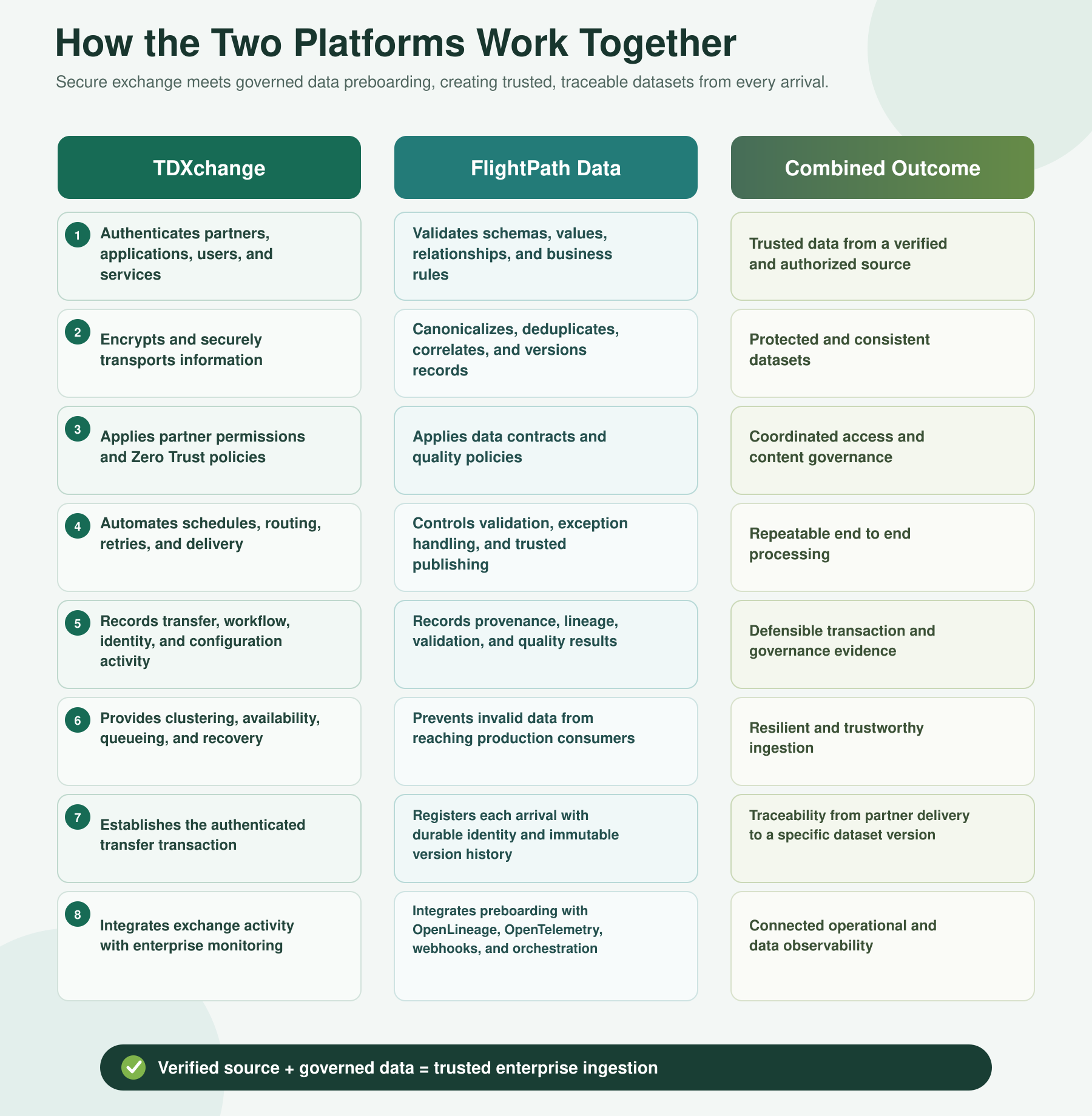
The division is straightforward:
TDXchange establishes trust in the source, connection, workflow, and delivery. FlightPath establishes trust in the data contract, content, version, lineage, and publication.
Together, they create a governed data intake process rather than a collection of disconnected transfers and validation scripts.
A Healthcare Navigation Scenario
Consider a healthcare navigation company receiving regular and ad hoc feeds from employers, insurers, pharmacy benefit organizations, provider networks, and other partners. The files contain PII and PHI, including diagnoses, procedures, provider information, demographics, locations, costs, payments, and coverage details.
Without a governed Gateway, every new partner may introduce another set of credentials, endpoints, schedules, schemas, scripts, spreadsheets, and exception procedures. Risks include unauthorized access, missed files, expired certificates, invalid codes, duplicate records, structural changes, incorrect routing, unverified downstream processing, and fragmented audit evidence.
With the Gateway, TDXchange authenticates the source, authorizes the exchange, protects the file, records the transfer, and delivers it into the governed workflow. FlightPath registers and versions the arrival, validates the data contract, checks structural and business requirements, canonicalizes approved content, records provenance and lineage, and determines whether the results can be published.
Failed data can be quarantined, rejected, returned, or routed for review. Approved information is released to authorized systems with its processing history retained for troubleshooting, security, governance, and audit.
Operational and Business Outcomes
The combined approach can provide:
- Faster partner onboarding: Centralized partner management, reusable workflows, governed data contracts, and AI assisted rule development reduce custom effort.
- Less manual review: Specialists can focus on exceptions and higher value decisions instead of routine spreadsheet inspection.
- Earlier problem detection: Invalid information is identified before it reaches applications, dashboards, analytics, payments, or AI models.
- Faster troubleshooting: Correlated transfer, identity, workflow, validation, lineage, and configuration histories show where processing stopped and what changed.
- Point in time investigation: Durable registration, immutable versions, validation history, and metadata support partner disputes, quality investigations, recovery, and audit.
- Greater scalability: Clustering, automation, reusable policies, and centralized administration allow partner and transaction growth without equivalent growth in manual work.
- Stronger governance: Evidence covers authentication, authorization, movement, validation, exceptions, changes, and downstream publication.
Compliance and Responsible AI
No platform automatically makes an organization HIPAA or SOC 2 compliant. Compliance also depends on architecture, configuration, policies, contracts, procedures, training, risk management, testing, and evidence.
The Gateway can support those programs through encryption, MFA, least privilege, role based and partner specific access, separation of responsibilities, transaction traceability, configuration history, validation, exception handling, provenance, lineage, evidence retention, alerting, recovery, availability, and security monitoring integration.
The difference is important: a configured feature shows what a product can do. Evidence shows what the control did for a specific transaction.
AI capabilities must follow the same governance model. AI services should operate as controlled workload identities with defined access to data, metadata, tools, and actions. Least privilege, human approval, testing, and auditing should apply to generated rules, recommendations, and configurations.
AI can help teams reach the right answer faster. It should not receive unrestricted access merely because it arrived with an impressive demonstration.
Executive Takeaways
Healthcare navigation depends on more than receiving data securely. Organizations must establish that the source is authorized, the exchange is protected, the contents satisfy technical and business requirements, downstream publication completed, and the entire process can be proven.
TDXchange provides the secure, Zero Trust, resilient, and observable exchange layer. FlightPath Data provides durable registration, immutable versioning, data contract enforcement, validation, upgrading, provenance, lineage, exception handling, and trusted publication.
Together, bTrade and Atesta Analytics turn external data exchange into a governed intake process from verified partner connection through trusted downstream use.
The objective is not simply to move more healthcare files. It is to receive better information, detect problems earlier, reduce manual effort, scale responsibly, and make important decisions using data the organization can trust.
To learn more about the Edge Data Governance Gateway, contact bTrade or Atesta Analytics.
About the Author
Hanz Jorgensen is Chief Operating Officer and Managing Member at bTrade, where he oversees daily operations and works closely with the leadership team to shape and execute the company’s strategic direction. With more than 20 years of experience with several different MFT/technology companies spanning system administration, development, customer support, pre-sales, and enterprise solution delivery, Hanz brings a uniquely practical perspective on what organizations actually need from managed file transfer platforms. He leads bTrade’s Solution Consulting team and plays a central role in aligning product capabilities with real customer requirements across regulated and high-complexity environments.
Frequently Asked Questions
What is an Edge Data Governance Gateway?
It is a controlled boundary that authenticates data sources, protects exchanges, validates content, applies governance policies, handles exceptions, and publishes trusted data to authorized consumers.
Why is secure file transfer alone insufficient?
Secure transfer protects the connection and data in transit, but it does not prove that the contents are complete, correctly structured, accurate, or valid for the intended business process.
What does TDXchange provide?
TDXchange provides secure multiprotocol connectivity, encryption, Zero Trust access, partner management, automation, high availability, transaction tracing, configuration history, alerting, retry, recovery, and enterprise monitoring integration.
What does FlightPath Data provide?
FlightPath registers CSV, Excel, and JSONL arrivals with durable identities, preserves immutable versions, enforces contracts, validates and upgrades content, records lineage, governs exceptions, and publishes approved results.
What is data preboarding?
Data preboarding is the governed process between secure delivery and ingestion. It registers, versions, validates, upgrades, and traces incoming data before releasing approved results.
Can invalid healthcare data be stopped before production?
Yes. Data that fails defined requirements can be quarantined, rejected, returned, or routed for review before reaching production consumers.
Can FlightPath support automated production workflows?
Yes. FlightPath Server supports REST APIs, automated registration and execution, data arrival activations, webhooks, previous result retrieval, cloud storage, SFTP, orchestration, lineage, and telemetry integrations.
How does the Gateway improve audit readiness?
It can preserve evidence of identity, authorization, file movement, workflows, validation, exceptions, routing, publication, and configuration changes.
Does the Gateway automatically provide HIPAA or SOC 2 compliance?
No. It can support compliance through security controls, governed workflows, validation, traceability, and evidence. Compliance depends on the complete organizational program.
How can AI assist the Gateway?
AI can help generate and explain validation rules, create test data, summarize activity, identify anomalies, and accelerate investigation while remaining subject to role based access, least privilege, approval, testing, and audit.
<script type="application/ld+json">
{
  "@context": "https://schema.org",
  "@graph": [
    {
      "@type": "Organization",
      "@id": "https://www.btrade.com/#organization",
      "name": "bTrade",
      "url": "https://www.btrade.com/",
      "logo": {
        "@type": "ImageObject",
        "@id": "https://www.btrade.com/#logo",
        "url": "https://cdn.prod.website-files.com/66a7f3a6c2fca5ac33297031/66a7f3a6c2fca5ac3329719f_btrade-logo.svg"
      }
    },
    {
      "@type": "WebSite",
      "@id": "https://www.btrade.com/#website",
      "url": "https://www.btrade.com/",
      "name": "bTrade",
      "publisher": {
        "@id": "https://www.btrade.com/#organization"
      },
      "inLanguage": "en"
    },
    {
      "@type": "ImageObject",
      "@id": "https://www.btrade.com/blogs/healthcare-data-exchange-tdxchange-flightpath-data-governance#primaryimage",
      "url": "https://cdn.prod.website-files.com/66a7f3a6c2fca5ac33297043/6a7f5b9272e79a2494342620_FlightPath%20TDX%20resized.png",
      "contentUrl": "https://cdn.prod.website-files.com/66a7f3a6c2fca5ac33297043/6a7f5b9272e79a2494342620_FlightPath%20TDX%20resized.png",
      "caption": "Healthcare data exchange with TDXchange and FlightPath Data"
    },
    {
      "@type": "BreadcrumbList",
      "@id": "https://www.btrade.com/blogs/healthcare-data-exchange-tdxchange-flightpath-data-governance#breadcrumb",
      "itemListElement": [
        {
          "@type": "ListItem",
          "position": 1,
          "name": "Home",
          "item": "https://www.btrade.com/"
        },
        {
          "@type": "ListItem",
          "position": 2,
          "name": "Blog",
          "item": "https://www.btrade.com/media/blog"
        },
        {
          "@type": "ListItem",
          "position": 3,
          "name": "Healthcare Navigation Built on Trustworthy Data Exchange",
          "item": "https://www.btrade.com/blogs/healthcare-data-exchange-tdxchange-flightpath-data-governance"
        }
      ]
    },
    {
      "@type": [
        "WebPage",
        "FAQPage"
      ],
      "@id": "https://www.btrade.com/blogs/healthcare-data-exchange-tdxchange-flightpath-data-governance#webpage",
      "url": "https://www.btrade.com/blogs/healthcare-data-exchange-tdxchange-flightpath-data-governance",
      "name": "Healthcare Data Exchange with TDXchange and FlightPath Data",
      "description": "Learn how TDXchange and FlightPath Data combine secure managed file transfer, Zero Trust, data validation, lineage, and governance for trusted healthcare data.",
      "isPartOf": {
        "@id": "https://www.btrade.com/#website"
      },
      "primaryImageOfPage": {
        "@id": "https://www.btrade.com/blogs/healthcare-data-exchange-tdxchange-flightpath-data-governance#primaryimage"
      },
      "breadcrumb": {
        "@id": "https://www.btrade.com/blogs/healthcare-data-exchange-tdxchange-flightpath-data-governance#breadcrumb"
      },
      "datePublished": "2026-08-12T15:46:16Z",
      "dateModified": "2026-08-12T15:46:16Z",
      "inLanguage": "en",
      "mainEntity": [
        {
          "@type": "Question",
          "name": "What is an Edge Data Governance Gateway?",
          "acceptedAnswer": {
            "@type": "Answer",
            "text": "It is a controlled boundary that authenticates data sources, protects exchanges, validates content, applies governance policies, handles exceptions, and publishes trusted data to authorized consumers."
          }
        },
        {
          "@type": "Question",
          "name": "Why is secure file transfer alone insufficient?",
          "acceptedAnswer": {
            "@type": "Answer",
            "text": "Secure transfer protects the connection and data in transit, but it does not prove that the contents are complete, correctly structured, accurate, or valid for the intended business process."
          }
        },
        {
          "@type": "Question",
          "name": "What does TDXchange provide?",
          "acceptedAnswer": {
            "@type": "Answer",
            "text": "TDXchange provides secure multiprotocol connectivity, encryption, Zero Trust access, partner management, automation, high availability, transaction tracing, configuration history, alerting, retry, recovery, and enterprise monitoring integration."
          }
        },
        {
          "@type": "Question",
          "name": "What does FlightPath Data provide?",
          "acceptedAnswer": {
            "@type": "Answer",
            "text": "FlightPath registers CSV, Excel, and JSONL arrivals with durable identities, preserves immutable versions, enforces contracts, validates and upgrades content, records lineage, governs exceptions, and publishes approved results."
          }
        },
        {
          "@type": "Question",
          "name": "What is data preboarding?",
          "acceptedAnswer": {
            "@type": "Answer",
            "text": "Data preboarding is the governed process between secure delivery and ingestion. It registers, versions, validates, upgrades, and traces incoming data before releasing approved results."
          }
        },
        {
          "@type": "Question",
          "name": "Can invalid healthcare data be stopped before production?",
          "acceptedAnswer": {
            "@type": "Answer",
            "text": "Yes. Data that fails defined requirements can be quarantined, rejected, returned, or routed for review before reaching production consumers."
          }
        },
        {
          "@type": "Question",
          "name": "Can FlightPath support automated production workflows?",
          "acceptedAnswer": {
            "@type": "Answer",
            "text": "Yes. FlightPath Server supports REST APIs, automated registration and execution, data arrival activations, webhooks, previous result retrieval, cloud storage, SFTP, orchestration, lineage, and telemetry integrations."
          }
        },
        {
          "@type": "Question",
          "name": "How does the Gateway improve audit readiness?",
          "acceptedAnswer": {
            "@type": "Answer",
            "text": "It can preserve evidence of identity, authorization, file movement, workflows, validation, exceptions, routing, publication, and configuration changes."
          }
        },
        {
          "@type": "Question",
          "name": "Does the Gateway automatically provide HIPAA or SOC 2 compliance?",
          "acceptedAnswer": {
            "@type": "Answer",
            "text": "No. It can support compliance through security controls, governed workflows, validation, traceability, and evidence. Compliance depends on the complete organizational program."
          }
        },
        {
          "@type": "Question",
          "name": "How can AI assist the Gateway?",
          "acceptedAnswer": {
            "@type": "Answer",
            "text": "AI can help generate and explain validation rules, create test data, summarize activity, identify anomalies, and accelerate investigation while remaining subject to role-based access, least privilege, approval, testing, and audit."
          }
        }
      ]
    },
    {
      "@type": "BlogPosting",
      "@id": "https://www.btrade.com/blogs/healthcare-data-exchange-tdxchange-flightpath-data-governance#article",
      "url": "https://www.btrade.com/blogs/healthcare-data-exchange-tdxchange-flightpath-data-governance",
      "mainEntityOfPage": {
        "@id": "https://www.btrade.com/blogs/healthcare-data-exchange-tdxchange-flightpath-data-governance#webpage"
      },
      "headline": "Healthcare Navigation Built on Trustworthy Data Exchange",
      "alternativeHeadline": "How bTrade and Atesta Analytics Combine Secure Managed File Transfer with Edge Data Governance",
      "description": "Learn how TDXchange and FlightPath Data combine secure managed file transfer, Zero Trust, data validation, lineage, and governance for trusted healthcare data.",
      "image": {
        "@id": "https://www.btrade.com/blogs/healthcare-data-exchange-tdxchange-flightpath-data-governance#primaryimage"
      },
      "datePublished": "2026-08-12T15:46:16Z",
      "dateModified": "2026-08-12T15:46:16Z",
      "author": {
        "@type": "Person",
        "@id": "https://www.btrade.com/blogs/healthcare-data-exchange-tdxchange-flightpath-data-governance#author",
        "name": "Hanz Jorgensen",
        "jobTitle": "Chief Operating Officer and Managing Member",
        "worksFor": {
          "@id": "https://www.btrade.com/#organization"
        },
        "sameAs": [
          "https://www.linkedin.com/in/hanzjorgensen/"
        ]
      },
      "publisher": {
        "@id": "https://www.btrade.com/#organization"
      },
      "articleSection": [
        "Healthcare Data Exchange",
        "Managed File Transfer",
        "Data Governance"
      ],
      "keywords": [
        "healthcare data exchange",
        "healthcare data governance",
        "managed file transfer",
        "TDXchange",
        "FlightPath Data",
        "Edge Data Governance Gateway",
        "Zero Trust",
        "healthcare data validation",
        "data lineage",
        "data preboarding",
        "HIPAA",
        "PHI",
        "PII"
      ],
      "about": [
        {
          "@type": "Thing",
          "name": "Healthcare data exchange"
        },
        {
          "@type": "Thing",
          "name": "Managed File Transfer"
        },
        {
          "@type": "Thing",
          "name": "Data governance"
        },
        {
          "@type": "Thing",
          "name": "Zero Trust security"
        }
      ],
      "mentions": [
        {
          "@type": "SoftwareApplication",
          "name": "TDXchange",
          "url": "https://www.btrade.com/solutions/tdxchange",
          "applicationCategory": "Managed File Transfer"
        },
        {
          "@type": "SoftwareApplication",
          "name": "FlightPath Data",
          "url": "https://www.flightpathdata.com/flightpath.html",
          "applicationCategory": "Data Governance"
        },
        {
          "@type": "Organization",
          "name": "Atesta Analytics",
          "url": "https://www.flightpathdata.com/"
        }
      ],
      "inLanguage": "en"
    }
  ]
}
</script>