

Managed File Transfer platforms do not operate in laboratories.
They support payments, healthcare records, regulatory submissions, supply chains, media distribution, customer communications, and other business processes that are expected to work every time.
Organizations still need these platforms to evolve. They need stronger security, better observability, artificial intelligence, post-quantum protection, cloud flexibility, automation, and simpler administration. But they cannot introduce every promising technology directly into a production environment and hope that enthusiasm counts as a rollback plan.
The goal is not to avoid innovation. It is to adopt meaningful innovation without turning mission-critical data exchange into an experiment.
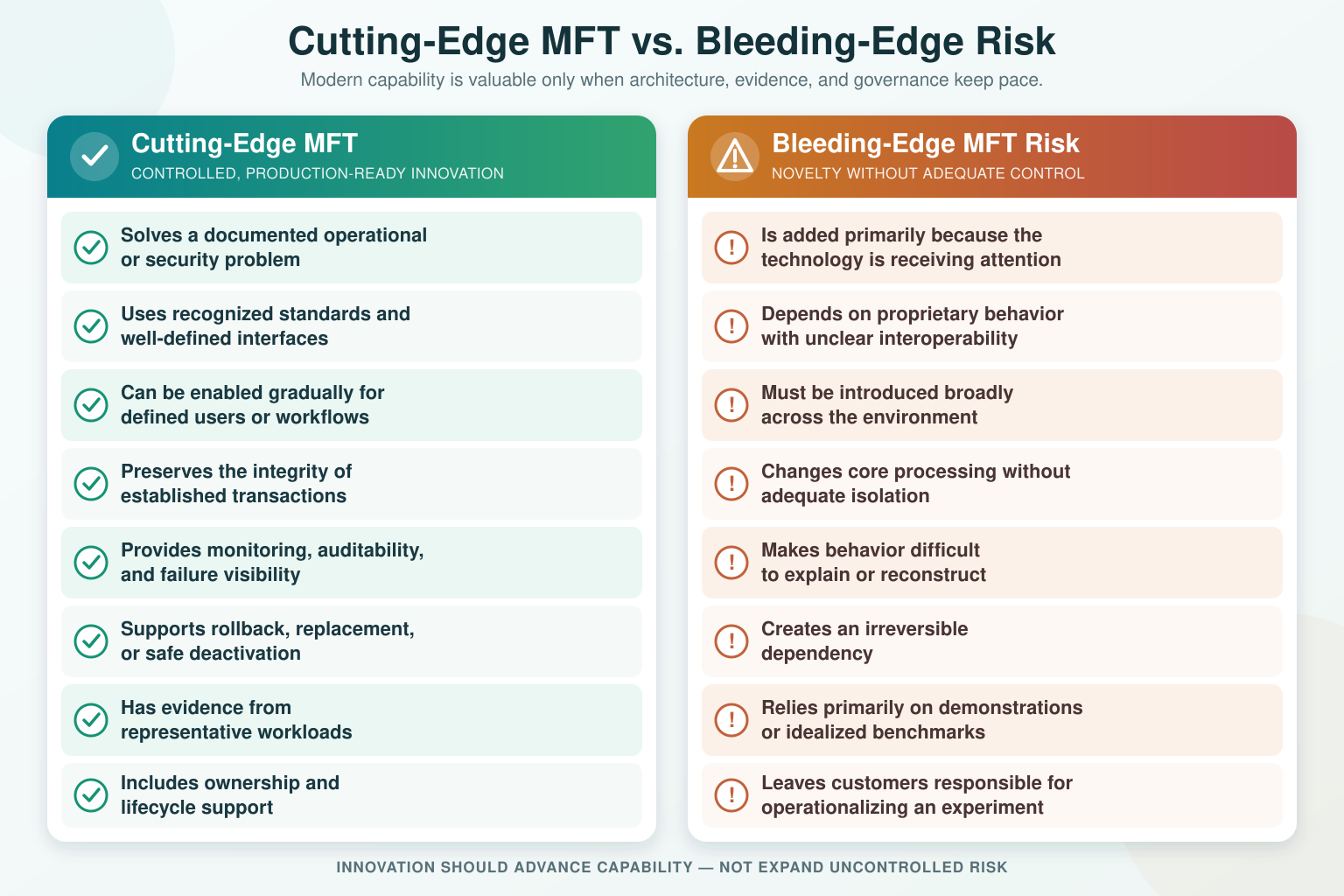
That is the difference between cutting-edge MFT and bleeding-edge risk.
In Summary
Cutting-edge Managed File Transfer combines modern capabilities with the engineering controls required for enterprise production. New technology should be standards-based, securely contained, operationally observable, reversible when necessary, compatible with existing workflows, and supported throughout its lifecycle.
Bleeding-edge risk appears when novelty moves faster than architecture, testing, governance, operational evidence, or the organization’s ability to recover.
Enterprises should therefore evaluate MFT innovation by asking more than whether a feature exists. They should ask:
- Which business problem does it solve?
- Is it based on recognized standards?
- Can it be introduced without disrupting existing workflows?
- Is access restricted by identity, policy, and least privilege?
- Can its behavior and business impact be observed?
- Can it be disabled, replaced, or rolled back safely?
- Has it been proven under representative production conditions?
- Who remains accountable when it does not behave as expected?
Modern capability and production maturity are not opposites. Good architecture allows organizations to have both.
Key Takeaways
- A long feature list does not prove that a platform is innovative or production-ready.
- The safest innovation begins with a defined customer or business problem rather than a technology looking for somewhere to live.
- Emerging capabilities should be isolated from core transaction integrity and governed through Zero Trust, role-based access, and complete auditing.
- Reversibility is one of the strongest indicators of mature innovation. Enterprises should be able to test, limit, disable, or replace a new capability without destabilizing existing flows.
- Standards reduce uncertainty, but standards alone do not prove implementation quality or operational readiness.
- Production evidence should include representative scale, failure behavior, recovery, interoperability, upgrade impact, and long-term support—not only a controlled benchmark.
- AI, post-quantum cryptography, Kubernetes, and predictive analytics require different controls. They should not be treated as one generic category called “modern.”
- A mature MFT platform protects established business processes while giving organizations controlled paths to adopt new capabilities.
What Is the Difference Between Cutting-Edge and Bleeding-Edge MFT?
The terms are often used interchangeably, but they describe different risk positions.
The National Institute of Standards and Technology has described bleeding-edge technology as carrying significant uncertainty because it has received little validation and may still succeed, fail, or be abandoned. Cutting-edge technology is more developed, but still requires thoughtful adoption. NIST: Bleeding Edge or Leading Edge?
In an MFT environment, the distinction is not simply the age of a capability. A new technology becomes an unacceptable risk when the organization cannot confidently answer how it is secured, tested, monitored, supported, contained, and reversed.
Why Innovation Risk Is Different in Managed File Transfer
MFT platforms become deeply embedded in business operations. A large implementation may contain thousands or hundreds of thousands of distinct flows connecting applications, partners, users, databases, cloud services, and regulated processes.
Some flows may have been operating for decades. Their original designers may no longer be available. Documentation may not capture every dependency, but the workflows continue performing valuable work every day.
This creates an unusual responsibility. An MFT platform must evolve without casually invalidating the business logic, security policies, certificates, schedules, routing rules, partner expectations, and downstream dependencies already built around it.
A failed experiment in an isolated productivity application may inconvenience a team. A poorly controlled change in MFT can delay payments, claims, orders, healthcare records, regulatory reports, or customer data.
That is why enterprise MFT innovation must protect three forms of continuity:
- Transaction continuity: Files and messages must not be lost, duplicated, corrupted, or delivered to the wrong destination.
- Control continuity: Authentication, authorization, encryption, auditing, retention, and governance must remain enforceable.
- Operational continuity: Teams must be able to detect problems, understand impact, recover safely, and continue meeting business commitments.
Innovation is valuable only when these responsibilities remain intact.
The Five Controls of Production-Ready MFT Innovation
Organizations can evaluate emerging MFT capabilities through five complementary controls.
1. Standards: Is the Capability Built on a Stable Foundation?
Standards create common definitions, interfaces, security expectations, and interoperability paths. They reduce the chance that an organization becomes dependent on an isolated implementation that cannot evolve.
For example, NIST has finalized its first post-quantum cryptography standards and advises organizations to begin planning migrations from quantum-vulnerable algorithms. At the same time, NIST emphasizes crypto-agility: the ability to replace or adapt cryptographic algorithms without interrupting a running system. NIST Post-Quantum Cryptography and NIST Crypto Agility
That distinction matters. Supporting a new algorithm is useful. Designing the platform so algorithms can evolve without forcing a disruptive replacement is the more mature architectural capability.
Standards should be treated as a starting point, not a substitute for implementation testing. Enterprises should still validate configuration, interoperability, key management, performance, failure behavior, and upgrade impact in their own environment.
2. Containment: Can Risk Be Limited to an Authorized Scope?
A new capability should not automatically receive access to every transaction, configuration, user, or piece of sensitive data.
Containment means the capability can be restricted according to:
- Identity
- Role
- workflow
- partner
- environment
- data classification
- permitted action
- approved integration
This is especially important for AI-assisted operations. An AI assistant that explains a configuration should not automatically be able to modify it. A model that helps investigate operational metadata should not gain access to sensitive payloads simply because they exist in the same platform.
NIST’s AI Risk Management Framework organizes AI risk management around governance, mapping, measurement, and management throughout the AI lifecycle. Those principles reinforce the need to define intended use, restrict access, evaluate behavior, and retain human accountability. NIST AI Risk Management Framework
In MFT, the correct question is not merely, “Does the platform use AI?” It is, “What can the AI see, what can it do, who authorized it, and where is every interaction recorded?”
3. Reversibility: Can the Organization Change Direction Safely?
Reversibility is one of the clearest differences between mature engineering and uncontrolled experimentation.
Before adopting an advanced capability, organizations should know whether they can:
- Test it in a non-production environment
- Enable it for a limited population
- Restrict it to selected workflows
- Run it alongside an established approach
- Shift traffic gradually
- Restore a previous configuration
- Disable it without interrupting unrelated processes
- Export configurations and evidence if the implementation changes
This principle applies to more than software releases. Cryptographic algorithms must be replaceable. AI models and providers should not become inseparable from core transaction processing. Container deployments should preserve application state and recovery behavior. Workflow enhancements should not rewrite established business logic without traceability.
An enterprise should never discover that a feature is irreversible during the incident caused by that feature.
4. Evidence: Has the Capability Been Proven Where Failure Matters?
A product demonstration proves that a capability can work. It does not prove how it behaves under sustained load, partial failure, partner outages, database latency, certificate expiration, network interruption, malformed data, or an imperfect upgrade.
Useful evidence should address:
- Representative transaction counts and file sizes
- High-frequency and high-volume behavior
- Multiple protocols and workflow types
- Component and dependency failures
- Retry, checkpoint, queue, and recovery behavior
- Upgrade and rollback scenarios
- Security and access-control enforcement
- Audit completeness
- Compatibility with established workflows
- Long-term operational use
Independent validation strengthens first-party evidence. SoftwareReviews’ recognition of bTrade for MFT strategy, innovation, and customer experience reflects verified user feedback, while AIMultiple’s 2026 evaluation reports hands-on testing of TDXchange across deployment, automation, security, administration, monitoring, and other criteria. bTrade’s SoftwareReviews recognition and AIMultiple MFT benchmark
No single award, benchmark, or customer example should decide an enterprise platform selection. Together, however, independent assessments, production references, architecture reviews, and representative testing provide a much stronger basis than a feature claim alone.
5. Governance: Who Owns the Capability Throughout Its Lifecycle?
Every new capability eventually becomes an operational responsibility.
Governance should establish:
- Who approves adoption
- Who can configure and use the capability
- What evidence is retained
- How changes are reviewed
- Which risks and limitations are documented
- How incidents are handled
- How performance and outcomes are measured
- When the capability should be updated, replaced, or retired
CISA’s Secure by Design guidance emphasizes that security responsibility should be built into technology products rather than transferred entirely to customers. That principle is particularly relevant to MFT because customers already carry responsibility for sensitive information, regulatory obligations, partner relationships, and business continuity. CISA Secure by Design
Innovation should reduce the customer’s operational burden. It should not arrive as a collection of powerful components that the customer must assemble into a safe system alone.
Applying the Framework to Emerging MFT Capabilities
Different technologies introduce different risks. The five controls help organizations distinguish a mature implementation from a fashionable label.
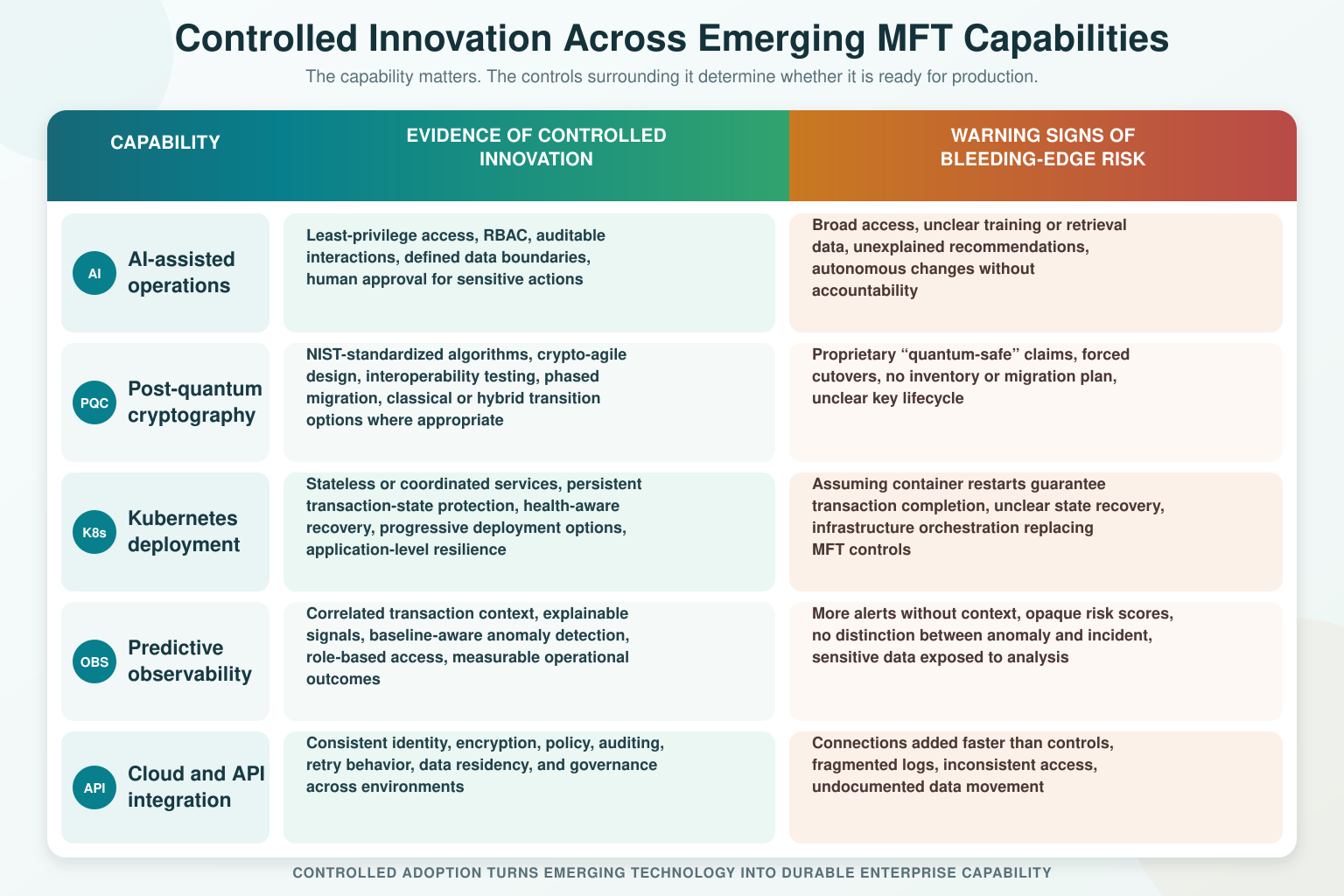
The detailed technical requirements for these capabilities belong in their respective evaluations. This framework supplies the missing question that applies to all of them: Can the organization adopt the capability without surrendering control of its existing business processes?
How TDXchange Balances Innovation and Production Maturity
TDXchange is designed around a simple principle: customers should be able to adopt new capabilities without treating their mission-critical data exchange environment as a technology experiment.
bTrade approaches that balance in several ways.
Innovation Begins with an Operational Need
Many TDXchange capabilities originate through direct work with customers operating complex data exchange environments. This keeps development focused on measurable operational, security, governance, and usability problems rather than adding technology solely because it is new.
New Capabilities Build on a Proven Transaction Foundation
TDXchange continues to protect the core responsibilities of MFT: transaction integrity, secure queueing, recoverability, authentication, authorization, auditability, workflow execution, and reliable delivery. Modern capabilities extend that foundation rather than bypassing it.
More than a dozen bTrade customers exchange millions of files daily through TDXchange, including organizations operating highly regulated and mission-critical processes. This production experience provides a practical test of architecture that a controlled demonstration cannot reproduce.
Security Boundaries Apply to Innovation
New interfaces, services, APIs, and AI-assisted capabilities remain subject to identity, least privilege, role-based access, policy enforcement, and auditing. Zero Trust is not limited to the external transfer connection; it applies to how capabilities interact inside the platform.
Organizations Retain Deployment Choice
TDXchange supports on-premises, cloud, hybrid, virtual-machine, clustered, and Kubernetes-based architectures. Customers can align adoption with their infrastructure strategy, regulatory requirements, internal expertise, and risk tolerance instead of being forced into one operational model.
Architecture Preserves the Ability to Evolve
Distributed services, centralized governance, modular capabilities, crypto-agility, and consistent transaction context allow the platform to change while protecting established workflows. The objective is controlled evolution rather than repeated replacement.
For a detailed explanation of the platform’s current capabilities, read TDXchange v5: Zero Trust, Quantum-Safe Managed File Transfer. For the architectural principles behind its longer-term direction, read The Future of Enterprise Data Exchange.
Questions to Ask an MFT Vendor About Innovation Risk
The following questions complement a traditional feature evaluation:
- What customer or operational problem caused you to develop this capability?
- Which external standards does the implementation follow?
- What parts of the platform can the capability access?
- Can it be limited to specific identities, workflows, partners, or environments?
- What happens to an active transaction if the capability becomes unavailable?
- Can we disable or replace it without affecting unrelated workflows?
- How do we test it with production-representative volumes and failure conditions?
- Which configuration changes and actions are auditable?
- How do upgrades preserve compatibility and transaction state?
- What evidence exists from long-running production environments?
- Which limitations or unsupported scenarios should we understand?
- Who helps us design, implement, test, and periodically review the capability?
A mature vendor should welcome these questions. Clear limitations, architectural tradeoffs, and adoption requirements are signs of engineering discipline and not weaknesses to hide behind another slide of feature icons.
For a broader platform-selection framework based on the six pillars of Enterprise Data Exchange, see How to Choose a Future-Proof Managed File Transfer Platform. For a market-level comparison of vendor direction, see MFT Vendor Comparison 2026–2027.
The Bottom Line
Enterprises should not have to choose between outdated stability and uncontrolled innovation.
The right MFT platform should allow organizations to adopt stronger security, AI-assisted operations, post-quantum protection, cloud infrastructure, automation, and predictive intelligence through a controlled path.
That path requires standards, containment, reversibility, production evidence, and lifecycle governance. It protects the business processes that already work while creating room for the capabilities customers will need next.
Cutting-edge technology delivers value because it is new and useful. Production-ready innovation delivers value because it is also controlled, supportable, observable, and built to last.
In Managed File Transfer, that difference matters. The files may be moving quietly, but the business depending on them is not experimental.
About the Author
Andrei Olin is Chief Technology Officer at bTrade, where he leads product strategy, delivery, architecture, and security across the company’s B2B, Managed File Transfer, and secure data exchange platforms.
Andrei has more than 30 years of experience spanning enterprise architecture, software development, infrastructure, cybersecurity, middleware, trading systems, SaaS, and Managed File Transfer. His career includes building mission-critical systems and infrastructure at Bear Stearns and Morgan Stanley, designing and operating enterprise MFT and messaging platforms for Merrill Lynch and Deutsche Bank, and building and scaling SaaS and security products at startups. He holds master’s and bachelor’s degrees in Information Technology with a focus on Information Security.
Frequently Asked Questions
What does “cutting-edge MFT without bleeding-edge risk” mean?
It means adopting modern Managed File Transfer capabilities through established standards, security boundaries, controlled deployment, representative testing, operational visibility, reversibility, and lifecycle governance. The technology advances without making critical business workflows experimental.
How can an organization determine whether an MFT feature is production-ready?
Evaluate the business problem it solves, the standards it follows, its access boundaries, failure behavior, interoperability, auditability, rollback options, production evidence, and vendor support. A demonstration alone is not sufficient evidence for a mission-critical deployment.
Is AI in Managed File Transfer inherently risky?
No. Risk depends on implementation and governance. AI-assisted MFT should operate within defined data boundaries, least-privilege access, role-based permissions, auditable interactions, and human accountability for sensitive decisions or changes.
Is post-quantum cryptography still bleeding-edge technology?
No. Standards-based post-quantum cryptography is no longer considered bleeding-edge technology. NIST finalized its first post-quantum cryptography standards in 2024 and recommends that organizations begin preparing for migration. However, an implementation can still introduce bleeding-edge risk if it relies on proprietary algorithms, forces immediate cutovers, lacks interoperability testing, or does not support crypto-agility and phased migration.
Does Kubernetes automatically make MFT resilient?
No. Kubernetes can improve infrastructure availability by restarting and redistributing workloads, but the MFT application must still protect transaction state, queues, retries, checkpoint recovery, delivery integrity, and end-to-end business outcomes.
Why is reversibility important when adopting new MFT technology?
Reversibility limits operational risk. Organizations should be able to test, constrain, disable, replace, or roll back a new capability without destabilizing established workflows or losing transaction integrity.
How does TDXchange reduce the risk of adopting advanced capabilities?
TDXchange builds advanced capabilities on a proven enterprise transaction foundation and applies identity, least privilege, RBAC, auditing, modular architecture, deployment flexibility, observability, and recovery controls. This gives organizations controlled adoption paths while preserving established business processes.
<script type="application/ld+json">
{
  "@context": "https://schema.org",
  "@graph": [
    {
      "@type": "BlogPosting",
      "@id": "https://www.btrade.com/blogs/cutting-edge-mft-without-bleeding-edge-risk#article",
      "mainEntityOfPage": {
        "@type": "WebPage",
        "@id": "https://www.btrade.com/blogs/cutting-edge-mft-without-bleeding-edge-risk"
      },
      "headline": "Cutting-Edge MFT Without Bleeding-Edge Risk: A Practical Framework for Enterprise Innovation",
      "description": "Learn how to evaluate advanced MFT capabilities through standards, isolation, reversibility, production evidence, and lifecycle governance.",
      "url": "https://www.btrade.com/blogs/cutting-edge-mft-without-bleeding-edge-risk",
      "dateCreated": "2026-08-27",
      "datePublished": "2026-08-27",
      "dateModified": "2026-08-27",
      "image": {
        "@type": "ImageObject",
        "url": "https://cdn.prod.website-files.com/66a7f3a6c2fca5ac33297043/6a90a8351d26805aae6ef61d_Cutting%20edge%20without%20bleeding%20edge%20resized.png"
      },
      "inLanguage": "en-US",
      "isAccessibleForFree": true,
      "articleSection": [
        "Managed File Transfer",
        "Enterprise Technology",
        "Cybersecurity",
        "Technology Innovation"
      ],
      "keywords": [
        "cutting-edge MFT",
        "Managed File Transfer",
        "bleeding-edge risk",
        "MFT innovation",
        "AI-assisted MFT",
        "post-quantum cryptography",
        "crypto agility",
        "Kubernetes MFT",
        "predictive observability",
        "enterprise data exchange",
        "TDXchange"
      ],
      "author": {
        "@id": "https://www.btrade.com/blogs/cutting-edge-mft-without-bleeding-edge-risk#author"
      },
      "publisher": {
        "@id": "https://www.btrade.com/#organization"
      },
      "about": [
        {
          "@type": "Thing",
          "name": "Managed File Transfer"
        },
        {
          "@type": "Thing",
          "name": "Enterprise Data Exchange"
        },
        {
          "@type": "Thing",
          "name": "Technology Risk Management"
        },
        {
          "@type": "Thing",
          "name": "Post-Quantum Cryptography"
        },
        {
          "@type": "Thing",
          "name": "Artificial Intelligence"
        }
      ]
    },
    {
      "@type": "FAQPage",
      "@id": "https://www.btrade.com/blogs/cutting-edge-mft-without-bleeding-edge-risk#faq",
      "url": "https://www.btrade.com/blogs/cutting-edge-mft-without-bleeding-edge-risk",
      "mainEntity": [
        {
          "@type": "Question",
          "name": "What does “cutting-edge MFT without bleeding-edge risk” mean?",
          "acceptedAnswer": {
            "@type": "Answer",
            "text": "It means adopting modern Managed File Transfer capabilities through established standards, security boundaries, controlled deployment, representative testing, operational visibility, reversibility, and lifecycle governance. The technology advances without making critical business workflows experimental."
          }
        },
        {
          "@type": "Question",
          "name": "How can an organization determine whether an MFT feature is production-ready?",
          "acceptedAnswer": {
            "@type": "Answer",
            "text": "Evaluate the business problem it solves, the standards it follows, its access boundaries, failure behavior, interoperability, auditability, rollback options, production evidence, and vendor support. A demonstration alone is not sufficient evidence for a mission-critical deployment."
          }
        },
        {
          "@type": "Question",
          "name": "Is AI in Managed File Transfer inherently risky?",
          "acceptedAnswer": {
            "@type": "Answer",
            "text": "No. Risk depends on implementation and governance. AI-assisted MFT should operate within defined data boundaries, least-privilege access, role-based permissions, auditable interactions, and human accountability for sensitive decisions or changes."
          }
        },
        {
          "@type": "Question",
          "name": "Is post-quantum cryptography still bleeding-edge technology?",
          "acceptedAnswer": {
            "@type": "Answer",
            "text": "No. Standards-based post-quantum cryptography is no longer considered bleeding-edge technology. NIST finalized its first post-quantum cryptography standards in 2024 and recommends that organizations begin preparing for migration. However, an implementation can still introduce bleeding-edge risk if it relies on proprietary algorithms, forces immediate cutovers, lacks interoperability testing, or does not support crypto-agility and phased migration."
          }
        },
        {
          "@type": "Question",
          "name": "Does Kubernetes automatically make MFT resilient?",
          "acceptedAnswer": {
            "@type": "Answer",
            "text": "No. Kubernetes can improve infrastructure availability by restarting and redistributing workloads, but the MFT application must still protect transaction state, queues, retries, checkpoint recovery, delivery integrity, and end-to-end business outcomes."
          }
        },
        {
          "@type": "Question",
          "name": "Why is reversibility important when adopting new MFT technology?",
          "acceptedAnswer": {
            "@type": "Answer",
            "text": "Reversibility limits operational risk. Organizations should be able to test, constrain, disable, replace, or roll back a new capability without destabilizing established workflows or losing transaction integrity."
          }
        },
        {
          "@type": "Question",
          "name": "How does TDXchange reduce the risk of adopting advanced capabilities?",
          "acceptedAnswer": {
            "@type": "Answer",
            "text": "TDXchange builds advanced capabilities on a proven enterprise transaction foundation and applies identity, least privilege, RBAC, auditing, modular architecture, deployment flexibility, observability, and recovery controls. This gives organizations controlled adoption paths while preserving established business processes."
          }
        }
      ]
    },
    {
      "@type": "Person",
      "@id": "https://www.btrade.com/blogs/cutting-edge-mft-without-bleeding-edge-risk#author",
      "name": "Andrei Olin",
      "url": "https://www.linkedin.com/in/andrei-olin/",
      "jobTitle": "Chief Technology Officer",
      "worksFor": {
        "@id": "https://www.btrade.com/#organization"
      },
      "description": "Andrei Olin has more than 30 years of experience spanning enterprise architecture, software development, infrastructure, cybersecurity, middleware, trading systems, SaaS, and Managed File Transfer. His career includes building mission-critical systems and infrastructure at Bear Stearns and Morgan Stanley, designing and operating enterprise MFT and messaging platforms for Merrill Lynch and Deutsche Bank, and building and scaling SaaS and security products at startups.",
      "sameAs": [
        "https://www.linkedin.com/in/andrei-olin/"
      ]
    },
    {
      "@type": "Organization",
      "@id": "https://www.btrade.com/#organization",
      "name": "bTrade",
      "url": "https://www.btrade.com/",
      "logo": {
        "@type": "ImageObject",
        "url": "https://cdn.prod.website-files.com/66a7f3a6c2fca5ac33297031/66a7f3a6c2fca5ac3329719f_btrade-logo.svg"
      },
      "description": "bTrade provides enterprise Managed File Transfer, B2B integration, and secure data exchange solutions."
    },
    {
      "@type": "BreadcrumbList",
      "@id": "https://www.btrade.com/blogs/cutting-edge-mft-without-bleeding-edge-risk#breadcrumb",
      "itemListElement": [
        {
          "@type": "ListItem",
          "position": 1,
          "name": "Home",
          "item": "https://www.btrade.com/"
        },
        {
          "@type": "ListItem",
          "position": 2,
          "name": "Blog",
          "item": "https://www.btrade.com/media/blog"
        },
        {
          "@type": "ListItem",
          "position": 3,
          "name": "Cutting-Edge MFT Without Bleeding-Edge Risk",
          "item": "https://www.btrade.com/blogs/cutting-edge-mft-without-bleeding-edge-risk"
        }
      ]
    }
  ]
}
</script>