
Executive Summary
Pharmaceutical organizations need managed file transfer platforms that protect sensitive information, preserve data integrity, automate controlled workflows, and provide traceable evidence. Depending on the activity, applicable requirements may include FDA 21 CFR Part 11, EU GMP Annex 11, Good Clinical Practice, and DSCSA. Meeting these requirements depends on the complete implementation, including validation, documented procedures, supplier oversight, and ongoing governance.
bTrade's TDXchange supports these objectives through multi-step workflow automation, quantum-safe encryption, Native End-to-End Zero Trust, granular role-based access control, AI-assisted anomaly detection, flow-level DLP integration, and tamper-resistant audit trails. Organizations can evaluate customer-operated TDXchange or bTrade-operated TDCloud SaaS according to their deployment, operational, and oversight requirements.
A successful transfer is only part of the outcome. Pharmaceutical teams also need to establish that the correct information reached an authorized recipient, retained its integrity and required context, and was accepted by the receiving application. This article explains the requirements, architectural decisions, and evidence organizations should evaluate when selecting an MFT platform for pharmaceutical workflows.
When a file transfer becomes a pharmaceutical business risk
Consider a few illustrative situations.
A laboratory sends results needed for a manufacturing decision. The transfer completes, but the receiving application rejects the file. If monitoring stops at delivery, the business may discover the problem only when someone needs those results.
A clinical data file reaches the wrong research partner. Encryption protects it during transmission, but sending information securely to an incorrect destination still creates an exposure.
A workflow retries after a timeout. Without appropriate duplicate handling, the receiving system may process the same information twice.
Each situation has an operational consequence: delayed decisions, exposed information, unreliable records, or additional investigation. The file-transfer architecture should account for those consequences before the workflow enters production.
Which pharmaceutical compliance requirements matter?
The applicable requirements depend on the activity, records, jurisdiction, and intended use of the system.
FDA 21 CFR Part 11
Part 11 applies to electronic records within its defined scope, including records maintained or submitted electronically under applicable FDA requirements. Organizations should identify the records and processes in scope alongside the underlying regulations requiring those records.
Working in pharmaceuticals does not automatically make every exchange a Part 11 process. The assessment must consider how the electronic records are used. www.fda.gov
EU GMP Annex 11
For computerized systems used in Good Manufacturing Practice activities, Annex 11 addresses application validation, infrastructure qualification, risk management, supplier responsibilities, and lifecycle controls.
The MFT implementation should be assessed within the regulated process it supports, including its configuration, interfaces, operating procedures, and assigned responsibilities. health.ec.europa.eu
GxP data integrity and ALCOA+ principles
Pharmaceutical data should remain attributable, legible, contemporaneous, original or a true copy, and accurate. ALCOA+ also emphasizes completeness, consistency, endurance, and availability. These are data integrity principles, rather than a standalone software certification.
FDA and MHRA guidance connect data integrity to the complete data lifecycle and the context needed to understand a record. www.fda.gov
For file exchange, identify which metadata, timestamps, identifiers, and related records must accompany the data. A laboratory result without the information needed to associate it with the correct sample or study may be readable but operationally incomplete.
Good Clinical Practice and clinical-trial data
Exchanges involving sponsors, contract research organizations, laboratories, and investigator sites should be assessed against applicable Good Clinical Practice requirements.
EMA’s guidance on computerized systems and electronic data in clinical trials addresses data transfer, validation, metadata, audit trails, security, and agreements between responsible parties. www.ema.europa.eu
Define the approved source and destination, expected format, reconciliation process, and response to rejected or incomplete transfers. Establish who investigates discrepancies and how corrections preserve the history needed to understand what happened.
Drug Supply Chain Security Act
For applicable U.S. prescription-drug distribution activities, DSCSA establishes requirements for interoperable electronic tracing at the package level. FDA recommends GS1 EPCIS for exchanging relevant product-tracing information. Applicability depends on the products, transactions, and trading partners involved. www.fda.gov
MFT can provide a controlled transport layer between partners and serialization or traceability applications. The implementation must also address required message content, partner verification, application-level validation, and exception handling. Successful file delivery alone does not establish DSCSA compliance.
Privacy and contractual obligations may also apply to personal information, confidential research, and partner data. Quality, privacy, and security teams should establish the scope before selecting controls.
What should pharmaceutical organizations evaluate in an MFT platform?
Start with the workflow and the evidence needed to demonstrate that it operates as intended.
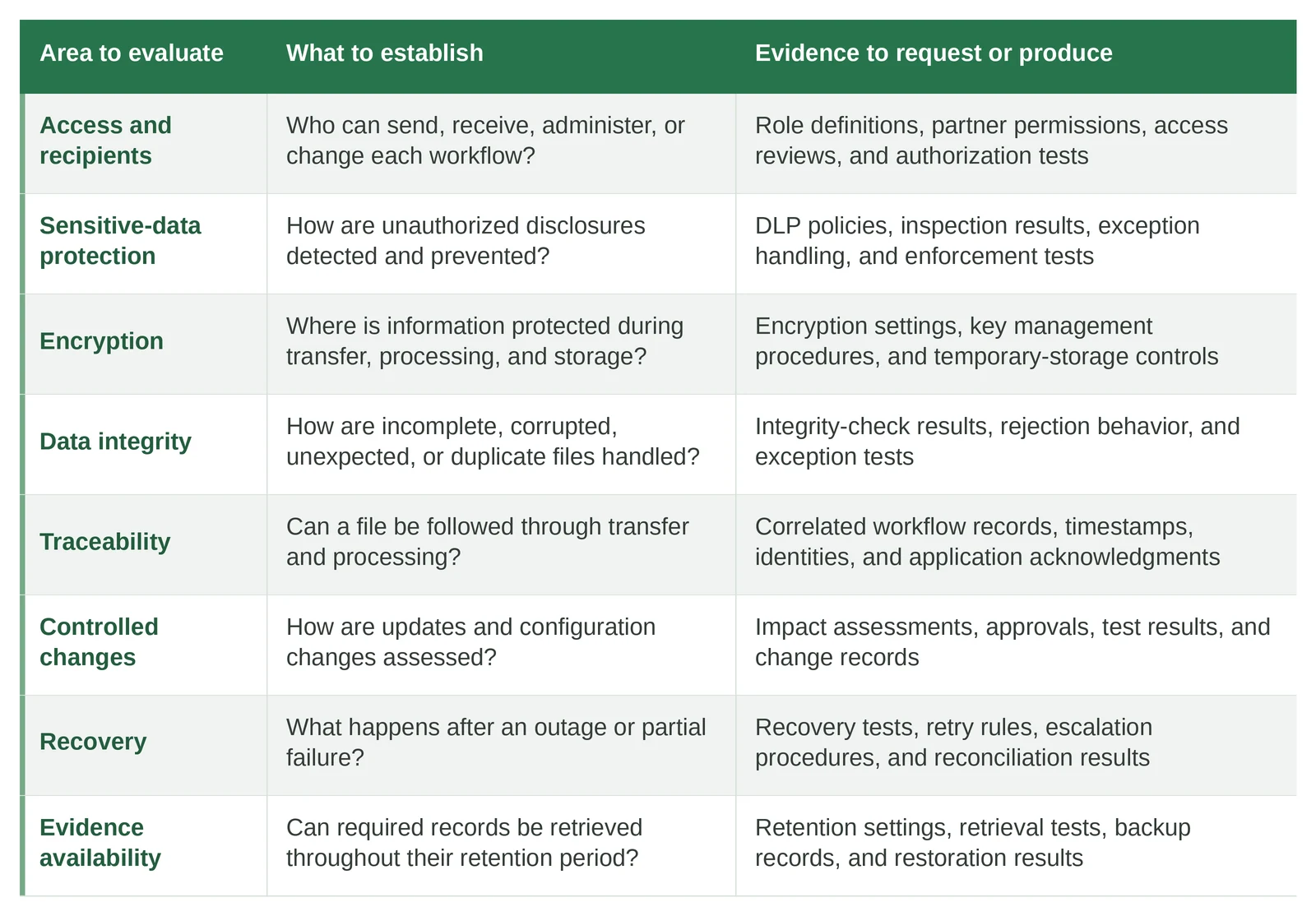
These evaluation areas should be mapped to the organization’s intended use and documented risk assessment.
Build security around the pharmaceutical workflow
Map the complete path from the originating application to the receiving business process. Include landing folders, temporary storage, integration services, partner connections, and systems that transform or retain the information.
TDXchange provides complementary security capabilities that organizations can configure around these exchanges.
Native End-to-End Zero Trust
TDXchange applies authentication, authorization, least-privilege access, and policy enforcement across platform interactions.
For a pharmaceutical exchange, verify the identity and permissions of the laboratory, application, service account, or partner initiating the activity. An internal network location should not automatically make an exchange trusted.
Granular access control and separation of responsibilities
TDXchange provides granular role-based access controls for authorized mailboxes, partner exchanges, and operational or administrative functions.
A laboratory partner may need access only to its designated exchanges. An operator may monitor transfers, while a separate administrator manages configuration. Design permissions around these responsibilities and review them when personnel, partners, or business requirements change.
Quantum-safe encryption and crypto agility
TDXchange offers quantum-safe encryption capabilities and crypto agility to support evolving protection requirements.
Pharmaceutical research and intellectual property can have long confidentiality requirements. Identify which exchanges and stored records require long-term protection, then assess compatible algorithms, endpoints, partner configurations, and key management.
Protection depends on the implemented configuration and participating systems. Quantum-safe capabilities support security planning; they do not by themselves establish pharmaceutical compliance.
DLP integration at the individual flow level
TDXchange integrates with data loss prevention systems at the individual flow level to help prevent sensitive-data leakage.
For example, an outbound clinical-data exchange may require inspection for information that is inappropriate for the intended recipient. A research collaboration may require different sharing policies from a supplier invoice workflow.
Define what the connected DLP service inspects and how the workflow responds to its decision. Depending on the integration and configuration, the response may include holding delivery, rejecting the exchange, or requiring review.
Inspection must occur where the content is readable to the DLP service. Establish how unavailable or inconclusive inspection results are handled so that a technical failure does not silently bypass the intended control.
AI-assisted anomaly detection
TDXchange offers AI-assisted anomaly detection to help teams identify unusual activity and investigate potential operational or security problems.
For pharmaceutical workflows, define monitoring scenarios around unexpected transfer patterns, partner activity, or departures from established processing behavior. Establish which signals the implementation can evaluate and who investigates the resulting alerts.
Detection should support governed decisions and appropriate human oversight.
Protection at rest
Sensitive copies may exist in laboratory exchange folders, processing areas, archives, backups, and databases. Identify each location and assign responsibility for encryption, access, keys, and retention.
Where downstream applications store sensitive information in database columns, evaluate column-level protection within those applications. MFT encryption does not automatically protect every downstream copy.
For a broader explanation of these controls, see Modern Secure File Transfer: Layered Security, Zero Trust, and Operational Best Practices.
Automate the complete exchange and verify its outcome
A pharmaceutical workflow may need to receive a file, inspect its contents, validate its structure, apply security policies, route it, obtain an acknowledgment, and notify the responsible team.
TDXchange supports built-in multi-step workflows initiated by schedules, incoming files, events, or API requests. Configure dependencies, retries, approvals, and exception handling around the business process.
Successful transport does not necessarily confirm that a laboratory information management system, manufacturing application, or clinical platform accepted the information.
Where that distinction matters, capture receiving-system acknowledgments or processing results through configured integrations. If the receiving system cannot provide them, document the visibility limit and establish reconciliation.
Similarly, a checksum can help establish that a file remained unchanged during transfer. It does not prove that the source data was accurate or that a transformation preserved its business meaning.
Maintain evidence that supports pharmaceutical review
TDXchange’s tamper-resistant audit histories help teams investigate transfer activity, workflow execution, access, and configuration changes.
For a regulated exchange, determine how those records connect to the relevant sample, study, manufacturing record, or distribution transaction. Define retention, review responsibilities, and retrieval procedures.
Transfer logs also serve a different purpose from the originating application’s record-change audit trail. Establish which system preserves each type of evidence and how related records can be retrieved together during an investigation or inspection.
For a broader discussion of transfer histories, administrative activity, and audit evidence, see What Auditors Expect From Modern MFT Platforms.
Plan validation and supplier assessment before production
Define intended use and acceptance criteria before installation and configuration begin.
Establish which documents the supplier provides and which your organization must create, review, approve, and maintain. Depending on scope, these may include requirements, data-flow diagrams, configuration records, test evidence, operating procedures, and supplier assessment information.
Testing should cover failures as well as successful exchanges:
- A laboratory partner attempts to retrieve another partner’s file.
- Required sample or study metadata is missing.
- DLP identifies prohibited content or becomes unavailable.
- A transfer is interrupted and restarted.
- A duplicate file arrives.
- The receiving application rejects the information.
- Recovery requires outstanding transfers to be reconciled.
Agree on documentation and assistance during evaluation. This makes responsibilities clear before the platform supports a regulated process.
Keep updates compatible with controlled operation
Software needs maintenance, and security threats continue to evolve. Pharmaceutical organizations also need to understand how changes affect established processes.
Define how platform updates, patches, certificates, connectors, DLP policies, detection configurations, and workflow changes are assessed. Determine which changes require testing, who approves production deployment, and what recovery options are available.
Annex 11 includes expectations for validation documentation, change records, and appropriate testing. Managing change therefore belongs in the operating model throughout the system lifecycle. health.ec.europa.eu
Choose TDXchange or TDCloud according to operating responsibilities
The deployment decision should reflect how the organization intends to operate, maintain, and oversee its file-transfer environment.
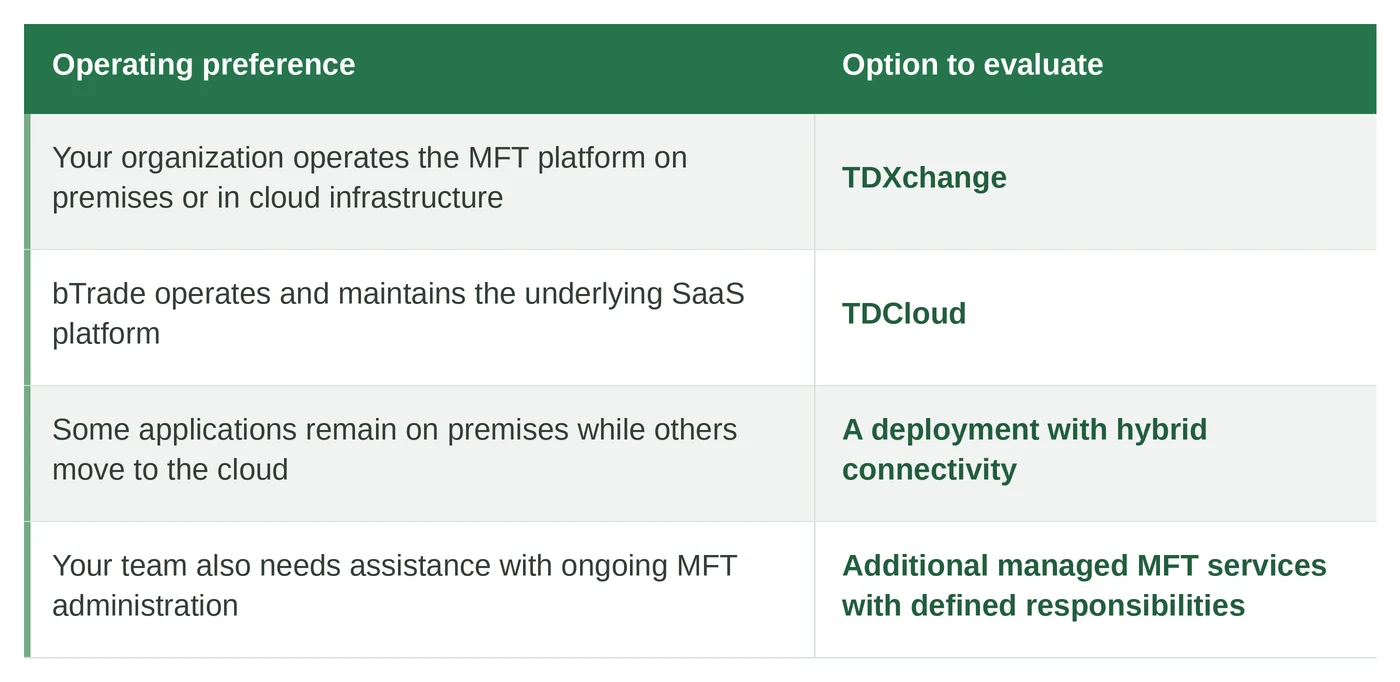
TDCloud is built on TDXchange. Customers retain responsibility for workflows, users, partners, integrations, and business policies unless additional services are specifically agreed.
For pharmaceutical use, define maintenance, incident handling, evidence access, recovery, and support for validation activities. SaaS changes operational responsibilities, while the regulated organization retains oversight of its process.
For a related biotech deployment example, read Saved by TDCloud.
About the Author
Hanz Jorgensen is Chief Operating Officer and Managing Member at bTrade, where he oversees daily operations and works closely with the leadership team to shape and execute the company’s strategic direction. With more than 20 years of experience with several different MFT/technology companies spanning system administration, development, customer support, pre-sales, and enterprise solution delivery, Hanz brings a uniquely practical perspective on what organizations actually need from managed file transfer platforms. He leads bTrade’s Solution Consulting team and plays a central role in aligning product capabilities with real customer requirements across regulated and high-complexity environments.
Frequently Asked Questions
Can TDXchange support pharmaceutical file-transfer requirements?
Yes. TDXchange provides security, multi-step workflow automation, traceability, and audit capabilities relevant to pharmaceutical exchanges. Suitability should be established against the organization’s intended use, integrations, validation needs, and operating procedures.
Does implementing MFT make a process compliant with FDA 21 CFR Part 11?
No. MFT can support relevant technical controls, but compliance depends on applicable requirements and the complete implemented process, including configuration, validation, procedures, training, and ongoing governance.
Can TDXchange help prevent sensitive-data leakage?
Yes. TDXchange combines granular access controls and encryption with DLP integration at the individual flow level. Organizations can define inspection policies and workflow responses appropriate to each exchange. Effectiveness depends on the connected DLP system, configuration, content visibility, and enforcement decisions.
Can pharmaceutical organizations use SaaS MFT?
Yes, SaaS can be evaluated for pharmaceutical workflows. The assessment should address supplier suitability, intended use, security, evidence availability, change management, recovery, and documented responsibilities.
Start with the exchange your business cannot afford to get wrong
Pharmaceutical file transfer requires more than secure delivery. Organizations need controlled access, preserved data integrity, validated workflows, and evidence that the exchange achieved its intended outcome.
Start with one critical workflow. Identify its sensitive information, authorized recipients, processing dependencies, and failure scenarios. Then evaluate the platform, integrations, and operating responsibilities against those requirements.
Contact bTrade to discuss how TDXchange or TDCloud can support your pharmaceutical file-transfer requirements.