
Managed File Transfer audits are no longer limited to confirming that files were encrypted and successfully delivered.
Auditors increasingly examine the complete governance surrounding file exchange, including who accessed information, which controls were applied, what changed, whether activity was monitored, how incidents were handled, and whether the organization can produce reliable evidence.
For organizations subject to frameworks such as PCI DSS, HIPAA, GDPR, DORA, SOX, GLBA, NIST, ISO 27001, SOC 2, or CJIS requirements, the MFT platform frequently becomes an important source of that evidence.
Executive Summary
Auditors evaluating a Managed File Transfer platform generally expect evidence of encryption, access control, accountability, transfer traceability, change management, monitoring, retention, and incident response.
A modern MFT platform should help an organization answer:
- Who accessed or transferred the information?
- What information was transferred?
- When and where did the transfer occur?
- Was the information encrypted in transit and at rest?
- Which workflow and security policies were applied?
- Were administrative and configuration changes recorded?
- Can the complete chain of custody be reconstructed?
- Were suspicious activities detected and investigated?
- Can audit evidence be produced without manually correlating multiple systems?
Enterprise MFT platforms can support these requirements through centralized controls, detailed audit trails, role based access, encryption, monitoring, automated workflows, and end-to-end transaction visibility.
However, no MFT product creates compliance by itself. Compliance depends on how the technology is configured, operated, monitored, documented, and incorporated into the organization’s broader security and risk management program.
Key Takeaways
- Auditors expect evidence of control, not simply confirmation that a file was delivered.
- Encryption is essential, but it must be combined with access governance, traceability, monitoring, change control, and retention management.
- MFT audit trails should cover transfers, user activity, administrative actions, configuration changes, and policy decisions.
- Framework requirements differ. AI, anomaly detection, malware inspection, and quantum safe encryption should be positioned accurately as advanced controls unless specifically required.
- Modern MFT helps support PCI DSS, HIPAA, GDPR, DORA, GLBA, SOX, NIST, ISO 27001, SOC 2, CJIS, and other compliance programs.
- An MFT platform supports compliance but does not make an organization compliant by itself.
- Centralized governance and automated evidence collection can significantly reduce the time and effort required to prepare for an audit.
The Eight MFT Areas Auditors Examine Most Closely
Although specific requirements vary by regulation, industry, and audit scope, auditors generally examine eight areas when evaluating Managed File Transfer environments. They are not simply confirming that files were encrypted and delivered. They want evidence that access is governed, activity is traceable, changes are controlled, risks are monitored, and security policies are consistently enforced.
1. Audit Trails, Logging, and Accountability
Auditors expect complete, reliable visibility into file transfers, user activity, administrative actions, security events, and workflow execution.
Organizations should be able to demonstrate:
- Who initiated, received, accessed, or modified a transfer
- When each activity occurred
- The source and destination systems
- Which trading partner, user, or service account was involved
- Authentication and authorization results
- Transfer status and delivery confirmation
- Workflow steps, routing decisions, and retries
- Administrative and configuration activity
- Security events and policy enforcement decisions
- Retention and deletion actions
Audit records should be centralized, searchable, time synchronized, protected against unauthorized modification or deletion, and retained according to organizational and regulatory requirements.
A defensible audit trail must provide enough context to reconstruct an event without manually correlating fragmented logs from multiple systems.
2. Zero Trust Access Controls and Authentication
Modern auditors evaluate whether access is explicitly authorized, limited to a legitimate business purpose, and continuously governed across users, applications, services, and trading partners.
The core principle of Zero Trust is simple:
Never trust. Always verify.
For MFT environments, this means trust should not be granted solely because a user or system is inside the network, possesses valid credentials, or has connected successfully in the past.
Auditors commonly review:
- Role based access control
- Least privilege enforcement
- Multi-factor authentication
- Enterprise identity and single sign-on integration
- Service-to-service authentication
- Segregation of duties
- File and workflow-level permissions
- Trading partner access governance
- Privileged account management
- Periodic access certification
- Immediate access revocation
- Authentication and authorization of nonhuman identities
Common audit questions include:
- Can users access only the partners, workflows, and information required for their roles?
- Are administrative responsibilities properly separated?
- Are permissions reviewed periodically?
- Are dormant accounts identified and removed?
- Are service accounts governed and monitored?
- Can access be revoked immediately?
- Are partner identities verified before transfers are accepted?
- Are sensitive administrative actions logged?
In MFT, Zero Trust extends beyond user authentication. It includes partner verification, workflow authorization, service identity, transfer-level policy enforcement, and validation of each request based on identity, context, and risk.
3. Encryption, Cryptographic Governance, and Data Protection
Organizations must demonstrate that sensitive information is protected throughout its lifecycle, not only while it crosses the network.
Auditors may examine:
- Encryption in transit
- Encryption at rest
- Payload-level encryption
- Approved protocols, algorithms, and key lengths
- Certificate and SSH key management
- Cryptographic key generation, storage, rotation, and revocation
- Expiration monitoring
- Protection of credentials and secrets
- Data retention and secure deletion
- Cryptographic inventory and migration planning
Auditors may also ask whether obsolete protocols, weak ciphers, expired certificates, or unmanaged keys remain in the environment.
Quantum safe encryption is not yet a universal compliance requirement. However, crypto agility and post-quantum migration planning increasingly demonstrate mature long-term risk management, particularly when sensitive information must remain confidential for many years.
4. End-to-End Transfer Traceability and Chain of Custody
A delivery confirmation alone may not establish a complete chain of custody.
Auditors expect organizations to reconstruct the entire lifecycle of a file, including:
- File receipt
- Partner or user authentication
- Authorization and policy validation
- Decryption, integrity checking, and content validation
- Workflow execution
- Transformation and routing decisions
- Delivery attempts and retries
- Final delivery and confirmation
- Retention, archival, or deletion
The audit record should connect these activities as one end-to-end transaction rather than present them as unrelated technical events.
Complete traceability helps organizations demonstrate accountability, integrity, policy enforcement, and reliable delivery. It also reduces the time required to investigate incidents, resolve partner disputes, answer regulatory inquiries, and determine whether an SLA was met.
5. Change Management and Configuration Governance
Routine configuration changes can introduce operational, security, and compliance risks. Auditors therefore examine whether changes are authorized, documented, traceable, and appropriately separated from approval responsibilities.
Relevant changes may include:
- Trading partner modifications
- Workflow and routing updates
- Certificate and key rotations
- Protocol or encryption changes
- User and role modifications
- Security policy updates
- Retention policy changes
- Schedule and automation changes
- Infrastructure and production configuration changes
Organizations should maintain:
- A complete history of changes
- Before and after values
- The identity of the person making the change
- Date and time of the change
- Business justification
- Approval records when required
- Testing and deployment evidence
- Audit-ready reports
- The ability to correlate incidents with recent changes
Strong configuration governance demonstrates that production changes are controlled and that unauthorized or high-risk modifications can be detected quickly.
6. Proactive Threat Detection, Monitoring, and Anomaly Detection
Traditional logging records what happened. Modern security monitoring must also help organizations identify unusual behavior and emerging risk.
Monitoring should evaluate conditions such as:
- Repeated authentication failures
- Unexpected transfer destinations
- Unusual file sizes or transfer volumes
- Transfers outside approved schedules
- Sudden changes in transfer frequency
- Suspicious user or administrator activity
- Abnormal trading partner behavior
- Repeated retries or delivery failures
- Unauthorized configuration changes
- Workflow delays and potential SLA breaches
Behavioral analytics and AI-assisted anomaly detection can strengthen these controls by identifying deviations from established patterns that static thresholds may overlook.
Not every framework specifically requires AI. However, many require monitoring, event analysis, and appropriate response. AI can help organizations satisfy those objectives more effectively by detecting subtle changes, prioritizing risk, and helping operations teams act before an anomaly becomes an outage, breach, or compliance incident.
7. Malware Prevention and Automated Incident Response
Encryption protects information from unauthorized disclosure, but it does not determine whether an encrypted file contains malware, ransomware, prohibited data, or other harmful content.
Based on the organization’s risk assessment, auditors may examine whether file transfer workflows support:
- Antivirus and antimalware integration
- File type and content validation
- Pre-delivery content inspection
- Data loss prevention integration
- Automated quarantine
- Policy-driven rejection or blocking
- Real-time security notifications
- SIEM and incident response integration
- Documented investigation and remediation
- Evidence of the action taken
Automated policy enforcement can reduce human error, apply controls consistently, and accelerate response. However, automated decisions must remain explainable, logged, governed, and subject to appropriate administrative review.
The specific controls required will depend on the information being transferred, the organization’s threat model, and its applicable regulatory obligations.
8. AI Governance, Access Control, and Data Protection
As organizations introduce AI-assisted administration, anomaly detection, and operational intelligence, auditors and risk teams are beginning to examine how AI interacts with enterprise information.
They may ask:
- What information can the AI access?
- Can it access regulated data or customer payloads?
- Are AI permissions limited by role and business purpose?
- Is information sent to an external model provider?
- Are prompts, responses, recommendations, and actions logged?
- Can AI-generated actions affect production configurations?
- Is human approval required for sensitive actions?
- Can administrators review, override, or reject AI recommendations?
- How is inaccurate or inappropriate output detected?
- Are data retention and privacy requirements applied to AI interactions?
Strong AI governance should include:
- Zero Trust access principles
- Least privilege permissions
- Clearly defined data boundaries
- Role based access to AI functions
- Restrictions on sensitive repositories and file contents
- Data classification and masking controls
- Auditable AI interactions
- Policy-based authorization
- Human oversight for consequential actions
- Monitoring of AI activity and outcomes
- Protection against unauthorized data disclosure
AI should be treated as another controlled identity. It should receive access only to information explicitly authorized by policy and should never have unrestricted visibility into transferred content merely because it operates within the MFT platform.
For MFT environments, the most defensible architecture allows AI to improve anomaly detection and operational decision-making while maintaining strict separation from sensitive payloads unless access is specifically authorized, necessary, and auditable.
What These Eight Areas Demonstrate
Together, these controls help organizations establish that their MFT environment provides:
- Confidentiality through encryption and controlled access
- Integrity through validation, traceability, and protected audit records
- Availability through monitoring and operational oversight
- Accountability through identity attribution and audit evidence
- Governance through policy enforcement and change control
- Resilience through early detection and automated response
- Privacy through data minimization, retention, and restricted access
No MFT platform makes an organization compliant by itself. However, a modern platform can provide many of the technical controls and audit records required to support PCI DSS, HIPAA, GDPR, DORA, GLBA, SOX, NIST, ISO 27001, SOC 2, CJIS, CMMC, and other security and regulatory programs.
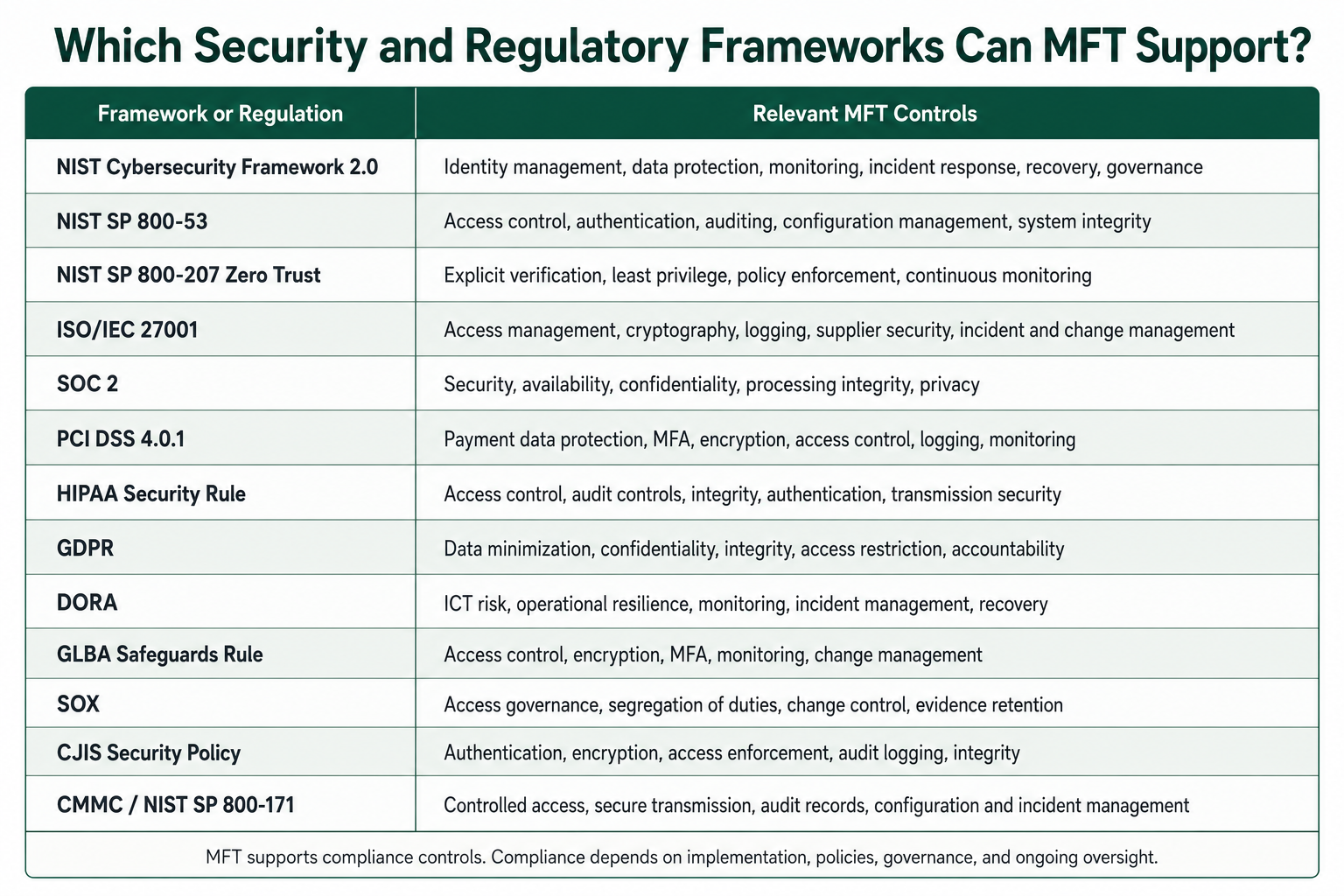
These mappings demonstrate how MFT controls can contribute to a broader compliance program. Applicability and sufficiency must be determined by the organization, its legal and compliance teams, and its auditors.
How Does MFT Support Specific Compliance Requirements?
PCI DSS 4.0.1
PCI DSS establishes technical and operational requirements for protecting payment account data. An MFT platform can support those requirements through encryption, strong authentication, least privilege, MFA, audit logging, activity monitoring, secure configuration, and controlled retention. PCI Security Standards Council
HIPAA Security Rule
For transfers containing electronic protected health information, MFT can support HIPAA technical safeguards through access control, authentication, audit controls, integrity protections, and transmission security. HHS specifically identifies mechanisms that record and examine system activity as part of the Audit Controls standard. U.S. Department of Health and Human Services
GDPR
GDPR does not prescribe a specific file transfer product. It requires appropriate technical and organizational measures based on risk. MFT can support security of processing through encryption, access restrictions, traceability, retention controls, data minimization, and evidence of accountability. Official GDPR text
DORA
For financial entities operating in the European Union, MFT may form part of the ICT environment governed by DORA. Centralized monitoring, resilience, incident evidence, change tracking, testing, third-party oversight, and recovery capabilities can support an organization’s broader DORA program. Official DORA text
GLBA Safeguards Rule
The Safeguards Rule calls for protections such as access controls, encryption, MFA, monitoring, change management, and service provider oversight. MFT can provide and document many of these controls for customer information moving between internal systems and third parties. Federal Trade Commission
NIST Cybersecurity Framework 2.0
NIST CSF 2.0 organizes cybersecurity outcomes around Govern, Identify, Protect, Detect, Respond, and Recover. MFT capabilities can support these outcomes through access governance, encryption, continuous monitoring, adverse event analysis, incident response evidence, and resilient transfer operations. NIST CSF is a risk management framework, not a product certification. NIST Cybersecurity Framework 2.0
SOX
SOX does not define specific MFT protocols or encryption algorithms. Its relevance arises when file transfers support financial reporting or internal controls over financial information.
MFT can support SOX auditability through:
- Controlled access to financial information
- Segregation of administrative duties
- Transfer confirmation and reconciliation
- Configuration change history
- Tamper-resistant audit records
- Evidence retention
- Repeatable and documented workflows
How TDXchange Supports Audit Readiness and Future-Ready Security
TDXchange helps organizations centralize the governance, security, monitoring, and audit evidence associated with enterprise file transfer operations.
Rather than functioning only as a secure transport layer, TDXchange provides the controls and visibility organizations need to demonstrate how sensitive information is accessed, protected, processed, transferred, monitored, and retained.
Core capabilities include:
- Encryption in transit and at rest
- Quantum-safe encryption capabilities
- Role-based access control
- Multi-factor authentication and enterprise identity integration
- Zero Trust-aligned access and policy enforcement
- Partner-specific permissions and governance
- Detailed user, administrative, configuration, and transaction audit trails
- End-to-end transfer traceability
- Configuration change tracking
- Automated workflows, notifications, and policy enforcement
- Retention and information lifecycle controls
- Secure content-level visibility governed by access permissions
- Centralized monitoring and reporting
- SIEM, malware scanning, data loss prevention, and security platform integration
- High availability clustering and resilient deployment options
- Hybrid cloud and Kubernetes-enabled scalability
- Accelerated transfer capabilities
- Secure browser-based file exchange
- Outlook integration through AttachGuard
Together, these capabilities help organizations produce audit evidence, enforce security policies consistently, reduce manual processes, and support requirements associated with PCI DSS, HIPAA, GDPR, DORA, GLBA, SOX, NIST, ISO 27001, SOC 2, CJIS, CMMC, and other security and regulatory programs.
Governed AI for Operational Intelligence
As AI becomes part of enterprise operations, auditors and risk teams are beginning to examine how AI accesses information, makes recommendations, and interacts with production systems.
They increasingly ask:
- What information can the AI access?
- Can it access customer files or regulated payloads?
- Are its permissions governed by least privilege?
- Is information shared with an external AI provider?
- Are AI interactions and recommendations logged?
- Can AI-generated actions affect production?
- Can recommendations be independently reviewed?
- Can an administrator reject or override an AI-generated action?
At bTrade, we believe AI should be treated as another controlled identity. It should receive access only to information explicitly authorized by policy, operate within clearly defined boundaries, and generate auditable activity.
AI-assisted operational intelligence can help identify unusual transfer patterns, detect behavioral anomalies, recognize potential SLA risks, and guide operational teams toward corrective action. However, AI should enhance human decision-making without bypassing access controls, established approval processes, or security governance.
This approach allows organizations to benefit from AI while maintaining accountability, data separation, least privilege, and human oversight.
Preparing for Post-Quantum Security
Compliance is not limited to addressing today’s threats. Organizations must also evaluate whether sensitive information will remain protected throughout its required confidentiality period.
Advances in quantum computing may eventually threaten widely used public-key cryptographic algorithms. Information intercepted today could potentially be retained and decrypted later, creating particular concern for financial, healthcare, government, intellectual property, and critical infrastructure data.
TDXchange supports quantum-safe encryption approaches designed to help organizations:
- Protect information that requires long-term confidentiality
- Reduce future cryptographic risk
- Begin preparing for post-quantum migration
- Strengthen crypto agility
- Support evolving security standards
- Improve long-term operational resilience
- Demonstrate forward-looking risk management
Quantum-safe encryption is not currently a universal compliance requirement. However, organizations that begin planning now will be better prepared as security standards, customer expectations, and regulatory guidance continue to evolve.
Why Organizations Choose bTrade for Secure and Governed File Exchange
bTrade combines enterprise Managed File Transfer technology with decades of experience supporting complex and highly regulated environments.
TDXchange is designed to help organizations move beyond fragmented file transfer tools by providing centralized administration, Zero Trust-aligned controls, end-to-end transaction visibility, detailed auditing, automation, resilient architecture, and forward-looking security capabilities within one enterprise platform.
Its architecture also supports integration with malware inspection, threat intelligence, SIEM, data loss prevention, and incident response technologies. This allows file transfer workflows to participate in the organization’s broader cybersecurity ecosystem rather than operate as an isolated service.
The result is a more secure, observable, scalable, and auditable approach to Enterprise Data Exchange.
How TDXchange Supports Audit Readiness
TDXchange helps organizations establish centralized governance and produce evidence across enterprise file transfer operations.
Relevant capabilities include:
- Encryption in transit and at rest
- Role based access control
- Multi-factor authentication and enterprise identity integration
- Detailed user, administrative, and transaction audit trails
- End-to-end transfer traceability
- Configuration change tracking
- Partner-specific access and policy enforcement
- Automated workflows and notifications
- Retention and lifecycle controls
- Monitoring, reporting, and SIEM integration
- High availability and resilient deployment options
- Quantum safe encryption capabilities
- Secure content-level visibility governed by access controls
These capabilities can support an organization’s compliance obligations, but the resulting compliance posture depends on implementation, configuration, governance, documentation, and operational procedures.
AI Governance Is Becoming Part of the Audit Conversation
As AI becomes part of enterprise operations, auditors and risk teams are beginning to ask additional questions:
- What information can the AI access?
- Can it access customer files or regulated payloads?
- Are its permissions governed by least privilege?
- Are AI interactions logged?
- Is information shared with an external model provider?
- Can AI recommendations be independently reviewed?
- Can an administrator override or reject an AI-generated action?
At bTrade, we believe AI should be treated as another controlled identity. It should receive access only to explicitly authorized information, operate within defined policy boundaries, and produce auditable activity.
AI-assisted analysis can help detect unusual transfer patterns, identify potential SLA risks, and provide operational guidance. It should enhance human decision-making without bypassing established security and governance controls.
What Auditors Expect from Modern MFT Platforms in 2026
✅ Zero Trust architecture and enforcement
✅ Least-privilege access controls
✅ Continuous user and service verification
✅ Role-based access controls (RBAC)
✅ Multi-factor authentication (MFA)
✅ Behavioral analytics
✅ Threat intelligence integration
✅ Inline malware scanning
✅ Automated quarantine workflows
✅ Context-rich audit trails
✅ Automated incident response
✅ File-level visibility and traceability
✅ Compliance reporting automation
✅ Threat-aware transfer monitoring
✅ Proactive anomaly detection
✅ Secure hybrid cloud governance
✅ Advanced encryption and quantum-safe security readiness
✅ AI governance and access controls
✅ Auditable AI interactions
✅ Zero Trust AI enforcement
Executive Takeways
Modern MFT audits are no longer focused solely on whether a file was encrypted and delivered.
Auditors increasingly expect organizations to demonstrate:
- Controlled and verifiable access
- End-to-end transfer traceability
- Context-rich audit evidence
- Configuration and change governance
- Continuous security monitoring
- Proactive anomaly detection
- Automated and policy-driven response
- Data retention and lifecycle control
- Governed use of AI
- Resilient and forward-looking cryptographic practices
TDXchange helps organizations address these expectations by bringing security, governance, observability, automation, and audit evidence together within a centralized Managed File Transfer platform.
No technology creates compliance by itself. The resulting compliance posture depends on the organization’s implementation, configuration, policies, documentation, risk management, and operating procedures. However, the right MFT platform can make those controls easier to enforce, demonstrate, and maintain.
About the Author
Hanz Jorgensen is Chief Operating Officer and Managing Member at bTrade, where he oversees daily operations and works closely with the leadership team to shape and execute the company’s strategic direction. With more than 20 years of experience with several different MFT/technology companies spanning system administration, development, customer support, pre-sales, and enterprise solution delivery, Hanz brings a uniquely practical perspective on what organizations actually need from managed file transfer platforms. He leads bTrade’s Solution Consulting team and plays a central role in aligning product capabilities with real customer requirements across regulated and high-complexity environments.
Frequently Asked Questions
What do auditors expect from MFT platforms in 2026?
Auditors expect evidence of encryption, strong authentication, least-privilege access, end-to-end transfer traceability, configuration governance, audit logging, retention controls, continuous monitoring, and incident response. Depending on risk and regulatory scope, they may also examine malware inspection, anomaly detection, automated policy enforcement, AI governance, and cryptographic readiness.
What is the most important MFT capability for audit readiness?
Complete and defensible audit trails are among the most important capabilities because they show who accessed or transferred information, when the activity occurred, which systems were involved, what controls were applied, whether delivery succeeded, and what administrative or configuration changes were made.
Why are MFT audit trails important for compliance?
MFT audit trails establish accountability and help organizations investigate incidents, resolve partner disputes, verify delivery, and produce regulatory evidence. They can support requirements associated with PCI DSS, HIPAA, GDPR, DORA, GLBA, SOX, NIST, ISO 27001, SOC 2, CJIS, and CMMC.
What makes an MFT audit trail defensible?
A defensible audit trail is complete, searchable, time synchronized, protected against unauthorized modification, and retained according to policy. It should provide enough context to reconstruct the transaction, including user identity, source, destination, authentication results, workflow activity, policy decisions, retries, delivery outcomes, administrative actions, and configuration changes.
Can auditors review MFT configuration changes?
Yes. Auditors may examine changes to workflows, trading partner settings, certificates, cryptographic keys, permissions, security policies, routing rules, schedules, and retention policies. Organizations should record who made each change, when it occurred, what changed, why it was required, and whether it received appropriate approval.
How does end-to-end transfer traceability support an audit?
End-to-end traceability allows an organization to reconstruct a file’s complete lifecycle, including receipt, authentication, authorization, validation, workflow processing, transformation, routing, retries, delivery, confirmation, retention, and deletion. This helps demonstrate chain of custody, policy enforcement, accountability, integrity, and reliable delivery.
Why is encryption alone insufficient for MFT compliance?
Encryption protects information from unauthorized disclosure, but it does not govern who can access it, document how it was processed, detect suspicious behavior, verify delivery, control configuration changes, or enforce retention requirements. Modern compliance programs combine encryption with identity governance, monitoring, traceability, audit evidence, change control, and incident response.
How does Zero Trust apply to Managed File Transfer?
Zero Trust for MFT means that no user, application, service, trading partner, or transfer is trusted solely because of its network location or previous access. Every request should be explicitly authenticated, authorized, and evaluated against policy using least privilege, role-based access, service identity, partner verification, and continuous monitoring.
Do MFT platforms need malware scanning for compliance?
Not every compliance framework explicitly requires inline malware scanning. The need depends on the organization’s risk assessment, data types, threat model, and regulatory obligations. MFT platforms can support malware prevention through integrations with antivirus, content inspection, data loss prevention, quarantine, SIEM, and incident response technologies.
Why is automated policy enforcement important in MFT?
Automated policy enforcement applies security controls consistently, reduces human error, and accelerates response. An MFT workflow can reject an unauthorized transfer, quarantine suspicious content, prevent delivery, notify security teams, or escalate an event. Automated decisions should remain documented, explainable, auditable, and subject to appropriate administrative oversight.
What is behavioral analytics in Managed File Transfer?
Behavioral analytics evaluates transfer activity for deviations from normal patterns. It can identify unexpected destinations, unusual file sizes, abnormal transfer volumes, irregular timing, repeated authentication failures, sudden partner behavior changes, or unusual administrative activity that may indicate operational problems, compromised credentials, policy violations, or emerging security threats.
Is AI-powered anomaly detection required for MFT compliance?
No. Most frameworks require monitoring, event analysis, and appropriate response, but they do not specifically require AI. AI-assisted anomaly detection can strengthen these controls by recognizing subtle behavioral changes, identifying potential SLA risks, prioritizing events, and helping teams respond before an anomaly becomes an outage or security incident.
How should AI be governed within an MFT platform?
AI should be treated as a controlled identity. Its access should follow least-privilege principles and be limited to explicitly authorized information. AI interactions, recommendations, and actions should be auditable, sensitive payloads should remain restricted, and consequential actions should include appropriate human review, approval, and override capabilities.
What is quantum-safe encryption?
Quantum-safe encryption uses cryptographic approaches designed to resist attacks from future quantum computers. It can help protect information that requires long-term confidentiality and reduce future cryptographic risk. Quantum-safe encryption is not currently a universal MFT compliance requirement, but it supports post-quantum readiness and long-term security planning.
Which security and regulatory frameworks can MFT support?
Managed File Transfer can support controls associated with PCI DSS 4.0.1, HIPAA, GDPR, DORA, GLBA, SOX, NIST CSF 2.0, NIST SP 800-53, NIST SP 800-207, ISO 27001, SOC 2, CJIS, CMMC, and NIST SP 800-171. Applicability depends on the organization, information, jurisdiction, and audit scope.
Can an MFT platform make an organization compliant?
No. An MFT platform can provide technical controls and audit evidence that support compliance, but compliance also depends on implementation, configuration, policies, procedures, risk assessments, documentation, third-party governance, employee responsibilities, and ongoing oversight.
How does TDXchange support MFT audit readiness?
TDXchange supports audit readiness through centralized governance, encryption, role-based access, multi-factor authentication, partner-specific policies, detailed audit trails, configuration change tracking, end-to-end transfer traceability, workflow-level visibility, retention controls, reporting, monitoring, and SIEM integration.
How does TDXchange support proactive security and compliance monitoring?
TDXchange provides centralized operational visibility, alerts, policy enforcement, transaction tracking, and integration with enterprise security technologies. These capabilities help organizations identify transfer failures, configuration changes, unusual activity, workflow delays, and potential SLA risks while preserving the evidence required for investigation and audit reporting.
How does bTrade help organizations prepare for modern MFT audits?
bTrade combines enterprise MFT technology with experience supporting complex and regulated environments. TDXchange provides Zero Trust-aligned controls, audit-ready reporting, end-to-end traceability, automated workflows, policy enforcement, security integrations, resilient architecture, and quantum-safe encryption capabilities to help organizations strengthen governance and prepare for evolving audit requirements.