
Executive Summary
Government agencies exchange enormous volumes of sensitive information every day. Personally Identifiable Information (PII), financial records, tax documents, healthcare information, benefits applications, procurement records, and operational data move between agencies, contractors, financial institutions, service providers, and citizens.
But government data exchange is rarely as simple as transferring a file from one server to another.
A single agency may operate decades-old mainframes alongside modern cloud applications, distributed regional offices, internal databases, financial systems, and thousands of external partners. Some exchanges involve automated transactions processing millions of files. Others involve an employee sending a sensitive document, a regional office submitting records, or a large archive being transferred between data centers.
Each interaction introduces security, integration, performance, governance, and operational challenges.
Government organizations need more than secure file transfer. They need a secure, scalable, and centrally governed Enterprise Data Exchange ecosystem.
bTrade addresses these requirements through a portfolio of complementary technologies:
- TDXchange: Enterprise Managed File Transfer, automation, security, integration, and centralized governance.
- TDConnect: Lightweight secure file transfer deployments for regional offices, departments, and distributed environments.
- TDAccess: Secure cross-platform communications for mainframes and other established enterprise systems.
- AFTP: Accelerated transfer of large datasets, archives, and other high-volume information.
- AttachGuard: Secure document sharing directly through Microsoft Outlook.
- Browser-based file exchange: Simple, secure transfers for non-technical employees and authorized external users.
- TDCloud: Flexible cloud-based Managed File Transfer deployment for organizations seeking a SaaS delivery model.
Together, these technologies help organizations connect modern and legacy environments, automate critical information exchanges, and maintain consistent security and operational oversight.
Equally important, bTrade works closely with customers to design infrastructure and deployment architectures around their actual security, compliance, performance, and availability requirements.
The objective is not simply to move information securely. It is to ensure that government data reaches the right destination, at the right time, through an authorized and accountable process.
Key Takeaways
- Government agencies need secure data exchange across an entire ecosystem of applications, mainframes, cloud platforms, regional offices, employees, and external organizations.
- Sensitive government information requires protection throughout its lifecycle, including storage, processing, transmission, and retention.
- Native End-to-End Zero Trust, quantum-safe encryption, granular access controls, and tamper-resistant auditing help strengthen enterprise data exchange security.
- Different environments require different solutions. A mainframe, a regional office, an automated payment system, and an employee using Outlook should not be forced into the same transfer model.
- Accelerated protocols, lightweight endpoints, browser-based interfaces, and secure Outlook integration make information exchange practical across diverse government environments.
- Centralized monitoring, workflow automation, high availability, and disaster recovery are essential to maintaining government services.
- bTrade combines enterprise technology with infrastructure architecture expertise and customer collaboration to help organizations build secure, scalable, and resilient data exchange environments.
1. The Government Data Exchange Challenge: An Entire Ecosystem, Not Just File Transfers
Government agencies rarely operate in isolated technology environments.
They must exchange information across an extensive network of internal systems, external organizations, and technology platforms.
Consider a government agency responsible for administering financial assistance programs.
An individual submits an application through a public-facing portal. The agency validates the information against internal databases, requests supporting records from another government organization, checks financial eligibility, processes the application, communicates with a financial institution, and generates payment instructions.
Behind this seemingly straightforward process, information may move between:
- Citizen-facing applications and government portals
- Internal financial and case management systems
- Legacy mainframes
- Databases and enterprise applications
- Other federal, state, and local agencies
- Banks and payment processors
- Contractors and service providers
- Regional and field offices
- Cloud storage and analytics platforms
- Auditors and regulatory organizations
Some exchanges occur in real time. Others follow scheduled processing windows. Certain transactions involve small structured files, while others require moving large archives containing millions of records.
The security requirements can also vary depending on the sensitivity of the information, the receiving organization, and the environment in which it is processed.
Traditional point-to-point file transfers create operational complexity when every application or partner requires a separate connection, script, credential, and monitoring process.
As the ecosystem grows, these isolated integrations become increasingly difficult to secure, maintain, troubleshoot, and audit.
The challenge is no longer simply how to transfer files. It is how to govern the entire flow of sensitive information across the government ecosystem.
2. Understanding Government Information Security Requirements
Not all government information is subject to the same protection requirements.
Personally Identifiable Information and Financial Records
Government agencies process personal and financial information that may include Social Security numbers, addresses, identification records, bank account details, tax information, and benefits records.
Unauthorized disclosure can expose individuals to identity theft, financial fraud, and privacy violations.
Protecting this information requires appropriate encryption, identity management, access controls, secure processing, monitoring, and retention policies.
Controlled Unclassified Information (CUI)
CUI is unclassified information requiring safeguarding or dissemination controls under applicable laws, regulations, or government-wide policies.
CUI is not simply another term for all sensitive information. Its designation depends on established categories and governing requirements.
Where applicable, NIST SP 800-171 provides security requirements for protecting CUI in nonfederal systems.
Classified National Security Information
Formally classified information, including Confidential, Secret, and Top Secret national security information, is subject to additional handling, cryptographic, personnel, infrastructure, and system authorization requirements.
An enterprise MFT platform is not automatically approved to process classified information because it supports Zero Trust, encryption, or FIPS-validated cryptographic modules.
The complete environment must meet applicable security requirements and receive the necessary authorization.
These distinctions matter when designing government data exchange architectures.
The appropriate security model depends on the information being exchanged, the systems involved, and the agency's specific requirements.
3. How bTrade Secures the Entire Government Data Exchange Ecosystem
bTrade approaches enterprise data exchange as an interconnected architecture rather than a collection of independent file transfer tools.
At the center of this approach is TDXchange, bTrade's enterprise Managed File Transfer and data exchange platform.
TDXchange connects internal applications, external organizations, cloud platforms, automated workflows, and authorized users through a centrally governed environment.
However, not every participant needs to deploy a complete enterprise MFT platform.
A regional office may require a lightweight endpoint. A mainframe may need specialized cross-platform connectivity. An employee may simply need a secure way to share a document. A data center may need to transfer a massive archive across a high-latency network.
bTrade provides complementary technologies to address these different requirements.
TDXchange: The Central Enterprise Data Exchange Platform
TDXchange provides centralized security, integration, automation, monitoring, and governance for mission-critical data exchange.
It supports secure transfer protocols including SFTP, FTPS, HTTPS, AS2, AS4, and AFTP, along with integration capabilities for APIs, enterprise applications, databases through supported interfaces, file systems, and cloud storage platforms.
Government agencies can use TDXchange to automate information exchange between internal systems and external organizations while maintaining centralized control over security policies, workflow execution, and transaction monitoring.
For example, an agency may receive eligibility records from an external organization, validate the files, route them to an internal application, wait for processing to complete, and deliver an acknowledgment or response.
TDXchange can coordinate these activities through scheduled and event-driven workflows with dependencies, conditions, retries, exception handling, notifications, and audit histories.
Instead of maintaining numerous independent scripts and transfer servers, agencies can manage these exchanges through a consistent operational framework.
TDConnect: Lightweight Secure Connectivity for Regional Offices and Departments
Government organizations frequently operate distributed environments with regional offices, local agencies, departmental systems, and smaller facilities.
These locations may need secure connectivity without requiring the infrastructure or administration associated with a full enterprise MFT deployment.
TDConnect provides a lightweight Managed File Transfer solution built on the TDXchange architecture.
It supports secure protocols, encryption, access controls, automation, and auditing for environments with smaller trading partner communities or lower transfer volumes.
For example, a regional government office could use TDConnect to securely exchange application records, financial documents, or operational files with a central agency.
This allows organizations to extend secure data exchange across distributed locations while selecting an appropriately sized solution for each environment.
TDConnect can also serve as a component in a broader hub-and-spoke architecture, where regional locations connect to a centrally governed TDXchange environment.
TDAccess: Connecting Government Mainframes and Legacy Systems
Many government agencies continue to depend on mainframe systems that support essential financial, administrative, and operational processes.
These systems may have been developed decades ago, but they continue to perform critical business functions.
Replacing them solely to modernize file exchange is often unnecessary, expensive, and operationally risky.
TDAccess provides secure cross-platform communications capabilities, including support for IBM MVS/zSeries and AS/400/iSeries environments.
It supports established EDIINT and AS2 communications, encryption, compression, and interoperability across multiple operating systems.
This allows organizations to maintain connectivity between legacy platforms and external systems without requiring wholesale replacement of established applications.
For example, a government financial system running on a mainframe may need to exchange payment records or reporting files with external organizations.
TDAccess can provide an appropriate communications endpoint for supported exchange requirements, while TDXchange and other integration components can be used where centralized workflow orchestration and broader enterprise connectivity are needed.
The objective is to modernize secure data exchange without unnecessarily disrupting systems that continue to serve important business functions.
AFTP: Accelerating Large Government Data Transfers
Government agencies also exchange large volumes of information, including:
- Compressed archives containing financial records
- Historical records and data exports
- Research and scientific datasets
- Imaging and multimedia files
- Large database extracts
- eDiscovery and investigation materials
- Backup and replication datasets
Traditional TCP-based transfer protocols can encounter performance limitations across long-distance or high-latency networks.
bTrade's Accelerated File Transfer Protocol (AFTP) uses a UDP-based acceleration architecture designed to improve bandwidth utilization, reduce the impact of network latency, and support reliable large-file movement.
For example, an agency transferring a large ZIP archive containing historical financial records between geographically separated data centers could use AFTP to reduce transfer times under suitable network conditions.
Because compressed archives may already have little additional compression potential, AFTP's principal advantage in this scenario is transport acceleration rather than further compression.
AFTP can also be used with lightweight clients at remote locations, avoiding the need to deploy a full MFT platform solely for accelerated transfers.
When integrated with TDXchange, these transfers can participate in centrally managed workflows with encryption, access controls, monitoring, auditing, and exception handling.
Browser-Based Secure File Transfer for Non-Technical Employees
Not every government employee exchanging sensitive information is a technology specialist.
Caseworkers, procurement officers, financial administrators, auditors, and other personnel often need to send and receive documents as part of their daily responsibilities.
Requiring these users to understand SFTP, certificates, or complex transfer configurations creates unnecessary friction.
TDXchange provides browser-based file exchange capabilities that allow authorized users to upload, download, send, and receive files through a familiar web interface.
Access is governed by configured authentication, role-based permissions, and security policies.
This makes secure information exchange accessible to non-technical employees without requiring them to bypass approved organizational controls.
AttachGuard: Secure Document Sharing Directly from Microsoft Outlook
Email remains one of the most common tools used by government employees to communicate with external organizations.
However, traditional email attachments can create security and governance challenges, particularly when sensitive documents are forwarded, copied, retained in multiple mailboxes, or exceed attachment size limits.
bTrade AttachGuard integrates secure file sharing directly into Microsoft Outlook.
Instead of transmitting sensitive files as conventional email attachments, AttachGuard securely uploads them to TDXchange and replaces them with controlled download links.
Files remain subject to configured encryption, access restrictions, expiration policies, and audit logging.
For example, a government employee could securely share a large financial report or procurement document with an authorized external organization directly from Outlook, without relying on consumer file-sharing services or manually configuring a transfer.
This simplifies the user experience while maintaining centralized control over the underlying information exchange.
TDCloud: Flexible Cloud-Based Government Data Exchange
Government organizations are increasingly adopting cloud services while continuing to operate existing on-premises applications and infrastructure.
This creates a need for secure data exchange across hybrid and multi-cloud environments.
TDCloud provides bTrade's cloud-based Managed File Transfer offering built on the TDXchange platform.
Depending on the deployment model, organizations can use bTrade-managed infrastructure or evaluate deployment options in an appropriate customer-controlled cloud environment.
TDCloud provides access to enterprise file transfer automation, security, integration, monitoring, and governance capabilities without requiring every organization to operate the underlying MFT infrastructure itself.
For government agencies, cloud deployment decisions must also consider applicable authorization requirements, data residency, agency security policies, and the responsibilities of the service provider and customer.
TDCloud should therefore be evaluated against the specific requirements of the intended government environment rather than assumed to possess an authorization applicable to every agency.
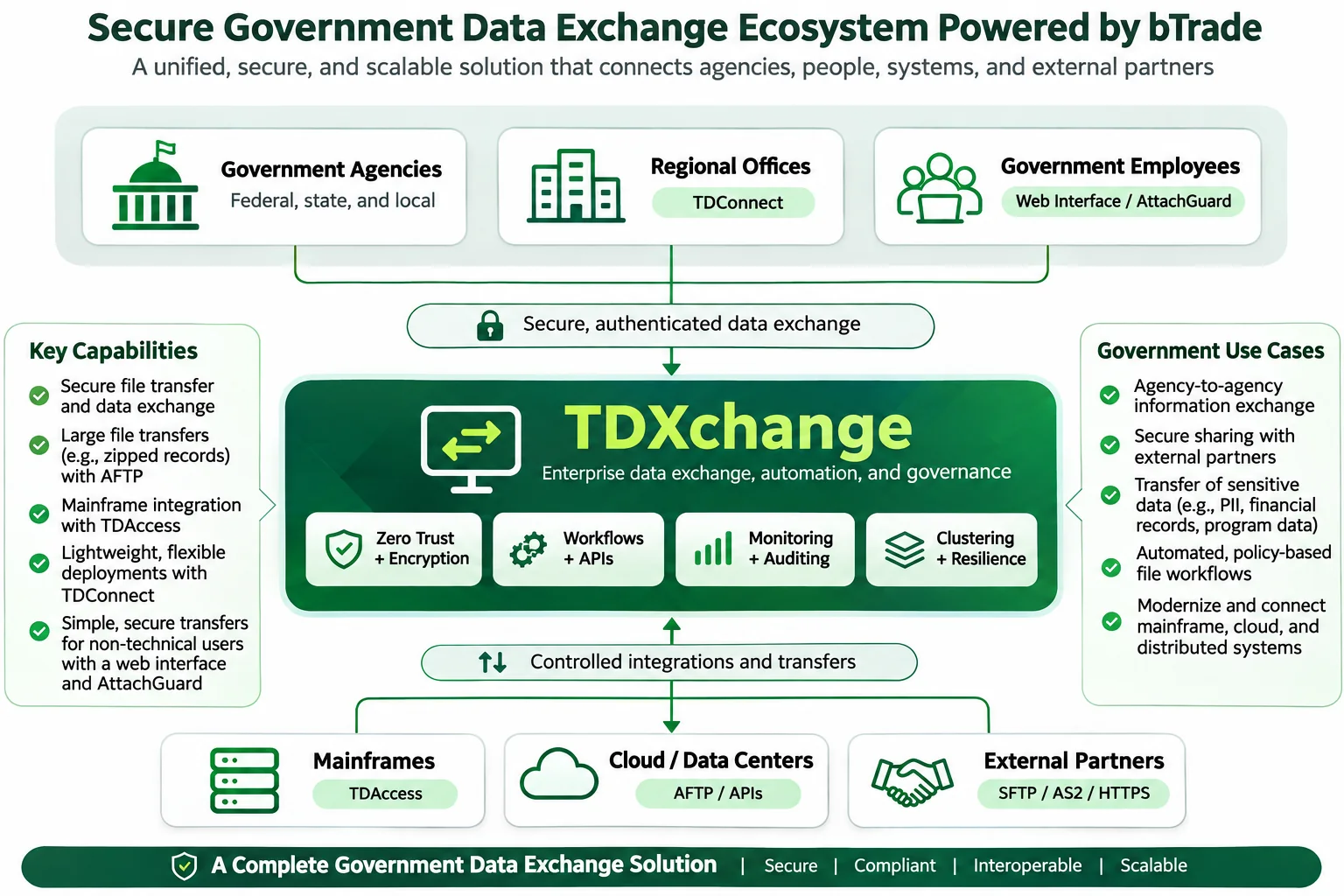
Illustrative bTrade government data exchange architecture showing how enterprise MFT, lightweight endpoints, mainframe connectivity, accelerated transfers, and secure employee file sharing support a connected government ecosystem.
4. One Government Data Exchange Strategy, Multiple Technologies
The value of bTrade's portfolio is not that every agency should deploy every product.
It is that different requirements can be addressed through technologies designed for those environments.
Government requirementbTrade solutionCentralized enterprise file exchange and automationTDXchangeSecure connectivity for smaller offices and departmentsTDConnectMainframe and legacy platform communicationsTDAccessLarge archives and high-speed long-distance transfersAFTPSecure file sharing through Microsoft OutlookAttachGuardSimple transfers for non-technical employeesTDXchange browser-based file exchangeCloud-based Managed File TransferTDCloudCross-system workflows, governance, and monitoringTDXchange
These technologies can be combined where appropriate to create a secure data exchange architecture across distributed government environments.
Not every product has identical security features, and integration does not automatically place every endpoint under the same technical controls. Security policies and enforcement must be designed and validated for each component and connection.
The objective is to reduce unnecessary complexity while establishing consistent governance and visibility wherever the architecture supports it.
5. Security Across the Entire Information Exchange Lifecycle
Supporting different technologies is only one part of the challenge.
Government organizations must also protect sensitive information throughout its lifecycle.
Native End-to-End Zero Trust
Traditional perimeter-based security often assumes that systems operating inside a trusted network can communicate with fewer restrictions.
Government environments increasingly require stronger identity verification, granular authorization, and least-privilege access.
TDXchange incorporates Native End-to-End Zero Trust across users, applications, automated workflows, service accounts, trading partners, and internal platform components.
This includes capabilities such as multi-factor authentication, role-based access controls, enterprise identity integration, and granular permissions.
Zero Trust helps reduce unnecessary access and limits the impact of compromised identities or systems.
However, Zero Trust complements rather than replaces other government security requirements.
Encryption and Quantum-Safe Cryptography
Sensitive government information must be protected during transmission, storage, and intermediate processing.
TDXchange supports encryption for data in transit and at rest, along with crypto agility and NIST-standardized post-quantum cryptographic capabilities.
Crypto agility helps organizations adapt to changing cryptographic requirements and emerging threats without repeatedly redesigning their entire file exchange infrastructure.
Post-quantum cryptography is particularly relevant for information that must remain confidential over extended periods.
The use of specific cryptographic algorithms and modules must be evaluated against applicable agency policies and approved configurations.
Network Segmentation and Secure Deployment Architecture
Government organizations frequently exchange information with external contractors, financial institutions, service providers, and other agencies.
A secure architecture should minimize unnecessary exposure of internal applications and data repositories.
Depending on the environment, this may involve DMZ relay services, network segmentation, restricted service communications, isolated processing environments, and controlled inbound and outbound connectivity.
TDXchange's distributed architecture provides flexibility in how these components are deployed.
bTrade works with customers to design the network topology, infrastructure placement, and security boundaries appropriate to their environment.
Data Loss Prevention and Malware Inspection
Encryption alone cannot determine whether a file is being delivered to an authorized destination or contains information that violates organizational policy.
Government organizations may require additional inspection and enforcement controls.
TDXchange supports integration with enterprise DLP and malware inspection technologies.
Depending on the connected tools and configured workflows, organizations can inspect files, enforce policy decisions, quarantine suspicious content, stop unauthorized transfers, and notify security teams.
These controls help protect information before it reaches an unintended recipient or internal application.
Tamper-Resistant Audit Logging
Government agencies must be able to establish what happened to sensitive information.
TDXchange provides centralized, searchable, tamper-resistant audit histories covering file transfers, workflow execution, access activity, administrative operations, and configuration changes.
This supports operational investigations, security reviews, compliance reporting, and accountability.
For example, an agency may need to determine when a financial file was received, which system processed it, whether delivery succeeded, and whether an acknowledgment was returned.
End-to-end transaction visibility is more useful than a collection of disconnected connection logs.
6. Government Compliance Requires More Than a Secure Product
Government security requirements extend beyond any individual software platform.
Depending on the agency and information involved, relevant frameworks may include:
- FISMA: Federal information security program and oversight requirements.
- NIST SP 800-53: Security and privacy controls for information systems and organizations.
- NIST SP 800-171: Requirements for protecting CUI in applicable nonfederal systems.
- FIPS 140-2 and FIPS 140-3: Security requirements and validation programs for cryptographic modules.
- FedRAMP: Security assessment and authorization for applicable federal cloud services.
- CJIS Security Policy: Security requirements for criminal justice information within its scope.
These frameworks are not interchangeable, and not every requirement applies to every deployment.
For example, a product using a FIPS-validated cryptographic module is not automatically FedRAMP authorized or approved to process classified information.
TDXchange provides security and operational capabilities that can help organizations implement relevant controls.
However, compliance and authorization depend on the complete deployment architecture, configuration, infrastructure, organizational policies, operational procedures, and applicable agency requirements.
7. Automating Government Workflows Across Multiple Systems and Organizations
Government information exchange frequently involves multi-step business processes rather than isolated transfers.
Consider a financial assistance workflow involving an application system, eligibility database, external verification service, payment processor, and reporting platform.
A successful transaction may require several dependent steps:
- Receive an application or financial record from an authorized source.
- Validate the file format and apply configured security inspection.
- Deliver the information to the appropriate internal application.
- Wait for the application to complete processing.
- Collect the result and evaluate whether the transaction succeeded.
- Generate and deliver a response or payment instruction.
- Receive an acknowledgment from the destination.
- Archive relevant records and maintain an audit history.
TDXchange supports scheduled and event-driven automation, multi-step workflows, conditional processing, retries, exception handling, notifications, and integration with enterprise applications and APIs.
This helps agencies reduce manual intervention and coordinate information exchange across multiple systems.
Importantly, TDXchange does not need to replace the underlying financial, case management, or business applications.
Instead, it can provide the secure exchange and workflow orchestration layer connecting those systems through supported interfaces.
8. Operational Visibility and AI-Assisted Monitoring
Government organizations cannot afford to discover critical transfer failures only after a payment is delayed, an application remains unprocessed, or an external organization reports missing information.
They need visibility into complete business transactions.
TDXchange provides transaction-level monitoring, dashboards, alerts, workflow tracking, and operational reporting.
These capabilities help teams identify failed transfers, delayed processing, missing acknowledgments, and other exceptions.
AI-assisted operational capabilities can further help identify unusual patterns, emerging performance bottlenecks, and infrastructure conditions that may require investigation or optimization.
For example, an unexpected increase in processing latency could indicate a database bottleneck, storage constraint, network problem, or sudden increase in workload.
Identifying these conditions early allows operations teams to evaluate corrective actions before they affect larger numbers of transactions.
AI-assisted capabilities should operate within established security policies, role-based permissions, and human oversight.
The objective is to improve operational intelligence, not to give autonomous systems unrestricted administrative authority.
9. High Availability, Disaster Recovery, and Government Service Continuity
Security also means ensuring that essential information remains available when it is needed.
A government file transfer outage can interrupt benefit payments, financial reporting, procurement activities, healthcare coordination, and other critical services.
Organizations must therefore design data exchange infrastructure around business continuity requirements.
TDXchange supports distributed processing, multi-node clustering, horizontal scalability, and high availability.
Depending on the environment, agencies can deploy redundant processing nodes, resilient storage, database availability configurations, and disaster recovery infrastructure.
However, achieving effective resilience requires more than enabling clustering.
Organizations must define:
- Recovery Time Objectives (RTO)
- Recovery Point Objectives (RPO)
- Transaction reconciliation procedures
- Backup and restoration policies
- Failover and recovery processes
- Monitoring and escalation responsibilities
- Periodic disaster recovery testing
bTrade works with customers to evaluate these requirements and design infrastructure that supports their operational objectives.
This includes capacity planning, database performance, storage architecture, network connectivity, recovery procedures, and validation testing.
A government data exchange platform should be designed to recover predictably, preserve transaction integrity, and minimize disruption to essential services.
10. How bTrade Helps Government Organizations Design the Right Architecture
At bTrade, we believe technology should solve real operational problems, not create additional complexity.
Government agencies already operate diverse and highly interconnected environments. The goal should not be to force every application, employee, or external organization onto a single technology model.
Instead, the architecture should be designed around how the organization actually operates.
That starts with understanding the complete data exchange ecosystem.
Understanding the Environment
We work with customers to identify the applications, mainframes, databases, cloud platforms, regional offices, external partners, and users involved in information exchange.
We also evaluate file sizes, transaction volumes, concurrency, processing windows, security classifications, and operational dependencies.
Designing the Security Architecture
Security requirements influence where services are deployed, how systems communicate, which identities have access, and how information is encrypted, processed, and audited.
We help customers evaluate network segmentation, DMZ placement, authentication, access controls, encryption, and integration with existing security systems.
Selecting the Right Technology for Each Requirement
A central agency processing millions of transactions may require clustered TDXchange infrastructure.
A regional office may need TDConnect.
A mainframe may require TDAccess.
A data center exchanging large archives may benefit from AFTP.
A government employee sharing documents may need only a secure web interface or AttachGuard.
The objective is to use the appropriate technology without unnecessary deployment complexity.
Designing for Performance and Growth
Government transaction volumes can increase as programs expand, new partners are added, or additional services are digitized.
We help customers evaluate infrastructure capacity, storage performance, database architecture, concurrency, network throughput, and horizontal scalability.
TDXchange's distributed architecture provides the flexibility to expand processing capacity as requirements evolve.
Building Operational Resilience
We also help customers define availability objectives, recovery requirements, monitoring processes, and disaster recovery procedures.
This includes planning for infrastructure failures, recovery testing, transaction reconciliation, and ongoing operational improvements.
Supporting Long-Term Evolution
Government technology environments evolve continuously.
New applications are introduced, legacy systems are modernized, cloud adoption expands, cryptographic requirements change, and security threats become more sophisticated.
bTrade's approach combines flexible technology, crypto agility, continuous platform development, and customer collaboration to help organizations adapt without repeatedly replacing their core data exchange infrastructure.
The result is an architecture designed around the government organization's needs, rather than forcing the organization to adapt to the limitations of a single file transfer product.
11. Example: A Secure Government Data Exchange Ecosystem
Consider a hypothetical government agency operating a nationwide financial assistance program.
The agency has a central processing environment, multiple regional offices, an established mainframe application, modern cloud services, external financial institutions, and employees who exchange sensitive documents.
A bTrade-based architecture could support the following model.
Central processing: TDXchange provides secure exchange, workflow automation, monitoring, and centralized governance for the agency's primary transaction processing environment.
Regional offices: TDConnect provides lightweight connectivity for offices that need to submit records and receive processed information without operating a full enterprise MFT deployment.
Mainframe integration: TDAccess supports secure communications for established mainframe systems where its supported protocols and interfaces are appropriate.
Large data movement: AFTP accelerates the transfer of large archives and consolidated datasets between authorized environments.
Employee collaboration: Authorized users exchange files through a browser-based interface, while AttachGuard enables secure sharing directly from Outlook.
Cloud integration: TDXchange connects approved cloud storage and applications through supported interfaces, while TDCloud may be evaluated for environments where an appropriate cloud-based MFT delivery model is required.
Security and governance: Configured identity controls, encryption, network segmentation, inspection integrations, and audit logging protect and track information as it moves through the environment.
Operational oversight: Centralized monitoring provides visibility into workflow execution, transfer status, exceptions, and service performance.
In this model, the agency does not need to replace its mainframe, redesign every application, or require every regional office to operate the same infrastructure.
Instead, the technologies are selected and integrated according to the needs of each part of the ecosystem.
This is the difference between deploying a collection of file transfer tools and designing a secure Enterprise Data Exchange architecture.
Executive Takeaway
Government agencies do not operate a single file transfer environment.
They operate complex ecosystems involving mainframes, modern applications, cloud platforms, regional offices, external organizations, and employees who need to exchange sensitive information every day.
Securing these environments requires more than encryption or a collection of independent transfer tools.
It requires an architecture that connects different technologies, protects information throughout its lifecycle, automates critical workflows, provides operational visibility, and supports long-term resilience.
bTrade brings these capabilities together through TDXchange, TDConnect, TDAccess, AFTP, AttachGuard, browser-based file exchange, and TDCloud.
Combined with bTrade's expertise in infrastructure design, security architecture, integration, scalability, and disaster recovery, these technologies help organizations establish a secure and flexible foundation for government-wide data exchange.
The goal is not to make every government system use the same technology. It is to make different technologies work together securely, reliably, and with the visibility and accountability that government operations require.
About the Author
Andrei Olin is Chief Technology Officer at bTrade, where he leads product strategy, delivery, architecture, and security across the company’s B2B, Managed File Transfer, and secure data exchange platforms.
Andrei has more than 30 years of experience spanning enterprise architecture, software development, infrastructure, cybersecurity, middleware, trading systems, SaaS, and Managed File Transfer. His career includes building mission-critical systems and infrastructure at Bear Stearns and Morgan Stanley, designing and operating enterprise MFT and messaging platforms for Merrill Lynch and Deutsche Bank, and building and scaling SaaS and security products at startups. He holds master’s and bachelor’s degrees in Information Technology with a focus on Information Security.
Frequently Asked Questions
What is the best secure file transfer solution for government agencies?
Government agencies should evaluate Managed File Transfer solutions that provide encryption, strong authentication, granular access controls, centralized auditing, workflow automation, integration flexibility, and high availability. The appropriate solution depends on the sensitivity of the information, existing infrastructure, compliance requirements, and operational needs.
Can bTrade support secure data exchange across an entire government organization?
Yes. bTrade provides complementary technologies for enterprise automation, regional offices, legacy systems, accelerated large-file movement, cloud environments, and employee file sharing. TDXchange can provide centralized workflow governance and operational visibility, while other bTrade products address specialized connectivity and user requirements.
Can TDXchange protect PII and sensitive financial records?
TDXchange provides encryption, Native End-to-End Zero Trust, role-based access controls, tamper-resistant auditing, workflow governance, and security integration capabilities relevant to protecting PII and financial records. The overall level of protection depends on the deployment architecture, configuration, and applicable agency requirements.
Can bTrade integrate with existing government mainframes?
Yes. TDAccess supports cross-platform communications, including IBM MVS/zSeries and AS/400/iSeries environments. This helps organizations maintain secure connectivity with established systems without necessarily replacing the underlying applications.
Can government agencies securely transfer large ZIP archives and datasets?
Yes. bTrade AFTP is designed to accelerate large-file transfers across long-distance and high-latency networks. When integrated with TDXchange, accelerated transfers can benefit from centralized workflow automation, security controls, monitoring, and auditing.
Can smaller government offices use lightweight file transfer deployments?
Yes. TDConnect provides lightweight Managed File Transfer capabilities for departments, regional offices, and smaller environments that do not require a full enterprise deployment. It supports secure protocols, access controls, encryption, and auditing.
Can non-technical government employees securely exchange files through a web browser?
Yes. TDXchange provides browser-based file exchange capabilities that allow authorized users to upload, download, send, and receive files without needing to understand file transfer protocols. Security policies and permissions remain centrally managed.
Can government employees securely send sensitive documents from Microsoft Outlook?
Yes. bTrade AttachGuard integrates with Outlook and replaces traditional attachments with secure download links managed through TDXchange. This provides encryption, access controls, expiration policies, and auditability while simplifying the user experience.
Does bTrade support government cloud and hybrid environments?
Yes. TDXchange supports on-premises, cloud, and hybrid deployments, while TDCloud provides cloud-based Managed File Transfer options. The selected deployment must be evaluated against applicable agency security, data residency, and authorization requirements.
Does Zero Trust make a file transfer platform approved for classified government information?
No. Zero Trust strengthens identity verification, authorization, and least-privilege access, but formally classified information requires additional security controls and system authorization appropriate to the classification level.
Does FIPS validation mean a platform is FedRAMP authorized?
No. FIPS validation applies to specific cryptographic modules and configurations. FedRAMP authorization involves assessment of an applicable cloud service offering and its complete security environment. These are different requirements.
Can bTrade automate multi-step government workflows?
Yes. TDXchange supports scheduled and event-driven workflows, conditional processing, dependencies, retries, notifications, exception handling, and integration with enterprise applications and APIs. This enables organizations to automate secure information exchange across multiple systems and external partners.
How does TDXchange support government audit and compliance requirements?
TDXchange provides centralized, searchable, tamper-resistant audit histories covering transfers, workflow activity, access events, administrative actions, and configuration changes. These records help support investigations, compliance reporting, and operational accountability.
How can government agencies maintain file transfer availability during infrastructure failures?
Government organizations should design for high availability, redundancy, failover, disaster recovery, and transaction reconciliation. TDXchange supports distributed processing and clustering, while bTrade works with customers to design infrastructure around RTO, RPO, performance, and continuity requirements.
<script type="application/ld+json">
{
  "@context": "https://schema.org",
  "@graph": [
    {
      "@type": "Organization",
      "@id": "https://www.btrade.com/#organization",
      "name": "bTrade",
      "legalName": "bTrade, LLC",
      "url": "https://www.btrade.com/",
      "foundingDate": "1990",
      "description": "bTrade provides enterprise Managed File Transfer, secure data exchange, workflow automation, and integration solutions for organizations operating complex and security-sensitive environments.",
      "address": {
        "@type": "PostalAddress",
        "streetAddress": "10100 N Central Expy, Suite 318",
        "addressLocality": "Dallas",
        "addressRegion": "TX",
        "postalCode": "75231",
        "addressCountry": "US"
      },
      "knowsAbout": [
        "Managed File Transfer",
        "Enterprise Data Exchange",
        "Government Secure File Transfer",
        "Zero Trust Security",
        "Post-Quantum Cryptography",
        "Secure B2B Integration",
        "Mainframe File Transfer",
        "Accelerated File Transfer",
        "File Transfer Automation",
        "Disaster Recovery",
        "Data Exchange Governance"
      ]
    },
    {
      "@type": "Person",
      "@id": "https://www.btrade.com/#andrei-olin",
      "name": "Andrei Olin",
      "url": "https://www.linkedin.com/in/andreiolin/",
      "jobTitle": "Chief Technology Officer",
      "worksFor": {
        "@id": "https://www.btrade.com/#organization"
      },
      "knowsAbout": [
        "Enterprise Architecture",
        "Cybersecurity",
        "Managed File Transfer",
        "Zero Trust Architecture",
        "Information Security",
        "Enterprise Integration",
        "Post-Quantum Cryptography",
        "Infrastructure Design",
        "Disaster Recovery"
      ]
    },
    {
      "@type": "SoftwareApplication",
      "@id": "https://www.btrade.com/solutions/tdxchange#software",
      "name": "TDXchange",
      "applicationCategory": "BusinessApplication",
      "applicationSubCategory": "Enterprise Managed File Transfer",
      "url": "https://www.btrade.com/solutions/tdxchange",
      "provider": {
        "@id": "https://www.btrade.com/#organization"
      },
      "description": "TDXchange is an enterprise Managed File Transfer and secure data exchange platform supporting Native End-to-End Zero Trust, encryption, workflow automation, centralized monitoring, tamper-resistant auditing, distributed processing, clustering, and integration with enterprise applications and external partners.",
      "featureList": [
        "Native End-to-End Zero Trust",
        "NIST-standardized post-quantum cryptography",
        "Crypto agility",
        "Encryption in transit and at rest",
        "Role-based access control",
        "Multi-factor authentication",
        "SFTP, FTPS, HTTPS, AS2, AS4 and AFTP",
        "Scheduled and event-driven workflows",
        "Multi-step workflow automation",
        "Browser-based secure file exchange",
        "Tamper-resistant audit logging",
        "Transaction-level monitoring",
        "DLP and malware inspection integrations",
        "Distributed processing",
        "Multi-node clustering",
        "Horizontal scalability",
        "High availability",
        "Hybrid and cloud deployment"
      ]
    },
    {
      "@type": "BlogPosting",
      "@id": "https://www.btrade.com/blogs/secure-government-managed-file-transfer-data-exchange#article",
      "mainEntityOfPage": {
        "@type": "WebPage",
        "@id": "https://www.btrade.com/blogs/secure-government-managed-file-transfer-data-exchange"
      },
      "url": "https://www.btrade.com/blogs/secure-government-managed-file-transfer-data-exchange",
      "headline": "Secure Government Data Exchange: How bTrade Connects Agencies, Mainframes, Cloud Systems, and External Partners",
      "description": "Discover how bTrade enables secure government data exchange across agencies, mainframes, cloud platforms, regional offices, and external partners using Zero Trust Managed File Transfer, encryption, automation, accelerated transfers, and centralized governance.",
      "datePublished": "2026-09-23",
      "dateModified": "2026-11-10",
      "inLanguage": "en-US",
      "author": {
        "@id": "https://www.btrade.com/#andrei-olin"
      },
      "publisher": {
        "@id": "https://www.btrade.com/#organization"
      },
      "isAccessibleForFree": true,
      "articleSection": [
        "Government Enterprise Data Exchange",
        "Government Information Security Requirements",
        "Government Data Exchange Ecosystem",
        "Managed File Transfer Solutions",
        "Zero Trust and Quantum-Safe Encryption",
        "Government Compliance",
        "Workflow Automation",
        "AI-Assisted Monitoring",
        "High Availability and Disaster Recovery",
        "Infrastructure Architecture",
        "Government Data Exchange Example",
        "Frequently Asked Questions"
      ],
      "keywords": [
        "government managed file transfer",
        "secure government file transfer",
        "government data exchange",
        "government enterprise data exchange",
        "secure file transfer for government agencies",
        "government file transfer solutions",
        "government PII protection",
        "secure financial records transfer",
        "Controlled Unclassified Information",
        "CUI secure file transfer",
        "Zero Trust managed file transfer",
        "quantum-safe encryption",
        "government mainframe integration",
        "mainframe file transfer",
        "accelerated file transfer",
        "government large file transfer",
        "secure Outlook file sharing",
        "browser-based secure file transfer",
        "government workflow automation",
        "government cloud integration",
        "government data exchange architecture",
        "government disaster recovery",
        "bTrade",
        "TDXchange",
        "TDConnect",
        "TDAccess",
        "AFTP",
        "AttachGuard",
        "TDCloud"
      ],
      "about": [
        {
          "@type": "Thing",
          "name": "Secure Government Data Exchange"
        },
        {
          "@type": "Thing",
          "name": "Managed File Transfer for Government Agencies"
        },
        {
          "@type": "Thing",
          "name": "Personally Identifiable Information Protection"
        },
        {
          "@type": "Thing",
          "name": "Controlled Unclassified Information"
        },
        {
          "@type": "Thing",
          "name": "Zero Trust Architecture"
        },
        {
          "@type": "Thing",
          "name": "Post-Quantum Cryptography"
        },
        {
          "@type": "Thing",
          "name": "Mainframe Integration"
        },
        {
          "@type": "Thing",
          "name": "Enterprise Data Exchange Architecture"
        }
      ],
      "mentions": [
        {
          "@id": "https://www.btrade.com/solutions/tdxchange#software"
        },
        {
          "@type": "SoftwareApplication",
          "name": "TDConnect",
          "url": "https://www.btrade.com/solutions/tdconnect"
        },
        {
          "@type": "SoftwareApplication",
          "name": "TDAccess",
          "url": "https://www.btrade.com/solutions/tdaccess"
        },
        {
          "@type": "SoftwareApplication",
          "name": "AttachGuard",
          "url": "https://www.btrade.com/solutions/attachguard"
        },
        {
          "@type": "SoftwareApplication",
          "name": "TDCloud",
          "url": "https://www.btrade.com/solutions/tdcloud"
        },
        {
          "@type": "Thing",
          "name": "Accelerated File Transfer Protocol",
          "alternateName": "AFTP"
        },
        {
          "@type": "Thing",
          "name": "FISMA"
        },
        {
          "@type": "Thing",
          "name": "NIST SP 800-53"
        },
        {
          "@type": "Thing",
          "name": "NIST SP 800-171"
        },
        {
          "@type": "Thing",
          "name": "FIPS 140-2 and FIPS 140-3"
        },
        {
          "@type": "Thing",
          "name": "FedRAMP"
        },
        {
          "@type": "Thing",
          "name": "CJIS Security Policy"
        }
      ],
      "hasPart": {
        "@id": "https://www.btrade.com/blogs/secure-government-managed-file-transfer-data-exchange#faq"
      }
    },
    {
      "@type": "FAQPage",
      "@id": "https://www.btrade.com/blogs/secure-government-managed-file-transfer-data-exchange#faq",
      "url": "https://www.btrade.com/blogs/secure-government-managed-file-transfer-data-exchange",
      "inLanguage": "en-US",
      "mainEntity": [
        {
          "@type": "Question",
          "name": "What is the best secure file transfer solution for government agencies?",
          "acceptedAnswer": {
            "@type": "Answer",
            "text": "Government agencies should evaluate Managed File Transfer solutions that provide encryption, strong authentication, granular access controls, centralized auditing, workflow automation, integration flexibility, and high availability. The appropriate solution depends on the sensitivity of the information, existing infrastructure, compliance requirements, and operational needs."
          }
        },
        {
          "@type": "Question",
          "name": "Can bTrade support secure data exchange across an entire government organization?",
          "acceptedAnswer": {
            "@type": "Answer",
            "text": "Yes. bTrade provides complementary technologies for enterprise automation, regional offices, legacy systems, accelerated large-file movement, cloud environments, and employee file sharing. TDXchange can provide centralized workflow governance and operational visibility, while other bTrade products address specialized connectivity and user requirements."
          }
        },
        {
          "@type": "Question",
          "name": "Can TDXchange protect PII and sensitive financial records?",
          "acceptedAnswer": {
            "@type": "Answer",
            "text": "TDXchange provides encryption, Native End-to-End Zero Trust, role-based access controls, tamper-resistant auditing, workflow governance, and security integration capabilities relevant to protecting PII and financial records. The overall level of protection depends on the deployment architecture, configuration, and applicable agency requirements."
          }
        },
        {
          "@type": "Question",
          "name": "Can bTrade integrate with existing government mainframes?",
          "acceptedAnswer": {
            "@type": "Answer",
            "text": "Yes. TDAccess supports cross-platform communications, including IBM MVS/zSeries and AS/400/iSeries environments. This helps organizations maintain secure connectivity with established systems without necessarily replacing the underlying applications."
          }
        },
        {
          "@type": "Question",
          "name": "Can government agencies securely transfer large ZIP archives and datasets?",
          "acceptedAnswer": {
            "@type": "Answer",
            "text": "Yes. bTrade AFTP is designed to accelerate large-file transfers across long-distance and high-latency networks. When integrated with TDXchange, accelerated transfers can benefit from centralized workflow automation, security controls, monitoring, and auditing."
          }
        },
        {
          "@type": "Question",
          "name": "Can smaller government offices use lightweight file transfer deployments?",
          "acceptedAnswer": {
            "@type": "Answer",
            "text": "Yes. TDConnect provides lightweight Managed File Transfer capabilities for departments, regional offices, and smaller environments that do not require a full enterprise deployment. It supports secure protocols, access controls, encryption, and auditing."
          }
        },
        {
          "@type": "Question",
          "name": "Can non-technical government employees securely exchange files through a web browser?",
          "acceptedAnswer": {
            "@type": "Answer",
            "text": "Yes. TDXchange provides browser-based file exchange capabilities that allow authorized users to upload, download, send, and receive files without needing to understand file transfer protocols. Security policies and permissions remain centrally managed."
          }
        },
        {
          "@type": "Question",
          "name": "Can government employees securely send sensitive documents from Microsoft Outlook?",
          "acceptedAnswer": {
            "@type": "Answer",
            "text": "Yes. bTrade AttachGuard integrates with Outlook and replaces traditional attachments with secure download links managed through TDXchange. This provides encryption, access controls, expiration policies, and auditability while simplifying the user experience."
          }
        },
        {
          "@type": "Question",
          "name": "Does bTrade support government cloud and hybrid environments?",
          "acceptedAnswer": {
            "@type": "Answer",
            "text": "Yes. TDXchange supports on-premises, cloud, and hybrid deployments, while TDCloud provides cloud-based Managed File Transfer options. The selected deployment must be evaluated against applicable agency security, data residency, and authorization requirements."
          }
        },
        {
          "@type": "Question",
          "name": "Does Zero Trust make a file transfer platform approved for classified government information?",
          "acceptedAnswer": {
            "@type": "Answer",
            "text": "No. Zero Trust strengthens identity verification, authorization, and least-privilege access, but formally classified information requires additional security controls and system authorization appropriate to the classification level."
          }
        },
        {
          "@type": "Question",
          "name": "Does FIPS validation mean a platform is FedRAMP authorized?",
          "acceptedAnswer": {
            "@type": "Answer",
            "text": "No. FIPS validation applies to specific cryptographic modules and configurations. FedRAMP authorization involves assessment of an applicable cloud service offering and its complete security environment. These are different requirements."
          }
        },
        {
          "@type": "Question",
          "name": "Can bTrade automate multi-step government workflows?",
          "acceptedAnswer": {
            "@type": "Answer",
            "text": "Yes. TDXchange supports scheduled and event-driven workflows, conditional processing, dependencies, retries, notifications, exception handling, and integration with enterprise applications and APIs. This enables organizations to automate secure information exchange across multiple systems and external partners."
          }
        },
        {
          "@type": "Question",
          "name": "How does TDXchange support government audit and compliance requirements?",
          "acceptedAnswer": {
            "@type": "Answer",
            "text": "TDXchange provides centralized, searchable, tamper-resistant audit histories covering transfers, workflow activity, access events, administrative actions, and configuration changes. These records help support investigations, compliance reporting, and operational accountability."
          }
        },
        {
          "@type": "Question",
          "name": "How can government agencies maintain file transfer availability during infrastructure failures?",
          "acceptedAnswer": {
            "@type": "Answer",
            "text": "Government organizations should design for high availability, redundancy, failover, disaster recovery, and transaction reconciliation. TDXchange supports distributed processing and clustering, while bTrade works with customers to design infrastructure around RTO, RPO, performance, and continuity requirements."
          }
        }
      ]
    },
    {
      "@type": "BreadcrumbList",
      "@id": "https://www.btrade.com/blogs/secure-government-managed-file-transfer-data-exchange#breadcrumb",
      "itemListElement": [
        {
          "@type": "ListItem",
          "position": 1,
          "name": "Home",
          "item": "https://www.btrade.com/"
        },
        {
          "@type": "ListItem",
          "position": 2,
          "name": "Blogs",
          "item": "https://www.btrade.com/blogs"
        },
        {
          "@type": "ListItem",
          "position": 3,
          "name": "Secure Government Data Exchange",
          "item": "https://www.btrade.com/blogs/secure-government-managed-file-transfer-data-exchange"
        }
      ]
    }
  ]
}
</script>