
What Is SaaS Managed File Transfer?
SaaS Managed File Transfer (SaaS MFT) is a cloud-delivered enterprise platform that securely automates, governs, monitors, and scales file transfers without requiring organizations to deploy and manage their own MFT infrastructure.
Unlike traditional on-premises MFT, SaaS MFT provides:
- Secure file exchange
- Workflow automation
- Operational visibility
- Business continuity
- High availability
- Centralized governance
- Simplified administration
Why Organizations Are Adopting SaaS MFT
Organizations are increasingly adopting SaaS MFT to:
- Reduce infrastructure management
- Accelerate deployment
- Improve business continuity
- Simplify disaster recovery
- Lower operational costs
- Improve scalability
- Enable hybrid cloud strategies
- Free IT teams to focus on higher-value initiatives
From Infrastructure Management to Operational Agility
For years, most Managed File Transfer (MFT) environments were built around traditional on-premise infrastructure.
Organizations deployed servers, configured failover systems, managed upgrades, planned disaster recovery strategies, and maintained large operational environments just to keep secure file transfer operations running smoothly.
At the time, that model made sense.
Enterprise infrastructure was more centralized.
Operations were more predictable.
Cloud adoption was still relatively limited.
But enterprise environments have changed dramatically.
Today’s organizations operate across:
- hybrid cloud infrastructure
- distributed applications
- remote workforces
- APIs
- SaaS ecosystems
- global partner networks
- highly automated operational workflows
At the same time, businesses face growing pressure to:
- move faster
- improve resiliency
- reduce operational overhead
- scale more efficiently
- accelerate onboarding
- modernize infrastructure
- improve operational visibility
This is one of the biggest reasons enterprises are increasingly moving toward SaaS-based Managed File Transfer platforms like TDCloud.
Because modern MFT is no longer simply about moving files securely.
It’s now directly tied to:
- operational continuity
- enterprise agility
- governance
- business resiliency
- modernization strategies
- distributed operations
And increasingly, organizations want all of that without the heavy burden of managing complex infrastructure themselves.
Building on the “Saved by TDCloud” Operational Story
Many of the operational lessons discussed in this article were originally highlighted in our earlier blog:
“Saved by TDCloud”
That article focused on a real-world operational scenario where cloud resiliency and operational flexibility became critically important during unexpected infrastructure challenges.
It highlighted something many organizations eventually realize:
traditional infrastructure models often work well — until operational disruption exposes their limitations.
This blog expands on those ideas further by exploring the broader enterprise shift toward SaaS-based Managed File Transfer (MFT), why organizations are modernizing away from infrastructure-heavy operational models, and how TDCloud helps enterprises improve:
- scalability
- operational agility
- resiliency
- governance
- centralized visibility
- business continuity
across increasingly distributed enterprise ecosystems.
In Summary
Modern organizations increasingly require SaaS-based Managed File Transfer platforms that provide:
- operational resiliency
- scalability
- centralized governance
- operational visibility
- deployment flexibility
- secure collaboration
- business continuity
- operational simplicity
Traditional infrastructure-heavy MFT environments often create:
- operational overhead
- scalability limitations
- disaster recovery complexity
- infrastructure management burdens
- slower modernization efforts
TDCloud helps organizations modernize enterprise file transfer operations through a SaaS-based MFT platform that delivers:
- cloud-native scalability
- operational continuity
- centralized visibility
- enterprise-grade security
- governance
- deployment flexibility
- reduced infrastructure complexity
- operational agility
while helping organizations focus more on business operations and less on infrastructure maintenance.
Key Takeaways
- SaaS MFT reduces operational infrastructure complexity.
- Modern enterprises increasingly prioritize resiliency and agility.
- Cloud-native scalability improves operational flexibility.
- Business continuity has become a strategic enterprise priority.
- Operational visibility remains critical in distributed environments.
- Hybrid deployment flexibility is increasingly important.
- SaaS MFT helps organizations modernize faster with less operational overhead.
Why Traditional MFT Infrastructure Is Becoming Harder to Manage
Many enterprise MFT environments were originally designed during a very different operational era.
At the time:
- workloads were smaller
- infrastructure was centralized
- remote operations were limited
- scaling demands were lower
- cloud integration was minimal
But modern enterprise operations are now significantly more distributed and dynamic.
Organizations today support:
- global operations
- remote workforces
- cloud applications
- APIs
- distributed partner ecosystems
- hybrid infrastructure
- large-scale automation
- continuous operational availability
As environments become more complex, maintaining traditional infrastructure-heavy MFT environments becomes significantly more challenging.
Operational teams often spend enormous amounts of time managing:
- servers
- upgrades
- failover environments
- disaster recovery planning
- scaling operations
- patching
- monitoring
- infrastructure maintenance
rather than focusing on:
- modernization
- automation
- onboarding
- governance
- operational optimization
Over time, that operational burden becomes increasingly difficult to justify.
The Growing Enterprise Demand for SaaS MFT
One of the biggest enterprise trends happening right now is operational simplification.
Organizations increasingly want platforms that help them:
- reduce infrastructure management
- improve agility
- simplify deployment
- accelerate onboarding
- improve scalability
- strengthen resiliency
- reduce operational friction
without sacrificing:
- security
- governance
- compliance
- visibility
- operational control
This is exactly why SaaS-based MFT adoption continues accelerating.
Instead of spending months:
- deploying infrastructure
- sizing environments
- configuring HA clusters
- managing upgrades
- planning DR architectures
organizations can focus more directly on:
- business enablement
- automation
- partner onboarding
- operational improvements
- governance initiatives
That shift fundamentally changes how enterprises approach file transfer operations.
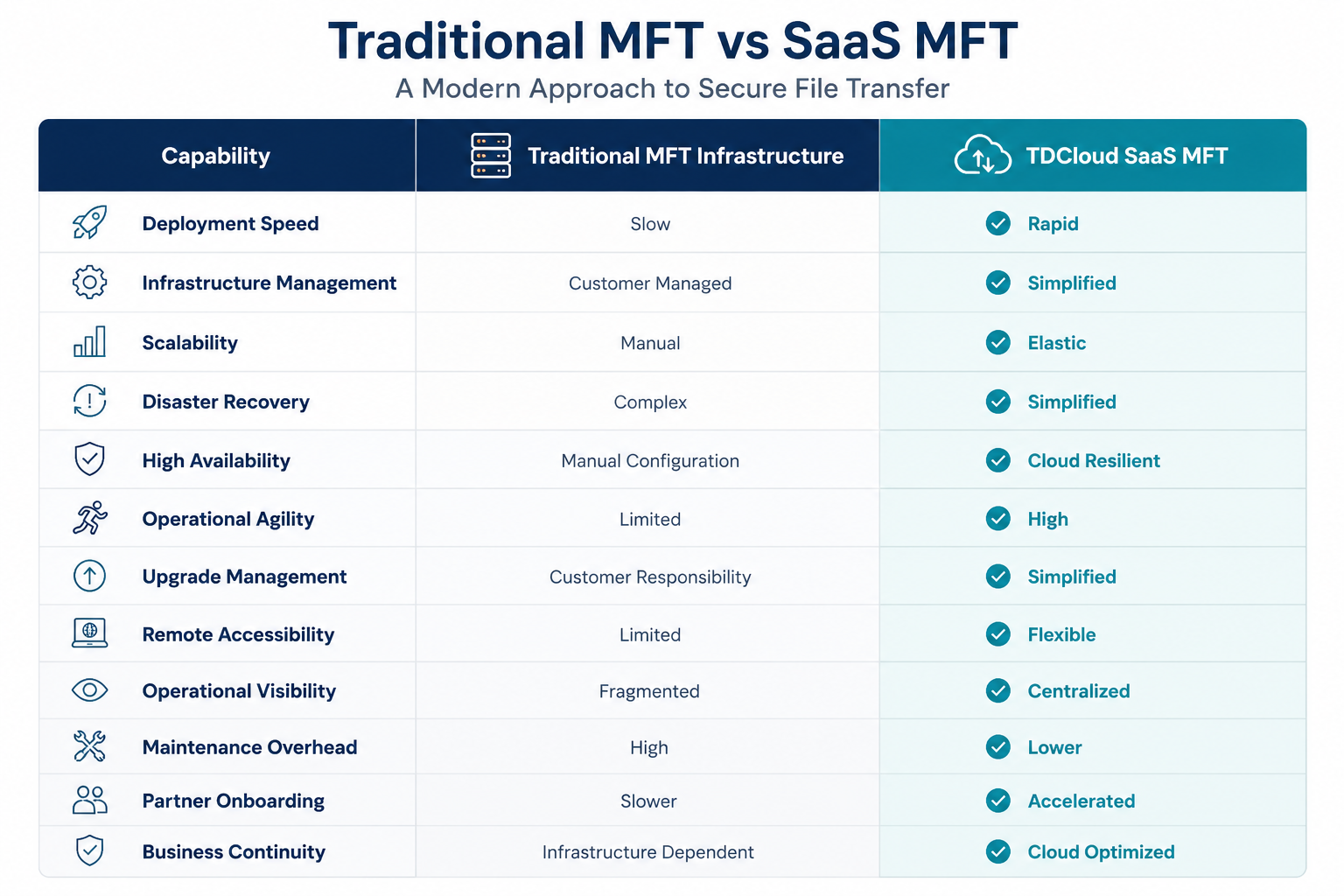
SaaS MFT Is About Much More Than Hosting
One of the most common misconceptions about SaaS MFT is that it’s simply “hosting file transfer in the cloud.”
But modern SaaS MFT fundamentally changes the operational model itself.
It allows organizations to shift focus away from:
- infrastructure maintenance
- hardware lifecycle management
- scaling complexity
- DR architecture management
- upgrade planning
- operational maintenance
and focus more on:
- operational efficiency
- governance
- automation
- onboarding
- partner enablement
- business agility
That operational shift becomes increasingly important as environments continue growing in scale and complexity.
Because infrastructure management itself can quickly become a major operational bottleneck.
Is SaaS Managed File Transfer Secure?
Moving Managed File Transfer to the cloud should never mean compromising security. In fact, a modern SaaS MFT platform should strengthen an organization's security posture by combining enterprise-grade protection with simplified operations.
At a minimum, enterprise SaaS Managed File Transfer should provide:
- End-to-end encryption for data in transit and at rest
- Native Zero Trust Architecture
- Multi-factor authentication (MFA)
- Granular role-based access controls (RBAC)
- Comprehensive audit trails and reporting
- Continuous monitoring and operational visibility
- Centralized security policy enforcement
- Compliance reporting for regulated industries
Security Built on a Native Zero Trust Architecture
Traditional security models often assume that users, applications, or systems operating inside the network can be trusted. Modern cyber threats have shown that this assumption is no longer valid.
TDCloud is built on the same native Zero Trust Architecture as TDXchange, where trust is never assumed and every request is continuously verified.
This approach extends beyond user authentication. Every interaction within the platform is governed by Zero Trust principles, including:
- Continuous authentication and authorization of users, administrators, applications, and services
- Verification of every process and system component before access is granted
- Least-privilege access controls that limit users to only the resources they require
- Granular permissions for business users, administrators, and external trading partners
- Secure integration with enterprise identity providers such as Microsoft Active Directory, LDAP, SAML, OAuth2, and OpenID Connect
- Centralized identity management that eliminates permission sprawl and simplifies administration
- Comprehensive auditing of every administrative action, configuration change, authentication event, and file transfer
Rather than relying on a trusted network perimeter, TDCloud continuously validates identity, permissions, and context before allowing access to sensitive data or business processes. This significantly reduces the risk of unauthorized access, privilege escalation, and lateral movement within the environment.
Enterprise Security Without the Operational Overhead
Because TDCloud is built on the proven TDXchange platform, organizations benefit from the same enterprise-grade security architecture while eliminating much of the operational complexity associated with managing on-premises infrastructure.
This includes:
- Enterprise-grade encryption for data at rest and in transit
- Native Zero Trust security across all platform components
- Continuous monitoring and operational observability
- Automated software updates and security maintenance
- High availability and resilient cloud infrastructure
- Centralized governance, compliance, and auditing
- NIST-approved quantum-safe encryption to protect against emerging "harvest now, decrypt later" threats
The result is a cloud-native Managed File Transfer platform that combines the flexibility and scalability of SaaS with the security, governance, and operational controls required by highly regulated enterprises.
Why Operational Resiliency Matters More Than Ever
Most organizations don’t fully appreciate operational resiliency until something unexpected happens.
A data center outage.
An infrastructure failure.
A sudden scaling event.
A remote connectivity issue.
A disaster recovery scenario.
That operational reality is exactly what we explored in our earlier “Saved by TDCloud” discussion — how unexpected infrastructure disruptions can quickly expose operational limitations in traditional environments.
For many organizations, those moments become the catalyst for broader modernization initiatives toward:
- SaaS MFT
- cloud-native resiliency
- operational simplification
- centralized visibility
- scalable infrastructure
because resiliency is no longer simply an IT concern.
It directly impacts:
- business continuity
- customer experience
- operational uptime
- partner operations
- compliance workflows
- revenue-generating business processes
Modern enterprises increasingly need systems that can continue supporting:
- file movement
- onboarding
- automation
- partner communication
- secure collaboration
- operational workflows
even during unexpected disruptions.
This is where SaaS-based MFT platforms provide significant operational advantages.
Why Hybrid Flexibility Still Matters
Even as organizations move toward SaaS, most enterprises are not becoming “100% cloud” overnight.
Real-world modernization is usually gradual and operationally complex.
Organizations often continue supporting combinations of:
- on-premise infrastructure
- cloud workloads
- legacy systems
- external integrations
- distributed applications
for many years.
This is why hybrid flexibility remains critically important.
Modern SaaS MFT platforms increasingly need to support:
- phased modernization
- hybrid operations
- distributed infrastructure
- cloud integration
- secure external collaboration
without forcing organizations into rigid infrastructure decisions.
This flexibility becomes especially important for:
- regulated industries
- global enterprises
- operationally complex organizations
where modernization must happen incrementally and carefully.
Visibility & Governance Still Matter in SaaS Environments
Moving to SaaS does not eliminate operational responsibilities.
In many ways, operational visibility becomes even more important.
Organizations still require centralized insight into:
- transfer activity
- workflow execution
- operational health
- user actions
- compliance reporting
- auditability
- security events
Without centralized visibility, troubleshooting distributed environments becomes significantly more difficult.
Modern SaaS MFT platforms increasingly need to provide:
- centralized observability
- operational analytics
- workflow visibility
- auditability
- governance reporting
- intelligent alerting
to help organizations maintain operational control across distributed ecosystems.
Real-World Operational Challenges SaaS MFT Helps Solve
One of the biggest reasons organizations continue modernizing toward SaaS MFT is because it addresses practical operational problems enterprises face every day.
Faster Deployment
Traditional MFT deployments often involve:
- infrastructure procurement
- HA configuration
- environment sizing
- operational testing
- DR planning
which can significantly delay operational readiness.
SaaS deployment dramatically accelerates onboarding and modernization timelines.
Rapid Scalability
As operational demand grows, organizations need to scale quickly.
Traditional environments may require:
- hardware expansion
- infrastructure redesign
- complex capacity planning
Cloud-native SaaS platforms provide significantly greater operational flexibility and scalability.
Reduced Operational Overhead
Operational teams spend less time managing:
- upgrades
- patching
- infrastructure maintenance
- DR operations
- scaling environments
allowing them to focus more on:
- governance
- automation
- onboarding
- operational optimization
which improves enterprise agility significantly.
Business Continuity
Cloud-native resiliency improves operational continuity during:
- outages
- infrastructure failures
- scaling events
- operational disruptions
which is increasingly important in modern distributed environments.
Enterprise MFT Is Becoming an Operational Platform
Modern enterprise MFT has evolved far beyond simply securing file movement.
Organizations increasingly expect MFT platforms to support:
- operational intelligence
- automation
- governance
- observability
- analytics
- onboarding
- compliance
- operational resiliency
because MFT now sits directly in the middle of critical enterprise operations.
This broader operational role is one of the biggest reasons SaaS MFT adoption continues accelerating.
Final Thoughts
The enterprise MFT market is evolving rapidly.
Organizations increasingly require platforms that provide:
- operational agility
- cloud resiliency
- scalability
- governance
- centralized visibility
- automation
- deployment flexibility
- operational simplicity
without creating unnecessary infrastructure complexity.
TDCloud helps organizations modernize enterprise file transfer operations through a SaaS-based MFT platform designed to support:
- distributed enterprise environments
- hybrid modernization
- operational continuity
- secure collaboration
- enterprise scalability
- governance
- operational intelligence
while reducing infrastructure overhead and improving operational agility.
If you haven’t already read it, our original “Saved by TDCloud” blog provides additional real-world operational context around how cloud resiliency and operational continuity can significantly impact enterprise operations during unexpected disruptions.
Together, both discussions highlight a broader enterprise trend:
modern organizations are increasingly modernizing toward SaaS-based MFT platforms that prioritize:
- resiliency
- agility
- operational simplicity
- centralized governance
- scalability
- business continuity
rather than relying solely on traditional infrastructure-heavy operational models.
About the Author
Don Miller is President and General Counsel of bTrade, where he leads day-to-day operations and oversees legal, regulatory, and compliance activities for the company’s secure managed file transfer (MFT) platform. In this dual role, he helps ensure bTrade’s products and services meet the operational, data-protection, and governance expectations of enterprise and regulated customers. Don brings more than 20 years of legal experience advising businesses on risk management, contracts, intellectual property, and dispute resolution, applying that background to the practical realities of software operations and compliance. He holds a Juris Doctor from the University of Southern California Gould School of Law and is admitted to practice before California state and federal courts.
Frequently Asked Questions (FAQ)
What is SaaS MFT?
SaaS Managed File Transfer (MFT) delivers enterprise file transfer capabilities through a cloud-based operational model that improves scalability, resiliency, and operational agility while reducing infrastructure complexity.
Why are organizations moving toward SaaS MFT?
Organizations are modernizing toward SaaS MFT to improve:
- operational flexibility
- scalability
- resiliency
- deployment speed
- business continuity
- infrastructure simplicity
while reducing operational overhead.
Is SaaS MFT secure?
Yes. Modern SaaS MFT platforms support enterprise-grade:
- encryption
- governance
- auditability
- operational visibility
- compliance
- access controls
for secure enterprise operations.
Can SaaS MFT support hybrid environments?
Yes. Modern SaaS MFT platforms increasingly support:
- cloud workloads
- on-premise systems
- distributed applications
- phased modernization strategies
for hybrid enterprise operations.
How does SaaS MFT improve business continuity?
SaaS MFT improves operational continuity through:
- cloud-native resiliency
- high availability
- scalable infrastructure
- operational flexibility
- faster recovery capabilities
during outages and operational disruptions.
How does TDCloud improve operational resiliency?
TDCloud improves resiliency through:
- cloud-native scalability
- centralized visibility
- governance
- operational continuity
- resilient infrastructure
- deployment flexibility
for modern enterprise environments.