
Executive Summary
As enterprise ecosystems become increasingly distributed across cloud platforms, APIs, AI services, SaaS applications, and hybrid infrastructure, traditional approaches to deploying and operating Managed File Transfer platforms no longer scale. Organizations need modern Enterprise Data Exchange platforms that automate deployment, standardize operations, and integrate security throughout the entire software lifecycle.
Applying DevOps and DevSecOps principles to Enterprise Data Exchange enables organizations to automate infrastructure provisioning, standardize deployments, improve operational consistency, accelerate change management, and continuously validate security across development, testing, and production environments. These practices reduce operational risk while helping organizations deliver new capabilities faster and more reliably.
This article explores how TDXchange applies DevOps principles through infrastructure automation, configuration management, reusable workflows, API-first integration, and continuous operational visibility. By embedding security into every stage of deployment and operations, these capabilities support Pillar 1 of Enterprise Data Exchange: Native-End-to-End Zero Trust Security, ensuring secure, resilient, and continuously verified data exchange across cloud, hybrid, and on-premises environments.
Key Takeaways
- Accelerated Partner Onboarding: API-first architecture, reusable workflow templates, and automated provisioning reduce trading partner onboarding from days to hours while improving consistency, reducing manual effort, and accelerating business integration.
- Operational Automation and Consistency: Infrastructure as Code (IaC), reusable configurations, and event-driven automation eliminate manual deployment errors, standardize environments, and enable organizations to manage Enterprise Data Exchange at scale with greater efficiency and reliability.
- Zero Trust Security by Design: Integrating DevSecOps practices, policy-driven automation, and version-controlled configurations embeds security throughout the software lifecycle, improving auditability, reducing configuration drift, and supporting Pillar 1 of Enterprise Data Exchange: Native End-to-End Zero Trust Security.
- Cloud-Native Scalability and Resilience: Containerized, distributed architectures and automated deployment pipelines enable organizations to scale seamlessly across on-premises, hybrid, and multi-cloud environments while improving performance, availability, and operational resilience.
Why Traditional MFT Becomes a Bottleneck
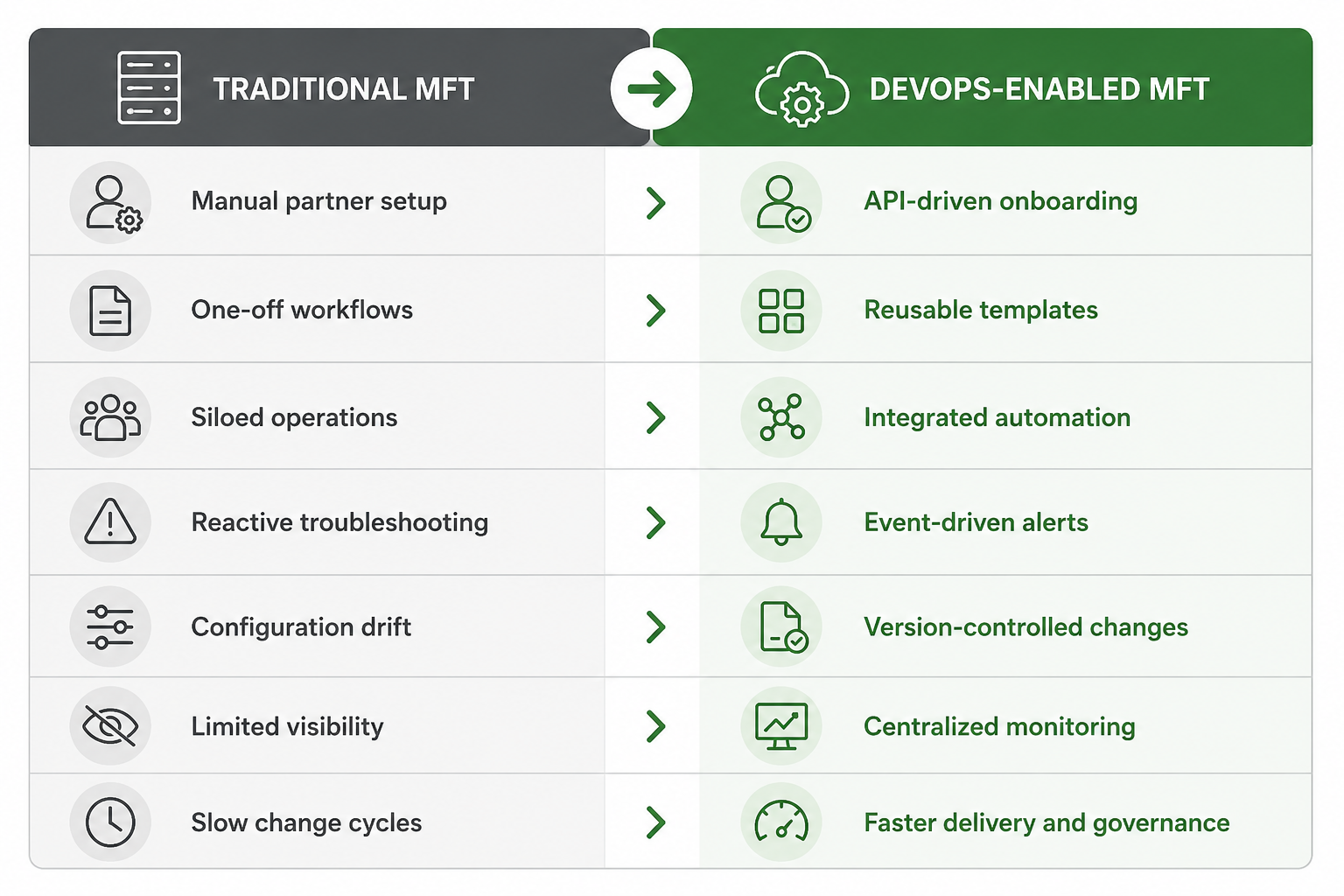
Many Managed File Transfer platforms have evolved technologically, but their operational models have not. As organizations expand across cloud platforms, APIs, SaaS applications, AI services, and global trading partner ecosystems, manual processes and isolated administration become significant barriers to agility, scalability, and security.
Common challenges include:
- Manual workflow configuration that slows deployments and increases the risk of configuration errors.
- Static trading partner onboarding that delays business integration and requires repetitive manual administration.
- Limited integration with modern DevOps, CI/CD, Infrastructure as Code (IaC), and enterprise automation frameworks, preventing consistent and repeatable deployments.
- Configuration drift across development, test, and production environments, leading to operational inconsistencies and increased support effort.
- Siloed operations that separate development, infrastructure, security, and operations teams, slowing change management and reducing visibility.
- Manual configuration changes that are difficult to audit, version control, or reproduce during disaster recovery and compliance reviews.
These limitations increase operational overhead, slow innovation, and make it difficult to deliver the speed, consistency, and continuous security required by modern Enterprise Data Exchange platforms. Applying DevOps and DevSecOps principles helps eliminate these bottlenecks by automating deployments, standardizing environments, embedding security throughout the software lifecycle, and enabling organizations to scale securely with confidence.
Impact on Business Operations
These operational inefficiencies extend far beyond IT and directly affect business performance:
- Longer onboarding cycles delay the integration of new trading partners, applications, and business services, slowing time-to-value.
- Manual configuration and deployment processes increase the likelihood of configuration drift, security vulnerabilities, and production outages.
- Higher operational overhead requires skilled resources to perform repetitive administrative tasks rather than focusing on strategic initiatives.
- Slower response to changing business requirements limits an organization's ability to rapidly deploy new workflows, respond to customer needs, or support regulatory changes.
- Reduced operational resilience makes it more difficult to maintain consistent, secure, and reliable data exchange across cloud, hybrid, and on-premises environments.
As organizations scale, these challenges compound, increasing operational costs, slowing innovation, and reducing the agility needed to compete in today's rapidly evolving digital landscape. Applying DevOps and DevSecOps principles helps eliminate these bottlenecks through automation, standardized deployments, continuous security validation, and policy-driven operations, enabling Enterprise Data Exchange platforms to scale securely and efficiently.
What Modern MFT Looks Like in 2026
Modern Managed File Transfer platforms are evolving beyond secure file transfer to become Enterprise Data Exchange platforms that embrace DevOps, DevSecOps, Zero Trust Security, and cloud-native architectures. The focus is no longer just accelerating deployments, but continuously delivering secure, resilient, and observable business services.
Key Characteristics of Modern Enterprise Data Exchange
1. API-First Architecture
Modern Enterprise Data Exchange platforms expose comprehensive APIs for:
- Trading partner provisioning
- Workflow configuration
- Policy management
- Identity integration
- Monitoring and reporting
- Certificate lifecycle management
Business Impact
- Accelerates integration across enterprise systems
- Reduces manual administration
- Enables end-to-end automation
- Simplifies partner onboarding
2. Infrastructure as Code (IaC)
Infrastructure, workflows, security policies, and operational configurations are managed as version-controlled code.
Business Impact
- Consistent deployments across environments
- Full change history and auditability
- Reduced configuration drift
- Faster disaster recovery
- Simplified rollback and recovery
3. DevSecOps and Zero Trust Security
Security becomes part of the deployment pipeline rather than a post-deployment activity. Every configuration change is continuously validated against organizational security policies before reaching production.
Modern Enterprise Data Exchange platforms should support:
- Automated security policy validation
- Configuration compliance checks
- RBAC policy verification
- Certificate and encryption policy validation
- Continuous configuration auditing
- Automated vulnerability assessments
- DAST scanning of newly deployed MFT environments
- Integration with SAST, DAST, SIEM, vulnerability management, and CI/CD security pipelines
Business Impact
- Reduces configuration-related security vulnerabilities
- Ensures Zero Trust policies remain consistently enforced
- Detects security issues before production deployment
- Improves compliance readiness
- Enables continuous security validation throughout the software lifecycle
4. Reusable and Standardized Workflows
Predefined templates replace one-off configurations while maintaining governance and consistency.
Business Impact
- Faster onboarding
- Reduced operational complexity
- Consistent deployments
- Improved reliability
- Simplified governance
5. Event-Driven Automation
Enterprise Data Exchange platforms integrate with SIEM, SOAR, observability platforms, ITSM systems, and orchestration tools to automatically respond to operational and security events.
Business Impact
- Faster incident response
- Reduced downtime
- Automated remediation
- Proactive operations
- Improved operational resilience
6. Cloud-Native Scalability
Containerized, distributed architectures dynamically scale across cloud, hybrid, and on-premises environments.
Business Impact
- Elastic scalability
- Improved availability
- Better resource utilization
- Simplified operations
- Multi-cloud flexibility
7. Continuous Security Validation
Modern Enterprise Data Exchange platforms should continuously verify that deployments remain secure after they are released.
Examples include:
- Scanning new MFT configurations for security weaknesses
- Verifying RBAC against least-privilege policies
- Detecting insecure protocol configurations
- Identifying weak cipher suites
- Validating MFA and authentication policies
- Detecting exposed endpoints
- Running scheduled DAST scans against externally accessible services
- Detecting configuration drift from approved security baselines
- Alerting when deployments no longer comply with Zero Trust policies
Business Impact
Rather than assuming a deployment remains secure after go-live, organizations continuously verify their Enterprise Data Exchange environment against evolving security policies, regulatory requirements, and emerging threats. This embodies the core principle of Zero Trust Security: never trust, always verify.
Why DevOps and DevSecOps Principles Matter for Enterprise Data Exchange
DevOps has transformed how modern enterprise platforms are designed, deployed, and operated by emphasizing automation, collaboration, continuous delivery, and operational visibility. As organizations increasingly depend on Enterprise Data Exchange to connect cloud platforms, APIs, AI services, SaaS applications, and trading partner ecosystems, these same principles become essential for securely managing business-critical data exchange at scale.
Modern Enterprise Data Exchange platforms must support:
- Infrastructure as Code (IaC) and automated deployments
- API-first integration and workflow automation
- Continuous Integration and Continuous Delivery (CI/CD)
- DevSecOps practices with security integrated throughout the software lifecycle
- Continuous configuration validation and policy enforcement
- Real-time monitoring, observability, and operational intelligence
- Zero Trust Security through continuous verification of identities, configurations, and security policies
Applying these principles transforms Managed File Transfer from an isolated file transfer solution into an intelligent Enterprise Data Exchange platform that continuously automates, secures, governs, and optimizes business-critical data exchange.
Business Impact
Organizations that adopt DevOps and DevSecOps principles can:
- Accelerate deployment of new workflows, trading partners, and business services.
- Standardize deployments through reusable, version-controlled configurations.
- Reduce operational risk by continuously validating security policies and detecting configuration drift before it reaches production.
- Improve resilience through automated testing, repeatable deployments, and simplified disaster recovery.
- Embed Zero Trust Security into every stage of the software lifecycle, ensuring infrastructure, configurations, identities, and data exchange policies are continuously verified rather than implicitly trusted.
This approach supports Pillar 1 of Enterprise Data Exchange: Native End-to-End Zero Trust Security, where automation, continuous verification, and policy-driven governance work together to strengthen security while improving operational agility and reliability.
How TDXchange Enables Modern Enterprise Data Exchange
TDXchange is designed to support modern DevOps and DevSecOps practices by combining API-first integration, Infrastructure as Code (IaC), workflow automation, centralized management, continuous operational visibility, and policy-driven governance within a single Enterprise Data Exchange platform.
Rather than relying on manual administration and isolated file transfer processes, organizations can automate trading partner onboarding, standardize workflow deployment, integrate with CI/CD pipelines, and manage configurations through version-controlled, repeatable processes. This reduces operational complexity while improving consistency, scalability, and reliability across development, test, and production environments.
TDXchange also supports Native End-to-End Zero Trust Security by enabling continuous policy enforcement across all platform components, automated configuration validation, role-based access controls, and integration with enterprise security tools. Organizations can automatically validate new configurations against security policies, detect configuration drift, integrate with vulnerability management platforms, and perform continuous security assessments, including Dynamic Application Security Testing (DAST), helping ensure deployments remain secure and compliant throughout their lifecycle.
Real-World Outcomes
Organizations adopting modern Enterprise Data Exchange platforms such as TDXchange commonly achieve:
- Faster onboarding of trading partners, applications, and business services through API-first automation and reusable workflow templates.
- Reduced operational overhead by eliminating repetitive manual configuration and standardizing deployments with Infrastructure as Code.
- Improved operational visibility through centralized monitoring, workflow orchestration, and real-time observability across the entire data exchange ecosystem.
- Stronger security and compliance through continuous configuration validation, policy-driven governance, automated security assessments, and Native End-to-End Zero Trust enforcement.
- Greater consistency and reliability across development, testing, disaster recovery, and production environments.
- Better collaboration between development, operations, infrastructure, security, and business teams through shared automation, standardized processes, and continuous delivery practices.
Executive Takeaways
Traditional Managed File Transfer platforms were designed to move files securely. Modern Enterprise Data Exchange platforms must also automate deployments, standardize operations, continuously validate security, and integrate seamlessly with enterprise DevOps and DevSecOps practices.
Applying DevOps principles enables organizations to automate infrastructure provisioning, standardize workflow deployment, accelerate trading partner onboarding, and reduce operational complexity through Infrastructure as Code, API-first integration, reusable workflows, and policy-driven automation. These capabilities improve consistency, scalability, and operational resilience while reducing manual effort and configuration errors.
Modern Enterprise Data Exchange platforms must also embrace DevSecOps by embedding security throughout the software lifecycle. Continuous configuration validation, automated security policy enforcement, configuration drift detection, vulnerability assessments, and Dynamic Application Security Testing (DAST) help ensure deployments remain compliant with Zero Trust principles long after they reach production.
TDXchange combines infrastructure automation, workflow orchestration, continuous operational visibility, security validation, and policy-driven governance into a single Enterprise Data Exchange platform. Together, these capabilities support Pillar 1 of Enterprise Data Exchange: Native End-to-End Zero Trust Security, ensuring that infrastructure, identities, workflows, configurations, and business-critical data exchange are continuously verified, monitored, and governed rather than implicitly trusted.
About the Author
Andrei Olin is Chief Technology Officer at bTrade, where he leads product strategy, delivery, architecture, and security across the company’s B2B, Managed File Transfer, and secure data exchange platforms.
Andrei has more than 30 years of experience spanning enterprise architecture, software development, infrastructure, cybersecurity, middleware, trading systems, SaaS, and Managed File Transfer. His career includes building mission-critical systems and infrastructure at Bear Stearns and Morgan Stanley, designing and operating enterprise MFT and messaging platforms for Merrill Lynch and Deutsche Bank, and building and scaling SaaS and security products at startups. He holds master’s and bachelor’s degrees in Information Technology with a focus on Information Security.
Frequently Asked Questions
What is DevOps-enabled Managed File Transfer?
DevOps-enabled Managed File Transfer applies modern software delivery practices such as Infrastructure as Code (IaC), API-first integration, workflow automation, CI/CD, reusable configurations, continuous monitoring, and policy-driven governance to enterprise data exchange. Rather than relying on manual administration, organizations can automate deployments, standardize operations, accelerate trading partner onboarding, and continuously improve reliability, scalability, and operational efficiency.
Why do traditional Managed File Transfer platforms become operational bottlenecks?
Traditional Managed File Transfer platforms often rely on manual configuration, static trading partner onboarding, isolated administration, and limited integration with DevOps and enterprise automation frameworks. These operational models slow business integration, increase configuration errors, create security risks, and make it difficult to scale or respond quickly to changing business and regulatory requirements. Modern Enterprise Data Exchange platforms eliminate these bottlenecks through automation, standardized deployments, and continuous operational visibility.
How does API-first architecture improve Managed File Transfer and Enterprise Data Exchange?
API-first architecture enables organizations to automate trading partner onboarding, workflow deployment, policy management, certificate lifecycle management, monitoring, and reporting. By integrating directly with enterprise applications, CI/CD pipelines, ITSM platforms, and orchestration tools, API-first Enterprise Data Exchange platforms reduce manual administration, accelerate business integration, and improve operational consistency across cloud, hybrid, and on-premises environments.
How does TDXchange support modern Enterprise Data Exchange operations?
TDXchange combines API-first integration, Infrastructure as Code, workflow orchestration, reusable deployment templates, policy-driven automation, centralized operational visibility, and enterprise governance into a single Enterprise Data Exchange platform. The platform also supports DevSecOps practices through automated security policy validation, configuration management, continuous monitoring, integration with enterprise security tools, and Native End-to-End Zero Trust Security principles, helping organizations securely automate and scale business-critical data exchange.
How does DevSecOps improve Managed File Transfer security?
DevSecOps integrates security throughout the software lifecycle rather than treating it as a final deployment step. Modern Enterprise Data Exchange platforms can automatically validate configurations, enforce security policies, detect configuration drift, integrate with vulnerability management tools, and perform security assessments, including Dynamic Application Security Testing (DAST). This continuous validation helps organizations maintain compliance while supporting Zero Trust Security principles.
Why is Zero Trust important for Enterprise Data Exchange?
Enterprise Data Exchange platforms process business-critical information across cloud services, APIs, AI systems, SaaS applications, and trading partner ecosystems. Zero Trust Security ensures that identities, infrastructure, workflows, configurations, and access policies are continuously verified rather than implicitly trusted. By combining continuous validation with policy-driven automation and operational governance, organizations can reduce security risk while improving resilience and compliance.
What is Infrastructure as Code (IaC) in Managed File Transfer?
Infrastructure as Code (IaC) is the practice of defining Managed File Transfer infrastructure, workflows, security policies, and system configurations as version-controlled code rather than configuring them manually. This approach enables automated deployments, consistent environments, simplified disaster recovery, and complete auditability while reducing configuration drift and human error. For Enterprise Data Exchange platforms, IaC improves operational efficiency, accelerates deployments, and supports repeatable, secure infrastructure across cloud, hybrid, and on-premises environments.
How do DevOps and DevSecOps support Zero Trust Security?
DevOps and DevSecOps help organizations implement Zero Trust Security by embedding security throughout the software lifecycle rather than treating it as a final deployment step. Modern Enterprise Data Exchange platforms can automatically validate configurations, enforce security policies, detect configuration drift, integrate with vulnerability management platforms, and perform continuous security assessments, including Dynamic Application Security Testing (DAST). By continuously verifying infrastructure, identities, workflows, and security controls, organizations reduce operational risk while ensuring deployments remain secure, compliant, and aligned with Pillar 1 of Enterprise Data Exchange: Zero Trust Security.