

Healthcare organizations depend on file transfers for far more than moving documents between two locations. Patient records, laboratory results, claims, billing information, medical images, referrals, pharmacy data and other sensitive information regularly move among medical practices, hospitals, laboratories, insurers, pharmacies, billing providers and technology partners.
Every one of these exchanges creates a responsibility to protect the confidentiality, integrity and availability of protected health information.
The HIPAA Security Rule establishes administrative, physical and technical safeguards for electronic protected health information, commonly known as ePHI. It applies to covered entities and their business associates, but it does not prescribe one specific technology or file transfer product. Instead, healthcare organizations must select and operate security measures appropriate to their size, infrastructure and risks.
This distinction is important. No software platform automatically makes an organization HIPAA compliant. Compliance depends on the complete environment, including technology, architecture, configuration, policies, procedures, contracts, workforce training, risk management, monitoring and documented evidence.
A properly implemented Managed File Transfer platform can provide many of the technical and operational controls required to build and maintain that program.
Can TDXchange Support HIPAA-Compliant File Transfer?
Yes. bTrade TDXchange provides healthcare organizations and medical practices with security, access control, automation, monitoring and audit capabilities that can support HIPAA-compliant exchanges of PHI and ePHI.
TDXchange can securely move sensitive information between internal systems, cloud services, applications, users and authorized external organizations. It gives administrators centralized control over who can exchange information, how files are protected, where they may be delivered, which processing steps must be completed and what evidence is retained.
Relevant TDXchange capabilities include:
- Encryption of information in transit and at rest
- Native End-to-End Zero Trust across users, services, workflows and internal platform components
- Multi-factor authentication for administrators and end users
- Role-based access control and least-privilege authorization
- Separation of users, organizations, partners and workflows
- Secure protocols including SFTP, FTPS, HTTPS, AS2 and other supported services
- Detailed transaction, user and administrative audit trails
- Automated workflows that reduce dependence on manual file handling
- File scanning and security integration
- Real-time monitoring, alerts and operational dashboards
- Integration with enterprise identity, security and monitoring systems
- Clustering, failover and recovery options for critical healthcare workflows
- On-premises, cloud, hosted and hybrid deployment models
These capabilities help healthcare organizations protect patient information while making file movement more visible, controlled and auditable.
Why Ordinary File Transfer Is Not Enough for Patient Data
A file can be encrypted while it crosses a network and still be exposed before or after the transfer.
The wrong person may receive it. An employee may place it in an unapproved location. A shared account may make it difficult to determine who accessed it. A failed transfer may go unnoticed. A file may arrive but never reach the clinical, billing or operational system that needs it. A certificate or SSH key may expire and interrupt a critical workflow. An administrator may change a configuration without appropriate review.
This is why healthcare file transfer requires more than an encrypted connection.
A mature MFT platform should govern the complete exchange:
- Who or what initiated the transaction
- Whether the identity was properly authenticated
- Whether the sender and recipient were authorized
- Which security policy was applied
- Whether the file passed the required inspection and processing steps
- Where the file was delivered
- Whether delivery and downstream processing succeeded
- Who accessed or changed the workflow
- Whether failures, delays or unexpected behavior were detected
- What evidence is available for an audit or investigation
TDXchange was designed to manage this broader operational and security context.
How TDXchange Helps Protect PHI and ePHI
Strong Authentication and Access Control
Healthcare information should only be available to properly authenticated and authorized people, applications and systems.
TDXchange supports multi-factor authentication, role-based permissions, least-privilege access and integration with enterprise identity providers. Access can be separated by user, role, business unit, participant, partner, mailbox, service and workflow.
This helps medical practices and healthcare organizations restrict access according to job responsibilities and business relationships instead of granting broad access to an entire file transfer environment.
TDXchange’s Native End-to-End Zero Trust model extends these controls beyond the external user. Users, services, workflows and internal components are authenticated and authorized according to their assigned permissions and intended functions.
Protection in Transit and at Rest
Patient information may be exposed both while it is moving and while it is waiting to be processed, retrieved or delivered.
TDXchange supports secure transfer protocols and strong cryptographic controls for protecting information in transit. It can also protect files and sensitive platform data stored within the environment.
bTrade’s crypto-agile architecture helps organizations manage changing cryptographic requirements without redesigning their entire file transfer infrastructure. TDXchange also supports quantum-safe cryptographic capabilities for organizations concerned about the long-term confidentiality of healthcare information.
Encryption is essential, but it should be combined with identity verification, access control, workflow governance, monitoring and auditability. Encryption by itself cannot prevent an authorized account from sending the wrong patient file to the wrong destination.
Complete Auditability and Operational Evidence
The HIPAA Security Rule requires regulated organizations to implement mechanisms for recording and examining activity involving systems that contain or use ePHI.
TDXchange records detailed information about file transfers, users, participants, services, workflows and administrative activity. Authorized personnel can investigate what happened, when it happened, which identity was involved, where information was sent and whether processing completed successfully.
This evidence can support:
- Security investigations
- Internal compliance reviews
- External audits
- Operational troubleshooting
- Access reviews
- Incident response
- Transaction reconciliation
- Partner disputes
- Confirmation that critical healthcare files were delivered
The objective is not simply to retain logs. The objective is to make the evidence understandable and usable when an organization needs it.
Secure Workflow Automation
Manual handling creates opportunities for mistakes. A user may select the wrong recipient, forget an encryption step, leave a file in an unsecured location or fail to recognize that a transfer did not complete.
TDXchange can automate repeatable healthcare data exchanges according to approved policies. A workflow can monitor an authorized location, identify an eligible file, inspect it, encrypt it, rename or transform it, route it to an approved recipient, verify delivery and notify the appropriate team if something goes wrong.
Workflows can be triggered by file arrival, a schedule, an application request or another approved event. Automated processing helps healthcare organizations apply the same security and operational controls consistently instead of relying on users to remember every step.
Monitoring, Alerting and Incident Investigation
A successful connection does not necessarily mean that a business process succeeded.
A laboratory file may arrive late. A claims file may be much smaller than expected. A transfer may succeed, but the destination application may reject the file. A workflow may repeatedly retry without completing. A critical patient-related exchange may stop because of an expired credential.
TDXchange provides centralized monitoring, alerts, dashboards and end-to-end transaction visibility. Operations and security teams can identify failures, delays and abnormal conditions before they become larger patient-care, financial or compliance problems.
TDXchange can also integrate with enterprise security monitoring and SIEM platforms so file transfer activity can be evaluated within the organization’s broader security program.
File Inspection and Malware Protection
Healthcare organizations receive files from many internal and external sources. Encryption protects information while it is being moved, but it does not establish that the contents are safe.
TDXchange can integrate file scanning, malware protection, data loss prevention and other inspection capabilities into controlled workflows. Scanning policies can be applied at the appropriate relationship or service level so that files are evaluated according to their source, destination and risk.
Files that fail an approved control can be rejected, quarantined or routed for review before they reach clinical, financial or operational systems.
TDXchange and HIPAA Security Objectives
The following table illustrates how TDXchange capabilities can contribute to a healthcare organization’s broader HIPAA security program.
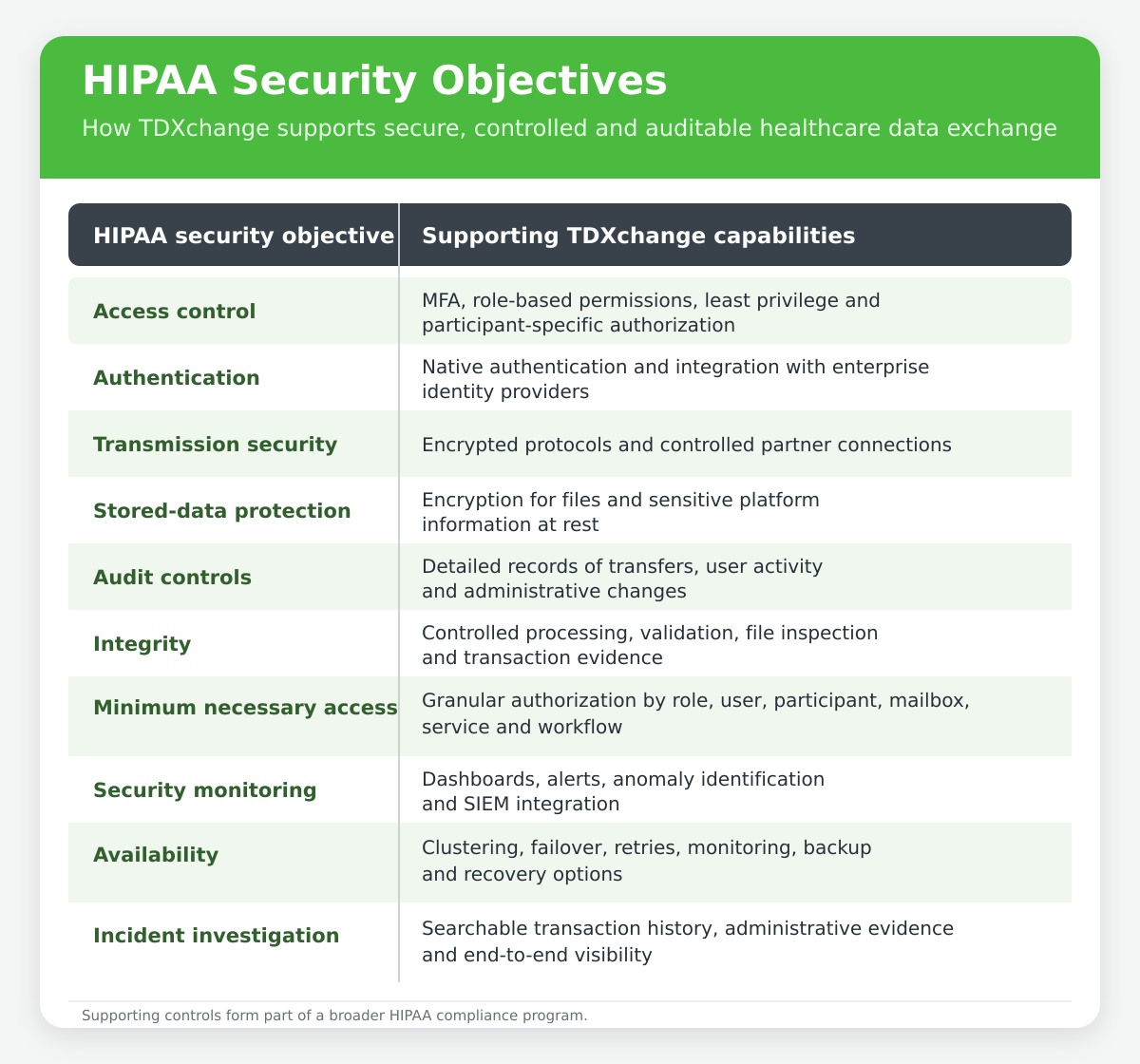
This mapping does not replace a HIPAA risk analysis, legal review or compliance assessment. It helps organizations understand how MFT controls can support the administrative and technical safeguards implemented across the larger healthcare environment.
Common Healthcare and Medical Practice Workflows
TDXchange can support automated and user-driven exchanges involving:
- Electronic health record exports and imports
- Patient records shared with authorized providers
- Laboratory orders and results
- Claims, eligibility and payment files
- Billing and revenue-cycle information
- Referrals and supporting clinical documentation
- Medical images and other large files
- Pharmacy and prescription-related exchanges
- Research and clinical-trial data
- Files exchanged with insurers and health plans
- Secure delivery to billing companies and other approved service providers
- Reports exchanged with government and public-health organizations
- Backup and replication of critical healthcare information
- Secure ad hoc exchanges that should not be sent as ordinary email attachments
Each workflow can be configured according to its participants, sensitivity, transfer method, schedule, retention requirements and operational importance.
Can Medical Practices Use TDXchange?
Yes. TDXchange is not limited to large hospital systems.
A medical practice may need to exchange information with laboratories, imaging centers, hospitals, specialists, insurers, pharmacies, billing providers and patients. Managing separate scripts, FTP servers, email attachments and consumer file-sharing services can create unnecessary security and operational complexity.
bTrade can help configure an implementation appropriate to the practice’s transaction volumes, workflows, security requirements and available technical resources. Organizations can begin with the capabilities they need and expand the platform as their partner community and automation requirements grow.
TDConnect can also provide a lighter-weight option for organizations that require secure, auditable file exchange without the scale and complexity of a larger enterprise deployment.
Flexible Deployment and Control of Healthcare Data
Healthcare organizations have different infrastructure, risk and data-governance requirements. Some want patient information to remain within infrastructure they directly control. Others prefer a hosted service. Many operate across a combination of on-premises systems and cloud platforms.
TDXchange can be deployed:
- Within an organization’s on-premises infrastructure
- In a customer-controlled private or public cloud
- Across a hybrid environment
- In a bTrade-managed cloud environment
- Across distributed and containerized architectures, including Kubernetes
The deployment model can be selected according to the organization’s security architecture, resources, recovery requirements, data-residency needs and operational model.
Regardless of deployment location, TDXchange provides centralized governance over users, partners, workflows, permissions, monitoring, alerts and audit evidence.
Business Associate Agreements and Shared Responsibility
HIPAA compliance also involves contractual and organizational responsibilities.
When a service provider creates, receives, maintains or transmits ePHI on behalf of a covered entity, the organizations must determine whether the service provider is acting as a business associate and whether a Business Associate Agreement is required.
Before selecting a hosted deployment, a healthcare organization should document:
- Which party will create, receive, maintain or transmit ePHI
- Where the information will be stored and processed
- Which security and operational responsibilities belong to each party
- Which subcontractors or infrastructure providers may be involved
- How security incidents and potential breaches will be reported
- Which contractual protections and agreements are required
For customer-managed deployments, the allocation of responsibilities may be different because TDXchange can operate entirely within the customer’s controlled infrastructure.
Healthcare organizations should discuss their proposed architecture and contractual requirements with bTrade and their legal, privacy and security teams before handling ePHI through the platform.
HIPAA Compliance Is a Continuing Operational Process
Installing secure software is not the end of a HIPAA compliance program.
Healthcare organizations should regularly evaluate whether their file transfer environment continues to protect ePHI appropriately. This includes reviewing users and permissions, removing unnecessary access, replacing expiring certificates and keys, applying security updates, testing recovery procedures, investigating unusual activity and confirming that critical workflows continue to operate as intended.
A mature program connects vulnerability management with business continuity, disaster recovery, incident communication, transaction reconciliation and end-to-end operational validation.
This is particularly important in healthcare. A failed file transfer may affect more than an IT metric. It can delay a laboratory result, interrupt billing, prevent information from reaching an authorized provider or create uncertainty about whether sensitive patient data reached the correct destination.
Why Healthcare Organizations Choose bTrade
bTrade has been developing secure enterprise file transfer and data-exchange technology since 1990.
During that time, we have worked closely with customers operating complex, highly regulated and business-critical environments. Many of the capabilities within TDXchange originated from real customer requirements and the operational lessons gained from long-term partnerships.
Our approach is based on several principles:
- Security must extend beyond the network connection
- Access should be continuously authenticated and authorized
- Sensitive information must be protected in transit and at rest
- Every critical exchange should be observable and auditable
- Automation should reduce human error without reducing governance
- Healthcare organizations should be able to choose where the platform operates
- Security architecture must evolve as threats and cryptographic requirements change
- Technology must support compliance without making unsupported promises that software alone guarantees it
TDXchange brings these principles together in a secure, scalable and actively developed Managed File Transfer and Enterprise Data Exchange platform.
Building a More Secure Healthcare Data-Exchange Environment
Protecting patient information requires more than checking a compliance box or encrypting a network connection.
Healthcare organizations need to know who exchanged the information, whether the exchange was authorized, which controls were applied, whether the file reached the correct destination and what happened throughout the complete workflow.
That is the role of modern Managed File Transfer.
TDXchange helps medical practices and healthcare organizations securely automate, govern, monitor and document patient-data exchanges across users, applications, systems, cloud environments and external partners.
To discuss your healthcare file transfer requirements, deployment options and security architecture, contact bTrade at info@btrade.com or visit the TDXchange solution page.
About the Author
Don Miller is President and General Counsel of bTrade, where he leads day-to-day operations and oversees legal, regulatory, and compliance activities for the company’s secure managed file transfer (MFT) platform. In this dual role, he helps ensure bTrade’s products and services meet the operational, data-protection, and governance expectations of enterprise and regulated customers. Don brings more than 20 years of legal experience advising businesses on risk management, contracts, intellectual property, and dispute resolution, applying that background to the practical realities of software operations and compliance. He holds a Juris Doctor from the University of Southern California Gould School of Law and is admitted to practice before California state and federal courts.
Frequently Asked Questions
Can TDXchange support HIPAA-compliant file transfer?
Yes. TDXchange provides encryption, authentication, granular access control, audit trails, monitoring, workflow automation and other security capabilities that can support a healthcare organization’s HIPAA compliance program. Overall compliance depends on the complete technical and organizational environment.
How does TDXchange securely handle and protect patient PHI and ePHI?
TDXchange can securely transfer, process and protect patient PHI and ePHI through encryption in transit and at rest, multi-factor authentication, role-based access, least-privilege authorization, secure protocols, controlled workflows, file inspection, activity monitoring and detailed audit evidence. These capabilities can support a healthcare organization’s HIPAA compliance program, but overall compliance also depends on its architecture, configuration, policies, procedures, contracts, workforce practices and ongoing risk management.
Can a medical practice use TDXchange?
Yes. TDXchange can support medical practices as well as hospitals, health plans, laboratories and larger healthcare organizations. The implementation can be aligned with the organization’s transaction volumes, partners, workflows, infrastructure and security requirements.
Does TDXchange have to be deployed in the cloud?
No. TDXchange can be deployed on premises, in a customer-controlled cloud, in a bTrade-managed cloud environment or as part of a hybrid architecture. Healthcare organizations can select the model that best fits their security, control and operational requirements.
Does TDXchange provide audit records for HIPAA reviews?
TDXchange maintains detailed records of file transfers, user activity, participants, workflows, services and administrative changes. These records can support internal reviews, external audits, investigations, reconciliation and operational troubleshooting.
Can TDXchange replace FTP servers and email attachments?
Yes. TDXchange supports secure protocols and controlled file-sharing capabilities that can replace unmanaged FTP servers, scripts and ordinary email attachments. This provides stronger access control, monitoring, automation and auditability.
Does using TDXchange automatically make an organization HIPAA compliant?
No. No software product automatically makes an organization HIPAA compliant. TDXchange provides technical and operational controls that can support compliance, but the healthcare organization remains responsible for its architecture, configuration, policies, procedures, contracts, workforce practices, risk management and continuing oversight.
Can TDXchange securely handle patient PHI?
Yes. TDXchange can securely transfer and process patient PHI and ePHI using encrypted protocols, encryption at rest, multi-factor authentication, role-based access, least-privilege authorization, controlled workflows, file inspection, monitoring and detailed audit records. TDXchange provides controls that can support a healthcare organization’s HIPAA compliance program, but overall compliance also depends on the organization’s configuration, policies, contracts and operating procedures.
Authoritative Resources
<script type="application/ld+json">
{
  "@context": "https://schema.org",
  "@graph": [
    {
      "@type": "Organization",
      "@id": "https://www.btrade.com/#organization",
      "name": "bTrade, LLC",
      "alternateName": "bTrade",
      "url": "https://www.btrade.com/",
      "description": "bTrade develops secure Managed File Transfer and Enterprise Data Exchange solutions for organizations with complex security, automation, integration and compliance requirements.",
      "foundingDate": "1990",
      "email": "info@btrade.com",
      "telephone": "+1-866-446-2935",
      "address": {
        "@type": "PostalAddress",
        "streetAddress": "10100 N Central Expy, Suite 318",
        "addressLocality": "Dallas",
        "addressRegion": "TX",
        "postalCode": "75231",
        "addressCountry": "US"
      }
    },
    {
      "@type": "Person",
      "@id": "https://www.btrade.com/blogs/hipaa-compliant-managed-file-transfer-healthcare#author",
      "name": "Andrei Olin",
      "jobTitle": "Chief Technology Officer",
      "worksFor": {
        "@id": "https://www.btrade.com/#organization"
      },
      "knowsAbout": [
        "Managed File Transfer",
        "Enterprise Data Exchange",
        "Healthcare Data Security",
        "HIPAA Security",
        "Zero Trust Architecture",
        "Post-Quantum Cryptography",
        "Cybersecurity",
        "DevSecOps",
        "Operational Resilience"
      ]
    },
    {
      "@type": "WebSite",
      "@id": "https://www.btrade.com/#website",
      "url": "https://www.btrade.com/",
      "name": "bTrade",
      "publisher": {
        "@id": "https://www.btrade.com/#organization"
      },
      "inLanguage": "en-US"
    },
    {
      "@type": "BreadcrumbList",
      "@id": "https://www.btrade.com/blogs/hipaa-compliant-managed-file-transfer-healthcare#breadcrumb",
      "itemListElement": [
        {
          "@type": "ListItem",
          "position": 1,
          "name": "Home",
          "item": "https://www.btrade.com/"
        },
        {
          "@type": "ListItem",
          "position": 2,
          "name": "Blog",
          "item": "https://www.btrade.com/media/blog"
        },
        {
          "@type": "ListItem",
          "position": 3,
          "name": "HIPAA-Compliant File Transfer for Healthcare",
          "item": "https://www.btrade.com/blogs/hipaa-compliant-managed-file-transfer-healthcare"
        }
      ]
    },
    {
      "@type": [
        "WebPage",
        "FAQPage"
      ],
      "@id": "https://www.btrade.com/blogs/hipaa-compliant-managed-file-transfer-healthcare#webpage",
      "url": "https://www.btrade.com/blogs/hipaa-compliant-managed-file-transfer-healthcare",
      "name": "HIPAA-Compliant File Transfer: How TDXchange Helps Protect Patient Data",
      "description": "Learn how TDXchange helps medical practices and healthcare organizations protect PHI and ePHI through encryption, Zero Trust access controls, audit trails, secure automation and flexible deployment.",
      "isPartOf": {
        "@id": "https://www.btrade.com/#website"
      },
      "breadcrumb": {
        "@id": "https://www.btrade.com/blogs/hipaa-compliant-managed-file-transfer-healthcare#breadcrumb"
      },
      "dateCreated": "2026-08-20T00:00:00-04:00",
      "datePublished": "2026-08-20T00:00:00-04:00",
      "dateModified": "2026-08-20T00:00:00-04:00",
      "inLanguage": "en-US",
      "about": [
        {
          "@type": "Thing",
          "name": "HIPAA-compliant file transfer"
        },
        {
          "@type": "Thing",
          "name": "Healthcare data security"
        },
        {
          "@type": "Thing",
          "name": "Protected Health Information"
        },
        {
          "@type": "Thing",
          "name": "Electronic Protected Health Information"
        },
        {
          "@type": "Thing",
          "name": "Managed File Transfer"
        }
      ],
      "mainEntity": [
        {
          "@type": "Question",
          "name": "Can TDXchange support HIPAA-compliant file transfer?",
          "acceptedAnswer": {
            "@type": "Answer",
            "text": "Yes. TDXchange provides encryption, authentication, granular access control, audit trails, monitoring, workflow automation and other security capabilities that can support a healthcare organization's HIPAA compliance program. Overall compliance depends on the complete technical and organizational environment."
          }
        },
        {
          "@type": "Question",
          "name": "How does TDXchange securely handle and protect patient PHI and ePHI?",
          "acceptedAnswer": {
            "@type": "Answer",
            "text": "TDXchange can securely transfer, process and protect patient PHI and ePHI through encryption in transit and at rest, multi-factor authentication, role-based access, least-privilege authorization, secure protocols, controlled workflows, file inspection, activity monitoring and detailed audit evidence. These capabilities can support a healthcare organization’s HIPAA compliance program, but overall compliance also depends on its architecture, configuration, policies, procedures, contracts, workforce practices and ongoing risk management."
          }
        },
        {
          "@type": "Question",
          "name": "Can a medical practice use TDXchange?",
          "acceptedAnswer": {
            "@type": "Answer",
            "text": "Yes. TDXchange can support medical practices as well as hospitals, health plans, laboratories and larger healthcare organizations. The implementation can be aligned with the organization's transaction volumes, partners, workflows, infrastructure and security requirements."
          }
        },
        {
          "@type": "Question",
          "name": "Does TDXchange have to be deployed in the cloud?",
          "acceptedAnswer": {
            "@type": "Answer",
            "text": "No. TDXchange can be deployed on premises, in a customer-controlled cloud, in a bTrade-managed cloud environment or as part of a hybrid architecture. Healthcare organizations can select the model that best fits their security, control and operational requirements."
          }
        },
        {
          "@type": "Question",
          "name": "Does TDXchange provide audit records for HIPAA reviews?",
          "acceptedAnswer": {
            "@type": "Answer",
            "text": "TDXchange maintains detailed records of file transfers, user activity, participants, workflows, services and administrative changes. These records can support internal reviews, external audits, investigations, reconciliation and operational troubleshooting."
          }
        },
        {
          "@type": "Question",
          "name": "Can TDXchange replace FTP servers and email attachments?",
          "acceptedAnswer": {
            "@type": "Answer",
            "text": "Yes. TDXchange supports secure protocols and controlled file-sharing capabilities that can replace unmanaged FTP servers, scripts and ordinary email attachments. This provides stronger access control, monitoring, automation and auditability."
          }
        },
        {
          "@type": "Question",
          "name": "Does using TDXchange automatically make an organization HIPAA compliant?",
          "acceptedAnswer": {
            "@type": "Answer",
            "text": "No. No software product automatically makes an organization HIPAA compliant. TDXchange provides technical and operational controls that can support compliance, but the healthcare organization remains responsible for its architecture, configuration, policies, procedures, contracts, workforce practices, risk management and continuing oversight."
          }
        }
      ]
    },
    {
      "@type": "BlogPosting",
      "@id": "https://www.btrade.com/blogs/hipaa-compliant-managed-file-transfer-healthcare#article",
      "url": "https://www.btrade.com/blogs/hipaa-compliant-managed-file-transfer-healthcare",
      "mainEntityOfPage": {
        "@id": "https://www.btrade.com/blogs/hipaa-compliant-managed-file-transfer-healthcare#webpage"
      },
      "headline": "HIPAA-Compliant File Transfer: How TDXchange Helps Protect Patient Data",
      "alternativeHeadline": "Managed File Transfer for Healthcare Organizations and Medical Practices",
      "description": "Learn how TDXchange helps medical practices and healthcare organizations protect PHI and ePHI through encryption, Zero Trust access controls, audit trails, secure automation and flexible deployment.",
      "dateCreated": "2026-08-20T00:00:00-04:00",
      "datePublished": "2026-08-20T00:00:00-04:00",
      "dateModified": "2026-08-20T00:00:00-04:00",
      "author": {
        "@id": "https://www.btrade.com/blogs/hipaa-compliant-managed-file-transfer-healthcare#author"
      },
      "publisher": {
        "@id": "https://www.btrade.com/#organization"
      },
      "articleSection": [
        "Managed File Transfer",
        "Healthcare Data Security",
        "HIPAA Compliance",
        "Patient Data Protection"
      ],
      "keywords": [
        "HIPAA-compliant file transfer",
        "HIPAA managed file transfer",
        "healthcare managed file transfer",
        "secure patient data transfer",
        "PHI file transfer",
        "ePHI security",
        "medical practice file transfer",
        "healthcare data security",
        "TDXchange",
        "bTrade",
        "Zero Trust managed file transfer",
        "secure healthcare data exchange"
      ],
      "about": [
        {
          "@type": "Thing",
          "name": "HIPAA Security Rule",
          "sameAs": "https://www.hhs.gov/hipaa/for-professionals/security/laws-regulations/index.html"
        },
        {
          "@type": "Thing",
          "name": "Protected Health Information"
        },
        {
          "@type": "Thing",
          "name": "Electronic Protected Health Information"
        },
        {
          "@type": "SoftwareApplication",
          "name": "TDXchange",
          "applicationCategory": "Managed File Transfer",
          "operatingSystem": "Cross-platform",
          "url": "https://www.btrade.com/solutions/tdxchange",
          "provider": {
            "@id": "https://www.btrade.com/#organization"
          }
        }
      ],
      "mentions": [
        {
          "@type": "Thing",
          "name": "Multi-factor authentication"
        },
        {
          "@type": "Thing",
          "name": "Role-based access control"
        },
        {
          "@type": "Thing",
          "name": "Zero Trust security"
        },
        {
          "@type": "Thing",
          "name": "Encryption at rest"
        },
        {
          "@type": "Thing",
          "name": "Transmission security"
        },
        {
          "@type": "Thing",
          "name": "Audit controls"
        },
        {
          "@type": "Thing",
          "name": "Business Associate Agreement"
        }
      ],
      "isAccessibleForFree": true,
      "inLanguage": "en-US"
    }
  ]
}
</script>