

From Secure File Transfer to Intelligent Orchestration and Measurable Business Outcomes
Throughout my career, whether building technology in startups, designing mission-critical platforms for global financial institutions, or developing enterprise software products, I have always believed that technology should be measured by the business problems it solves and the value it delivers rather than the number of features it provides.
Managed File Transfer (MFT) is no exception.
Over the past several decades, Managed File Transfer platforms have become increasingly secure, reliable, scalable, and automated.
However, successfully delivering information does not necessarily mean that the business process relying on that information has completed successfully.
Organizations do not exchange information simply because they need to move files. They exchange information because they need to accomplish something.
As we continue investing in the evolution of TDXchange at bTrade, our vision for 2027 and beyond is to extend Enterprise Data Exchange beyond secure transport and workflow automation toward intelligent information processing, deeper enterprise integration, proactive operational intelligence, and measurable business outcomes.
Our objective is to help organizations reduce operational costs, improve business process efficiency, increase throughput, strengthen reliability, improve customer satisfaction and retention, and create opportunities for sustainable revenue growth.
This article outlines that vision, why I believe it matters, and the technology direction we are pursuing at bTrade.
Executive Summary
The next evolution of Managed File Transfer is not simply about moving information faster or introducing more artificial intelligence capabilities.
It is about helping organizations achieve better business outcomes through intelligent Enterprise Data Exchange.
Modern Enterprise Data Exchange platforms should increasingly help organizations:
- Analyze, validate, transform, and enrich information before it reaches downstream processing applications.
- Integrate specialized AI, information processing, security, and business technologies into governed enterprise workflows.
- Understand whether business processes have achieved their intended objectives.
- Identify operational risks and inefficiencies before they result in business disruptions.
- Reduce operational complexity, manual intervention, and dependency on individual experts.
- Provide customers, trading partners, and business stakeholders with relevant and actionable information.
- Continuously improve business process efficiency, reliability, and scalability.
At bTrade, we refer to this direction as Business Outcome Intelligence.
Building upon the architectural and operational foundations established through TDXchange v5, our technology investments for 2027 and beyond are intended to help organizations reduce the cost of doing business while improving their ability to serve customers, protect existing revenue, and support business growth.
Key Takeaways
- Successful file delivery is a technical milestone, not necessarily a successful business outcome.
- Intelligent information processing can reduce downstream failures, manual remediation costs, and processing delays.
- Operational AI and Business Processing AI address complementary business challenges.
- Proactive operational intelligence can reduce the frequency, duration, and financial impact of business disruptions.
- More efficient business processes can increase throughput without proportional increases in operational costs.
- Higher business reliability can contribute to improved customer satisfaction, retention, and revenue protection.
- Open enterprise integration architectures allow organizations to leverage specialized technologies and protect existing investments.
- bTrade's technology vision for 2027 and beyond is focused on translating engineering innovation into measurable business value.
What Is Business Outcome Intelligence in Managed File Transfer?
Business Outcome Intelligence in Managed File Transfer is an approach to Enterprise Data Exchange that combines intelligent workflow orchestration, information analysis and validation, enterprise integration, operational visibility, business SLA governance, security controls, and AI-powered intelligence to help organizations achieve, verify, and continuously improve their intended business outcomes.
It extends the traditional responsibilities of Managed File Transfer beyond secure delivery toward three complementary objectives.
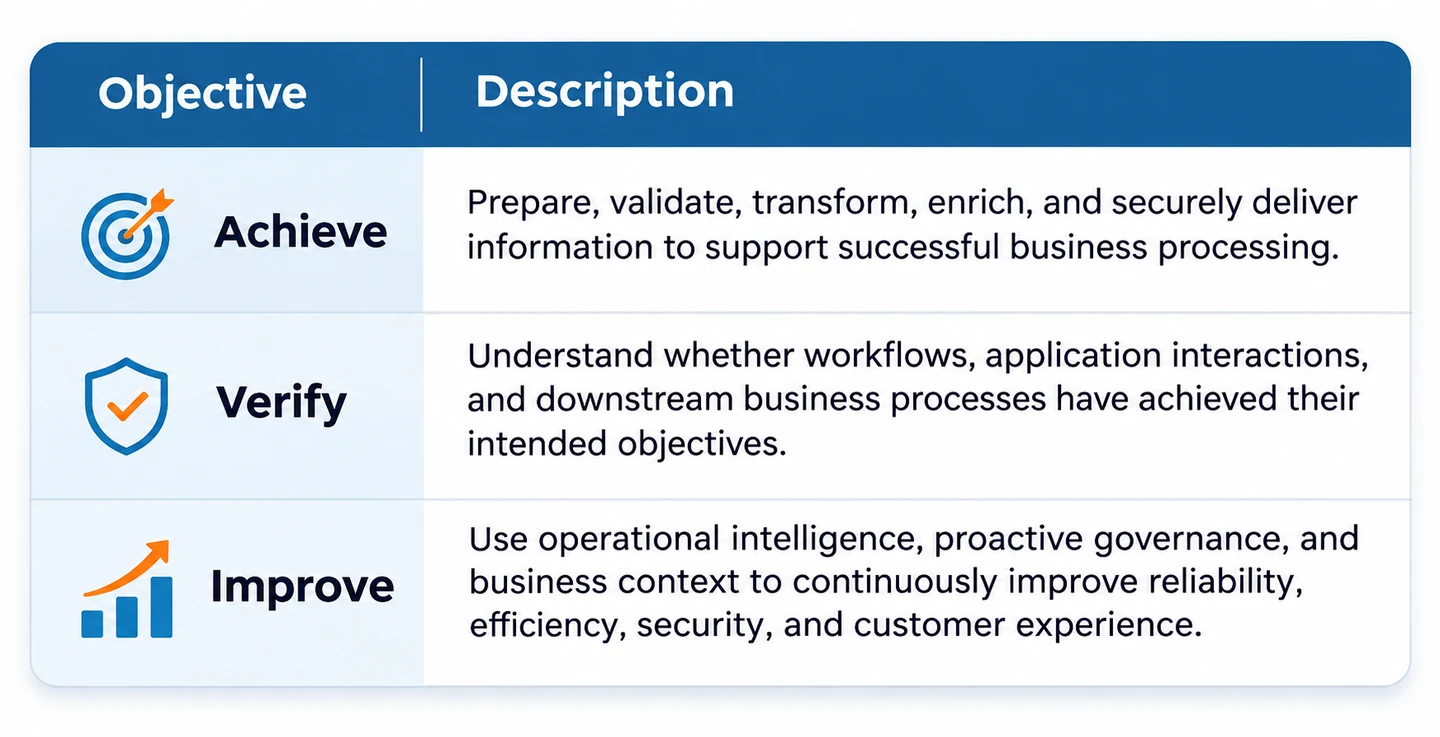
Business Outcome Intelligence does not replace ERP systems, financial processing platforms, data analytics solutions, or other specialized business applications.
Instead, it provides an intelligent orchestration and governance layer that helps these technologies work together more effectively.
Its value should ultimately be measured through reduced operational costs, increased business throughput, improved reliability, customer satisfaction, and sustainable business growth.
Automation Solved the First Problem
When I began working with enterprise data exchange technologies, much of the effort associated with moving information between systems and organizations was manual.
Over time, Managed File Transfer platforms helped organizations automate:
- Trading partner communications
- File transfer scheduling
- Encryption and decryption
- Application integrations
- Information transformation
- Incoming file processing
- Exception handling and retries
- Operational monitoring and reporting
These capabilities significantly improved operational efficiency, security, and reliability.
However, as enterprise environments became more interconnected, workflows became increasingly complex, operational dependencies increased, and organizations continued to rely heavily on experienced administrators to investigate problems and maintain business continuity.
Automation solved many of the challenges associated with moving information.
The next opportunity is to improve the efficiency, reliability, and economics of the business processes that depend on that information.
A Successful File Transfer Is Not Always a Successful Business Outcome
Traditional Managed File Transfer platforms primarily measure success through technical events.
A file was received.
A file was delivered.
A workflow completed.
A transfer met its SLA.
These measurements remain important, but they do not necessarily indicate that the intended business objective was achieved.
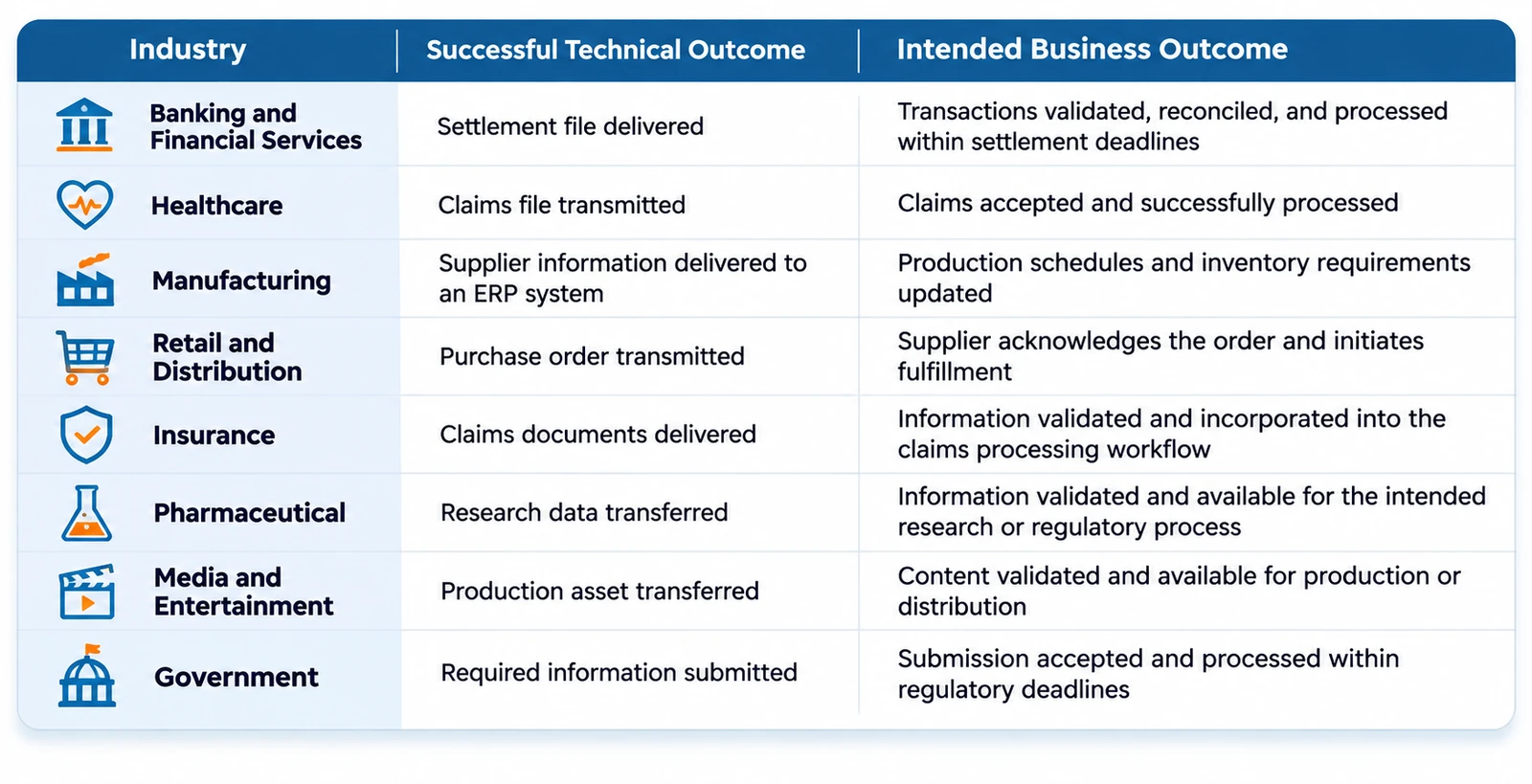
A technically successful transfer can still result in a failed business process.
The consequences may include additional processing costs, missed deadlines, delayed payments, interrupted production, dissatisfied customers, and lost revenue.
Where downstream applications provide processing results, acknowledgments, API responses, or business events, Enterprise Data Exchange platforms should increasingly incorporate that information into workflow visibility and business SLA governance.
However, improving business outcomes should begin even before information reaches its destination.
Beyond File Delivery: Preparing Information for Successful Business Processing
One of the most significant opportunities for the evolution of Managed File Transfer is helping organizations improve the quality and readiness of information before it reaches downstream business applications.
Poor information quality can result in:
- Rejected financial transactions
- Delayed healthcare and insurance claims
- Incorrect inventory information
- Failed application processing
- Regulatory compliance exceptions
- Manual data corrections
- Missed business deadlines
- Customer dissatisfaction
Traditionally, many of these problems are discovered only after information has been delivered to the receiving application.
By that point, the business process may already be delayed, and additional operational resources may be required to investigate and resolve the problem.
Integrating Specialized Information Processing Technologies
We see significant opportunities to extend Enterprise Data Exchange through deeper integration with specialized technologies, including:
- AI-powered content and document analysis
- Intelligent document processing
- Information classification and extraction
- Data quality and validation
- Data mapping, transformation, and normalization
- Business rule validation
- Information enrichment
- Malware scanning and Data Loss Prevention
- Fraud detection and risk assessment
- Industry-specific information processing
Rather than attempting to replicate every specialized capability within the Managed File Transfer platform, we believe the greater value comes from intelligently orchestrating these technologies within secure and governed enterprise workflows.
Based on processing results, information can be delivered, transformed, enriched, routed for additional processing, submitted for human review, quarantined, or rejected.
Preventing Business Processing Failures Before They Occur
Consider a financial institution receiving transaction information from external trading partners.
An intelligent Enterprise Data Exchange workflow could:
- Authenticate the submitting organization and securely receive the information.
- Validate information integrity and applicable security requirements.
- Identify the type and intended business purpose of the information.
- Validate required fields, formats, and applicable business rules.
- Transform or enrich the information where necessary.
- Route exceptions for remediation or authorized review.
- Deliver validated information to the appropriate processing application.
- Capture available downstream processing results.
- Evaluate business SLA achievement.
- Provide authorized stakeholders with relevant processing status information.
The objective is to deliver the right information, in the right format, with the required quality and security, to the right application, at the right time.
Identifying problems earlier can reduce manual remediation costs, improve business process completion rates, increase transaction throughput, and provide customers with more reliable services.
The Importance of an Open Enterprise Integration Architecture
I do not believe that any single technology provider can or should attempt to build the best solution for every enterprise information processing requirement.
Organizations already have significant investments in specialized technologies, including:
- ERP and financial processing systems
- Data mapping and transformation platforms
- AI and machine learning services
- Intelligent document processing solutions
- Data quality and validation platforms
- Security and compliance technologies
- Cloud applications and storage platforms
- Industry-specific business applications
- APIs and customer-developed services
- Edge computing and connected devices
The role of intelligent Enterprise Data Exchange should be to bring these technologies together through secure integration, workflow orchestration, operational visibility, and centralized governance.
An open integration architecture also creates opportunities for technology partnerships that allow organizations to adopt new capabilities without unnecessarily replacing existing applications or redesigning established business processes.
This approach can reduce integration and modernization costs, accelerate the implementation of new business requirements, shorten time to market, and protect existing technology investments.
Two Complementary Applications of Artificial Intelligence
Artificial intelligence will play an increasingly important role in the evolution of Enterprise Data Exchange.
However, I believe it is important to distinguish between two complementary applications of AI.
Operational AI
Operational AI focuses on understanding, managing, securing, and continuously improving the Enterprise Data Exchange environment itself.
Its applications may include:
- Intelligent troubleshooting and root cause analysis
- Anomaly detection
- Proactive operational assessment
- Configuration dependency intelligence
- Identification of operational risks and inefficiencies
- Administrator onboarding
- Institutional knowledge management
- Operational improvement recommendations
The objective is to reduce the cost, complexity, and business risks associated with operating Enterprise Data Exchange environments.
Business Processing AI
Business Processing AI focuses on understanding and processing the information moving through Enterprise Data Exchange environments.
Its applications may include:
- Analyzing documents and information
- Extracting and classifying content
- Identifying inconsistencies
- Validating information completeness
- Enriching business information
- Supporting fraud detection
- Performing industry-specific information analysis
These capabilities may be provided through native functionality or integrations with specialized AI and information processing technologies.
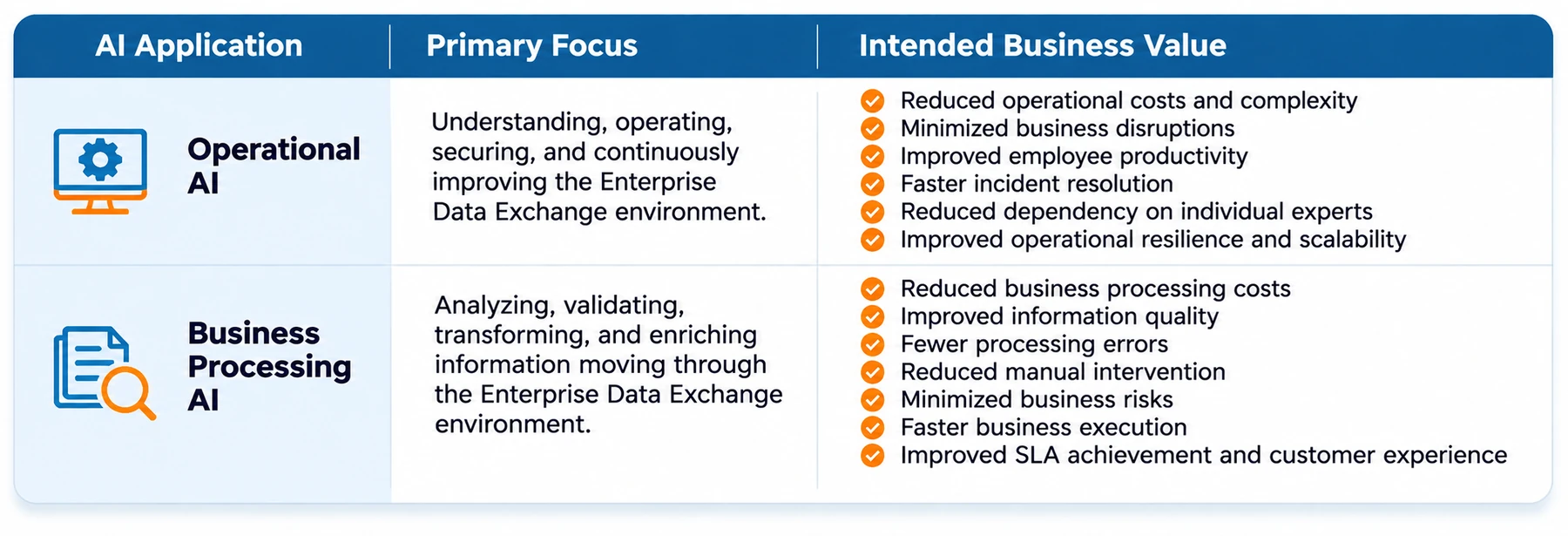
Both applications of AI must operate within appropriate security, privacy, authorization, and governance boundaries.
Where business or security decisions require deterministic validation, AI-generated results should be evaluated against established rules, confidence thresholds, and appropriate human oversight.
The ultimate measure of AI's value in Enterprise Data Exchange should not be the number of AI capabilities introduced, but the measurable improvements those capabilities deliver to the business.
The Five Stages of Managed File Transfer Evolution
We see the evolution of Managed File Transfer as a progression through five complementary stages, each extending the value that Enterprise Data Exchange delivers.
Stage 1: Secure File Transfer
Was the information delivered securely?
Business value: Reduced security risks, improved compliance, and protection of sensitive information and customer trust.
Stage 2: Intelligent Workflow Automation
Was the required workflow executed successfully and efficiently?
Business value: Reduced manual processing costs, fewer human errors, faster business execution, and increased throughput.
Stage 3: Enterprise Observability
What happened, why did it happen, and what was the business impact?
Business value: Faster incident resolution, reduced business disruption costs, improved SLA achievement, and higher service reliability.
Stage 4: AI-Powered Operational Intelligence
What can we learn, what problems can we prevent, and how can we operate more efficiently?
Business value: Reduced operational costs, improved employee productivity, fewer disruptions, and greater operational scalability.
Stage 5: Business Outcome Intelligence
How can we help achieve, verify, and continuously improve the intended business outcome?
Business value: Lower business processing costs, increased throughput, improved reliability, higher customer satisfaction and retention, and greater opportunities for revenue growth.
These stages represent our conceptual view of the evolution of Managed File Transfer rather than a formal industry maturity standard.
Organizations may develop these capabilities concurrently, with each stage building upon and benefiting from the others.
The Foundations We Have Already Built
bTrade's vision for 2027 and beyond is not starting from scratch.
Over the past several years, we have made significant architectural, security, operational, and product investments in the evolution of TDXchange.
These investments have established many of the foundations required to support intelligent Enterprise Data Exchange while already providing opportunities to improve operational efficiency, reduce costs, and strengthen business resilience.
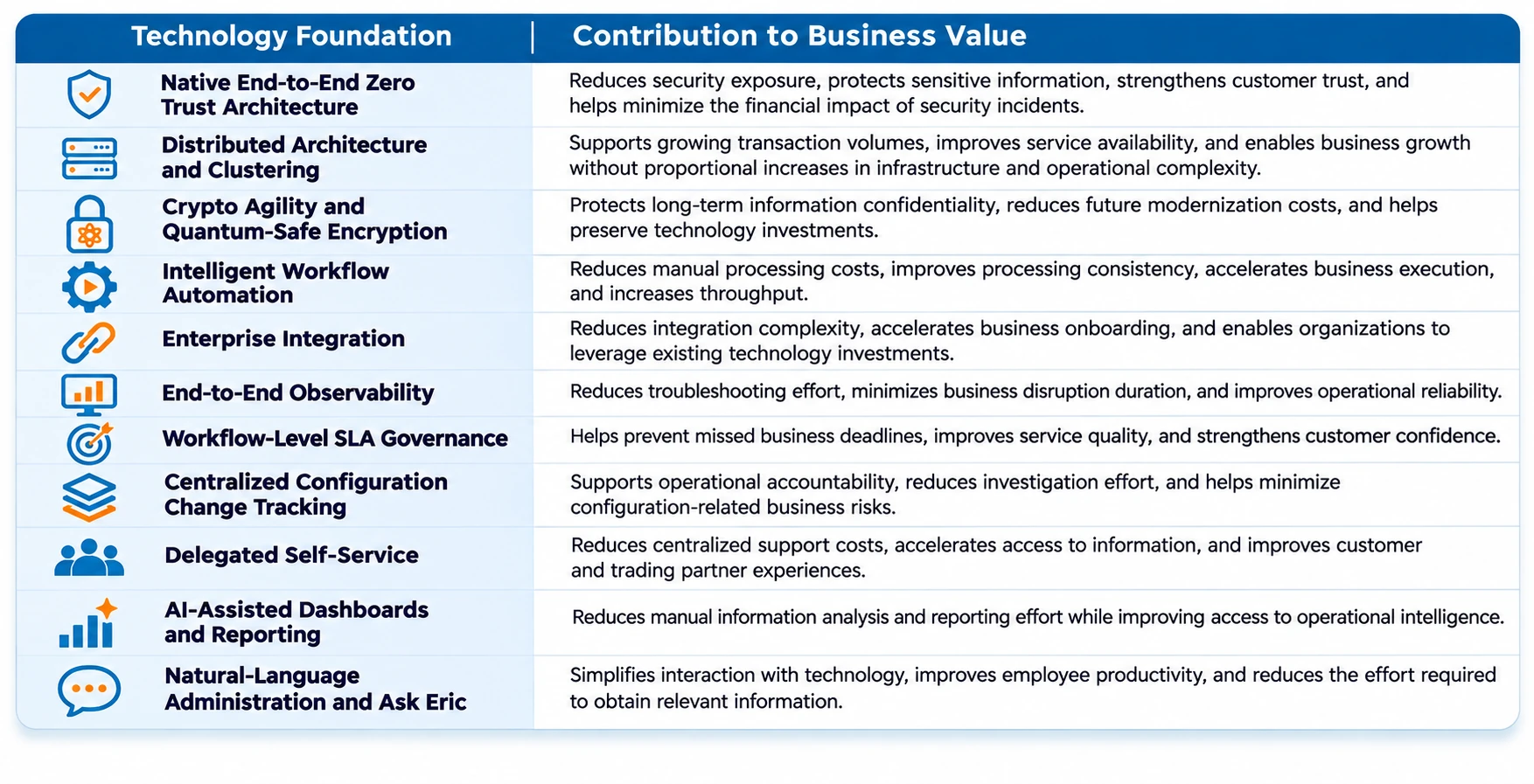
These technology investments are grounded in our Six Pillars of Enterprise Data Exchange, which establish the architectural and operational foundation of bTrade's long-term technology strategy.
Our vision for 2027 and beyond builds upon these foundations with a greater emphasis on measurable business outcomes.
Our Technology Investment Priorities for 2027 and Beyond
As we continue evolving TDXchange, our technology investments will be evaluated against their ability to reduce costs, improve business processes, increase throughput, strengthen reliability, and support customer satisfaction and business growth.
The following nine areas represent the technology direction we are pursuing. Some build directly upon existing capabilities, others are part of our ongoing development efforts, and others represent longer-term product objectives.
1. Intelligent Information Processing and Expanded Enterprise Integration
We intend to continue expanding the ability of TDXchange to orchestrate specialized information processing technologies, including AI-powered content analysis, data quality, validation, transformation, information enrichment, security, and industry-specific business processing.
The objective is to help organizations identify and address information quality and processing issues before they result in downstream business failures, while allowing customers to leverage existing technology investments.
Intended Business Value: Lower business processing and remediation costs, fewer rejected transactions, increased throughput, faster customer and trading partner onboarding, improved customer experience, and greater capacity to support revenue growth.
2. Context-Aware AI Assistance
Our existing AI-assisted dashboards, reporting, natural-language administration, and Ask Eric provide the foundation for more intelligent interaction with Enterprise Data Exchange environments.
We intend to extend these capabilities toward understanding authorized operational context, including workflows, configurations, trading partner relationships, dependencies, operational history, and business SLA requirements.
The objective is to help administrators understand their specific environments rather than simply obtain generic product information.
Intended Business Value: Reduced administrative costs, improved employee productivity, faster access to operational information, reduced dependency on individual experts, and greater operational scalability.
3. Intelligent Troubleshooting and Root Cause Analysis
We intend to extend our existing observability and AI-assisted capabilities to simplify incident investigation by correlating operational events, configuration changes, workflow dependencies, and business context.
The objective is to help administrators identify potential root causes, understand affected business processes, and evaluate remediation options more efficiently.
AI-assisted conclusions must remain grounded in verifiable operational evidence, with observed facts clearly distinguishable from inferred relationships and potential explanations.
Intended Business Value: Reduced incident investigation costs, faster restoration of business processes, minimized financial impact of disruptions, improved service reliability, and higher customer satisfaction and retention.
4. Configuration Dependency Intelligence and Proactive Change Impact Assessment
A modification to a shared certificate, credential, endpoint, security policy, or workflow can affect multiple applications, trading partners, and business processes.
Building upon our existing configuration change tracking capabilities, we see opportunities to help administrators identify these dependencies and assess the potential impact of proposed changes before they are implemented.
Authoritative configuration data and deterministic analysis should establish dependencies, while AI can help interpret their operational and business implications.
Intended Business Value: Fewer configuration-related incidents, lower remediation costs, reduced business disruption risks, more predictable technology changes, improved business continuity, and protection of revenue.
5. Continuous Operational Assessment and Improvement
Anomaly detection is an important component of Operational AI, but we believe operational intelligence should extend beyond identifying unusual behavior.
We see opportunities to continuously assess Enterprise Data Exchange environments for recurring problems, inefficient configurations, processing bottlenecks, unnecessary manual intervention, emerging SLA risks, and opportunities to improve resource utilization.
A workflow may complete successfully while consuming unnecessary resources or consistently operating close to its business SLA deadline.
The objective is to identify opportunities for improvement even when no operational incident has occurred.
Intended Business Value: Reduced recurring operational and infrastructure costs, increased processing capacity, improved resource utilization, higher reliability, and the ability to accommodate business growth without proportional increases in costs.
6. Institutional Knowledge and Intelligent Administrator Onboarding
Enterprise environments frequently depend on a small number of experienced individuals who understand why workflows were designed in particular ways, which applications depend on them, and what business risks are associated with modifying them.
We see opportunities to combine configuration intelligence, operational context, dynamically generated technical documentation, and AI-assisted interaction to make institutional knowledge more accessible.
Business purpose, ownership, and organizational requirements must still be provided or validated by the appropriate people.
Intended Business Value: Reduced training and onboarding costs, faster knowledge transfer, improved employee productivity, reduced business continuity risks associated with employee turnover, and faster execution of business initiatives.
7. Business Outcome Visibility and SLA Governance
TDXchange already provides transaction visibility and workflow-level SLA governance.
Our direction is to expand this visibility by incorporating available downstream application processing results, acknowledgments, and business events into workflow governance.
This can help organizations distinguish between information being received, validated, delivered, accepted, successfully processed, and completed within the intended business SLA.
Intended Business Value: Earlier identification of business processing failures, lower remediation costs, improved business process completion rates, higher throughput, improved SLA achievement, customer retention, and revenue protection.
8. Intelligent Delegated Self-Service
We intend to continue expanding controlled access to relevant operational and business information for customers, trading partners, business process owners, and other authorized stakeholders.
AI-assisted interaction can further simplify access to information and help users understand processing status, exceptions, and appropriate corrective actions without unnecessary dependencies on centralized administration teams.
Intended Business Value: Reduced support and administrative costs, faster resolution of customer issues, improved customer satisfaction and retention, stronger trading partner relationships, and greater capacity to support growing customer populations.
9. Continuous Security Innovation and Future-Ready Architecture
As Enterprise Data Exchange platforms become more intelligent and interconnected, AI services, external processing applications, and AI agents introduce additional interactions that must be appropriately governed.
Our continuing investments will build upon Native End-to-End Zero Trust Architecture, crypto agility, quantum-safe encryption, least-privilege access, deterministic security controls, immutable audit history, and human accountability.
Security must remain an architectural foundation rather than an additional layer introduced after new capabilities have been developed.
Intended Business Value: Reduced security and compliance risks, lower potential incident remediation and modernization costs, improved business continuity, protection of customer trust and existing revenue, and preservation of long-term technology investments.
Translating Technology Investments into Business Value
The collective value of these nine technology investment areas comes from how they contribute to the broader economic and operational objectives of an organization.
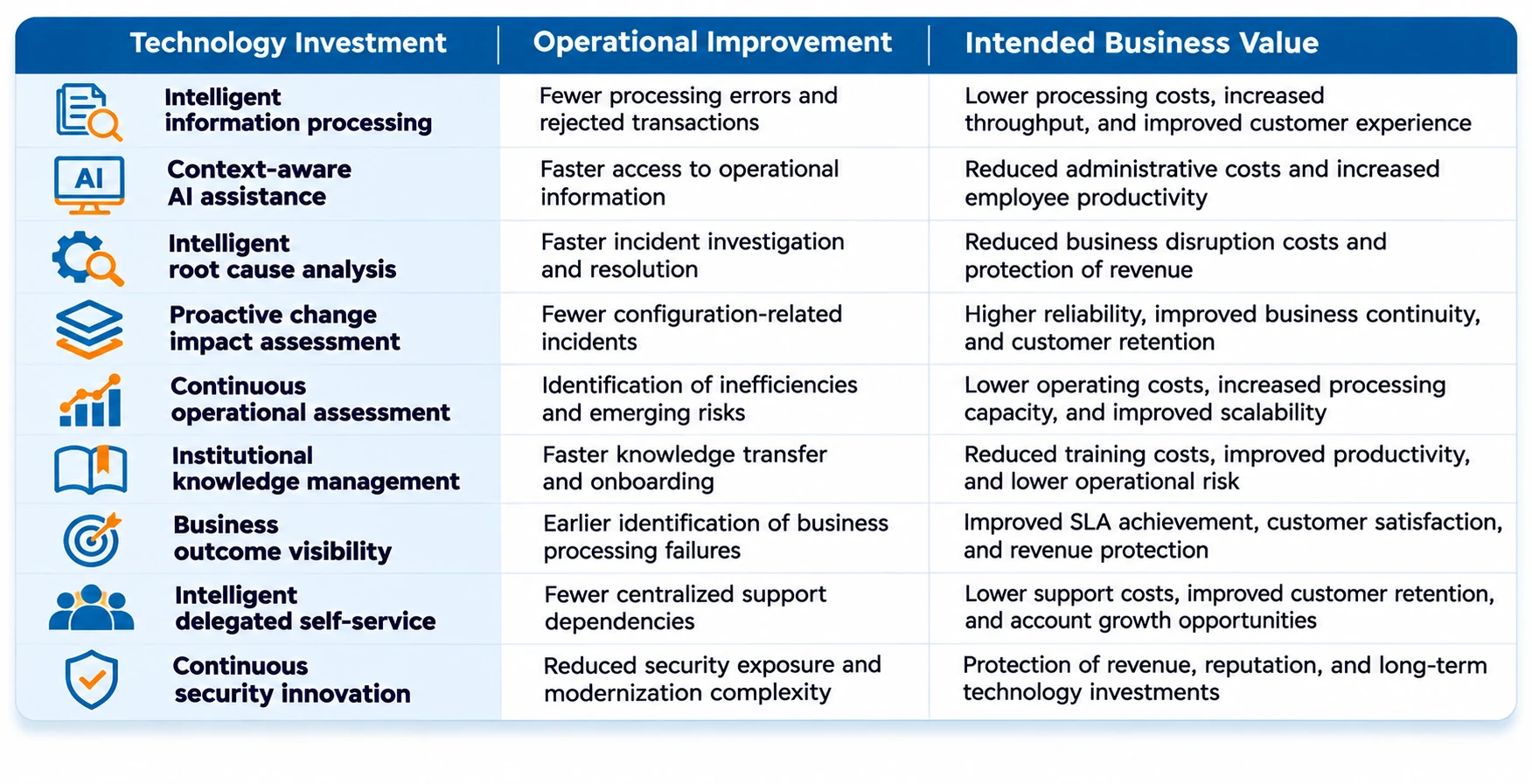
Our objective is to ensure that improvements in technology and operations translate into meaningful improvements in business performance.
What This Vision Could Mean Across Different Industries
The value of intelligent Enterprise Data Exchange becomes particularly clear when we consider practical business applications.
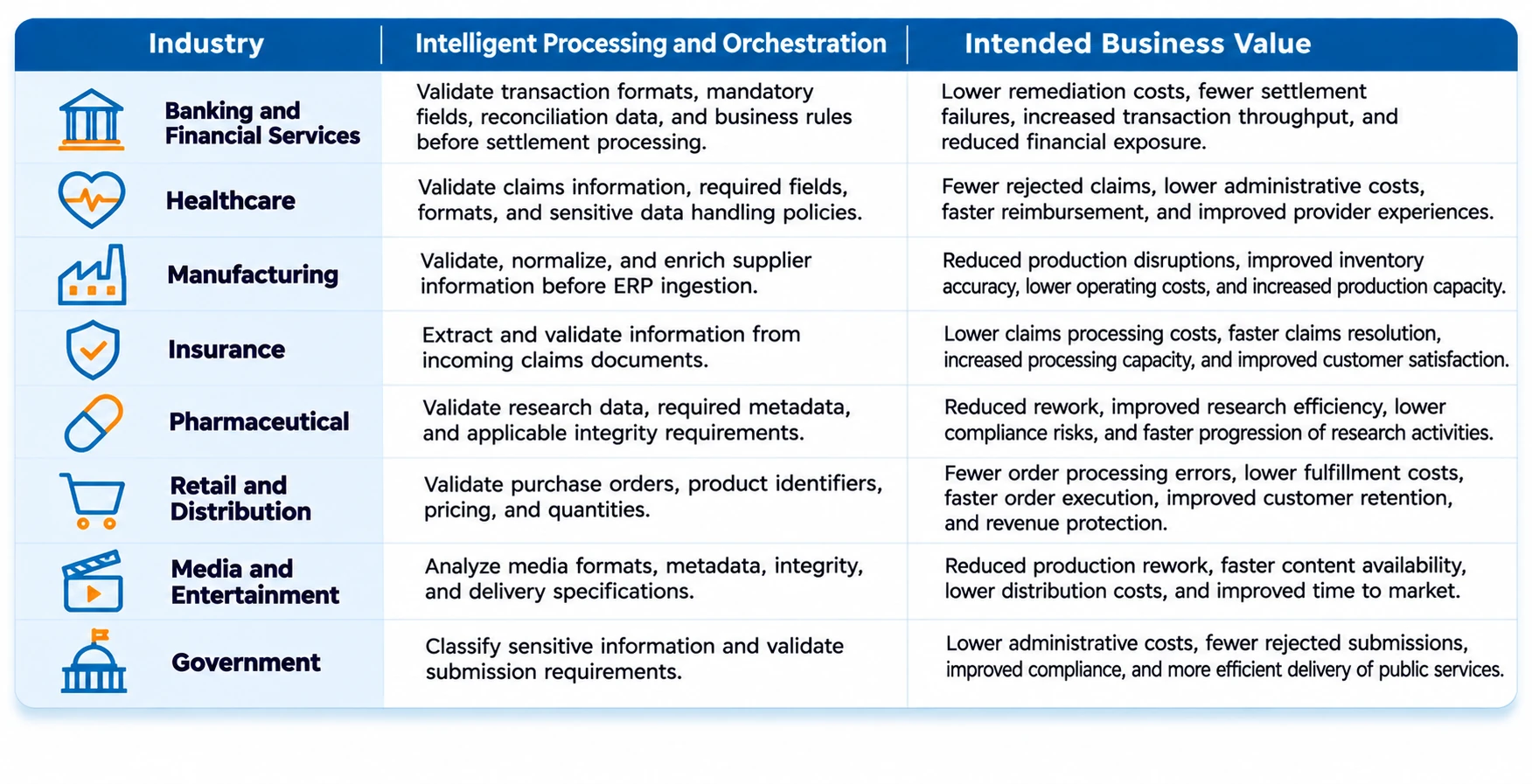
These examples illustrate how specialized processing technologies, intelligent orchestration, and business outcome visibility could work together.
The appropriate technologies, integrations, business rules, and governance requirements will depend on each organization's environment.
Extending Intelligence Beyond IT
Enterprise Data Exchange supports business processes across virtually every industry.
Its value should therefore extend beyond the technology teams responsible for operating the platform.
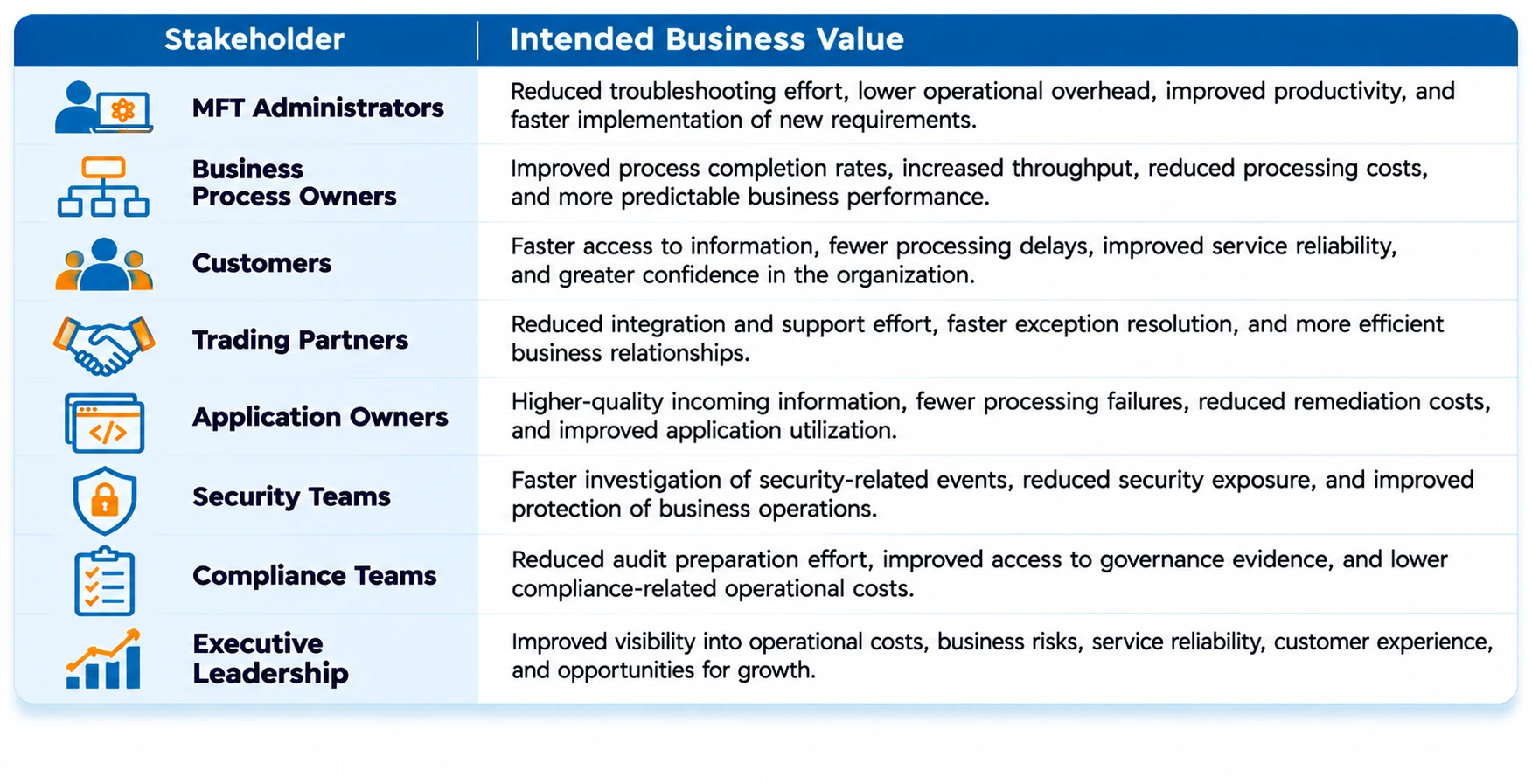
The objective is not to provide everyone with the same technical dashboard, but to provide relevant, actionable information appropriate to each person's responsibilities and authorization.
Reducing unnecessary dependencies between teams improves productivity, accelerates decision-making, and allows business activities to progress more efficiently.
From Operational Efficiency to Revenue Growth
One of the most important aspects of Business Outcome Intelligence is understanding how improvements in Enterprise Data Exchange can contribute to an organization's financial performance.
The value of technology should not be evaluated exclusively through infrastructure savings or reduced administrative effort.
It should also be evaluated through its contribution to business capacity, service quality, customer experience, and growth.
Reduced Operational Costs
Intelligent automation, AI-assisted operations, delegated self-service, and more effective troubleshooting can reduce the effort required to operate Enterprise Data Exchange environments.
Intelligent information processing can further reduce the costs associated with rejected transactions, manual corrections, and repeated business activities.
These improvements can contribute to lower operating costs and improved profitability.
Increased Business Throughput
Reducing processing errors, eliminating unnecessary manual activities, and improving workflow efficiency can allow organizations to process more business transactions using their existing resources.
Whether processing financial transactions, customer orders, healthcare claims, or other business activities, increased throughput creates opportunities to accommodate growing demand and generate additional revenue without proportional increases in operating costs.
Improved Business Reliability
Proactive operational intelligence, stronger change governance, enterprise observability, and resilient architecture can help reduce the frequency, duration, and financial impact of business disruptions.
More reliable business processes allow organizations to deliver products and services consistently, meet contractual obligations, and protect revenue-generating activities.
Higher Customer Satisfaction and Retention
Customers are rarely concerned with which technologies are responsible for processing their information.
They care whether their orders are fulfilled, their claims are processed, their transactions are completed, their information is protected, and their issues are resolved quickly.
More efficient and reliable business processes can improve customer experiences, strengthen relationships, and contribute to higher customer retention.
Revenue Protection and Growth
Reducing business disruptions helps protect existing revenue.
Improving customer satisfaction and retention helps protect recurring revenue and the long-term value of customer relationships.
Increasing processing capacity and accelerating customer onboarding can create opportunities to generate additional revenue.
Reducing operational costs while supporting business growth can also improve operating margins.
These relationships establish a more meaningful way to evaluate the contribution of Enterprise Data Exchange technology to overall business performance.
Measuring the Business Value of Enterprise Data Exchange
Traditional Managed File Transfer metrics such as transfer volumes, throughput, availability, and delivery success rates remain important.
However, they should increasingly be complemented by measurements that reflect the economic and business outcomes Enterprise Data Exchange is intended to support.
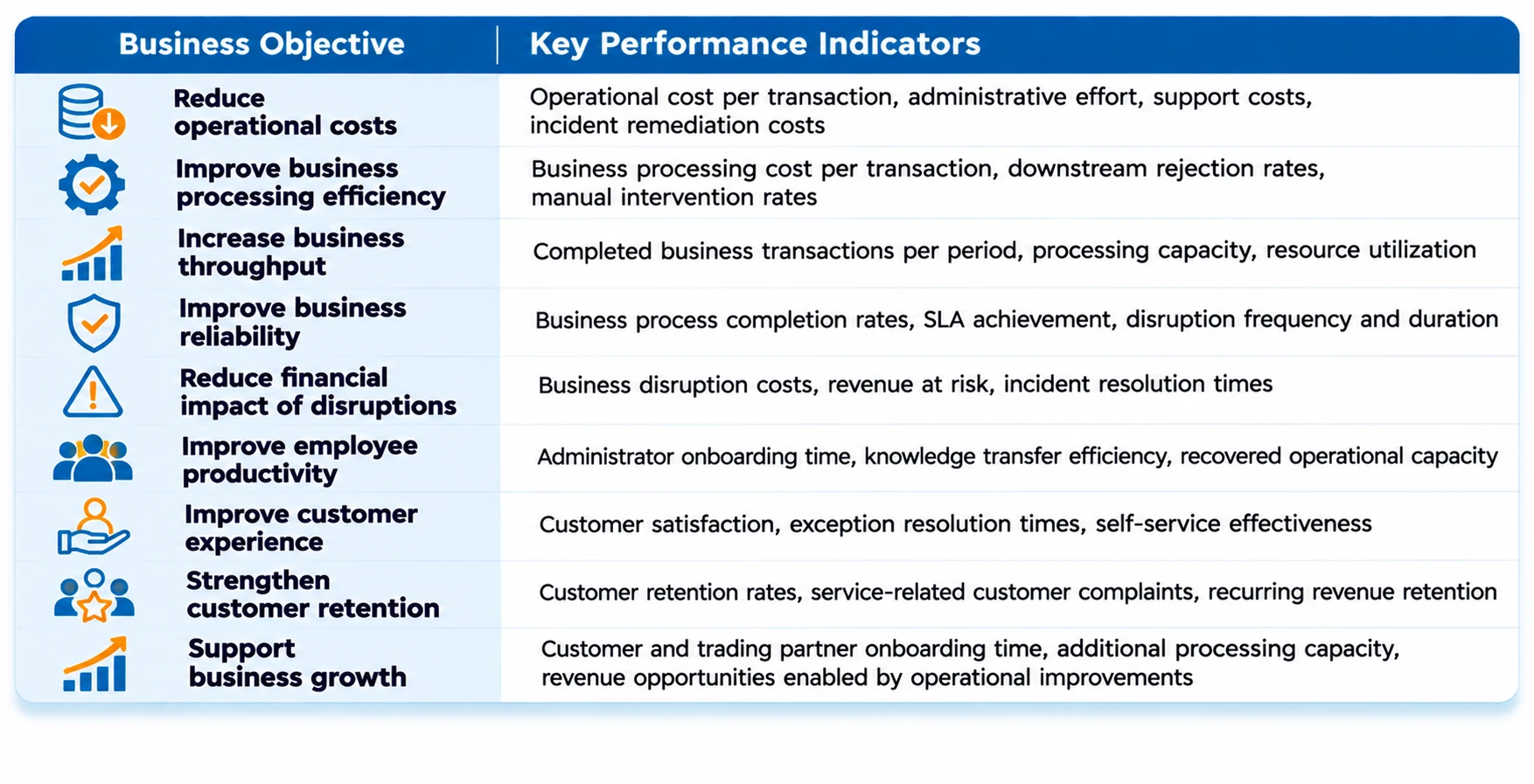
Where appropriate, these metrics should be established before introducing new capabilities so organizations can evaluate the improvements those capabilities deliver.
Illustrating the Potential Economic Value
The following three hypothetical examples illustrate how improvements in Enterprise Data Exchange could translate into measurable financial benefits.
Example 1: Reducing Business Processing Costs
Consider an organization processing 100,000 business transactions per month.
Assume intelligent information validation reduces downstream rejection rates from 4% to 1%.
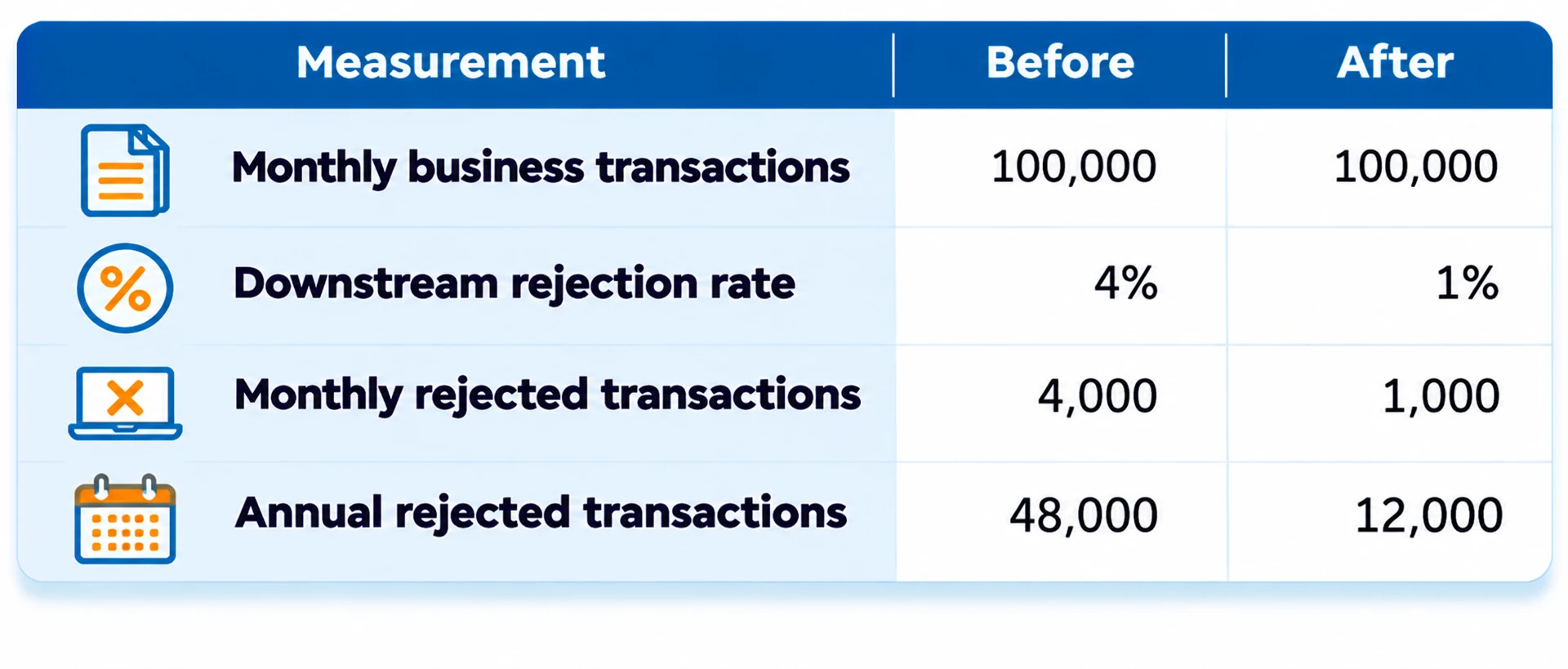
This represents 36,000 fewer rejected transactions annually.
At an illustrative remediation cost of $10 per rejected transaction, the organization could avoid approximately $360,000 in annual remediation costs.
Additional benefits could include faster business processing, improved SLA achievement, and fewer customer inquiries.
Example 2: Increasing Business Throughput and Revenue Potential
Consider an organization currently processing 100,000 business transactions per month.
Assume improved automation, information validation, and workflow efficiency increase processing capacity by 20% using existing operational resources.
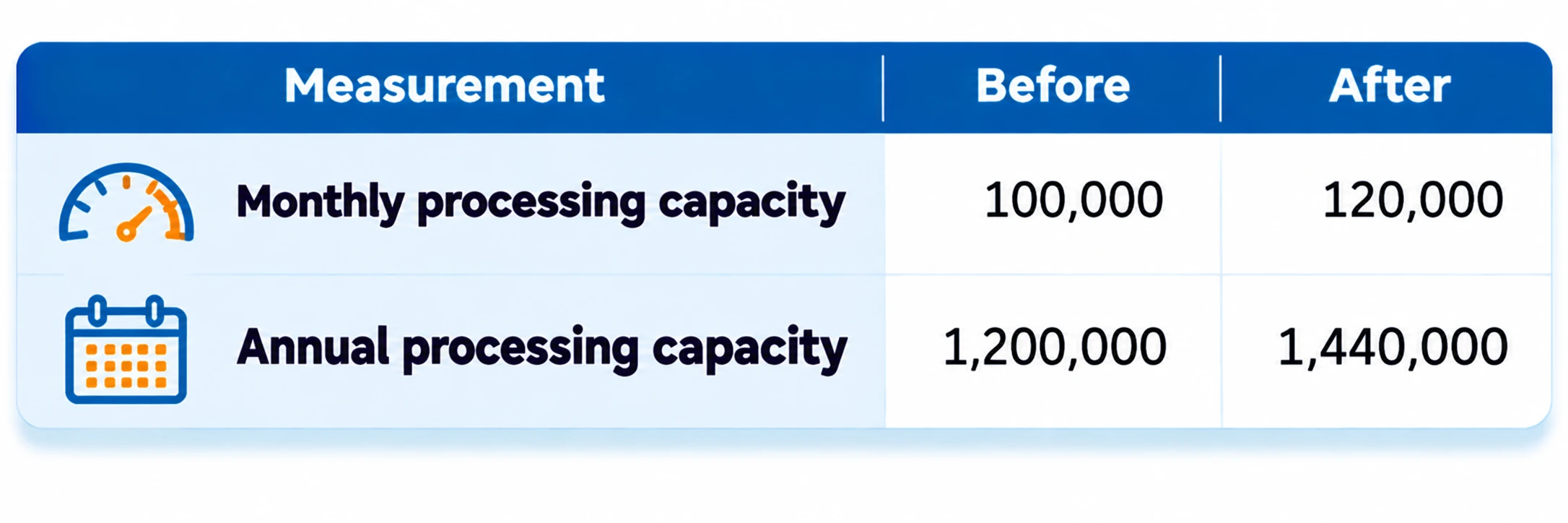
This represents additional annual processing capacity of 240,000 transactions.
If sufficient business demand exists and each additional completed transaction generates $5 in revenue, this capacity could support up to $1.2 million in incremental annual revenue.
The actual financial benefit would depend on customer demand, pricing, incremental processing costs, and the organization's ability to utilize the additional capacity.
Example 3: Improving Customer Retention and Protecting Revenue
Consider an organization with 1,000 customers generating an average of $10,000 in annual recurring revenue per customer.
Assume improved service reliability, faster business processing, and better customer experiences contribute to increasing annual customer retention from 90% to 92%.
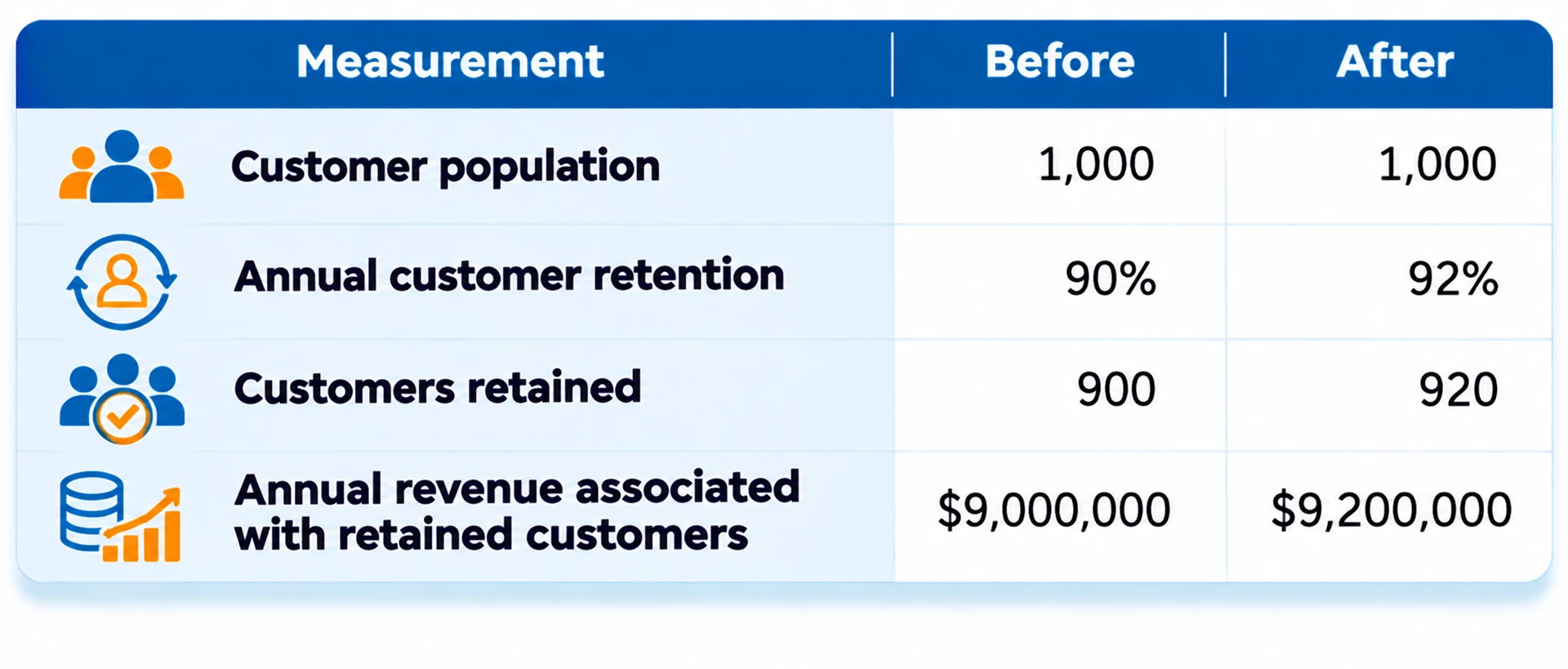
Retaining an additional 20 customers would represent $200,000 in protected annual recurring revenue.
Customer retention is influenced by many factors, but this example illustrates why service reliability and customer experience should be considered when evaluating technology investments.
These examples are independent illustrative financial models, not reported bTrade customer results or guaranteed outcomes. They should not be combined into a single ROI calculation.
Actual financial benefits depend on implementation costs, business conditions, customer demand, operational improvements, and an organization's ability to translate those improvements into measurable results.
From Vision to Product Delivery
For more than 36 years, innovation has been central to bTrade's evolution.
Our investments in TDXchange v5 have established a modern architectural foundation designed to support continued innovation rather than limit it.
Throughout 2027 and beyond, we intend to progressively build upon these foundations through upcoming TDXchange releases, technology partnerships, and continued customer-driven innovation.
Our engineering investments will continue to be guided by several fundamental questions:
- Does this capability solve a meaningful customer problem?
- Does it make the technology easier to use?
- Does it reduce operational or business processing costs?
- Does it improve business process efficiency and throughput?
- Does it help prevent operational or business failures?
- Does it improve service reliability and customer experience?
- Does it help our customers protect revenue and create new business opportunities?
I believe the responsibility of every technology provider is to make the lives of the people using its technology easier while helping their organizations become more successful.
The technology direction described in this article represents our strategic vision rather than a commitment to specific features in individual releases.
Implementation priorities and delivery schedules will continue to evolve based on customer requirements, engineering validation, security considerations, and product development priorities.
Publishing a technology vision is important.
Consistently demonstrating that we are delivering on that vision and creating measurable customer value is considerably more important.
bTrade's Vision for the Future
As we look toward 2027 and beyond, I believe the Managed File Transfer industry has an opportunity to redefine the value it delivers to organizations.
We have spent decades making the movement of information more secure, reliable, scalable, and automated.
The next challenge is to make the entire process more intelligent and more directly aligned with business objectives.
That means understanding and preparing information before delivery, integrating specialized technologies that can improve its quality and usefulness, verifying business processing outcomes, and continuously improving the operations that support them.
At bTrade, this is the direction in which we are investing and evolving TDXchange.
Our objective is not to build a platform that simply moves more files, provides more features, or introduces more AI capabilities.
It is to build technology that helps our customers:
- Reduce operational and business processing costs.
- Improve employee productivity and resource utilization.
- Increase business process efficiency and throughput.
- Minimize the financial impact of business disruptions.
- Improve business reliability and customer satisfaction.
- Strengthen customer relationships and retention.
- Protect existing revenue and create opportunities for revenue growth.
I also believe that the most successful technology providers will not necessarily be those that build every capability themselves.
They will be those that understand their customers' challenges, establish the right architectural foundations, integrate the right technologies, and consistently deliver meaningful business improvements.
After all, organizations do not exchange information simply because they need to move files.
They exchange information because they need to accomplish something.
Helping them accomplish it more securely, reliably, intelligently, and efficiently, while reducing costs and creating opportunities for business growth, is the future we believe our industry should be building toward.
And it is the future we are working toward at bTrade.
About the Author
Andrei Olin is Chief Technology Officer at bTrade, where he leads product strategy, delivery, architecture, and security across the company’s B2B, Managed File Transfer, and secure data exchange platforms.
Andrei has more than 30 years of experience spanning enterprise architecture, software development, infrastructure, cybersecurity, middleware, trading systems, SaaS, and Managed File Transfer. His career includes building mission-critical systems and infrastructure at Bear Stearns and Morgan Stanley, designing and operating enterprise MFT and messaging platforms for Merrill Lynch and Deutsche Bank, and building and scaling SaaS and security products at startups. He holds master’s and bachelor’s degrees in Information Technology with a focus on Information Security.
Frequently Asked Questions
What is the future of Managed File Transfer in 2027 and beyond?
The future of Managed File Transfer is evolving beyond secure file delivery and traditional workflow automation toward intelligent Enterprise Data Exchange. This includes deeper enterprise integration, intelligent information processing, AI-powered Operational Intelligence, proactive governance, and business outcome visibility. The objective is to reduce operational costs, increase business throughput, improve reliability, and support customer satisfaction and business growth.
What is Business Outcome Intelligence in Managed File Transfer?
Business Outcome Intelligence is an approach to Enterprise Data Exchange that combines intelligent workflow orchestration, information analysis and validation, enterprise integration, operational visibility, business SLA governance, security controls, and AI-powered intelligence to help organizations achieve, verify, and continuously improve their intended business outcomes.
Its value can be measured through reduced costs, increased throughput, improved reliability, customer satisfaction, and opportunities for revenue protection and growth.
Why is successful file delivery not always a successful business outcome?
A file can be delivered successfully while subsequent application processing, validation, reconciliation, acknowledgment, or other business activities fail. These failures may result in additional processing costs, missed deadlines, dissatisfied customers, and potential revenue loss. Business success depends on whether the intended business process achieves its objective.
Can Managed File Transfer platforms analyze and validate files before delivering them to downstream applications?
Modern Managed File Transfer platforms can integrate with specialized AI, data quality, security, validation, and transformation services to analyze information before delivery. Through intelligent workflow orchestration, platforms can use processing results to determine whether information should be delivered, transformed, enriched, reviewed, quarantined, or rejected.
This can reduce downstream processing failures, manual remediation costs, and business processing delays.
What is the difference between Operational AI and Business Processing AI in Managed File Transfer?
Operational AI focuses on understanding, managing, securing, troubleshooting, and improving the Managed File Transfer environment. Its intended business value includes reduced operational costs, improved employee productivity, and minimized business disruptions.
Business Processing AI focuses on analyzing, classifying, extracting, validating, or enriching information moving through that environment. Its intended business value includes lower processing costs, fewer business errors, increased throughput, and improved customer experiences.
Can an MFT platform determine whether a downstream business process completed successfully?
An MFT platform can incorporate downstream processing results when receiving applications provide acknowledgments, API responses, processing status, or other relevant business events.
This can help organizations identify processing failures earlier, improve business SLA achievement, reduce remediation costs, and improve customer experiences. The level of business outcome visibility depends on available integrations and information provided by participating systems.
How can AI-powered Managed File Transfer reduce operational costs and business disruptions?
AI-powered Managed File Transfer can help reduce operational costs by simplifying incident investigation, reducing repetitive administrative activities, improving access to institutional knowledge, identifying operational inefficiencies, and enabling more effective delegated self-service.
Combined with enterprise observability, configuration dependency intelligence, and proactive operational assessment, AI can also help organizations identify emerging risks, prevent avoidable incidents, and reduce the financial impact of business disruptions.
How can intelligent Enterprise Data Exchange increase business throughput?
Intelligent Enterprise Data Exchange can increase business throughput by orchestrating information validation, transformation, automation, and exception handling while reducing manual intervention and downstream processing failures.
More efficient business processes can enable organizations to handle additional transactions, customers, and trading partners using existing or more efficiently utilized resources.
How can Managed File Transfer improve customer satisfaction, retention, and revenue?
Managed File Transfer can contribute to customer satisfaction and retention by improving business process reliability, reducing processing errors, accelerating service delivery, strengthening information security, and providing customers with relevant information through controlled self-service.
Higher reliability can help protect existing revenue, while increased processing capacity and faster customer onboarding can create opportunities for additional revenue. Actual financial outcomes depend on broader business and market factors.
Does intelligent Enterprise Data Exchange replace ERP, ETL, or data analytics platforms?
No. Intelligent Enterprise Data Exchange complements these technologies by providing secure orchestration, integration, automation, observability, and governance.
Specialized platforms remain responsible for their respective business processing, transformation, analytics, and information management functions. Integrating these technologies can help organizations leverage existing investments while improving overall business process efficiency.
How can organizations measure the return on investment of Managed File Transfer?
Organizations can measure the return on investment of Managed File Transfer through reduced operational costs, lower business processing costs, fewer rejected transactions, reduced business disruption costs, increased processing throughput, improved employee productivity, improved SLA achievement, customer retention, and revenue opportunities enabled by additional processing capacity.
These benefits should be evaluated against the total cost of implementing, integrating, operating, and maintaining the technology.
What is bTrade's technology vision for TDXchange in 2027 and beyond?
bTrade's technology vision includes continued investment in intelligent workflow orchestration, specialized information processing integrations, contextual AI assistance, proactive operational assessment, configuration dependency intelligence, institutional knowledge management, business outcome visibility, intelligent delegated self-service, and future-ready security.
These investments build upon the existing architectural foundations of TDXchange v5 and are intended to help organizations reduce costs, improve business processes, increase throughput, strengthen reliability, and support sustainable business growth.
The vision will be implemented progressively through upcoming TDXchange releases, with individual feature availability and delivery schedules determined by customer requirements, engineering validation, security considerations, and product development priorities.