
Introduction
Managed File Transfer (MFT) platforms have evolved far beyond secure file movement. Today, they serve as critical components of enterprise data exchange infrastructure, supporting digital supply chains, cloud integration, regulatory compliance, and the secure movement of business-critical information.
Protocols, automation, and security controls remain essential MFT requirements. Modern evaluations must now go further by determining whether a platform can automate complete business processes, integrate files with APIs, cloud services and enterprise applications, provide end-to-end operational visibility, and scale across increasingly distributed environments.
Organizations are also evaluating hybrid and multi-cloud architectures, Kubernetes deployment, cyber resilience, Zero Trust security, AI governance, delegated administration, and post-quantum cryptography readiness. As a result, replacing an MFT platform is often part of a broader enterprise integration and infrastructure modernization initiative rather than a simple software upgrade.
GoAnywhere MFT, MOVEit, and Globalscape EFT are mature and widely deployed platforms with established capabilities for secure file transfer, workflow automation, integration, and compliance. The purpose of this article is not to suggest otherwise. It is to explain how enterprise requirements are evolving and which capabilities organizations should evaluate when considering their next MFT platform.
The article also examines how TDXchange differentiates itself by bringing Managed File Transfer, intelligent workflow automation, enterprise integration, accelerated data movement, end-to-end observability, hybrid-cloud flexibility, Native Zero Trust security, AI-assisted operations, and quantum-safe cryptography together within one governed Enterprise Data Exchange platform.
Key Takeaways
- GoAnywhere, MOVEit, and Globalscape EFT are mature and widely deployed Managed File Transfer platforms with established security, automation, integration, and compliance capabilities.
- Enterprise MFT evaluations should examine how a platform automates complete workflows, connects files with APIs, cloud services and applications, and manages the full business outcome.
- Modern selection criteria also include hybrid-cloud flexibility, Kubernetes support, operational observability, Zero Trust security, AI governance, cyber resilience, and quantum-safe readiness.
- TDXchange supports scheduled, event-driven, API-initiated, and condition-based workflows across files, applications, cloud platforms, AI services, and external trading partners.
- TDXchange combines workflow automation and enterprise integration with accelerated transfer, end-to-end observability, delegated administration, Native Zero Trust security, hybrid-cloud scalability, and quantum-safe cryptography.
- Organizations should evaluate each platform against their workflows, integrations, operating model, transaction volumes, security requirements, and long-term modernization objectives.
Why Organizations Are Re-Evaluating MFT Platforms
Historically, organizations selected MFT platforms based on:
- Protocol support
- Workflow automation
- Security controls
- Auditing
- Compliance reporting
Today, requirements have expanded significantly.
Enterprise architecture teams are increasingly focused on:
- Hybrid cloud strategies
- Kubernetes adoption
- Operational observability
- Zero Trust architectures
- Cyber resilience
- AI governance
- Post-quantum cryptography
- Long-term scalability
This aligns closely with guidance from organizations such as NIST, CISA, and the NSA, which continue to promote Zero Trust architectures, continuous verification models, and cryptographic modernization initiatives.
As a result, many MFT evaluations have become broader modernization projects rather than simple product replacement exercises. Understanding these evolving priorities provides useful context for comparing how today's leading Managed File Transfer platforms address modern enterprise requirements.
Platform Comparison
While each of these platforms has earned a strong reputation within the Managed File Transfer market, enterprise buying criteria continue to evolve. Today, enterprise IT teams are evaluating not only core MFT functionality, but also how well each platform supports modernization initiatives such as hybrid cloud adoption, operational observability, Zero Trust security, AI governance, and post-quantum cryptography.
GoAnywhere MFT
GoAnywhere is a mature enterprise Managed File Transfer platform with a long history of helping organizations automate workflows, strengthen security, and support regulatory compliance. Its broad protocol support and extensive automation capabilities have made it a popular choice across many industries.
As organizations modernize their technology environments, many are expanding their evaluation criteria beyond traditional MFT capabilities. Hybrid cloud modernization, Kubernetes deployments, operational observability, large-scale data movement, and post-quantum security planning are increasingly influencing platform selection.
MOVEit
MOVEit has earned a strong reputation for secure file transfer, workflow automation, and compliance-focused deployments. Its centralized administration and mature feature set have made it a widely adopted enterprise MFT solution.
Following the highly publicized security incidents involving MOVEit in 2023, many IT teams expanded their evaluation criteria beyond traditional security features. Today's discussions increasingly include software supply chain resilience, Zero Trust architectures, operational visibility, accelerated recovery, and broader cybersecurity modernization initiatives. As a result, many organizations evaluating Managed File Transfer platforms are looking not only at current functionality, but also at long-term architectural flexibility and operational resilience.
Globalscape EFT
Globalscape EFT has long been recognized for secure file transfer, event-driven automation, and compliance-focused deployments. Many companies have relied on the platform for years to support mission-critical business processes and partner communications.
As enterprise infrastructure continues to evolve, organizations are increasingly evaluating how well their MFT platform aligns with hybrid cloud strategies, Kubernetes deployments, operational observability, and future security initiatives. These broader modernization objectives are driving many organizations to reassess whether their existing platform will continue to meet long-term business and technology requirements.
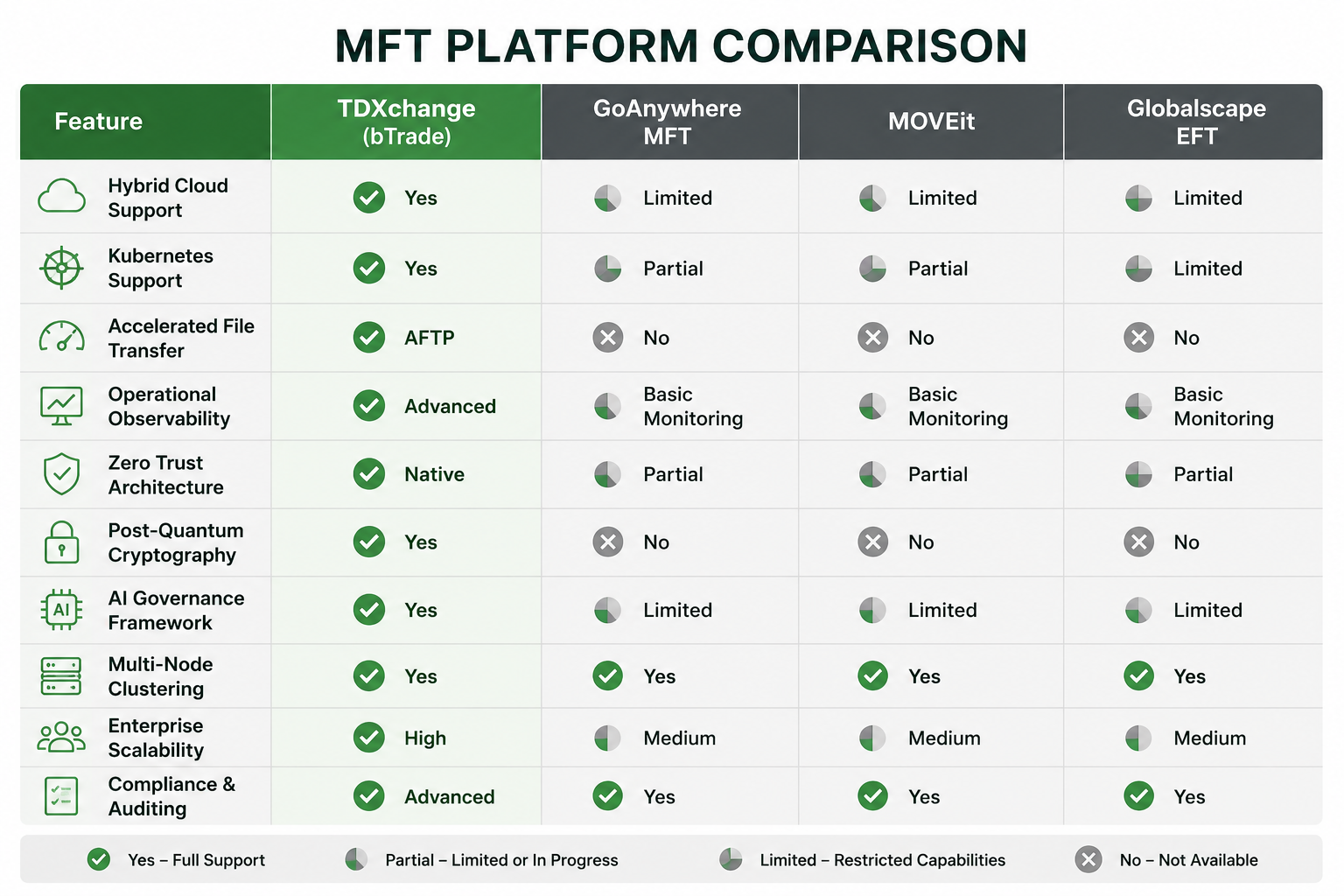
While each platform offers mature Managed File Transfer capabilities, modern enterprise requirements increasingly extend beyond traditional file transfer functionality. These broader priorities highlight several areas where TDXchange was specifically designed to differentiate.
Where TDXchange Differentiates
1. Architecture Designed for Enterprise Scale
TDXchange was built to support:
- Distributed deployments
- Multi-node clustering
- High-volume transaction processing
- Hybrid cloud architectures
- Kubernetes-based scaling
Enterprises can scale without repeatedly redesigning infrastructure.
Many TDXchange deployments support millions of file transfers per day across highly regulated industries including financial services, healthcare, government, media, and retail.
2. Workflow Automation, Enterprise Integration, and Operational Simplicity
GoAnywhere is widely recognized for mature workflow automation and broad connectivity. Organizations evaluating an alternative should confirm that the replacement can support their existing workflows while also meeting future integration, governance, scalability, and operational-resilience requirements.
Important evaluation questions include:
- Can workflows begin through schedules, file events, API calls, dependencies, or business conditions?
- Can the platform coordinate validation, transformation, routing, delivery, downstream processing, and acknowledgment?
- Can it connect files with APIs, cloud services, enterprise applications, databases, EDI environments, and trading partners?
- Can temporary failures and planned maintenance be handled without unnecessary alerts and manual reprocessing?
- Can automation remain governed through role-based access, policy enforcement, monitoring, and auditing?
- Can administrators build and manage workflows without relying on a growing collection of external scripts and specialized tools?
TDXchange supports scheduled, event-driven, API-initiated, and condition-based workflows across files, APIs, cloud platforms, enterprise applications, and external trading partners.
Its orchestration capabilities can coordinate file processing, API interaction, delivery, downstream actions, retries, notifications, acknowledgments, and recovery while preserving centralized security, visibility, and auditability.
TDXchange also provides native cloud and application integrations, API-first integration, reusable workflows, delegated access, and maintenance-window automation.
This does not mean GoAnywhere lacks strong automation or integration. The relevant distinction is how each platform combines those capabilities with its architecture, security model, observability, scalability, governance, operating experience, and long-term technology direction.
For a complete description of TDXchange’s capabilities, visit the TDXchange product page. To understand its broader architecture and Enterprise Data Exchange vision, read the TDXchange v5 overview.
3. Accelerated File Transfer for Large Data Sets
One of the most significant differentiators is bTrade's Accelerated File Transfer Protocol (AFTP).
AFTP is designed for:
- Large media assets
- Data lake replication
- Disaster recovery synchronization
- eDiscovery data transfers
- Global data movement
Unlike traditional TCP-based protocols, AFTP utilizes intelligent UDP-based transfer optimization to maximize bandwidth utilization and reduce transfer windows.
For enterprise security teams moving terabytes of data, this can significantly improve operational efficiency.
4. Operational Observability
Traditional monitoring tells administrators whether a file transfer or workflow succeeded or failed. Operational observability goes much further by helping organizations understand why an issue occurred, what systems or business partners were affected, and how similar conditions may be impacting other operations.
Monitoring tells you that something happened. Observability helps you understand why it happened and what to do next.
TDXchange was designed with this broader operational visibility in mind. Beyond basic transfer status, organizations gain insight into:
- Workflow execution
- Partner behavior
- Transfer patterns
- System changes
- Audit history
- Operational anomalies
This deeper level of visibility helps organizations reduce troubleshooting time, improve governance, identify trends before they become business problems, and maintain more resilient data exchange operations.
5. Zero Trust Security
Modern cybersecurity initiatives increasingly require Zero Trust architectures.
TDXchange supports:
- Granular access controls
- Continuous authorization
- Identity-centric security
- Least-privilege enforcement
- Context-aware permissions
Trust is never assumed between users, systems, services, or workflows.
6. Post-Quantum Cryptography Readiness
Many organizations retain sensitive information for years or decades.
TDXchange supports NIST-approved post-quantum cryptography (PQC) initiatives designed to address future "Harvest Now, Decrypt Later" threats.
This includes protection for:
- Data at rest
- Internal repositories
- Secure file transfers
- Long-term archives
As organizations begin planning cryptographic modernization programs, quantum-safe readiness is becoming an increasingly important evaluation criterion.
7. AI Operational Assistance Built on Zero Trust Principles
Artificial intelligence has the potential to dramatically improve Managed File Transfer operations by helping administrators locate information, troubleshoot workflows, investigate transfer activity, answer operational questions, and analyze system behavior in seconds rather than manually searching documentation, logs, or configuration settings.
For many organizations, however, the biggest question is not whether AI is useful, it's whether it can be trusted. Enterprise buyers increasingly ask:
- Can AI see my files?
- Can AI access sensitive data?
- Can AI bypass security controls?
- What information is used to train the model?
- Can AI access partner data?
At bTrade, we believe AI should accelerate operational decision making without expanding access to sensitive information. TDXchange's AI roadmap is built on Zero Trust principles, ensuring that AI systems have access only to information they are explicitly authorized to use and cannot bypass existing security, governance, or compliance controls.
This enables organizations to leverage AI for:
- Natural language operational queries
- Workflow troubleshooting
- Transfer status analysis
- Operational reporting
- Knowledge retrieval
- Configuration guidance
- Anomaly identification
while maintaining strict control over:
- Sensitive business data
- Customer information
- Regulated content
- User permissions
- Administrative boundaries
Unlike traditional AI implementations that often require broad access to enterprise data, TDXchange applies the same governance, role-based access controls, and least-privilege principles to AI that it applies to users and services.
The most valuable AI isn't the AI that can access everything. It's the AI that can provide meaningful operational assistance while accessing only the information it is explicitly authorized to see.
8. Native Zero Trust Architecture
TDXchange is built on a native Zero Trust Architecture where:
- Users are continuously validated
- Services authenticate one another
- Internal workflows are authorized
- AI follows Zero Trust principles
- Trust is never assumed
That's a differentiator very few MFT vendors can credibly claim.
Migration Considerations
Moving from GoAnywhere, MOVEit, or Globalscape EFT
A common concern during platform evaluations is migration complexity.
Most organizations already possess many of the assets required for a successful transition.
Typical migration activities include:
Environment Assessment
Reviewing:
- Trading partners
- Workflows
- Security policies
- Compliance requirements
- Operational dependencies
Workflow Inventory
Documenting:
- Existing jobs
- Automation rules
- Scheduling logic
- Business processes
Protocol Mapping
Validating:
- SFTP
- FTPS
- HTTPS
- AS2
- AS4
- APIs
Parallel Testing
Running environments simultaneously to validate functionality and performance.
Controlled Cutover
Transitioning workloads in phases to minimize business risk.
bTrade has extensive experience helping customers migrate from:
- GoAnywhere
- MOVEit
- Globalscape EFT
- Axway SecureTransport
- IBM Sterling
- Homegrown file transfer platforms
Technology is only part of a successful Managed File Transfer strategy. Long-term success also depends on the expertise and partnership behind the platform.
Why Customer Partnership Matters
Selecting a Managed File Transfer platform is about more than choosing software. It is selecting a long-term technology partner that will help your organization adapt to evolving business requirements, cybersecurity threats, regulatory expectations, and infrastructure modernization initiatives.
While features and functionality are important, the long-term value of an MFT platform often depends on the expertise, responsiveness, and strategic guidance provided long after implementation. As business requirements change, organizations benefit from a partner that understands not only the technology, but also the operational and compliance challenges that drive secure data exchange.
At bTrade, many of our engineers have supported the same customer environments for years and, in many cases, decades. This continuity provides a deep understanding of our customers' business processes, operational challenges, and long-term objectives—not just their MFT infrastructure.
As a result, customers benefit from:
- Faster issue resolution through experienced engineers who already understand their environment
- Proactive recommendations that improve performance, security, and operational efficiency
- Strategic guidance for modernization initiatives, cloud adoption, and Zero Trust implementation
- Ongoing optimization as business and compliance requirements evolve
- Direct access to product experts, architects, and executive leadership when it matters most
Many of the capabilities available in TDXchange today including operational enhancements, security improvements, and workflow automation features—originated from real customer conversations and practical operational challenges.
This collaborative approach has helped us build enduring customer relationships while continuously improving our secure data exchange platform to meet evolving business and cybersecurity requirements. Rather than simply delivering software, we work alongside our customers to continuously improve their secure data exchange ecosystem and help them prepare for future business and cybersecurity challenges.
Which Organizations Should Consider TDXchange?
TDXchange is particularly well suited for organizations that:
- Exchange large volumes of data
- Require high availability
- Need hybrid cloud flexibility
- Need flexible workflow automation across files, APIs, cloud services, and enterprise applications
- Want to consolidate external scripts, schedulers, and disconnected integration tools
- Require automated recovery, secure queueing, and maintenance-window awareness
- Support multiple business units
- Require extensive auditability
- Need accelerated data movement
- Value direct access to MFT experts
- Are planning Zero Trust initiatives
- Are preparing for post-quantum security
Industries commonly deploying TDXchange include:
- Financial Services
- Healthcare
- Government
- Retail
- Manufacturing
- Media & Entertainment
- Legal Services
- eDiscovery
Executive Takeaways
GoAnywhere, MOVEit, and Globalscape EFT remain respected enterprise Managed File Transfer platforms that continue to serve many organizations successfully. However, the criteria used to evaluate MFT solutions have changed significantly.
Today, organizations are looking beyond secure file movement to platforms that support broader business and technology initiatives, including hybrid cloud adoption, Kubernetes deployments, operational observability, Zero Trust security, cyber resilience, AI governance, and post-quantum cryptography readiness.
The question is no longer simply, "Which platform can securely transfer files?" Increasingly, organizations are asking, "Which platform is best positioned to support our business over the next decade?"
For organizations that view Managed File Transfer as strategic enterprise infrastructure rather than a standalone utility, TDXchange offers a compelling alternative by combining enterprise MFT, workflow automation, accelerated file transfer, operational observability, Zero Trust security, hybrid cloud flexibility, and future-ready cryptography in a single platform.
As enterprise data exchange continues to evolve, organizations that invest in scalable, resilient, and security-focused platforms today will be better positioned to adapt to tomorrow's business, regulatory, and cybersecurity challenges.
About the Author
Don Miller is President and General Counsel of bTrade, where he leads day-to-day operations and oversees legal, regulatory, and compliance activities for the company’s secure managed file transfer (MFT) platform. In this dual role, he helps ensure bTrade’s products and services meet the operational, data-protection, and governance expectations of enterprise and regulated customers. Don brings more than 20 years of legal experience advising businesses on risk management, contracts, intellectual property, and dispute resolution, applying that background to the practical realities of software operations and compliance. He holds a Juris Doctor from the University of Southern California Gould School of Law and is admitted to practice before California state and federal courts.
Frequently Asked Questions
Is TDXchange a replacement for GoAnywhere, MOVEit, and Globalscape EFT?
Yes. TDXchange provides enterprise MFT capabilities including workflow automation, auditing, security controls, compliance reporting, partner management, and orchestration.
What is the biggest difference between TDXchange and traditional MFT platforms?
DXchange is designed as a governed Enterprise Data Exchange platform that brings Managed File Transfer, workflow automation, enterprise integration, accelerated data movement, operational observability, hybrid-cloud and Kubernetes scalability, delegated administration, Native Zero Trust security, AI-assisted operations, and quantum-safe encryption into one architecture.
Organizations should evaluate these differences against their actual workflows, integrations, security requirements, transaction volumes, operating model, and long-term modernization plans.
How does TDXchange automation compare with GoAnywhere?
GoAnywhere and TDXchange both support enterprise workflow automation. Organizations should compare how each platform addresses their specific schedules, events, APIs, processing steps, integrations, exception handling, governance, and operational requirements.
TDXchange supports scheduled, event-driven, API-initiated, dependency-based, and condition-based workflows across files, cloud services, enterprise applications, and trading partners. It also connects workflow automation with centralized governance, end-to-end observability, maintenance-window awareness, automated recovery, and Native Zero Trust security.
Does TDXchange support Kubernetes?
Yes. TDXchange supports Kubernetes deployments and cloud-native scaling strategies.
Why would an organization migrate to TDXchange?
Common reasons include modernization initiatives, hybrid cloud adoption, accelerated file transfer requirements, operational visibility, Zero Trust programs, and future cryptographic readiness.
Can TDXchange support enterprise-scale deployments?
Yes. TDXchange supports clustered, distributed, and Kubernetes-based architectures designed for high-volume enterprise workloads.
Does bTrade assist with migrations?
Yes. bTrade provides migration planning, architecture reviews, workflow mapping, testing support, and cutover assistance for organizations moving from other MFT platforms.
Which MFT Platform Supports Quantum-Safe Encryption?
Most traditional MFT platforms focus on current cryptographic standards. TDXchange includes support for NIST-approved post-quantum cryptography initiatives designed to address long-term data protection requirements.