
The Future of Regulatory Compliance Runs Through MFT and Here’s Why
Executive Summary
For decades, organizations viewed Managed File Transfer (MFT) as a secure way to move files between systems and trading partners. While encryption, automation, and audit logging remain essential, today's regulatory landscape demands far more. Organizations must demonstrate continuous governance, operational resilience, policy enforcement, complete auditability, and the ability to quickly detect and respond to emerging risks.
As we discussed in our article, "The Future of Enterprise Data Exchange: AI, Zero Trust, Quantum-Safe Security, and the Evolution of Managed File Transfer," the role of MFT is evolving beyond secure file movement into a comprehensive Enterprise Data Exchange platform that orchestrates data across files, APIs, cloud services, AI, applications, and business partners while continuously enforcing security, governance, and compliance.
Regulatory compliance is a natural extension of that evolution. Modern compliance is no longer achieved through periodic audits or manual evidence collection. It requires platforms capable of continuously enforcing policies, maintaining immutable audit trails, monitoring business transactions in real time, automating governance, and providing complete operational visibility across the enterprise.
This article explores how modern Managed File Transfer has become a foundational component of Enterprise Data Exchange, helping organizations reduce operational risk, simplify regulatory compliance, and build resilient data exchange ecosystems that are prepared for both today's requirements and tomorrow's evolving regulatory and cybersecurity challenges.
Key Takeaways
- Regulatory compliance has evolved from passing periodic audits to continuously demonstrating governance, security, and operational resilience.
- Modern Managed File Transfer has become a foundational component of Enterprise Data Exchange by enforcing security, governance, automation, and end-to-end visibility across every business transaction.
- Policy-driven automation, Zero Trust access controls, immutable audit trails, and encryption help reduce compliance risk while minimizing manual effort and human error.
- Transaction-level monitoring and real-time operational intelligence enable organizations to identify compliance issues before they become security incidents or regulatory violations.
- Automated workflows, standardized processes, and centralized governance improve consistency across internal systems, cloud environments, and trading partner ecosystems.
- Comprehensive reporting, complete audit trails, and operational visibility simplify regulatory reviews while providing the evidence required to demonstrate ongoing compliance.
- Modern MFT platforms support compliance initiatives including GDPR, HIPAA, PCI DSS, SOX, GLBA, FISMA, CJIS, and other industry-specific regulatory frameworks.
- TDXchange transforms compliance from a reactive, audit-driven exercise into a continuous operational capability that strengthens security, reduces risk, and prepares organizations for the future of Enterprise Data Exchange.
Why Regulatory Compliance Has Become More Challenging
Organizations today exchange sensitive information across increasingly complex ecosystems that span employees, customers, business partners, suppliers, cloud services, SaaS applications, APIs, AI services, and third-party providers. Data is no longer confined to a single network or data center, making it significantly more difficult to maintain consistent governance and demonstrate compliance.
At the same time, regulatory requirements continue to evolve, requiring organizations to provide greater visibility and control over:
- Data protection and privacy
- Identity verification and least-privilege access
- Auditability and immutable audit trails
- Incident detection and response
- Data residency and sovereignty
- Retention and lifecycle management
- Operational resilience and business continuity
- Continuous governance and policy enforcement
Beyond regulatory complexity, security teams face an increasingly difficult operational challenge. New vulnerabilities are disclosed every day, requiring continuous scanning, risk assessment, patch validation, and remediation across growing technology environments. The sheer volume of vulnerability reports, security alerts, and compliance findings makes it difficult to prioritize the issues that pose the greatest business risk. As a result, many organizations spend more time reacting to alerts than proactively reducing risk.
Traditional monitoring compounds this problem by generating thousands of infrastructure and security alerts without providing the business context needed to understand which events truly require immediate attention. This often leads to alert fatigue, delayed remediation, and increased compliance risk.
Modern compliance therefore requires more than periodic audits or manual evidence collection. Organizations need continuous operational visibility, AI-assisted monitoring that can correlate events and identify meaningful anomalies, automated policy enforcement, and transaction-level intelligence that helps prioritize risk before it becomes a security incident or regulatory violation.
Without these capabilities, compliance gaps often remain hidden until an audit, regulatory investigation, or cyberattack exposes them, turning what could have been a manageable operational issue into a costly business event.
Why Is Managed File Transfer Important for Regulatory Compliance?
The growing complexity of regulatory compliance is one of the primary reasons Managed File Transfer is evolving into Enterprise Data Exchange platforms.
As organizations exchange data across cloud environments, SaaS applications, APIs, AI services, internal systems, and thousands of business partners, compliance can no longer be addressed by securing individual file transfers. Organizations need a platform that continuously governs every business transaction, regardless of where data originates, where it travels, or how it is consumed.
This evolution reflects a broader shift in enterprise architecture. Modern organizations require platforms that combine secure data movement with governance, operational intelligence, automation, resilience, and continuous policy enforcement. These capabilities form the foundation of Enterprise Data Exchange and are essential for maintaining compliance in increasingly dynamic and interconnected environments.
At its core, regulatory compliance is about demonstrating continuous control over sensitive information throughout its entire lifecycle. Organizations must prove that data is:
- Protected in transit and at rest using modern encryption, including quantum-safe cryptography where appropriate
- Accessible only to authenticated and authorized users through Zero Trust and least-privilege access controls
- Continuously monitored at the transaction level to detect anomalies and potential compliance risks
- Governed by automated business and security policies that are consistently enforced
- Fully traceable through immutable audit trails that provide complete operational transparency
- Retained, archived, and disposed of according to regulatory and corporate policies
- Recoverable through resilient architectures that support business continuity and disaster recovery objectives
Traditional file transfer solutions, custom scripts, and isolated automation tools were never designed to provide this level of governance. While they may move files securely, they often lack centralized visibility, standardized policy enforcement, transaction-level intelligence, operational resilience, AI-assisted monitoring, and the comprehensive reporting required to demonstrate continuous compliance.
Enterprise Data Exchange platforms address these challenges by integrating the six foundational capabilities required by modern organizations:
Modern Architecture
Supporting secure data exchange across on-premises, cloud, hybrid, and multi-cloud environments.
Zero Trust Security
Continuously verifying identities, enforcing least-privilege access, and protecting every transaction.
Quantum-Safe Security
Preparing organizations for emerging cryptographic threats while protecting sensitive information for decades to come.
Operational Intelligence
Providing transaction-level visibility, SLA monitoring, AI-assisted anomaly detection, and proactive compliance monitoring instead of relying solely on infrastructure alerts.
Automation and Governance
Standardizing workflows, enforcing policies, reducing manual intervention, and maintaining consistent compliance across the enterprise.
Customer-Driven Innovation and Delegated Self-Service
Empowering business users through controlled self-service while continuously evolving the platform to address changing regulatory requirements, operational challenges, and customer needs.
This is why modern Managed File Transfer is no longer simply a secure file transfer solution. It has become the operational foundation of Enterprise Data Exchange, enabling organizations to transform compliance from a reactive, audit-driven activity into a continuously governed business capability that improves security, operational resilience, and regulatory confidence.
Why Modern Enterprise Data Exchange Platforms Are Becoming the Foundation of Regulatory Compliance
The increasing complexity of regulatory compliance is one of the primary drivers behind the evolution of Managed File Transfer into Enterprise Data Exchange platforms.
Organizations no longer exchange data only between internal servers and a handful of trading partners. Today's business transactions span cloud services, SaaS applications, APIs, AI systems, mobile users, suppliers, customers, and global partner ecosystems. Securing individual file transfers is no longer enough. Organizations must continuously govern every transaction, enforce consistent security policies, maintain complete operational visibility, and demonstrate compliance across the entire data exchange lifecycle.
This shift reflects the broader vision of Enterprise Data Exchange, where secure file movement becomes just one component of a comprehensive platform that combines security, governance, operational intelligence, automation, resilience, and customer-driven innovation. These six foundational pillars work together to help organizations transform compliance from a reactive audit exercise into a continuous operational capability.
Modern Architecture Enables Consistent Governance
Regulatory compliance becomes significantly more difficult when data is exchanged across disconnected on-premises systems, cloud platforms, SaaS applications, containers, and business partners. Enterprise Data Exchange platforms provide a unified architecture that applies consistent governance, security policies, and operational controls regardless of where data originates or where it is delivered.
Zero Trust Security Protects Sensitive Information
Modern compliance requires organizations to demonstrate that access is continuously verified rather than implicitly trusted. Enterprise Data Exchange platforms enforce Zero Trust principles through Multi-Factor Authentication (MFA), Role-Based Access Control (RBAC), least-privilege administration, partner isolation, IP filtering, geographic restrictions, secure certificate management, and comprehensive identity verification. These controls help ensure sensitive information is accessible only to authorized users while supporting regulatory requirements across industries.
Quantum-Safe Security Protects Long-Term Data
Many organizations store sensitive information for years or even decades. As quantum computing advances, protecting long-lived data has become an important consideration for future compliance strategies. Enterprise Data Exchange platforms increasingly incorporate quantum-safe cryptography alongside encryption in transit, encryption at rest, secure protocol support, certificate lifecycle management, and data integrity validation to help organizations prepare for emerging cryptographic threats.
Operational Intelligence Provides Continuous Compliance
Modern regulators increasingly expect organizations to demonstrate not only that security controls exist, but that they are continuously enforced and monitored.
Enterprise Data Exchange platforms provide transaction-level operational intelligence through:
- Real-time transaction monitoring
- Workflow visibility
- SLA tracking
- AI-generated monitoring and anomaly detection
- Automated alert prioritization
- Immutable audit trails
- Performance analytics
- Operational reporting
Rather than overwhelming administrators with thousands of infrastructure alerts, AI-assisted monitoring helps identify unusual behavior, prioritize meaningful risks, and surface potential compliance issues before they become security incidents or regulatory violations.
Automation and Governance Reduce Operational Risk
Manual compliance processes are difficult to scale and often introduce inconsistency, delays, and human error. Enterprise Data Exchange platforms automate policy enforcement across every stage of the data lifecycle, including:
- File routing
- Approval workflows
- Data classification
- Retention and archival policies
- Compliance validation
- Partner onboarding
- Escalation procedures
- Security policy enforcement
Automation ensures policies are applied consistently across every transaction while reducing operational overhead and improving audit readiness.
Customer-Driven Innovation Keeps Organizations Prepared
Regulatory requirements, cybersecurity threats, and business expectations continue to evolve. Enterprise Data Exchange platforms must evolve just as quickly.
Modern platforms increasingly incorporate AI-assisted operations, delegated self-service, transaction-level visibility, intelligent policy recommendations, and continuously enhanced security capabilities based on customer feedback and emerging regulatory requirements. This allows organizations to adapt to changing compliance obligations without fundamentally redesigning their data exchange infrastructure.
Compliance Requires More Than Security
For years, regulatory compliance focused primarily on encryption, access controls, and audit logging. While these remain essential, today's regulations require organizations to demonstrate continuous governance, operational resilience, proactive risk management, and the ability to detect and respond to issues before they become security incidents.
This shift is one of the primary drivers behind the evolution of Managed File Transfer into Enterprise Data Exchange platforms. Modern organizations need more than secure file movement, they need platforms that continuously govern every business transaction across increasingly complex hybrid environments.
Enterprise Data Exchange platforms help organizations ensure that sensitive information is:
- Protected using modern and quantum-safe encryption where appropriate
- Accessible only through authenticated users and Zero Trust access controls
- Governed by automated business and security policies
- Fully traceable through immutable audit trails
- Classified according to business and regulatory requirements
- Retained and disposed of according to policy
- Recoverable through resilient disaster recovery architectures
By combining modern architecture, Zero Trust security, quantum-safe encryption, automation, operational intelligence, and governance, Enterprise Data Exchange platforms transform compliance from a periodic audit exercise into a continuously governed operational capability.
AI-Powered Operational Intelligence Enables Continuous Compliance
Traditional monitoring generates thousands of alerts, vulnerability reports, and operational events every day, making it increasingly difficult for security teams to identify the issues that pose the greatest business and compliance risk. Continuous vulnerability scanning and the growing number of disclosed security vulnerabilities further increase the challenge of prioritizing remediation efforts.
AI-powered operational intelligence helps organizations move beyond alert overload by analyzing transaction patterns, correlating events, identifying anomalies, and prioritizing risks based on business impact rather than technical severity.
Examples include:
- Detecting unusual file transfer behavior and anomalous partner activity
- Correlating infrastructure events with business transactions
- Prioritizing vulnerabilities based on operational risk
- Identifying trends before SLAs or compliance obligations are affected
- Generating intelligent operational summaries that accelerate investigations
Rather than replacing administrators, AI helps security and operations teams focus on the issues that matter most. Combined with transaction-level visibility, Enterprise Data Exchange platforms enable organizations to identify, prioritize, and remediate compliance risks before they become security incidents or regulatory violations.
How TDXchange Supports Regulatory Compliance Through Enterprise Data Exchange
As regulatory requirements continue to evolve, organizations need more than secure file transfer. They need an Enterprise Data Exchange platform that continuously governs how sensitive information is exchanged, protected, monitored, and managed across the enterprise.
Built on the six foundational pillars of Enterprise Data Exchange, TDXchange transforms compliance from a reactive audit activity into a continuously governed operational capability.
Modern Architecture
TDXchange provides a scalable, resilient architecture that securely exchanges data across on-premises, cloud, hybrid, and multi-cloud environments while applying consistent governance and security policies throughout the enterprise.
Zero Trust Security
Every transaction is protected through Zero Trust principles, combining Multi-Factor Authentication (MFA), Role-Based Access Control (RBAC), least-privilege administration, partner isolation, encryption in transit and at rest, certificate management, and comprehensive audit logging to ensure only authorized users and systems access sensitive information.
Quantum-Safe Security
TDXchange extends traditional encryption with quantum-safe cryptography to help organizations protect long-lived sensitive information against emerging cryptographic threats while supporting evolving security and regulatory requirements.
Operational Intelligence
Transaction-level visibility, real-time dashboards, SLA governance, AI-powered operational monitoring, immutable audit trails, alerts, and compliance reporting provide complete operational transparency. Rather than simply reporting technical events, TDXchange helps operations teams identify potential compliance issues before they become business disruptions or regulatory violations.
Automation and Governance
Policy-driven workflows automate file routing, partner onboarding, security controls, retention policies, approvals, and operational procedures. Automation reduces manual effort, improves consistency, minimizes human error, and helps organizations maintain continuous compliance across every business transaction.
Customer-Driven Innovation and Delegated Self-Service
As regulations and business requirements evolve, TDXchange continues to evolve alongside its customers. Delegated administration, controlled self-service capabilities, and customer-driven innovation enable organizations to adapt quickly while maintaining centralized governance, security, and compliance.
Together, these six pillars enable organizations to securely exchange data while continuously demonstrating the governance, visibility, resilience, and operational controls required by today's regulatory frameworks.
For regulated organizations, TDXchange helps:
- Secure sensitive information across internal systems, cloud environments, business partners, APIs, and third-party ecosystems
- Track every business transaction through immutable, transaction-level audit trails
- Enforce security and compliance policies consistently across the entire data exchange lifecycle
- Reduce manual handling of sensitive information through intelligent automation
- Continuously monitor operations using AI-powered operational intelligence and proactive alerting
- Improve audit readiness with comprehensive reporting and complete chain-of-custody visibility
- Strengthen operational resilience while simplifying regulatory compliance
Instead of preparing for the next audit, organizations can build compliance directly into their daily operations, reducing risk while creating a more secure, resilient, and future-ready Enterprise Data Exchange environment.
How TDXchange Helps Organizations Keep Pace With Changing Requirements and Threats
Compliance requirements and security threats continue to evolve after a file transfer platform is deployed. Organizations need a way to translate those changes into updated controls, validate their implementation, and preserve evidence that the controls are operating as intended.
TDXchange supports this process through configurable governance, adaptable security controls, enterprise integrations, and continued product development. The appropriate response depends on what changed and which capabilities are available in the deployed environment.
For example:
- Changes to access requirements: Teams can revise roles, permissions, authentication settings, and approval workflows to reflect updated responsibilities and security policies.
- Changes to data handling requirements: Teams can adjust retention, routing, and workflow controls, and use connected DLP technology to apply revised inspection policies before sensitive files are released.
- Changes to cryptographic standards: Crypto agility supports updates to algorithms, keys, certificates, and cryptographic policies as organizations plan and validate their transition.
- Changes to audit expectations: Transfer records, administrative activity, and configuration change histories help teams demonstrate how controls were applied and investigate exceptions.
Responding to emerging threats also requires ongoing work within the software itself. bTrade’s DevSecOps practices include threat modeling, automated vulnerability scanning, code analysis, security assessments, controlled releases, and vulnerability remediation. These practices complement the controls customers configure within TDXchange.
A practical change process is to identify the applicable requirement or threat, assess the affected workflows, determine whether configuration or software changes are needed, test the response, deploy it through change control, and retain evidence of the result.
TDXchange provides capabilities that support this process. Each organization remains responsible for determining its obligations and validating that its implementation meets them.
Learn more about bTrade’s DevSecOps and vulnerability response approach and cryptographic agility for evolving security standards.
Which Regulations Can MFT Help Support?
While compliance requirements vary by industry and geography, MFT platforms commonly support initiatives such as:
GDPR
Protecting personal information, enforcing access controls, maintaining auditability, and supporting data governance requirements.
HIPAA
Securing Protected Health Information (PHI), controlling access, and maintaining audit trails.
PCI DSS
Protecting payment card data and supporting secure transmission requirements.
SOX
Providing operational transparency, reporting controls, and evidence of governance.
GLBA
Supporting the protection of financial information and customer data.
FISMA and Government Regulations
Helping agencies and contractors secure sensitive information and maintain accountability.
Why Auditability Matters More Than Ever
Many organizations focus on implementing controls but struggle to demonstrate that those controls are functioning consistently.
Auditability bridges that gap.
The ability to show:
- Who accessed data
- When it was transferred
- Which controls protected it
- Whether policies were enforced
- How incidents were handled
is increasingly becoming just as important as the controls themselves.
Organizations that can quickly produce this evidence often experience smoother audits, faster investigations, and greater confidence from regulators, customers, and partners.
From Compliance to Operational Resilience
The most mature organizations no longer view compliance as a periodic exercise.
Instead, they embed governance directly into operational processes.
Managed File Transfer plays an important role in this evolution by helping organizations:
- Reduce compliance risk
- Improve visibility
- Strengthen security
- Simplify audits
- Increase operational accountability
- Build trust with customers and partners
When implemented correctly, MFT becomes more than a file transfer solution. It becomes part of an organization's broader governance and resilience strategy.
Executive Takeaways
• Regulatory compliance has evolved beyond periodic audits into a continuous operational discipline that requires organizations to demonstrate governance, security, operational resilience, and complete visibility across every business transaction.
• The increasing complexity of cloud computing, hybrid infrastructure, APIs, AI services, and partner ecosystems is accelerating the evolution of Managed File Transfer into Enterprise Data Exchange platforms that provide end-to-end governance rather than simply moving files securely.
• Enterprise Data Exchange platforms combine six foundational capabilities: Modern Architecture, Zero Trust Security, Quantum Safe Security, Operational Intelligence, Automation and Governance, and Customer Driven Innovation to help organizations build secure, resilient, and continuously compliant data exchange ecosystems.
• AI powered operational intelligence enables organizations to reduce alert fatigue by correlating events, detecting anomalies, prioritizing vulnerabilities based on business impact, and identifying potential compliance risks before they become security incidents or regulatory violations.
• Transaction level visibility, immutable audit trails, policy driven automation, and real time monitoring provide the operational transparency and evidence organizations need to simplify audits, strengthen governance, reduce manual effort, and improve regulatory compliance.
• Modern Enterprise Data Exchange platforms support regulatory frameworks including GDPR, HIPAA, PCI DSS, SOX, GLBA, FISMA, CJIS, and other industry specific requirements by protecting sensitive information throughout its entire lifecycle while enforcing consistent security and governance policies.
• TDXchange applies the six pillars of Enterprise Data Exchange to transform compliance from a reactive audit exercise into a continuously governed operational capability, helping organizations reduce risk, strengthen operational resilience, simplify regulatory reporting, and prepare for the future of secure enterprise data exchange.
About the Author
Don Miller is President and General Counsel of bTrade, where he leads day-to-day operations and oversees legal, regulatory, and compliance activities for the company’s secure managed file transfer (MFT) platform. In this dual role, he helps ensure bTrade’s products and services meet the operational, data-protection, and governance expectations of enterprise and regulated customers. Don brings more than 20 years of legal experience advising businesses on risk management, contracts, intellectual property, and dispute resolution, applying that background to the practical realities of software operations and compliance. He holds a Juris Doctor from the University of Southern California Gould School of Law and is admitted to practice before California state and federal courts.
bTrade is a global technology leader in managed file transfer (MFT) solutions and MFT services. We are committed to continuous innovation in technology and to exceeding the needs and requirements of our diverse customer base.
Frequently Asked Questions
How does Managed File Transfer help with regulatory compliance?
MFT helps organizations secure, monitor, audit, and govern sensitive data movement through encryption, access controls, automation, audit trails, and reporting capabilities.
What makes MFT different from basic file transfer tools?
Basic file transfer tools move files. MFT platforms govern the entire exchange process through security controls, workflow automation, monitoring, auditability, and compliance reporting.
Can MFT support GDPR, HIPAA, PCI DSS, and SOX requirements?
Yes. MFT platforms help support these initiatives by protecting sensitive data, enforcing access controls, maintaining audit trails, and providing compliance reporting.
Why are audit trails important for compliance?
Audit trails provide evidence of who accessed data, when it was transferred, what actions occurred, and whether security and compliance policies were enforced.
How does TDXchange support compliance programs?
TDXchange combines encryption, Zero Trust security, access controls, audit logging, workflow automation, SLA governance, policy enforcement, and compliance reporting to help organizations improve governance and audit readiness.
What is the relationship between compliance and operational resilience?
Organizations with strong governance, visibility, automation, and monitoring capabilities are often better positioned to prevent incidents, detect issues early, and maintain business continuity while meeting compliance obligations.
How does MFT improve audit readiness?
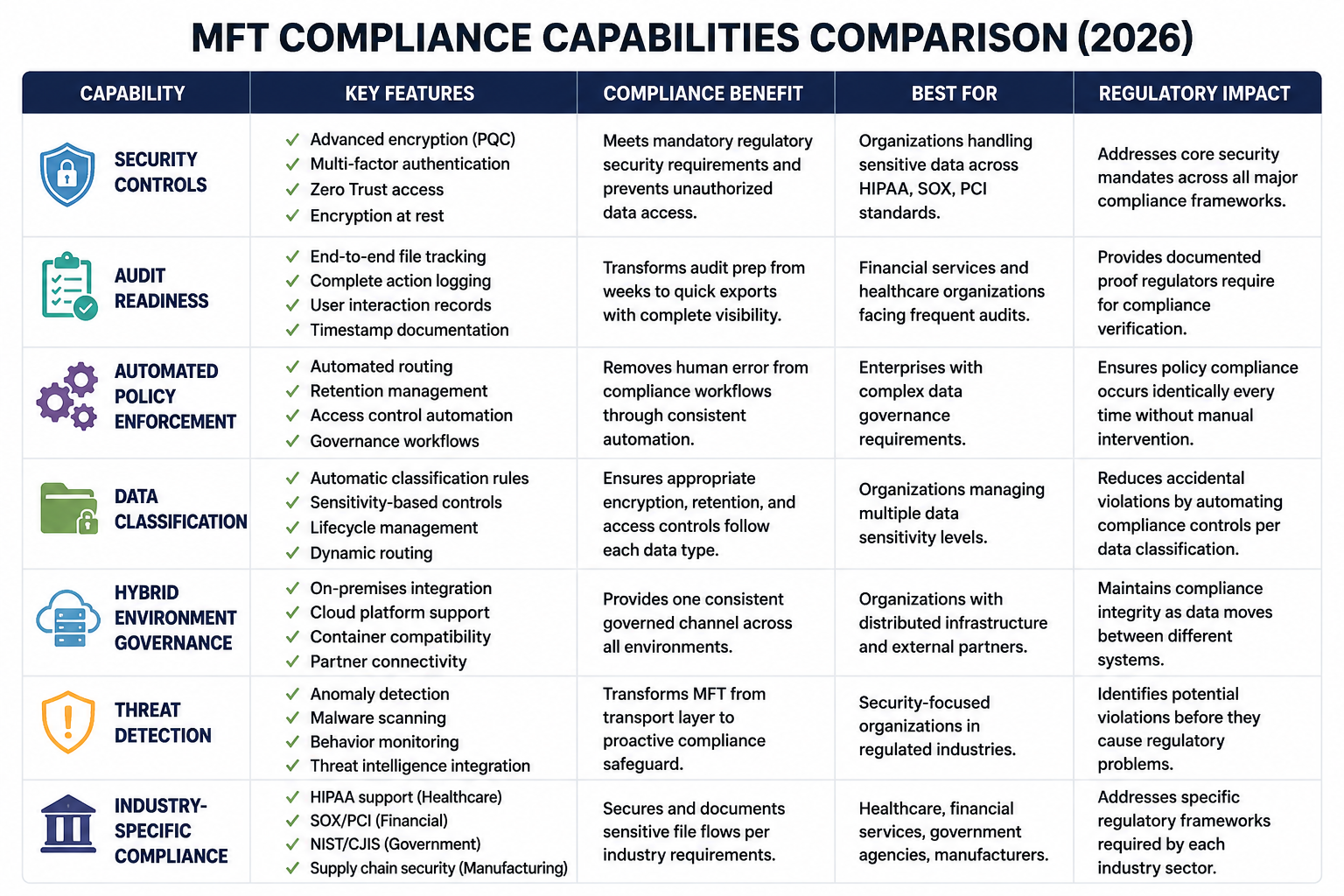
MFT tracks every file transfer, user action, and system interaction with detailed logs and timestamps. This transforms audit preparation from weeks of manual documentation gathering into quick exports of complete, organized records. Auditors receive end-to-end visibility showing exactly who accessed what data, when, and how it was protected.
What industries require MFT for compliance?
Healthcare organizations need MFT for HIPAA compliance, financial services use it for SOX and PCI requirements, government agencies rely on it for NIST and CJIS standards, and manufacturers depend on it for supply chain security. Any industry handling sensitive data benefits from MFT's security and documentation capabilities.
How does MFT handle data classification?
Modern MFT platforms automatically classify data by sensitivity level and apply appropriate controls throughout its lifecycle. Classification rules determine encryption strength, retention periods, routing paths, and access permissions. This automation ensures consistent handling of regulated data and reduces accidental compliance violations across all file transfers.
Can MFT work in hybrid environments?
Yes, MFT provides unified governance across on-premises systems, cloud platforms, containers, and external partners. It maintains consistent security policies, encryption standards, and audit trails regardless of where data originates or travels. This single governed channel prevents compliance gaps that occur when data moves between different environments.
Does MFT include threat detection?
Modern MFT solutions integrate threat intelligence to detect anomalies, scan files for malware, and monitor unusual user behavior. This transforms MFT from a passive transport layer into an active security safeguard that identifies potential compliance violations or security incidents before they cause regulatory problems.