
Why Traditional Email Attachments No Longer Meet Modern Enterprise Requirements
Email was never designed to be a secure enterprise file exchange platform.
Yet every day, organizations still rely heavily on email attachments to exchange:
- sensitive operational documents
- customer information
- financial records
- healthcare data
- legal contracts
- large media assets
- confidential reports
- regulated business information
across increasingly distributed and interconnected business environments.
For years, email attachments were “good enough.” But modern enterprise operations have evolved dramatically. Organizations now operate across:
- hybrid work environments
- cloud platforms
- external partner ecosystems
- global teams
- regulated industries
- remote collaboration models
At the same time, cybersecurity threats and compliance expectations continue increasing.
What used to be a simple attachment now introduces significant operational and security concerns:
- large attachment failures
- limited visibility
- no centralized governance
- poor auditability
- accidental data leaks
- phishing exposure
- malware risks
- version confusion
- lack of expiration controls
- uncontrolled external sharing
Modern enterprises require significantly more than simply “sending files.”
They increasingly need:
- secure ad hoc collaboration
- centralized governance
- operational visibility
- compliance controls
- controlled file access
- secure external communication
- auditability
- self-service usability
without disrupting how business users already work.
This is exactly where TDXchange AdHoc and bTrade’s AttachGuard Outlook Plugin help organizations modernize enterprise file sharing operations.
In Summary
Traditional email attachments create major operational, security, and compliance limitations for modern enterprises.
Organizations increasingly require secure ad hoc file sharing capabilities that provide:
- enterprise-grade security
- centralized governance
- operational visibility
- compliance support
- secure external collaboration
- malware scanning integration
- auditability
- controlled file access
while remaining simple and intuitive for end users.
TDXchange AdHoc enables organizations to securely exchange files through centralized self-service secure file sharing workflows while maintaining governance and operational control.
Unlike traditional email attachments, TDXchange AdHoc allows organizations to:
- control how many times files can be downloaded
- configure expiration/TTL policies for sharing links
- monitor download history
- maintain centralized auditability
- support secure back-and-forth collaboration through secure links
rather than relying on insecure one-way attachment workflows.
bTrade’s AttachGuard Outlook Plugin further simplifies adoption by integrating secure AdHoc file exchange functionality directly into Microsoft Outlook, allowing users to securely exchange files without changing how they already work.
Together, TDXchange AdHoc and AttachGuard help organizations improve:
- operational efficiency
- governance
- security
- compliance
- usability
- visibility
- collaboration
while reducing reliance on insecure attachment-based workflows.
Key Takeaways
- Traditional email is not designed for secure enterprise file exchange.
- Large email attachments frequently fail or violate size restrictions.
- Sensitive files should not be transferred through unmanaged attachment workflows.
- TDXchange AdHoc enables secure self-service enterprise file sharing.
- Organizations can control download counts and link expiration policies.
- Centralized visibility improves governance and auditability.
- TDXchange supports secure two-way collaboration, not just one-way sharing.
- AttachGuard integrates secure file sharing directly into Microsoft Outlook.
- User-friendly secure collaboration improves adoption and reduces shadow IT.
The Real Problem With Traditional Email Attachments
Most people have experienced the frustration:
- “Attachment too large”
- “Mailbox quota exceeded”
- “Email rejected”
- “Recipient didn’t receive the file”
- “Which version is correct?”
- “Can you resend the attachment?”
What begins as a simple operational task often becomes:
- inefficient
- difficult to track
- operationally risky
- insecure
The reality is that traditional email platforms were designed for communication, not enterprise-grade file governance.
Modern organizations increasingly exchange:
- gigabyte-sized files
- regulated information
- sensitive operational data
- customer records
- confidential business documents
- financial reports
- healthcare information
that require:
- governance
- auditability
- expiration controls
- malware scanning
- encryption
- operational visibility
- access tracking
- compliance monitoring
which standard email systems simply were never designed to provide.
As organizations continue scaling across distributed environments, these operational limitations become significantly more problematic.
What Is Enterprise Ad Hoc File Transfer?
Enterprise ad hoc file transfer allows employees, customers, partners, and vendors to securely exchange files outside automated MFT workflows while maintaining governance, auditability, security controls, and compliance visibility. Unlike email attachments, enterprise ad hoc file transfer provides download tracking, expiration controls, centralized auditing, malware scanning integration, and secure collaboration capabilities.
Unlike system-to-system MFT integrations designed for:
- recurring workflows
- scheduled automation
- backend integrations
- machine-to-machine transfers
ad hoc transfer focuses on:
- business-user collaboration
- one-time secure sharing
- operational flexibility
- external communication
- secure collaboration
Modern enterprise ad hoc transfer platforms provide:
- encrypted file sharing
- secure upload portals
- centralized auditability
- download tracking
- expiration controls
- access controls
- malware scanning integration
- operational visibility
- self-service usability
without requiring:
- scripting
- VPN access
- consumer-grade sharing tools
- complex technical workflows
This allows organizations to securely exchange files while maintaining centralized governance and operational oversight.
Why Traditional Attachments Create Security & Compliance Risks
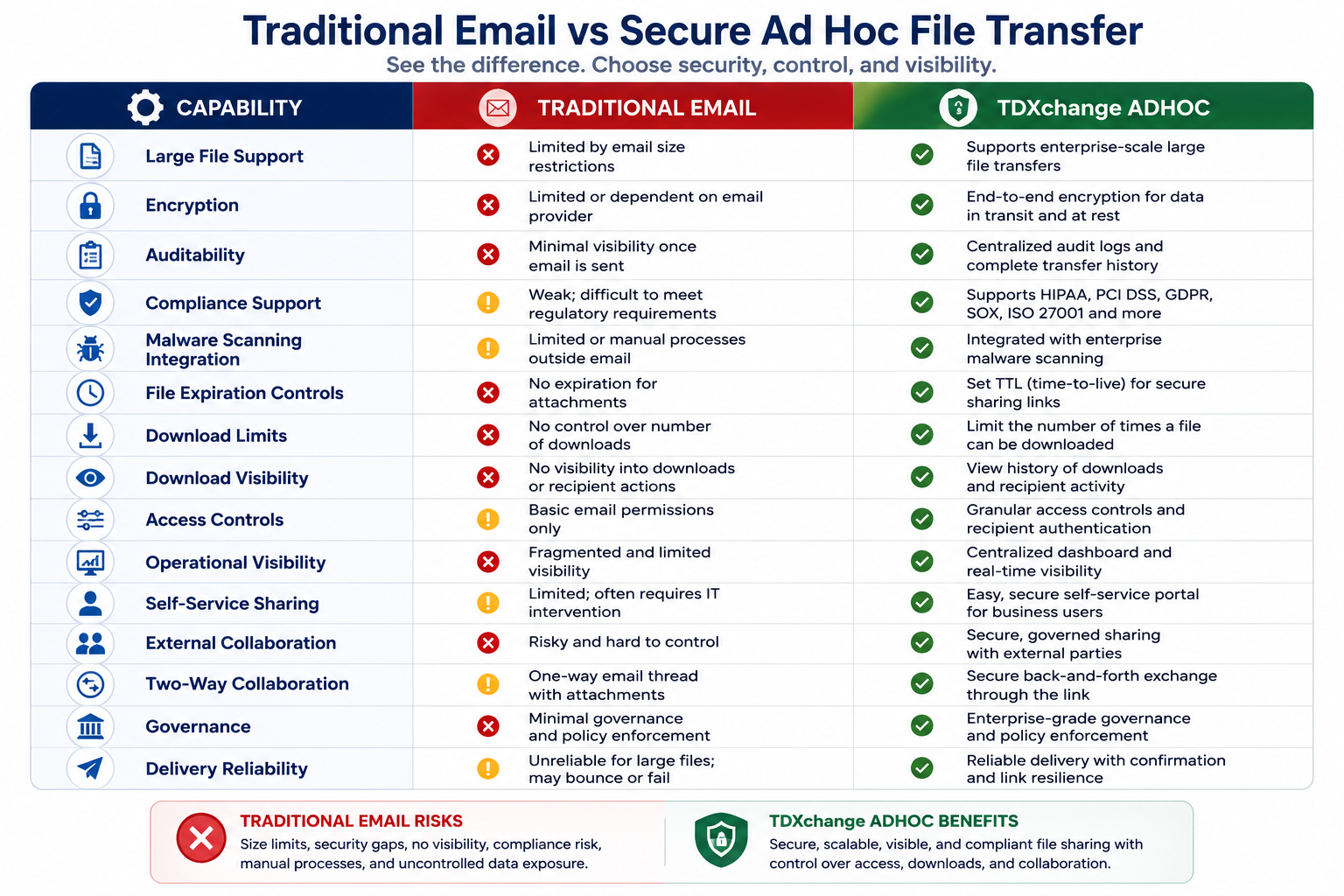
Many organizations underestimate how much operational and cybersecurity risk exists within unmanaged email attachments.
Sensitive information exchanged through email may include:
- PCI data
- customer information
- healthcare records
- financial statements
- legal documentation
- confidential operational files
- regulated information
Without centralized governance, organizations often lack visibility into:
- who accessed files
- who downloaded files
- whether links expired
- whether unauthorized recipients accessed content
- whether malware was scanned
- how many times files were downloaded
- whether files were forwarded externally
This creates significant:
- governance gaps
- operational blind spots
- compliance concerns
- cybersecurity risks
particularly for regulated industries.
In many cases, organizations discover these visibility gaps only after:
- audits
- compliance reviews
- security incidents
- data leakage events
- operational investigations
which is often far too late.
Why Not Just Use OneDrive, Dropbox, or Google Drive?
When discussing enterprise ad hoc file transfer, one of the most common questions we hear is:
"Why can't we just use OneDrive, Dropbox, or Google Drive?"
The answer is that these platforms solve a different problem.
Cloud storage and collaboration platforms are excellent for storing documents, collaborating on files, and sharing information within teams. They have become an important part of modern workplace productivity.
However, enterprise ad hoc file transfer is not simply about sharing files. It is about securely exchanging sensitive information while maintaining governance, accountability, visibility, and compliance.
For many organizations, especially those operating in regulated industries, these requirements extend well beyond what traditional file-sharing platforms were designed to address.
The Difference Between File Sharing and Governed File Transfer
A user sharing a presentation with colleagues is very different from:
- Sending patient records to a healthcare provider
- Delivering financial reports to external auditors
- Sharing legal documents with outside counsel
- Exchanging payment files with banking partners
- Sending confidential intellectual property to suppliers
In these situations, organizations need more than convenience. They need control.
Questions security and compliance teams often ask include:
- Who sent the file?
- Who received it?
- Was it downloaded?
- How many times was it accessed?
- Did the recipient forward it?
- Was sensitive information included?
- Did the transfer comply with company policy?
- Can we prove all of this during an audit?
These are governance questions rather than storage questions.
The Governance Gap
Traditional file-sharing platforms often provide basic sharing controls, but many organizations require additional governance capabilities such as:
- Centralized auditing
- Detailed activity tracking
- Policy-based access controls
- Download restrictions
- Automatic expiration policies
- Approval workflows
- Data Loss Prevention (DLP)
- Security and compliance reporting
- Integration with enterprise governance processes
Without these controls, organizations may struggle to demonstrate compliance, investigate incidents, or maintain visibility into how sensitive information is being shared.
Shadow IT and Unmanaged Sharing Risks
Another challenge is user behavior.
When employees find security controls difficult to use, they often seek alternative ways to share files.
This can result in:
- Personal cloud storage accounts
- Consumer file-sharing services
- Unapproved collaboration platforms
- Email attachments containing sensitive information
These practices create governance blind spots and increase the risk of accidental data exposure.
The goal is not to prevent collaboration.
The goal is to make secure collaboration easier than insecure alternatives.
Governance, Not Just Convenience
Enterprise ad hoc file transfer solutions are designed to provide the convenience users expect while giving security and compliance teams the controls they require.
This includes:
- Secure delivery
- End-to-end auditing
- Access controls
- Expiration policies
- Compliance visibility
- Data governance
- Centralized reporting
The objective is not to replace collaboration tools.
The objective is to provide a governed and auditable method for sharing sensitive information when security, compliance, and accountability matter most.
How TDXchange AdHoc Improves Enterprise File Sharing
TDXchange AdHoc was designed specifically to modernize secure enterprise collaboration without sacrificing usability.
Through intuitive web interfaces and secure sharing workflows, business users can securely exchange files while organizations maintain centralized governance and operational control.
Unlike traditional email attachments, TDXchange AdHoc allows organizations to:
- configure file expiration policies
- define how many times a file may be downloaded
- track download history
- maintain centralized auditability
- monitor transfer activity
- support secure external collaboration
- enforce operational governance
This introduces significantly more operational control over sensitive information exchange.
For example:
- a file may expire after 7 days
- downloads may be limited to a single recipient action
- administrators can review download history
- organizations can maintain visibility into external collaboration activity
These controls help organizations reduce:
- unauthorized sharing
- stale file exposure
- operational blind spots
- uncontrolled distribution
while improving governance and compliance readiness.
Secure Two-Way Collaboration and Not Just One-Way File Sharing
Traditional attachment workflows are typically one-directional:
- send file
- wait for reply
- receive another attachment
- lose visibility
This often creates fragmented communication chains and scattered file versions.
TDXchange AdHoc improves collaboration by supporting secure back-and-forth information exchange directly through the secure transfer link itself.
Rather than continuously emailing attachments back and forth, users can:
- securely exchange updates
- upload additional documents
- continue collaboration within the governed secure workspace
- maintain centralized auditability throughout the exchange lifecycle
This creates a much more secure and operationally manageable collaboration experience compared to fragmented email attachment chains.
AttachGuard: Secure File Sharing Directly Inside Outlook
One of the biggest enterprise challenges with secure collaboration platforms is adoption.
Even the most secure platform becomes ineffective if users bypass it in favor of simpler workflows.
This is why bTrade developed AttachGuard, an Outlook plugin that integrates directly with TDXchange AdHoc functionality.
AttachGuard allows users to securely exchange files directly from Microsoft Outlook while continuing to work inside their familiar email workflows.
Instead of attaching files directly to emails, AttachGuard can:
- securely upload files through TDXchange AdHoc
- generate secure download links
- apply expiration policies
- enforce governance controls
- support large file sharing
- improve auditability
- maintain operational visibility
without requiring users to:
- leave Outlook
- install consumer sharing tools
- learn entirely new workflows
This dramatically improves:
- usability
- user adoption
- governance consistency
- operational efficiency
- secure collaboration adoption
while reducing shadow IT and insecure file sharing behavior.
Why Centralized Auditability Matters
Modern organizations increasingly require centralized visibility into:
- who shared files
- who downloaded files
- when downloads occurred
- how many downloads occurred
- whether transfers expired
- whether files were accessed externally
- operational anomalies
- policy violations
Traditional email provides very limited operational visibility once attachments leave the mailbox.
TDXchange AdHoc improves enterprise governance through:
- centralized audit logging
- transfer monitoring
- download tracking
- expiration visibility
- reporting
- operational observability
- policy enforcement visibility
This becomes critically important for:
- compliance audits
- investigations
- governance reporting
- operational troubleshooting
- cybersecurity monitoring
- forensic analysis
across distributed enterprise environments.
Compliance & Governance Benefits
Secure ad hoc file sharing significantly improves compliance readiness for frameworks such as:
- HIPAA
- PCI DSS
- GDPR
- SOX
- ISO 27001
- internal governance policies
by improving:
- auditability
- transfer traceability
- operational visibility
- secure collaboration
- reporting consistency
- access governance
- expiration enforcement
- sensitive data control
This reduces operational overhead associated with:
- manual tracking
- attachment investigations
- insecure sharing
- shadow IT
- audit preparation
while improving long-term operational governance.
Real-World Enterprise Use Cases
Legal Teams Sharing Sensitive Contracts
Legal teams frequently exchange:
- contracts
- case files
- confidential legal documents
- regulated communications
with external parties.
TDXchange AdHoc improves:
- confidentiality
- visibility
- auditability
- governance
while reducing the risks associated with uncontrolled email attachments.
Healthcare Organizations Exchanging PHI
Healthcare providers regularly exchange:
- patient records
- medical imaging
- healthcare documentation
- regulated information
that require HIPAA-compliant governance and secure collaboration.
Centralized secure sharing significantly improves:
- audit readiness
- visibility
- governance
- operational security
across healthcare ecosystems.
Media & Creative Teams Sharing Large Files
Media organizations frequently exchange:
- video files
- production assets
- creative content
- large design files
that exceed traditional email limits.
TDXchange AdHoc enables secure enterprise-scale large file sharing without relying on unsecured consumer-grade sharing platforms.
Financial Services Collaboration
Financial institutions frequently exchange:
- reconciliation files
- operational reports
- trading data
- sensitive financial documents
that require strong governance and operational visibility.
TDXchange AdHoc improves:
- operational control
- secure collaboration
- auditability
- governance
- transfer visibility
across distributed financial ecosystems.
Why Secure File Sharing Must Be User-Friendly
One of the most important lessons in enterprise security is simple:
if secure tools are difficult to use, users will bypass them.
This is why usability matters just as much as security.
TDXchange AdHoc and AttachGuard were designed to provide:
- enterprise-grade governance
- centralized visibility
- operational security
- compliance controls
while remaining:
- intuitive
- simple
- accessible
- business-user friendly
This balance between:
- security
- usability
- governance
- operational simplicity
is critical for long-term enterprise adoption and operational success.
Final Thoughts
Modern enterprise collaboration requires significantly more than email attachments.
Organizations increasingly need:
- secure ad hoc collaboration
- centralized governance
- controlled file access
- operational visibility
- download tracking
- expiration policies
- auditability
- secure external communication
- large file sharing
- self-service usability
to securely exchange information across distributed enterprise ecosystems.
TDXchange AdHoc and AttachGuard help organizations modernize enterprise file sharing while improving:
- governance
- compliance
- operational efficiency
- visibility
- collaboration
- cybersecurity resiliency
- user adoption
without disrupting how business users already work.
As enterprise collaboration continues evolving, organizations that modernize secure file sharing early will be significantly better positioned to:
- reduce operational risk
- improve governance
- strengthen compliance
- support hybrid work
- eliminate insecure sharing workflows
- improve operational visibility
- scale collaboration securely
across increasingly complex digital environments.
About the Author
Hanz Jorgensen is Chief Operating Officer and Managing Member at bTrade, where he oversees daily operations and works closely with the leadership team to shape and execute the company’s strategic direction. With more than 20 years of experience with several different MFT/technology companies spanning system administration, development, customer support, pre-sales, and enterprise solution delivery, Hanz brings a uniquely practical perspective on what organizations actually need from managed file transfer platforms. He leads bTrade’s Solution Consulting team and plays a central role in aligning product capabilities with real customer requirements across regulated and high-complexity environments.
Frequently Asked Questions (FAQ)
What is ad hoc file transfer?
Ad hoc file transfer allows users to securely exchange files outside traditional automated MFT workflows using secure self-service file sharing capabilities.
Why is email insecure for enterprise file sharing?
Traditional email lacks:
- centralized governance
- auditability
- operational visibility
- large file support
- expiration controls
- download tracking
- secure collaboration capabilities
required for modern enterprise file exchange.
Can TDXchange AdHoc limit how many times a file is downloaded?
Yes. Organizations can configure download limits to control how many times recipients may access shared files.
Can TDXchange AdHoc expire sharing links?
Yes. Organizations can configure TTL and expiration policies for secure sharing links to reduce long-term exposure risk.
Can organizations track download history?
Yes. TDXchange AdHoc provides centralized visibility into download activity and transfer history for improved governance and auditability.
Does TDXchange AdHoc support two-way collaboration?
Yes. TDXchange AdHoc supports secure back-and-forth collaboration directly through secure sharing links rather than relying on fragmented email attachment chains.
What is AttachGuard?
AttachGuard is bTrade’s Outlook plugin that integrates directly with TDXchange AdHoc, allowing users to securely exchange files from within Microsoft Outlook.
Why is centralized auditability important?
Centralized auditability improves:
- governance
- operational visibility
- compliance readiness
- investigations
- transfer traceability
- cybersecurity monitoring
across enterprise collaboration environments.